

Abstract
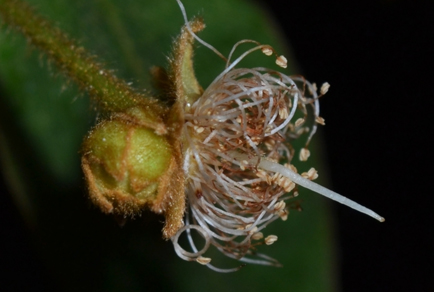
Myrcia (Myrciinae, Myrteae, Myrtaceae) is one of the most diverse genera of Neotropical angiosperms, with ca. 790 species. In the Brazilian state of São Paulo, 11 species of Myrcia sect. Myrcia have been identified, being characterized by a hypanthium not or only slightly extended longitudinally above the ovary apex, non-gomidesioid anthers, and a calyx divided into five sepals. During taxonomic studies in the montane dense ombrophilous forest of Parque Estadual da Serra do Mar-Núcleo Cunha (PESM-NC), in São Paulo state, a population that does not correspond to any previously known species of Myrcia sect. Myrcia was found. After detailed morphological analyses and comparisons with type specimens and original descriptions, we describe it as a new species. Myrcia barbata sp. nov. is morphologically similar to M. bracteata in the presence of golden hirsute indumentum on the branches and leaves measuring 3–10 cm in length, as well as bracteoles subtending the floral buds, but differs by having elliptic leaves (vs. lanceolate), inflorescences arranged in three-flowered dichasia (vs. panicles with 8–20 flowers), sessile leaves (vs. shortly petiolate, 1–3 mm), a densely pubescent hypanthium (vs. pubescent to sericeous), obtuse-triangular sepals (vs. lanceolate), and ovate bracteoles (vs. elliptic). Myrcia barbata also resembles M. eriopus, sharing hirsute young branches and leaves 3–10 cm long, in addition to bracteoles subtending the floral bud. Myrcia barbata differs from M. eriopus by its elliptic (vs. lanceolate) leaves, inflorescences reduced to three-flowered dichasia (vs. panicles with 10–25 flowers), discolorous (vs. concolorous) leaves, sessile leaves (vs. shortly petiolate, 1.8–3 mm), revolute (vs. flat) leaf blade margins, a densely pubescent (vs. hirsute) hypanthium, and conspicuous (vs. inconspicuous) bracteoles. We provide a list of Myrcia sect. Myrcia species recorded in São Paulo State (including Myrcia bracteata, which is not found in São Paulo), as well as a dichotomous identification key and comparative data table including morphological characters such as branch and leaf morphology (shape, size, color, indumentum), leaf blade margin, petiole length, inflorescence type, bracteole and sepal features, hypanthium indumentum, and fruit characteristics. Known only from the type locality, the new species occurs 1,100 m above sea level and flowers between September and January. Myrcia barbata exhibits an extremely restricted distribution inside a conservation site but the low number of known individuals led to the classification of its conservation status as Data Deficient.
References
- Bachman, S., Moat, J., Hill, A.W., de la Torre, J. & Scott, B. (2011) Supporting Red List threat assessments with GeoCAT: geospatial conservation assessment tool. ZooKeys 150: 117–126. https://doi.org/10.3897/zookeys.150.2109
- Barroso, G.M. & Peixoto, A.L. (1990) Espécies novas de Myrcia DC. e Marlierea Cambess. (Myrtaceae). Acta Botanica Brasilica 4 (2): 8. https://doi.org/10.1590/S0102-33061990000200001
- Berg, O. (1857) Myrtaceae. In: Martius, C.P.F. (Ed.) Flora Brasiliensis 14 (1). pp. 1–468.
- Berg, O. (1859) Myrtaceae. In: Martius, C.P.F. (Ed.) Flora Brasiliensis 14. pp. 529–656.
- Cambessedès, J. (1832–1833) Myrtaceae. In: Saint-Hilaire, A.F.C.P., de Jussieu, A.H.L. & Cambessedès, J. (Eds.) Flora Brasiliae Meridionalis 2. Apud A. Berlin, Bibliopolam, Via Dicta Des Mathuris S.-J., Parisiis, pp. 277–384.
- Cicco, V., Galvani, E., Forti, M.C., Arcova, F.C.S., Ranzini, M., Cielo Filho, R. & Maruyama, L.S.C. (2019) Interceptação da chuva em ambiente de Mata Atlântica em clima tropical de altitude. Revista Brasileira de Climatologia 24: 89. Available from: https://www.researchgate.net/publication/339394270_interceptacao_da_chuva_em_ambiente_de_mata_atlantica_em_clima_tropical_de_altitude (accessed 18 May 2025)
- De Candolle, A.P. (1828) Myrtaceae. In: De Candolle, A.P. (Ed.) Prodromus Systematis Naturalis Regni Vegetabilis 3. Treuttel & Würtz, Paris, pp. 207–296.
- Gaem, P.H., Lucas, E., Andrade, A., Vicentini, A. & Mazine, F.F. (2021) A taxonomic account of Myrcia (Myrtaceae) at the sites of the Biological Dynamics of Forest Fragments Project, Amazonas, Brazil. Rodriguésia 72: e021391. https://doi.org/10.1590/2175-7860202172139
- IUCN (2019) IUCN Red List Categories and Criteria, Version 3.1. 2nd edition. Prepared by the Species Survival Commission. International Union for Conservation of Nature, Gland and Cambridge. Available from: https://portals.iucn.org/library/sites/library/files/documents/RL-2001-001-2nd.pdf (accessed 29 August 2024)
- JBRJ—Instituto de Pesquisas Jardim Botânico do Rio de Janeiro (2025) Jabot—Banco de Dados da Flora Brasileira. Available from: https://jabot.jbrj.gov.br/ (accessed 15 September 2025)
- Legrand, D. (1961) Mirtáceas del Estado de Santa Catarina (Brasil). Sellowia 13: 289.
- Linnaeus, C. (1753) Species Plantarum. Impensis Laurentii Salvii, Stockholm, 560 pp.
- Lucas, E.J., Matsumoto, K., Harris, S.T., Nic Lughadha, E.M., Benardini, B. & Chase, M.W. (2011) Phylogenetics, morphology, and evolution of the large genus Myrcia s.l. (Myrtaceae). International Journal of Plant Sciences 172: 915–934. https://doi.org/10.1086/660118
- McVaugh, R. (1956) Tropical American Myrtaceae. Notes on generic concepts and descriptions of previously unrecognized species. Fieldiana, Botany 29: 145–228. https://doi.org/10.5962/bhl.title.2444
- MOOII Tech (2019) PhotoScape. Graphic editing software. Korea. Available from: http://www.photoscape.org (accessed 27 May 2025)
- POWO (2025) Plants of the World Online. Facilitated by the Royal Botanic Gardens, Kew. Available from: https://powo.science.kew.org/ (accessed 27 May 2025)
- Santos, L.L. (2017) Taxonomia e filogenia de Myrcia sect. Myrcia (Myrcia s.l., Myrtaceae). Ph.D. thesis. Universidade Federal Rural de Pernambuco, 319 pp.
- Santos, L.L., Vasconcelos, T.N.C., Sales, M.F. & Lucas, E. (2021) Three new species of Myrcia sect. Myrcia (Myrtaceae) from South America. Phytotaxa 520: 249–256. https://doi.org/10.11646/phytotaxa.520.3.3
- Santos, M.F., Amorim, B.S., Burton, G.P., Faria, J.E.Q., Fernandes, T., Flickinger, J.A., Gaem, P.H., Landrum, L.R., Lima, D.F., Proença, C.E.B., Rosa, P.O. & Lima-Dos-S, L. (2024) A taxonomic account of Myrciinae (Myrteae, Myrtaceae): generic and sectional placement of forgotten species and a list of all accepted species. Phytotaxa 674 (2): 129–170. https://doi.org/10.11646/phytotaxa.674.2.1
- Santos, M.F., Amorim, B.S., Burton, G.P., Fernandes, T., Gaem, P.H., Lourenço, A.R.L., Lima, D.F., Rosa, P.O., Santos, L.L.D., Staggemeier, V.G., Vasconcelos, T.N.C. & Lucas, E.J. (2025) Myrcia in Flora e Funga do Brasil. Jardim Botânico do Rio de Janeiro. Available from: https://floradobrasil.jbrj.gov.br/FB10660 (accessed 27 May 2025)
- SpeciesLink network (2025) speciesLink. Available from: https://specieslink.net/search (accessed 15 September 2025)
- SerrAcima (2010) A enchente na região de Cunha: catástrofe ou consequência? Available from: https://www.serracima.org.br/a-enchente-na-regiao-de-cunha-catastrofe-ou-consequencia/ (accessed 27 May 2025)
- Swartz, O.P. (1788) Nova Genera et Species Plantarum seu Prodromus Descriptionum Vegetalium, Maximam Partem Incognitorum quae Sub Itinere in Indiam Occidentalem Annis 1783–1787 Digessit. Uppsala & Abo, Stockholm. https://doi.org/10.5962/bhl.title.433
- Thiers, B. (2025) Index Herbariorum: A worldwide list of herbaria and associated staff and collections (ninth ed.). New York Botanical Garden.