
Abstract
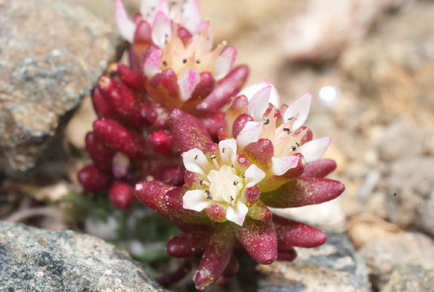
A new subspecies, Sedum confertiflorum subsp. euboicum, is described from Mt. Ochi in southern Evvia Island, Greece. Morphological comparisons with typical S. confertiflorum, known from Anatolia, Lesvos Island, northeastern Greece, and South Bulgaria, revealed consistent differences in size, inflorescence structure, and flower morphology. These differences, though not sufficient for species-level distinction, justify recognition at the subspecific level. The new subspecies is currently known from a single high-altitude locality (1,170 m) on a small rocky plateau and is estimated to number fewer than one thousand individuals. Its discovery highlights the biogeographic singularity of Evvia, where Balkan, Aegean, and Southwest Asiatic floristic elements co-occur.
References
- Al-Shehbaz, I.A. (2014) A synopsis of the genus Noccaea (Coluteocarpae, Brassicaceae). Harvard Papers in Botany 19: 25–51. https://doi.org/10.3100/hpib.v19iss1.2014.n3
- Boissier, E. (1843a) Diagnoses Plantarum Orientalium Novarum 3. Typographia Ferd. Ramboz., Genevæ, 60 pp.
- Boissier, E. (1843b) Diagnoses Plantarum Orientalium Novarum 1. Typographia Ferd. Ramboz., Genevæ, 76 pp.
- Boissier, E. (1854) Diagnoses Plantarum Orientalium Novarum, series 2, No 1. B. Neocomi., Lipsiae, Parisiis, 120 pp.
- Carrillo-Reyes, P., Sosa, V. & Mort, M.E. (2009) Molecular phylogeny of the Acre clade (Crassulaceae): Dealing with the lack of definitions for Echeveria and Sedum. Molecular Phylogenetics and Evolution 53: 267–276. https://doi.org/10.1016/j.ympev.2009.05.022
- Chamberlain, D.F. (1972) Sedum L. In: Davis, P.H. (Ed.) Flora of Turkey and the East Aegean Islands, vol. 4. Edinburgh University Press, Edinburgh, pp. 224–243.
- Chemisquy, A.M., Giussani, L.M., Scataglini, M.A., Kellogg, E.A. & Morrone, O. (2010) Phylogenetic studies favour the unification of Pennisetum, Cenchrus and Odontelytrum (Poaceae): a combined nuclear, plastid and morphological analysis, and nomenclatural combinations in Cenchrus. Annals of Botany 106: 107–130. https://doi.org/10.1093/aob/mcq090
- Dimitrov, D. (2010) Sedum confertiflorum Boissier. In: Greuter, W. & Raus, T. (Eds.) Med-Checklist Notulae 29. Willdenowia 40: 189–204. https://doi.org/10.3372/wi.40.40205
- Dimopoulos, P., Raus, T., Bergmeier, E., Constantinidis, Th., Iatrou, Gr., Kokkini, S., Strid, A. & Tzanoudakis, D. (2013) Vascular plants of Greece, an annotated checklist. Englera 31: 1–372. https://doi.org/10.3372/en.31
- Dimopoulos, P., Raus, T., Bergmeier, E., Constantinidis, Th., Iatrou, Gr., Kokkini, S., Strid, A. & Tzanoudakis, D. (2016) Vascular plants of Greece: An annotated checklist. Supplement. Willdenowia 46: 301–347. https://doi.org/10.3372/wi.46.46303
- Doumas, P., Goula, K. & Constantinidis, T. (2022) Thirty-two new and noteworthy floristic records from northeastern Greece. Biodiversity Data Journal 10: e81817. https://doi.org/10.3897/BDJ.10.e81817.figure10
- Ehrendorfer, F. (1953) Critical notes on Turkish Rubiaceae. Notes from the Royal Botanic Garden, Edinburgh 22: 323–401. https://doi.org/10.24823/nrbge.1958.2512
- Fu, K.J. & Ohba, H. (2001) Crassulaceae. In: Wu, Z.Y. & Raven, P.H. (Eds.) Flora of China, vol. 8. Science Press, Beijing and Missouri Botanical Garden, St. Louis, pp. 202–268.
- Greuter, W. & Raus, T. (Eds.) (1985) Med-Checklist Notulae, 11. Willdenowia 15: 61–84.
- Gussone, J. (1827) Florae Siculae Prodromus 1. Regia Typographia, Neapoli, 592 pp.
- Linnaeus, C. (1753) Species plantarum 1–2. Impensis Laurentii Salvii, Holmiæ, Stockholm, 1200 pp.
- Linnaeus, C. (1763) Species plantarum, Vol. 2. Impensis Laurentii Salvii, Holmiæ, Stockholm, 1684 pp.
- Messerschmid, T.F.E., Klein, J.T., Kadereit, G. & Kadereit, J.W. (2020) Linnaeus’s folly-phylogeny, evolution and classification of Sedum (Crassulaceae) and Crassulaceae subfamily Sempervivoideae. Taxon 69: 892–926. https://doi.org/10.1002/tax.12316
- Nyman, C.F. (1879) Conspectus Florae Europaeae. Typis Officinae Bohlinianae, Örebro Sueclae, 858 pp.
- Persoon, C.H. (1805) Synopsis Plantarum, 1. Parisii, Tubingae, 546 pp.
- POWO (2025) Plants of the World Online. Facilitated by the Royal Botanic Gardens, Kew. Available from: https://powo.science.kew.org (accessed 22 June 2025)
- Tan, K. (1984) More new taxa from South and East Anatolia. Notes from the Royal Botanic Garden, Edinburgh 42: 61–67. https://doi.org/10.24823/nrbge.1984.3369
- ’t Hart, H. (1991) Evolution and classification of the European Sedum species (Crassulaceae). Flora Mediterranea 1: 31–61.
- ’t Hart, H. & Alpinar, K. (1991a) Biosystematic studies in Sedum (Crassulaceae) of Turkey. 1. Notes on four hitherto little known species collected in the western part of Anatolia. Willdenowia 10: 143–156.
- ’t Hart, H. & Alpınar, K. (1991b) The Sedum Flora of Turkey. Sedum Society Newsletter 16: 10–13.
- ’t Hart, H. (2002) Sedum L. In: Strid, A. & Tan, K. (Eds.) Flora Hellenica, vol. 2. A.R.G. Gantner Verlag K.G., pp. 314–334.
- Trigas, P., Constantinidis, T. & Touloumenidou, T. (2008) A new hexaploid species of Centaurea section Acrolophus (Asteraceae) from Evvia Island, Greece. Botanical Journal of the Linnean Society 158: 762–774. https://doi.org/10.1111/j.1095-8339.2008.00870.x
- Trigas, P. & Iatrou, G. (2000) Additions to the flora of Evvia (Greece). Botanika Chronika 13: 273–286.
- Trigas, P., Iatrou, G. & Tzanoudakis, D. (2010) Allium apergii sp. nov. (Alliaceae, A. sect. Codonoprasum) from Evvia Island, Greece. Journal of Biological Research-Thessaloniki 14: 225–229.
- Vahl, M. (1805) Enumeratio Plantarum, Vol. 2. Hauniae, 381 pp.
- Willdenow, C.L. (1806) Species Plantarum, Volume 4, Part 2. G.C. Nauk, Berolini, 525 pp.
- Zou, C.Y., Meng, T., Meng, S.Y. & Liu, Y. (2025) A new species of Sedum (Crassulaceae, Saxifragineae) from Guangxi, China. Phytokeys 252: 287–299. https://doi.org/10.3897/phytokeys.252.128011