

Abstract
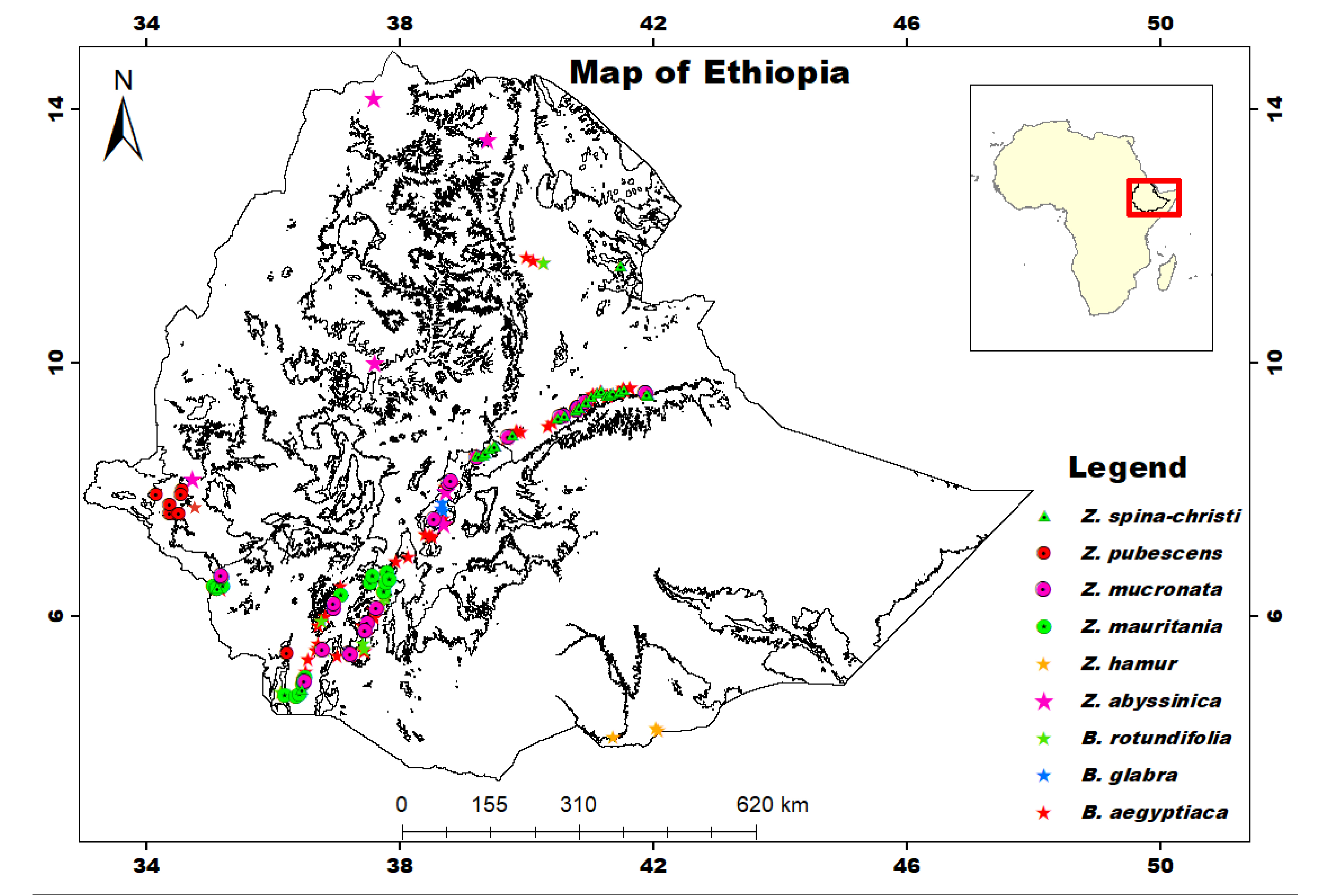
Morphological traits provide critical insights for evolutionary and taxonomic studies. This study examined inter- and intraspecific morphological variation among Balanites and Ziziphus species collected across Ethiopia from January 2019 to June 2022. Up to three plant specimens per population were sampled 5–10 km apart and 50–100 m from roads. Morphological traits, bark colour, leaf shape and texture, fruit shape, and spine condition, were recorded. Environmental data were obtained from WorldClim v2, ISRIC, and FAO terrain datasets. Morphological data were analysed using hierarchical clustering (HC), principal component analysis (PCA), and redundancy analysis (RDA) in R 4.1.3. Hierarchical clustering (HC) identified five clusters in Balanites and eight in Ziziphus. Analysis of similarity (ANOSIM) confirmed significant dissimilarity among groups (Balanites: p = 0.001, R = 0.763; Ziziphus: p = 0.001, R = 0.938). The PCA revealed fruit shape, spine condition, and flower merosity as key traits in Balanites, while leaf base symmetry, bark colour, and leaf surface pubescence were important in Ziziphus. Redundancy analysis showed that environmental factors such as annual mean temperature (Bio01), isothermality (Bio03), and precipitation of the wettest quarter (Bio16) significantly affected Balanites morphology. For Ziziphus, temperature and precipitation-related variables, elevation, and topographic position index were significant contributors to variation. The findings highlight substantial morphological diversity within and between species of both genera, shaped by environmental gradients. Further studies of molecular phylogenetics and genetic diversity are recommended to support and expand these morphological insights.
References
- Almalki, R.A. & Alzahrani, D.A. (2018) Morphological investigation of genus Ziziphus Mill. (Rhamnaceae) in Saudi Arabia. American Journal of Plant Sciences 9 (13): 2644–2658. https://doi.org/10.4236/ajps.2018.913192
- APG IV. (2016) An update of the Angiosperm Phylogeny Group classification for the orders and families of flowering plants: APG IV. Botanical Journal of the Linnean Society 181 (1): 1–20. https://doi.org/10.1111/boj.12385
- Archie, J.W. (1985) Methods for coding variable morphological features for numerical taxonomic analysis. Systematic Biology 34 (3): 326–345. https://doi.org/10.1093/sysbio/34.3.326
- Blatter, E. (1919) Flora Arabica: Part I: Ranunculaceae–Moringaceae. Records of the Botanical Survey of India 8 (1): 1–519. [https://www.biodiversitylibrary.org/item/226752#page/9/mode/1up]
- Carbajal, R., Serrano, M., Ortiz, S. & Sáez, L. (2017) Two new combinations in Iberian Santolina (Compositae) based on morphology and molecular evidences. Phytotaxa 291 (3): 217–223. https://doi.org/10.11646/phytotaxa.291.3.6
- Chiovenda, E. (1932) Flora Somala. R. Orto Botanico, Rome, 483 pp.
- Clarke, K.R. & Gorley, R.N. (2001) Primer v5: User Manual/Tutorial. Primer-E Ltd., Plymouth, 91 pp.
- Cruz-Cárdenas, G., Villaseñor, J.L., López-Mata, L., Martínez-Meyer, E. & Ortiz, E. (2014) Selection of environmental predictors for species distribution modeling in Maxent. Chapingo Magazine Forestry and Environmental Sciences 20 (2): 187–201. https://doi.org/10.5154/r.rchscfa.2013.09.034
- Delile, A.R. (1813) Description de l’Égypte, ou, Recueil des observations et des recherches qui ont été faites en Égypte pendant l’expédition de l’armée française, Vol. 2: Histoire naturelle. Imprimerie Imperiale, Paris, 752 pp. https://doi.org/10.5962/bhl.title.62506
- De Marco Júnior, P. & Nóbrega, C.C. (2018) Evaluating collinearity effects on species distribution models: An approach based on virtual species simulation. PLoS ONE 13 (9): e0202403. https://doi.org/10.1371/journal.pone.0202403
- Desfontaines, R.L. (1798) Flora Atlantica, sive historia plantarum quae in Atlante, agro Tunetano et Algeriensi crescunt, Vol. 1. L.P. Desgranges, Paris, 444 pp. https://doi.org/10.5962/bhl.title.323
- Dirzo, R. & Domínguez, C.A. (1986) Seed shadows, seed predation and the advantages of dispersal. In: Estrada, A. & Fleming, T.H. (Eds.) Frugivores and seed dispersal. Springer, Dordrecht, pp. 237–249. https://doi.org/10.1007/978-94-009-4812-9_22
- Engler, H.G.A. (1897) Contribuzioni alla conoscenza ella flora dell’Africa orientale: XIV. Annuario del Reale Istituto Botanico di Roma 7: 13–31.
- Fick, S.E. & Hijmans, R.J. (2017) WorldClim 2: new 1 km spatial resolution climate surfaces for global land areas. International Journal of Climatology 37 (12): 4302–4315. https://doi.org/10.1002/joc.5086
- Fischer, G., Nachtergaele, F., Prieler, S., Van Velthuizen, H.T., Verelst, L. & Wiberg, D. (2008) Global agro-ecological zones assessment for agriculture (GAEZ 2008). IIASA, Laxenburg, Austria and FAO, Rome, Italy.
- Friis, I., Demissew, S. & Van Bruegel, P. (2010) Atlas of the potential vegetation of Ethiopia. The Royal Danish Academy of Sciences and letters 58: 1–312. [https://www.researchgate.net/publication/235941830_Atlas_of_the_Potential_Vegetation_of_Ethiopia]
- Garcia, S., Luengo, J., Sáez, J.A., López, V. & Herrera, F. (2013) A survey of discretization techniques: taxonomy and empirical analysis in supervised learning. IEEE Transactions on Knowledge and Data Engineering 25 (4): 734–750. https://doi.org/10.1109/TKDE.2012.35
- Gidado, M.S. & Yaradua, S.S. (2006) Numerical taxonomy and morphological variability of the genus Ziziphus in Katsina state, northwest Nigeria. The Bioscientist 12 (2): 127–136.
- Gour, V.S. & Kant, T. (2012) Balanites aegyptiaca (L.) Del.: A multipurpose and potential biodiesel tree species of the arid regions. International Journal of Science and Nature 3 (2): 472–475.
- Hamada, F.A., El-Banhawy, A., Ellmouni, F.Y., Al-Juhani, W., Makharita, R.R. & Nour, I.H. (2022) Comparative taxonomic study of Balanites aegyptiaca (L.) Delile (Zygophyllaceae). Biology and Life Sciences Forum 11 (1): a72. https://doi.org/10.3390/IECPS2021-12060
- Harrison, S. & Hastings, A. (1996) Genetic and evolutionary consequences of metapopulation structure. Trends in Ecology and Evolution 11 (4): 180–183. https://doi.org/10.1016/0169-5347(96)20008-4
- Hoot, S.B., Reznicek, A.A. & Palmer, J.D. (1994) Phylogenetic relationships in Anemone (Ranunculaceae) based on morphology and chloroplast DNA. Systematic Botany 19 (1): 169–200. https://doi.org/10.2307/2419720
- Hufford, L. & Dickson, W.C. (1992) A phylogenetic analysis of Cunoniaceae. Systematic Botany 17 (2): 181–200. https://doi.org/10.2307/2419516
- Islam, M.B. & Simmons, M.P. (2006) A thorny dilemma: testing alternative intrageneric classifications within Ziziphus (Rhamnaceae). Systematic Botany 31 (4): 826–842. https://doi.org/10.1600/036364406779695997
- Kamal, A.H.M., Laouali, A., Habou, R., Josef, G., Maïmounatou, I.B., Kéllou, K.B. & Ali, M. (2020) Variability of the morphological characters of Balanites aegyptiaca (L.) Del. based on the climatic gradient of Zinder region (East-Central Niger). International Journal of Development Research 10 (10): 33309–33315.
- Karbstein, K., Prinz, K., Hellwig, F. & Römermann, C. (2020) Plant intraspecific functional trait variation is related to within-habitat heterogeneity and genetic diversity in Trifolium montanum L. Ecology and Evolution 10 (11): 5015–5033. https://doi.org/10.1002/ece3.6255
- Kraus, F. (1988) An empirical evaluation of the use of the ontogeny polarization criterion in phylogenetic inference. Systematic Biology 37 (2): 106–141. https://doi.org/10.2307/2992271
- Lamarck, J. (1789) Encyclopedie Methodique. Botanique 3. Pancoucke, Paris & Plomteux, Liège, 759 pp. https://doi.org/10.5962/bhl.title.824
- Lepš, J. & Šmilauer, P. (2010) Multivariate analysis of ecological data using CANOCO. Cambridge University Press, Cambridge, 269 pp. https://doi.org/10.1017/CBO9780511615146
- Linnaeus, C. (1753) Species plantarum. Laurentii Salvii, Stockholm, 1200 pp. https://doi.org/10.5962/bhl.title.669
- Manly, B.F.J. (1994) Multivariate statistical methods: a primer. Western Ecosystem Technology, Inc. Laramie, Wyoming, 224 pp.
- Mildbraed, J. & Schlechter, R. (1913) Beiträge zur Kenntnis der Gattung Balanites Del. Botanische Jahrbücher für Systematik, Pflanzengeschichte und Pflanzengeographie 51 (1): 156–163. [https://www.biodiversitylibrary.org/item/714#page/164/mode/1up]
- Miller, P. (1754) The gardeners dictionary: containing the methods of cultivating and improving all sorts of trees, plants, and flowers, for the kitchen, fruit, and pleasure gardens, as also those which are used in medicine : with directions for the culture of vineyards, and making of wine in England ..., vol. 3, 4th ed. John & James Rivington, London, pages not numbered. https://doi.org/10.5962/bhl.title.79061
- Murthy, H.N., Yadav, G.G., Dewir, Y.H. & Ibrahim, A. (2021) Phytochemicals and biological activity of desert date (Balanites aegyptiaca (L.) Delile). Plants 10 (1): a32. https://doi.org/10.3390/plants10010032
- Ningrum, A.M. & Chasani, A.R. (2021) Numerical phenetic and phylogenetic relationships in silico among brown seaweeds (Phaeophyceae) from Gunungkidul, Yogyakarta, Indonesia. Biodiversitas 22 (6): 3057–3064. https://doi.org/10.13057/biodiv/d220607
- Norouzi, E., Erfani-Moghadam, J., Fazeli, A. & Khadivi, A.N. (2017) Morphological variability within and among three species of Ziziphus genus using multivariate analysis. Scientia Horticulturae 222: 180–186. https://doi.org/10.1016/j.scienta.2017.05.016
- Okia, C.A., Agea, J.G., Kimondo, J.M., Abohassan, R.A.A., Okiror, P. & Obua, J. & Teklehaimanot, Z. (2011) Use and management of Balanites aegyptiaca in drylands of Uganda. Research Journal of Biological Sciences 6: 15–24. https://doi.org/10.3923/rjbsci.2011.15.24
- Oliver, D. (1887) Enumeration of the plants collected by Mr. H. H. Johnston on the Kilimajaro Expedition, 1884. Transactions of the Linnean Society of London, Botany, 2nd ser., 2 (15): 327–355. [https://www.biodiversitylibrary.org/page/784522#page/411/mode/1up] https://doi.org/10.1111/j.1095-8339.1887.tb01008h.x
- Orwa, C., Mutua, A., Kindt, R., Jamnadass, R. & Anthony, S. (2009) Agroforestree Database: a tree reference and selection guide version 4.0. World Agroforestry Centre, Kenya. Available from: https://apps.worldagroforestry.org/treedb/ (accessed 1 June 2025)
- Pescador, D.S., De Bello, F., Valladares, F. & Escudero, A. (2015) Plant trait variation along an altitudinal gradient in Mediterranean High Mountain Grasslands: controlling the species turnover effect. PLoS ONE 10 (3): e0118876. https://doi.org/10.1371/journal.pone.0118876
- Poggio, L., De Sousa, L.M., Batjes, N.H., Heuvelink, G.B.M., Kempen, B., Ribeiro, E. & Rossiter, D. (2021) SoilGrids 2.0: producing soil information for the globe with quantified spatial uncertainty. SOIL 7 (1): 217–240. https://doi.org/10.5194/soil-7-217-2021
- Qi, J., Liu, W., Jiao, T. & Hamblin, A. (2020) Variation in morphological and physiological characteristics of wild Elymus nutans ecotypes from different altitudes in the northeastern Tibetan Plateau. Journal of Sensors 2020 (1): a2869030. https://doi.org/10.1155/2020/2869030
- Radford, A.E., Dickison, W.C., Massey, J.R. & Bell, C.R. (1974) Vascular plant systematics. Harper and Row Publishers, New York, 891 pp.
- Richard, A. (1847) Tentamen Florae Abyssinicae seu Enumeratio Plantarum hucusque in plerisque Abyssiniae. Vol. 1. Arthus Bertrand, Paris, 472 pp. https://doi.org/10.5962/bhl.title.334
- Sands, M.J.S. (1983) Notes on Balanites from the Somali Republic and Ethiopia. Kew Bulletin 38 (1): 40. https://doi.org/10.2307/4107958
- Sands, M.J.S. (1989) Balanitaceae. In: Hedberg, I. & Edwards, S. (Eds.) Flora of Ethiopia and Eritrea. Vol. 3. Addis Ababa University, Ethiopia & Uppsala University, Sweden, pp. 433–436.
- Sands, M.J.S. (2001) The desert date and its relatives: a revision of the genus Balanites. Kew Bulletin 56 (1): 1–128. https://doi.org/10.2307/4119431
- Stevens, P.F. (1991) Character states, morphological variation, and phylogenetic analysis: a review. Systematic Botany 16 (3): 553–583. https://doi.org/10.2307/2419343
- Strait, D., Moniz, M. & Strait, P. (1996) Finite mixture coding: a new approach to coding continuous characters. Systematic Biology 45 (1): 67–78. https://doi.org/10.1093/sysbio/45.1.67
- Sultan, S.E. (1995) Phenotypic plasticity and plant adaptation. Acta Botanica Neerlandica 44 (4): 363–383. https://doi.org/10.1111/j.1438-8677.1995.tb00793.x
- Thiele, K. (1993) The holy grail of the perfect character: the cladistic treatment of morphometric data. Cladistics 9 (3): 275–304. https://doi.org/10.1111/j.1096-0031.1993.tb00226.x
- Tieghem, P. van (1906) Sur les Agialidacées. Annales des Sciences Naturelles, Botanique, ser. 9, 4: 223–260. [https://www.biodiversitylibrary.org/item/148267#page/235/mode/1up]
- Tsukaya, H. (2018) A consideration of leaf shape evolution in the context of the primary function of the leaf as a photosynthetic organ. In: Adams, W. & Terashima, I. (Eds.) The leaf: a platform for performing photosynthesis, Advances in Photosynthesis and Respiration Vol. 44. Springer, Cham, pp. 1–26. https://doi.org/10.1007/978-3-319-93594-2_1
- Valladares, F., Gianoli, E. & Gómez, J. (2007) Ecological limits to plant phenotypic plasticity. New Phytologist 176 (4): 749–736. https://doi.org/10.1111/j.1469-8137.2007.02275.x
- Vollesen, K. (1989) Rhamnaceae. In: Hedberg, I. & Edwards, S. (Eds.) Flora of Ethiopia and Eritrea. Vol. 3. Addis Ababa University, Ethiopia & Uppsala University, Sweden, pp. 385–398.
- Wiens, J.J. (2000) Coding morphological variation for phylogenetic analysis: polymorphism and interspecific variation in higher taxa. In: Wiens, J.J. (Ed.) Phylogenetic analysis of morphological data. Smithsonian Press, Washington, pp. 115–145.
- Willdenow, C.L. (1809) Enumeratio Plantarum Horti Regii Botanici Berolinensis: continens descriptiones omnium vegetabilium in horto dicto cultorarum, part 1. Taberna libraria Scholae Realis, Berlin, 1099 pp. [https://bibdigital.rjb.csic.es/idurl/1/10963] https://doi.org/10.5962/bhl.title.165500
- Wright, I.J., Reich, P.B., Cornelissen, J.H.C., Falster, D.S., Garnier, E., Hikosaka, K., Lamont, B.B., Lee, W., Oleksyn, J., Osada, N., Poorter, H., Villar, R., Warton, D.I. & Westoby, M. (2005) Assessing the generality of global leaf trait relationships. New Phytologist 166 (2): 485–496. https://doi.org/10.1111/j.1469-8137.2005.01349.x
- Wondimu, T., Asfaw, Z. & Kelbessa, E. (2006) Ethnobotanical study of food plants around ‘Dheeraa’ town, Arsi, Ethiopia. SINET Ethiopian Journal of Science 29 (1): 71–80. https://doi.org/10.4314/sinet.v29i1.18261
- Wondimu, T., Asfaw, Z. & Kelbessa, E. (2007) Ethnobotanical study of medicinal plants around ‘Dheera’ town, Arsi, Ethiopia. Journal of Ethnopharmacology 112 (1): 152–161. https://doi.org/10.1016/j.jep.2007.02.014
- Wondimu, T., Zeinu, A., Eyado, A. & Mekonnen, Y. (2025) Plants used for hair and skin health care by local communities of Afar, Northeastern Ethiopia. Ethnobotany Research and Applications 30: 1–12. https://doi.org/10.32859/era.30.72.1-12
- WorldClim. (2020–2025) WorldClim Bioclimatic variables. Available from: https://www.worldclim.org/data/bioclim.html (accessed 1 June 2025)
- Yirga, G. (2010) Use of traditional medicinal plants by indigenous people in Mekele town, capital city of Tigray regional state of Ethiopia. Journal of Medicinal Plants Research 4 (17): 1799–1804.
- Zarei, A., Rezaei, A., Esmailpour, M. & Ebrahimi, A. (2021) A comparative assessment of morphological and molecular characterization among three Ziziphus species. Physiology and Molecular Biology of Plants 27: 1007–1025. https://doi.org/10.1007/s12298-021-01000-7