

Abstract
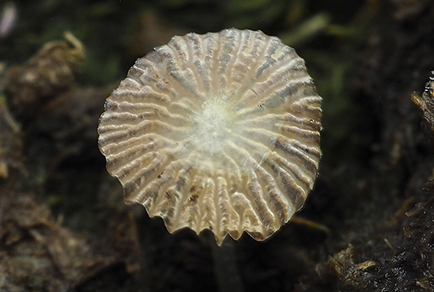
A new coprophilous species of Bolbitius, B. corrugatus sp. nov., is described and illustrated based on collections from Scotland. The new species is characterised by its yellow, corrugated pileus, hexagonal spores, and coprophilous habitat. A phylogenetic analysis based on ITS and LSU was conducted to support morphological data. A link to a time-lapse video showing the growth of basidiocarps in the type collection is included as part of the description. Another coprophilous species, B. excoriatus, is introduced as new to Britain and is included in the phylogenetic analysis. Morphological descriptions, illustrations, and phylogenetic analysis results of the two species are provided. A competition-based hypothesis is proposed for the variation in basidiocarp size among coprophilous fungi.
References
- Alfaro, M.E., Zoller, S. & Lutzoni, F. (2003) Bayes or bootstrap? A simulation study comparing the performance of Bayesian Markov chain Monte Carlo sampling and bootstrapping in assessing phylogenetic confidence. Molecular Biology and Evolution 20: 255–266. https://doi.org/10.1093/molbev/msg028
- Arnolds, E. (2003) Notulae Ad Floram Agaricinam Neerlandicam—XXXIX Bolbitius. Persoonia 18 (Part 2): 201–214.
- Arnolds, E. (2005) Bolbitiaceae. In: Noordeloos, M.E., Kuyper, T.W. & Vellinga, E.C. (Eds.) Flora Agaricina Neerlandica 6: pp. 112–119.
- Averis, A., Averis, B., Birks, J., Horsfield, D., Thompson, D. & Yeo, M. (2004) An Illustrated Guide to British Upland Vegetation. JNCC, Peterborough, ISBN: 1 86107 553 7.
- Clements, T. (2021) Mushroom Observer (observation no. 527422). Available from: https://mushroomobserver.org/527422 (accessed 14 April 2025)
- Cubeta, M.A., Echandi, E., Abernethy, T. & Vilgalys, R. (1991) Characterization of anas-tomosis groups of binucleate Rhizoctonia fungi using restriction analysis of ribosomal RNA genes. Phytopathology 81: 1395–1400. https://doi.org/10.1094/Phyto-81-1395
- Dotmatics (2025) SnapGene (version 8.0.1) [Software]. Available from: https://www.snapgene.com (accessed 14 April 2025)
- Doveri, F. (2004) Fungi Fimicoli Italici: A guide to the recognition of Basidiomycetes and Ascomycetes living on faecal material. Trento: Associazione Micologica Bresadola.
- Ferisin, G. & Pellizzari, L. (2017) Bolbitius excoriatus, una nuova specie per il Friuli Venezia Giulia. Micologia e Vegetazione Mediterranea 32 (1): 75–80.
- Halbwachs, H., Karasch, P. & Simmel, J. (2018) Small can be beautiful: ecological trade-offs related to basidiospore size. Asian Journal of Mycology 1 (1): 15–21. https://doi.org/10.5943/ajom/1/1/3
- Hausknecht, A., Contu, M.E., Krisai-Greilhuber, I., Dähncke, R.M. & Vizzini, A. (2010) Bolbitius excoriatus (Basidiomycota, Agaricales), a new species from Spain. Österreichische Zeitschrift für Pilzkunde 19: 121–126.
- Hillis, D.M. & Bull, J.J. (1993) An empirical test of bootstrapping as a method for assessing confidence in phylogenetic analysis. Systematic Biology 42: 182–192. https://doi.org/10.1093/sysbio/42.2.182
- Horek, E., Monero, G., Ortega, A. & Esteve-Raventós, F. (2002) Bolbitius elegans, a striking new species from southern Spain. Persoonia 17 (4): 615–623.
- Hutchinson, G.E. (1957) Concluding remarks. Cold Spring Harbor Symposia on Quantitative Biology 22: 415–427. https://doi.org/10.1101/SQB.1957.022.01.039
- Ikediugwu, F.E.O. & Webster, J. (1970a) Antagonism between Coprinus heptemerus and other coprophilous fungi. Transactions of the British Mycological Society 54 (2): 181–204.
- Ikediugwu, F.E.O. & Webster, J. (1970b) Hyphal interference in a range of coprophilous fungi. Transactions of the British Mycological Society 54 (2): 205–210.
- Moore, J. (2013) Diversity, Taxonomic versus Functional. Encyclopedia of Biodiversity (second edition): pp. 648–656. https://doi.org/10.1016/B978-0-12-384719-5.00036-8
- Katoh, K., Rozewicki, J. & Yamada, K.D. (2019) MAFFT online service: multiple sequence alignment, interactive sequence choice and visualization. Briefings in Bioinformatics 20 (4): 1160–1166. https://doi.org/10.1093/bib/bbx108
- Kearney, M., Simpson, S.J., Raubenheimer, D. & Helmuth, B. (2010) Modelling the ecological niche from functional traits. Philosophical Transactions of the Royal Society B 365: 3469–3483. https://doi.org/10.1098/rstb.2010.0034
- Krug, J.C., Benny, G.L. & Keller, H.W. (2005) Coprophilous fungi. In: Mueller, G.M., Bills, G.F. & Foster, M.S. (Eds.) Biodiversity of fungi: inventory and monitoring methods. Elsevier Academic Press, pp. 467–499.
- Kuyper, K., van Peer, A. & Baars, J.J.P. (2021) Closing the loop: improving circularity with manure-loving mushrooms. Wageningen Research, Report WPR-2021-1. https://doi.org/10.18174/539315
- Largent, D., Johnson, D. & Watling, R. (1977) How to identify mushrooms to genus III: microscopic features. Mad River Press.
- Letunic, I. & Bork, P. (2019) Interactive Tree Of Life (iTOL) v4: Recent updates and new developments. Nucleic Acids Research 47: W256–W259. https://doi.org/10.1093/nar/gkz239
- Malysheva, E., Malysheva, V. & Svetasheva, T. (2015) Molecular phylogeny and taxonomic revision of the genus Bolbitius (Bolbitiaceae, Agaricales) in Russia. Mycological Progress 14: 64. https://doi.org/10.1007/s11557-015-1087-2
- Malysheva, E. (2018) Familia Bolbitiaceae. Definitorium Fungorum Rossiae: Ordo Agaricales. Nestor-Historia, Saint Petersburg. [In Russian]
- Mullis, K.B. & F.A. Faloona (1987) Specific synthesis of DNA in vitro via a polymerase-catalyzed chain reaction. Methods in Enzymology 155: 335–350. https://doi.org/10.1016/0076-6879(87)55023-6
- Örstadius, L. & Larsson, E. (2013) Bolbitius excoriatus, flagnande guldskivling, funnen på spillning i Sverige. Svensk Mykologisk Tidskrift 34 (2): 2–6.
- Osmundson, T.W., Robert, V.A., Schoch, C.L., Baker, L.J., Smith, A., Robich, G., Mizzan, L. & Garbelotto, M.M. (2012) Filling gaps in biodiversity knowledge for macrofungi: Contributions and assessment of an herbarium collection DNA barcode sequencing project. PLoS ONE 8 (4): e62419. https://doi.org/10.1371/journal.pone.0062419
- Polechová, J. & Storch, D. (2019) Ecological niche. In: Fath, B. (Ed.) Encyclopedia of Ecology, Second edition. Vol. 3. Elsevier, pp. 72–80. https://doi.org/10.1016/B978-0-12-409548-9.11113-3
- Rambaut, A., Drummond, A.J., Xie, D., Baele, G. & Suchard, M.A. (2018) Posterior summarisation in Bayesian phylogenetics using Tracer 1.7. Systematic Biology 67: 901–904. https://doi.org/10.1093/sysbio/syy032
- Richardson, M.J. & Watling, R. (1997) Keys to fungi on dung. British Mycological Society.
- Richardson, M.J. (2001) Diversity and occurrence of coprophilous fungi. Mycological Research 105 (4): 387–402. https://doi.org/10.1017/S0953756201003884
- Richardson, M.J. (2002) The coprophilous succession. In: Hyde, K.D. & Jones, E.B.G. (Eds.) Fungal Succession. Fungal Diversity 10: pp. 101–111.
- Richardson, M.J. (2003) Coprophilous fungi. Field Mycology 4 (2): 41–43. https://doi.org/10.1016/S1468-1641(10)60185-5
- Ronquist, F., Teslenko, M., van der Mark, P. , Ayres, D.L., Darling, A., Höhna, S., Larget, B., Liu, L., Suchard, M.A. & Huelsenbeck, J.P. (2012) MrBayes 3.2: Efficient Bayesian phylogenetic inference and model choice across a large model space. Systematic Biology 61: 539–542. https://doi.org/10.1093/sysbio/sys029
- Sarrocco, S. (2016) Dung-inhabiting fungi: a potential reservoir of novel secondary metabolites for the control of plant pathogens. Pest Management Science 72 (4): 643–52. https://doi.org/10.1002/ps.4206
- Stearn, W.T. (1992) Botanical Latin: history, grammar, syntax, terminology and vocabulary, 4th edn. Timber Press, Portland.
- Tamura, K., Stecher, G. & Kumar, S. (2021) MEGA11: Molecular Evolutionary Genetics Analysis version 11. Molecular Biology and Evolution 38: 3022–3027. https://doi.org/10.1093/molbev/msab120
- Trifinopoulos, J., Nguyen, L.-T., von Haeseler, A. & Minh, B.Q. (2016) W-IQ-TREE: a fast online phylogenetic tool for maximum likelihood analysis. Nucleic Acids Research 44: W232–W235. https://doi.org/10.1093/nar/gkw256
- Vilgalys, R. & Hester, M. (1990) Rapid genetic identification and mapping of enzymatically amplified ribosomal DNA from several Cryptococcus species. Journal of Bacteriology 172: 4238–4246. https://doi.org/10.1128/jb.172.8.4238-4246.1990
- Watling, R. (1982) British Fungus Flora: Agarics and Boleti. 3 Bolbitiaceae: Agrocybe, Bolbitius and Conocybe. Royal Botanic Gardens, Edinburgh.
- Webster, J. (1970) Coprophilous fungi. Transactions of the British Mycological Society 54 (2): 161–180.
- White, T.J., Bruns, T.D., Lee, S.B. & Taylor, J.W. (1990) Amplification and direct sequencing of fungal ribosomal RNA genes for phylogenetics. In: Innis, M.A., Gelfand, D.H., Sninsky, J.J. & White, T.J. (Eds.) PCR Protocols: a guide to methods and applications. Academic Press, pp. 315–322. https://doi.org/10.1016/B978-0-12-372180-8.50042-1