
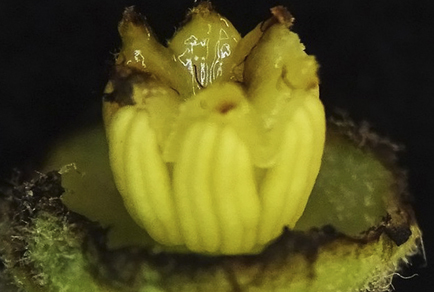

Abstract
A new species, Aristolochia guillermoi is described from seasonal dry forests of northern Peru, in the Department of Piura, at elevations between 1000 and 1600 m. The new species is similar to A. andina from central and southern Bolivia. They differ in several characters of the leaves, the perianth, the capsule and the seeds. Aristolochia guillermoi is the fourth Aristolochia species known to have branched trichomes, a very unusual epidermal trait in the genus, which also occurs in A. andina, A. fosteri and A. killipiana. Notably, all these species are restricted to the Andes of Ecuador, Peru and Bolivia, at elevations between 1000 and 2580 m. A key and a map of distribution for these species are provided.
References
- Ahumada, Z. (1979) Novedades sistemáticas en el género Aristolochia (Aristolochiaceae) en Sudamérica II. Hickenia 1 (32): 171–184.
- Barringer, K. (1986) New species of Aristolochia (Aristolochiaceae) from Peru. Brittonia 38: 128–132. https://doi.org/10.2307/2807264
- Correns, C. (1891) Beiträge zur biologischen Anatomie der Aristolochia-Blüthe. Jahrbücher für Wissenschaftliche Botanik 22: 161–189, t. 4, 5.
- Daumann, E. (1959) Zur Kenntnis der Blütennektarien von Aristolochia. Preslia 31: 359–372.
- Duchartre, P. (1854) Metodicae Divisionis Generis Aristolochia, additis descriptionibus complurium novarum specierum. Annales des Sciences Naturelles; Botanique, série 4, 2: 63–65.
- Esquerre-Ibañez, B. (2019) Una especie nueva ovo-imitadora en Passiflora (Passifloraceae) de la Provincia Huancabamba, Piura, Perú. Revista Peruana de Biología 26 (1): 3–8. https://doi.org/10.15381/rpb.v26i1.15902
- Freitas, J., Lírio, E.J., Barros, F. & González, F. (2020) Aristolochiaceae. In: Flora do Brasil 2020. Jardim Botânico do Rio de Janeiro. Available from: [https://floradobrasil.jbrj.gov.br/reflora/floradobrasil/FB54].
- González, F. (1994) Aristolochiaceae. In: Harling, G. & Andersson, L. (Eds.) Flora of Ecuador. Monograph No. 51. Council for Nordic Publications in Botany, pp. 1–42.
- González, F. (1999) A phylogenetic analysis of the Aristolochioideae (Aristolochiaceae). Ph. D. dissertation. The City University of New York, Ndew York, USA.
- González, F. (2000) Notes on the central Andean species of Aristolochia (Aristolochiaceae) with the description of a new species from Bolivia. Kew Bulletin 55 (4): 905–916. https://doi.org/10.2307/4113637
- González, F. & Monzón-Sierra, J. (2022) An updated synopsis of Aristolochia (Aristolochiaceae) in Guatemala. Brittonia 74 (3): 239–264. https://doi.org/10.1007/s12228-022-09704-0
- González, F., Ospina, J.C. & Zanotti, C. (2015) Sinopsis y novedades taxonómicas de la familia Aristolochiaceae para la Argentina. Darwiniana nueva serie 3 (1): 38–64. https://doi.org/10.14522/darwiniana.2015.31.644
- González, F. & Pabón-Mora, N. (2018) Sinopsis actualizada de Aristolochia (Aristolochiaceae: Piperales) en Panamá. Acta Botanica Mexicana 122: 109–140. https://doi.org/10.21829/abm122.2018.1249
- González, F., Valenzuela, L. & Pabón-Mora, N. (2023) Aristolochia brachylimba (Aristolochiaceae; Piperales), a new species from the Peruvian Amazonia with an unusually short perianth limb. Darwiniana nueva serie 11 (1): 347–356. https://doi.org/10.14522/darwiniana.2023.111.1139
- Harling, G. & Sparre, B. (1973) Flora of Ecuador 2: Tropaeolaceae. University of Göteborg, Sweden.
- Hoehne, F.C. (1927) Monographia Ilustrada das Aristolochiaceas brasileiras. Memorias do Instituto Oswaldo Cruz 20: 67–175, t. 1‒103. https://doi.org/10.1590/S0074-02761927000100004
- Hoehne, F.C. (1942) Aristolochiaceas. Flora Brasílica 15 (2): 1–141, t. 1–123.
- Huber, H. (1960) Zur Abgrenzung der Gattung Aristolochia L. Mitteilungen der Botanischen Staatssammlung München 3: 531–553.
- Huber, H. (1985) Samenmerkmale und Gliederung der Aristolochiaceen. Botanische Jahrbücher fur Systematik, Pflanzengeschichte und Pflanzengeographie 107: 277–320.
- Inamdar, J.A., Avita, S. & Mohan, J.S.S. (1989) Histomorphological studies in some Aristolochiaceae. Feddes Repertorium 100: 257–269. https://doi.org/10.1002/j.1522-239X.1989.tb00183.x
- IUCN Standards and Petitions Committee (2024) guidelines for using the IUCN Red List Categories and Criteria. Version 16. Available from: http://www.iucnredlist.org/documents/Redlistguidelines.pdf (accessed 10 March 2025)
- JSTOR (2025, updated continuously) JSTOR Global Plants. Available from: https://plants.jstor.org/collection/TYPSPE (accessed May 2025)
- León, B. & La Torre, M.I. (2006) Aristolochiaceae endémicas del Perú. Revista Peruana de Biología 13: 56s–57s. https://doi.org/10.15381/rpb.v13i2.1804
- Linnaeus, C. (1753) Species Plantarum vol. 2. Laurentius Salvius, Stockholm, 640 pp.
- Macbride, J.F. (1937) Aristolochiaceae, Flora of Peru. Field Museum of Natural History Botanical Series 13: 431–443.
- Marión-H., L. (2011) Aristolochias de la Isla Española. Jardín Botánico Nacional Dr. Rafael M. Moscoso and Academia de Ciencias de la República Dominicana, Santo Domingo, 108 pp.
- Metcalfe, C.R. & Chalk, L. (1950) Anatomy of the dicotyledons. 2 vols. Clarendon Press, Oxford.
- Ocupa-Horna, L. & Valencia-D, J. (2025) Sobralia aryaelizabethiana (Orchidaceae), a small and unusual new species from northern Peru. Lankesteriana: International Journal on Orchidology 25 (1): 9–19. https://doi.org/10.15517/lank.v25i1.62949
- Petch, T. (1924) Notes on Aristolochia. Annals of the Royal Botanic Gardens, Peradeniya 8: 1–109.
- Pfeifer, H.W. (1966) Revision of the north and central american hexandrous species of Aristolochia (Aristolochiaceae). Annals of the Missouri Botanical Garden 53: 115–196. https://doi.org/10.2307/2394940
- Pfeifer, H.W. (1970) A taxonomic revision of the pentandrous species of Aristolochia. University of Connecticut Publication Series, 134 pp.
- Rankin Rodríguez, R. (1998) Aristolochiaceae. In: Manitz, H. (Ed.) Flora de la República de Cuba 1 (2). Koeltz Scientific Books, Königstein, pp. 9–39.
- Schmidt, O.C. (1927) Beiträge zur Kenntnis der Aristolochiaceen I. Repertorium Specierum Novarum Regni Vegetabilis 23: 282–299. https://doi.org/10.1002/fedr.19270231803
- Schmidt, O.C. (1932) Beiträge zur Kenntnis der Aristolochiaceen III. Repertorium Specierum Novarum Regni Vegetabilis 30: 66–75. https://doi.org/10.1002/fedr.19320300104
- Schmidt, O.C. (1935) Beiträge zur Kenntnis der Aristolochiaceae VI. Repertorium Specierum Novarum Regni Vegetabilis 38: 110–112. https://doi.org/10.1002/fedr.19350380611
- Schmidt, O.C. (1936) Beiträge zur Kenntnis der Aristolochiaceae VII. Repertorium Specierum Novarum Regni Vegetabilis 40: 133–135. https://doi.org/10.1002/fedr.19360400106
- Schmidt, O.C. (1938) Beiträge zur Kenntnis der Aristolochiaceae VIII. Repertorium Specierum Novarum Regni Vegetabilis 45: 52–55. https://doi.org/10.1002/fedr.19380450108
- Solereder, H. (1889) Beiträge zur vergleichenden Anatomie der Aristolochiaceen. Botanische Jahrbücher für Systematik, Pflanzengeschichte und Pflanzengeographie 10: 410–542.
- Solereder, H. (1908) Systematic anatomy of the dicotyledons. 2 vols. Clarendon Press, Oxford.
- Suárez-Baron, H., Alzate, J.F., González, F., Ambrose, B.A. & Pabón-Mora, N. (2019) Genetic mechanisms underlying perianth epidermal elaboration of Aristolochia ringens Vahl (Aristolochiaceae). Flora 253: 56–66. https://doi.org/10.1016/j.flora.2019.03.004
- Suárez-Baron, H., Alzate, J.F., González, F., Pelaz, S., Ambrose, B.A. & Pabón-Mora, N. (2021) Gene expression underlying floral epidermal specialization in Aristolochia fimbriata (Aristolochiaceae). Annals of Botany 127: 749–764. https://doi.org/10.1093/aob/mcab033
- Suárez-Baron, H., Alzate, J.F., Ambrose, B.A., Pelaz, S., González, F. & Pabón-Mora, N. (2023) Comparative morphoanatomy and transcriptomic analyses reveal key factors controlling floral trichome development in Aristolochia (Aristolochiaceae). Journal of Experimental Botany 74 (21): 6588–6607. https://doi.org/10.1093/jxb/erad345
- Thiers, B.M. (2025, updated continuously) Index Herbariorum. Available from: [https://sweetgum.nybg.org/science/ih/]
- Ule, E.H.G. (1905) Aristolochiaceae. Verhandlungen des Botanischen Vereins für die Provinz Brandenburg 47: 118–124.
- Vásquez, M., Berg, C. & Kooy, F. (1984) New taxa of South American Ficus (Moraceae). Acta Amazonica 14 (1/2, supl.): 195–213. https://doi.org/10.1590/1809-43921984145213
- Weigend, M. (2002) Observations of the biogeography on the Amotape-Huancabamba Zone in northern Peru. The Botanical Review 68 (1): 38–54. https://doi.org/10.1663/0006-8101(2002)068[0038:OOTBOT]2.0.CO;2