

Abstract
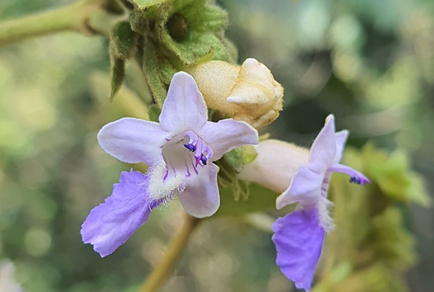
This study consisted of a floristic survey of Lamiaceae in Parque Estadual do Juquery (PEJY), a Conservation Unit located in São Paulo’s metropolitan area (in Franco da Rocha and Caieiras cities) which is considered the biggest Cerrado refuge of the state. It possesses a high biodiversity, however, is constantly threatened due to the indiscriminate use of fire by men. To access the diversity of Lamiaceae in PEJY we analyzed herbaria collections and made field expeditions between 2022 and 2023. We recorded 17 Lamiaceae species (15 native to Brazil) occurring in PEJY, arranged in 12 genera: Aegiphila (1 spp.), Cantinoa (2 spp.), Eriope (1 spp.), Hyptis (3 spp.), Leonurus (1 spp.), Leucas (1 spp.), Medusantha (1 spp.), Mesosphaerum (2 spp.), Ocimum (1 spp.), Rhabdocaulon (1 spp.), Salvia (2 spp.), and Vitex (1 spp.). Here we provide comprehensive treatments for all native species recorded; notably, for Hyptis marrubioides, Ocimum carnosum, and Salvia minarum, these are the first detailed descriptions since their original descriptions. Finally, this work brings seven new occurrences for the area, highlighting the importance of floristic studies for specific groups or families, especially the ones with a high diversity of herbs and shrubs.
References
- Ab’Saber, A.N. (1978) O domínio dos mares de morros no Brasil: Introdução ao estudo do sistema ambiental brasileiro. Revista do Instituto Geográfico 4: 1–55.
- Ab'Sáber, A.N. (2003) Os domínios de natureza no Brasil: Potencialidades paisagísticas. Ateliê Editorial, São Paulo, 159 pp.
- Albuquerque, U.P. & Andrade, L.H.C. (1998) El género Ocimum L. (Lamiaceae) en el Nordeste del Brasil. Anales Jardín Botánico de Madrid 56: 43–64.
- Alencar, A., Shimbo, J.Z., Lenti, F., Balzani Marques, C., Zimbres, B., Rosa, M., Arruda, V., Castro, I., Ribeiro, J.P.F.M., Varela, V., Alencar, I., Piontekowski, V., Ribeiro, V., Bustamante, M.M.C., Sano, E.E. & Barroso, M. (2020) Mapping three decades of changes in the Brazilian savanna native vegetation using Landsat data processed in the Google Earth Engine platform. Remote Sensing 12: 924–943. https://doi.org/10.3390/rs12060924
- Alves, D.S., de Almeida, G.S.S. & Santana, S.N. (2023) Lamiaceae Martinov no município de Alagoinhas, Bahia, Brasil. Paubrasília 6: 105–119. https://doi.org/10.33447/paubrasilia.2023.e0105
- Antar, G.M. (2025b) Ocimum in Flora e Funga do Brasil. Jardim Botânico do Rio de Janeiro. Available from: https://floradobrasil.jbrj.gov.br/FB8276 (accessed 23 February 2025)
- Antar, G.M. (2025a) Mesosphaerum in Flora e Funga do Brasil. Jardim Botânico do Rio de Janeiro. Available from: https://floradobrasil.jbrj.gov.br/FB59202 (accessed 23 February 2025)
- Antar, G.M. & Oliveira, A.B. (2025) Rhabdocaulon in Flora e Funga do Brasil. Jardim Botânico do Rio de Janeiro. Available from: https://floradobrasil.jbrj.gov.br/FB8286 (accessed 23 February 2025)
- Antar, G.M., de Lírio, E.J., Freitas, J. & Fraga, C.N. (2022) Vitex pomerana (Lamiaceae; Viticoideae), a new unifoliolate species from the Brazilian Atlantic Forest. Kew Bulletin 77: 941–952. https://doi.org/10.1007/s12225-022-10064-x
- Antar, G.M., Harley, R.M., Oliveira, A.B., Buchoski, M.G., França, F., Faria, M.T., Soares, A.S., Mota, M.C.A., Schliewe, M.A., Pastore, J.F.B., Sarraff, H., Alves, D.S. & Luz, L. (2025) Lamiaceae in Flora e Funga do Brasil. Jardim Botânico do Rio de Janeiro. Available from: https://floradobrasil.jbrj.gov.br/FB142 (accessed 23 February 2025)
- Baitello, J.B., de Aguiar, O.T., Pastore, J.A. & Arzolla, F.A.P. (2013) Parque estadual do Juquery: refúgio de Cerrado no Domínio Atlântico. Instituto Florestal Série Registros 50: 1–46.
- Batalha, M.A., Aragaki, S. & Mantovani, W. (1997) Florística do Cerrado em Emas (Pirassununga, SP). Boletim de Botânica da Universidade de São Paulo 16: 49–64. https://doi.org/10.11606/issn.2316-9052.v16i0p49-64
- Batalha, M.A. & Mantovani, W. (2001) Floristic composition of the cerrado in the Pé-de-Gigante Reserve (Santa Rita do Passa Quatro, southeastern Brazil). Acta Botanica Brasilica 15: 289–304. https://doi.org/10.1590/S0102-33062001000300001
- Bayer, K. (1822) Denkschriften der Königlich-Baierischen Botanischen Gesellschaft in Regensburg. Regensburg: In Commission der Montag- und Weissischen Buchh 2: 52.
- Bentham, G. (1832) Labiatarum Genera et Species. James Ridgway and sons 1: 11.
- Bentham, G. (1833) Labiatarum Genera et Species. James Ridgway and sons 2: 1–783.
- Briquet, J.I. (1896) Bulletin de l'Herbier Boissier. Imprimerie Romet 4: 855.
- Brown, R. (1811) In: Aiton, W. & Aiton, W.T. (eds.) Hortus Kewensis; or, a Catalogue of the Plants Cultivated in the Royal Botanic Garden at Kew. Richard Taylor and Co., Shoe-Lane, 3: 409.
- Buchoski, M.G. (2025) Cantinoa in Flora e Funga do Brasil. Jardim Botânico do Rio de Janeiro. Available from: https://floradobrasil.jbrj.gov.br/FB132548 (accessed 23 February 2025)
- Carvalho, M.B., Ishara, K.L. & Maimoni-Rodella, R.C.S. (2010) Vascular Flora of a Cerrado sensu stricto remnant in Pratânia, state of São Paulo, southeastern Brazil. Check List 6: 433–439. https://doi.org/10.15560/6.3.350
- Cavassan, O. & Weiser, V.L. (2015) Vascular flora of the cerrado of Bauru-SP. Biota Neotropica 15: e20140093. https://doi.org/10.1590/1676-0611-BN-2014-0093
- Chamisso, L.K.A. (1832) Linnaea: Ein Journal für die Botanik in ihrem ganzen Umfange. Schlechtendal, D.F.L. von 7: 371.
- Coulter, J.M., Barnes, C.R. & Arthur J.C. (1876) Botanical Gazette. University of Chicago 25: 157.
- Da Costa, F.C.P. & de Melo, J.I.M. de (2019) Boraginales (Boraginaceae s.l.) and Lamiales (Lamiaceae and Verbenaceae) in a Conservation Area in the Semiarid Region of Northeastern Brazil. Rodriguésia 70: e01472017. https://doi.org/10.1590/2175-7860201970009
- Darwin, C.R., Hooker, J.D. & Jackson, B.D. (1893) Index Kewensis plantarum phanerogamarum : nomina et synonym omnium generum et specierum a linnaeo usque as annum MDCCLXXXV. Clarendon Press 1: 46.
- de Brito, W.M.C. (1997) Cerrado: bases para a conservação e uso sustentável das áreas de cerrado do estado de São Paulo. Secretaria de Estado do Meio Ambiente, São Paulo, 113 pp.
- Durigan, G., Pilon, N.A.L., Assis, G.B., Souza, F.M. & Baitello, J.B. (2018) Plantas pequenas do cerrado: biodiversidade negligenciada. Instituto Florestal, São Paulo, 722 pp.
- Epling, C. (1936) Repertorium Specierum Novarum Regni Vegetabilis. Dahlem bei Berlin, Verlag des Repertoriums 85: 136.
- Epling, C. (1937) Repertorium Specierum Novarum Regni Vegetabilis. Dahlem bei Berlin, Verlag des Repertoriums 85.
- Epling, C. & Toledo, J.F. (1943) Labiadas. In: Hoehne, F.C. (Ed.) Flora Brasílica. Vol. 48. Secretaria da Agricultura, Indústria e Comércio, São Paulo, pp. 1–107.
- Fidalgo, O. & Bononi, V.L.R. (1984) Técnicas de coleta, preservação e herborização do material botânico. Instituto de Botânica, São Paulo, 62 pp.
- Filgueiras, T.S., Nogueira, P.E., Brochado, A.L. & Gualla, G.F. (1994) Caminhamento: um método expedito para levantamentos florísticos qualitativos. Cadernos de Geociências 12: 39–43.
- Flora e Funga do Brasil (2025) Jardim Botânico do Rio de Janeiro. Available from: https://floradobrasil.jbrj.gov.br/FB71762 (accessed 23 February 2025)
- Forzza, R.C., Baumgratz, J.F.A., Bicudo, C.W.E., Canhos, D.A.L., Carvalho Júnior, A.A., Coelho, M.A.N., Costa, A.F., Costa, D.P., Hopkins, M.G., Leitman, P.M., Lohmann, L.G., Lughadha, E.N., Maia, L.C., Martinelli, G., Menezes, M., Morim, M.P., Peixoto, A.L., Pirani, J.R., Prado, J., Queiroz, L.P., Souza, S., Souza, V.C., Stehmann, J.R., Sylvestre, L.S., Walter, B.M. & Zappi, D.C. (2012) New Brazilian floristic list highlights conservation challenges. BioScience 62: 39–45. https://doi.org/10.1525/bio.2012.62.1.8
- França, F. (2025) Aegiphila in Flora e Funga do Brasil. Jardim Botânico do Rio de Janeiro. Available from: https://floradobrasil.jbrj.gov.br/FB8102 (accessed 23 February 2025)
- França, F.A. (2003) Revisão de Aegiphila (Lamiaceae) e seu posicionamento taxonômico. PhD Thesis, Universidade de São Paulo, 500 pp.
- França, F. (2025) Vitex in Flora e Funga do Brasil. Jardim Botânico do Rio de Janeiro. Available from: https://floradobrasil.jbrj.gov.br/FB8366 (accessed 23 February 2025)
- IBGE - Instituto Brasileiro de Geografia e Estatística (2019) Biomas e sistema costeiro-marinho do Brasil: compatível com a escala 1:250.000. Coordenação de Recursos Naturais e Estudos Ambientais, Rio de Janeiro, 168 pp.
- Harley, R.M. (1988) Revision of generic limits in Hyptis Jacq. (Labiatae) and its allies. Botanical Journal of the Linnean Society 98 (3): 91–92. https://doi.org/10.1111/j.1095-8339.1988.tb01697.x
- Harley, R.M. (2016) Flora of the cangas of the Serra dos Carajás, Pará, Brasil: Lamiaceae. Rodriguésia 67 (5): 1381–1398. https://doi.org/10.1590/2175-7860201667536
- Harley, R.M., Atkins, S., Budantsev, A.L., Cantino, P.D., Conn, B.J., Grayer, R., Harley, M.M., de Kok, R., Krestovskaja, T., Morales, R., Paton, A.J., Ryding, O. & Upson, T. (2004) Labiatae. In: Kubitzki, K. & Kadereit, J.W. (Eds.) The Families and Genera of Vascular Plants VII - Flowering Plants, dicotyledons: Lamiales. Springer-Nature, Berlin, pp. 167–276.
- Harley, R.M. & Pastore, J.F.B. (2012) A generic revision and new combinations in the Hyptidinae (Lamiaceae), based on molecular and morphological evidence. Phytotaxa 58: 1–55. https://doi.org/10.11646/phytotaxa.58.1.1
- Harley, R.M., Pastore, J.F.N., Soares, A.S., Fernando, E.M.P. & Mota, M. (2019) Mesosphaerum caatingense (Lamiaceae), a new species from the semi-arid Caatinga Region of Northeast Brazil. Kew Bulletin 74 (1): 1–8. https://doi.org/10.1007/s12225-019-9795-4
- Harley, R.M. & Antar, G.M. (2025) Hyptis in Flora e Funga do Brasil. Jardim Botânico do Rio de Janeiro. Available from: https://floradobrasil.jbrj.gov.br/FB8183 (accessed 23 February 2025)
- Harley, R.M. & Antar, G.M. (2025) Key to the native or naturalized genera of Lamiaceae in Brazil. Flora e Funga do Brasil. Jardim Botânico do Rio de Janeiro. Available from: http://floradobrasil.jbrj.gov.br/ (accessed 23 February 2025)
- JSTOR Global Plants (2025) Available from: https://plants.jstor.org/ (accessed 23 February 2025)
- Keller, V.C., Pereira-Silva, E.F.L. & Hardt, E. (2021) High richness, new occurrences, and threatened species in a savanna grassland remnant in the largest Brazilian metropolis. Check List 17 (2): 507–549. https://doi.org/10.15560/17.2.507
- Kriebel, R. (2014) Sexual Dimorphism in the Flowers of Aegiphila odontophylla (Lamiaceae). Systematic Botany 39 (4): 1204–1207. https://doi.org/10.1600/036364414X683930
- Kronka, M.N., Pires, J.L., Tardin, F.D., Almeida, A.F. & Martins, E.S. (2005) Diagnóstico da vegetação nativa do estado de São Paulo. Instituto Florestal, São Paulo, 100 pp.
- Kuntze (1891) Revisio generum plantarum:vascularium omnium atque cellularium multarum secundum leges nomenclaturae internationales cum enumeratione plantarum exoticarum in itinere mundi collectarum. A. Felix 2: 525.
- Lambers, H., Costa, P.B., Oliveira, R.S. & Silveira, F.A.O. (2020) Towards more sustainable cropping systems: lessons from native Cerrado species. Theoretical and Experimental Plant Physiology 32: 175–194. https://doi.org/10.1007/s40626-020-00180-z
- Lima, C.T. & França, F. (2009) Flora da Bahia: Vitex Tour. ex. L. Lamiaceae Sitientibus Série Ciências Biológicas 9 (4): 225–244. https://doi.org/10.13102/scb8015
- Linneaeus, C. (1753) Species plantarum: exhibentes plantas rite cognitas, ad genera relatas, cum differentiis specificis, nominibus trivialibus, synonymis selectis, locis natalibus, secundum systema sexuale digestas... Holmiae: Impensis Laurentii Salvii 1: 1–560.
- Linnaeus, C. (1759) Systema naturae per regna tria naturae :secundum classes, ordines, genera, species, cum characteribus, differentiis, synonymis, locis. Impensis Direct. Laurentii Salvii 1: 1100.
- Lorenzi, H. & Matos, F.J.A. (2008) Plantas medicinais no Brasil: nativas e exóticas. Instituto Plantarum, São Paulo, 386 pp.
- L'Héritier (1787) Sertum Anglicum: seu Plantae Rariores quae in Hortis juxta Londinum. Horto Regio Kewensi Excoluntur 1: 19.
- Medeiros, J.D. (2008) Guia de campo: vegetação do Cerrado 500 espécies. Ministério do Meio Ambiente, Secretaria de Biodiversidade e Florestas, Brasília, 192 pp.
- Miller, P.J., Miller, P.M., Rivington, J. & Rivington, F. (1768) The Gardeners Dictionary : containing the best and newest methods of cultivating and improving the kitchen, fruit, flower garden, and nursery, as also for performing the practical parts of agriculture, including the management of vineyards, with the methods of making and preserving wine, according to the present practice of the most skilful vignerons in the several wine countries in europe, together with directions for propagating and improving, from real practice and experience, all sorts of timber trees. John and Francis Rivington, 2: 222.
- Miranda, H.S., Mercedes, M.C.B. & Miranda, A.C. (2002) The fire factor. In: Oliveira, P.S. & Marquis, R.J. (Eds.) The Cerrados of Brazil: ecology and natural history of a neotropical savanna. Columbia University Press, New York, pp. 51–68.
- Mittermeier, R.A., Turner, W.R., Larsen, F.W., Brooks, T.M. & Gascon, C. (2011) Global biodiversity conservation: the critical role of hotspots. In: Zachos, F. & Habel, J. (Eds.) Biodiversity Hotspots. Springer, Berlin, pp. 3–22.
- Moldenke, H.N. (1934) A monograph of the genus Aegiphila. Brittonia 1: 245–477.
- Monteiro, F.K.S., Pastore, J.F.B. & de Melo, J.I.M. (2018) The flora of Paraíba State, Brazil: subfamilies Ajugoideae and Viticoideae (Lamiaceae). Biota Neotropica 18 (3): e20180004. https://doi.org/10.1590/1676-0611-BN-2017-0472
- Monteiro, F.K.S. & Melo, J.I.M. (2020) Flora da Paraíba, Brasil: subfamília Nepetoideae (Lamiaceae). Rodriguésia 71 (1): 19–27. https://doi.org/10.1590/2175-7860202071086.
- Mota, M.C.A., Pastore, J.F.B., Neto, R.M., Harley, R.M. & Salimena, F.R. (2017) Lamiaceae na Serra Negra, Minas Gerais, Brasil. Rodriguésia 68 (1): 143–157. https://doi.org/10.1590/2175-7860201768123
- Mota, M., Pastore, J.F.B., Neto, R.M. & Salimena, F.R. (2020) Lamiaceae do Parque Estadual do Ibitipoca, Minas Gerais, Brasil. Rodriguésia 71 (1): 1–11. https://doi.org/10.1590/2175-7860202071005
- Nees, C.G.D.E (1821) Reise nach Brasilien. H.L. Brönner 2: 335.
- O'Leary, N. (2015) Synopsis of subtribe Hyptidinae (Lamiaceae) in Argentina. Phytotaxa 233 (3): 201–235. https://doi.org/10.11646/phytotaxa.233.3.1
- Oliveira, A.B., Antar, G.M., Mota, M.C.A. & Pastore, J.F.B. (2025) Salvia in Flora e Funga do Brasil. Jardim Botânico do Rio de Janeiro. Available from: https://floradobrasil.jbrj.gov.br/FB8296 (accessed 23 February 2025)
- Oliveira, A.B., Antar, G.M. & Trovó, M. (2022) Mentheae (Nepetoideae - Lamiaceae) from the Itatiaia National Park, Brazil. Rodriguésia 73 (1): 7–17. https://doi.org/10.1590/2175-7860202273065
- Pohl (1827) Plantarum Brasiliae icones et descriptiones hactenus ineditae. Vindobonae [Vienna], Antonii Strauss 1:68.
- Radford, A.E., Dickson, W.C., Massey, J.R. & Bell, C.R. (1974) Vascular plant systematics. Harper & Row, New York, 891 pp.
- Reflora–Herbário Virtual (2025) Available from: http://reflora.jbrj.gov.br/reflora/herbarioVirtual/ (accessed 23 February 2025)
- Rossato, D.R., Zugliani, M.T. & Durigan, G. (2008) Flora fanerogâmica não-arbórea do cerrado na Estação Ecológica de Assis, Estado de São Paulo. Revista Brasil. Bot. 31 (3): 409–424.
- Rossatto, I.C. & Bruniera, C.P. (2024) Floristic survey of Rubiaceae in the largest remnant of Cerrado in the metropolitan region of São Paulo, Brazil. Rodriguésia 75: e01062023. https://doi.org/10.1590/S0100-84042008000300005
- Salimena-Pires, F.R. & Giulietti, A.M. (1998) Flora da Serra do Cipó, Minas Gerais: Verbenaceae. Boletim de Botânica 17: 155–186. https://doi.org/10.11606/issn.2316-9052.v17i0p155-186.
- Santos, J.S.S., França, F., Da Silva, M.J. & Sales, M.F. (2012) Levantamento das espécies de Amasonia (Lamiaceae) para o Brasil. Rodriguésia 64 (4): 1101–1116. https://doi.org/10.1590/S2175-78602012000400021
- Santos, D. & Costa, F.C.P. (2023) New record of Vitex orinocensis Kunth (Lamiaceae) for the state of Ceará, Brazil: insights on its conservation. Check-list 19 (2): 263–268. https://doi.org/10.15560/19.2.263
- Santos, E.P. & Harley, R.M. (2004) Notes on Salvia Section Nobiles (Lamiaceae) and Two New Species from Brazil. Kew Bulletin 59 (1): 103–109. https://doi.org/10.2307/4111080
- Santos, E.P., Santos, L.A.C., Miranda, S. & Silva Neto, C.M. (2020) Fitofisionomias do Cerrado: definições e tendências: Cerrado phytophysiognomies: definitions and trends. Élisée - Revista De Geografia Da UEG 9 (2): e922022.
- Sasaki, D. & Mello-Silva, R. (2008) Levantamento florístico no cerrado de Pedregulho, SP, Brasil. Acta Botânica Brasílica 22 (1): 187–202. https://doi.org/10.1590/S0102-33062008000100019
- Schliewe, M.A. (2025) Eriope in Flora e Funga do Brasil. Jardim Botânico do Rio de Janeiro. Available from: https://floradobrasil.jbrj.gov.br/FB8138 (accessed 23 February 2025)
- Sistema de Gestão Ambiental do Estado de São Paulo (SIGAM) (2025) Available from: https://sigam.ambiente.sp.gov.br/sigam3/ (accessed 8 September 2025)
- Soares, A.S. (2025) Medusantha in Flora e Funga do Brasil. Jardim Botânico do Rio de Janeiro. Available from: https://floradobrasil.jbrj.gov.br/FB132623 (accessed 23 February 2025)
- Soares, A.S., Pastore, J.F.B. & Jardim, J.G. (2017) New records, conservation assessments and distribution of Lamiaceae in Rio Grande do Norte, northeastern, Brazil. Phytotaxa 311 (1): 43–56. https://doi.org/10.11646/phytotaxa.311.1.4
- Soares, A.S., Pastore, J.F.B. & Jardim, J.G. (2019) Lamiaceae no Rio Grande do Norte, Brasil. Rodriguésia 70: 259–271. https://doi.org/10.1590/2175-7860201970067
- Thiers, B. (2025) Index Herbariorum: a global directory of public herbaria and associated staff. New York Botanical Garden’s Virtual Herbarium, New York. Available from: http://sweetgum.nybg.org/science/ih/ (accessed 23 February 2025)
- Tropicos (2025) Tropicos. org. Missouri Botanical Garden, Missouri. Available from: https://tropicos.org (accessed 23 April 2024)
- IPNI (2025) International Plant Names Index. The Royal Botanic Gardens, Kew, Harvard University Herbaria & Libraries and Australian National Herbarium. Available from: http://www.ipni.org (accessed 23 February 2025)
- Vasquez, G.D. & Harley, R.M. (2004) Flora de Grão Mogol. Minas Gerais: Labiatae. Boletim de Botânica da Universidade de São Paulo 22 (2): 193–204. https://doi.org/10.11606/issn.2316-9052.v27i1p101-102
- Vellozo, J.M.C. (1825) Florae fluminensis, seu, Descriptionum plantarum praefectura Fluminensi sponte mascentium liber primus ad systema sexuale concinnatus. Flumine Januario: ex Typographia nationali 1: 37.
- Weiser, V.L. & Godoy, S.A.P. (2001) Florística em um hectare de cerrado stricto sensu na área - cerrado Pé-de-gigante, Santa Rita do Passa Quatro, SP. Acta Botánica Brasilica 15 (2): 201–212. https://doi.org/10.1590/S0102-33062001000200007
- WFO (2025) World Flora Online. Available from: http://www.worldfloraonline.org (accessed 23 February 2025)