

Abstract
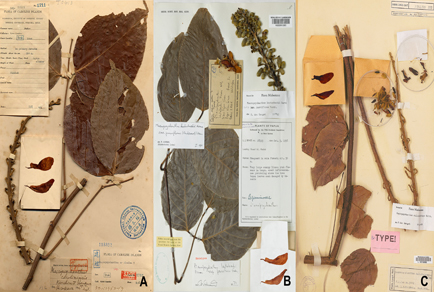
Macropsychanthus currently comprises 52 species, with Southeast Asia and Oceania ranking as the second-richest region in terms of species and where the genus exhibits the greatest diversity in floral structures. Until now, seven species have been recognized in this region, including M. lauterbachii, a taxon encompassing substantial morphological variation and previously divided into four varieties. As part of our revision of Macropsychanthus, we examined all species occurring in Southeast Asia and Oceania. Based on our findings, we propose M. javanicus as a synonym of M. hexander, and M. dolichobotrys and M. lauterbachii var. parviflorus as synonyms of M. carolinensis. We also elevate the remaining varieties of M. lauterbachii to species rank. In addition, we describe three new species: M. magnificus, M. bracteosus, and M. wiakabumba. With these changes, the number of recognized species in Southeast Asia and Oceania increases to 12.
References
- Adema, F. (1998) Notes on Malesian Fabaceae (Leguminosae-Papilionoideae) 3. The genera Dioclea, Luzonia, and Macropsychanthus. Blumea 43: 233–239. Available from: http://www.repository.naturalis.nl/record/525756 (accessed March 2025)
- Amaral-Neto, L.P., Westerkamp, C. & Melo, G.A.R. (2015) From keel to inverted keel flowers: functional morphology of “upside down” papilionoid flowers and the behavior of their bee visitors. Plant Systematics and Evolution 301: 2161–2178. https://doi.org/10.1007/s00606-015-1221-2
- Arroyo, M.T.K. (1981) Breeding systems and pollination biology in Leguminosae. In: Polhill, R.M. & Raven, P.H. (Eds.) Advances in legume systematics (Part II). Royal Botanic Gardens, Kew, pp. 723–769.
- Bachman, S., Moat, J., Hill, A.W., de la Torre, J. & Scott, B. (2011) Supporting Red List threat assessments with GeoCAT: geospatial conservation assessment tool. In: Smith, V. & Penev, L. (Eds.) E-Infrastructures for data publishing in biodiversity science. ZooKeys 150: 117–126. https://doi.org/10.3897/zookeys.150.2109
- Beentje, H. (2010) The Kew Plant Glossary. Royal Botanic Gardens, Kew, Richmond, U.K.
- Bentham, G. (1840) Contributions towards a Flora of South America.—Enumeration of Plants collected by Mr. Schomburgk in British Guiana. Le Journal de Botanique 2: 38–103.
- Browne, P. (1756) The Civil and Natural History of Jamaica. T. Osborne & J. Shipton, London.
- Candolle, A.P. (1825) Prodromus Systematis Naturalis Regni Vegetabilis, Part 2. Sumptibus Sociorum Treuttel et Würtz, Paris.
- Curtis, P.G., Slay, C.M., Harris, N.L., Tyukavina, A. & Hansen, M.C. (2018) Classifying drivers of global forest loss. Science. Accessed through Global Forest Watch 6 January 2025. Available from: www.globalforestwatch.org (accessed 1 March 2025)
- Elmer, A.D.E. (1907) Some new Leguminosae. Leaflets of Philippine Botany 1: 220–232.
- Faegri, K. & van der Pijl, L. (1979) The Principles of Pollination Ecology. Pergamon Press, Oxford. https://doi.org/10.1016/B978-0-08-023160-0.50020-7
- Franco, A.L.M. (1995) Sistemas de polinização e reprodução de espécies de Papilionoideae. PhD Thesis, Universidade Estadual de Campinas.
- Fonseca-Cortés, A. (2021a) Dos nuevas especies de Macropsychanthus (Leguminosae, Papilionoideae) de Colombia. Revista de la Academia Colombiana de Ciencias Exactas, Físicas y Naturales 45 (175): 489–499. https://doi.org/10.18257/raccefyn.1351
- Fonseca-Cortés, A. (2021b) Macropsychanthus magnus (Leguminosae: Papilionoideae: Diocleae), a new species from Costa Rica and Nicaragua. Phytotaxa 500 (4): 266–274. https://doi.org/10.11646/phytotaxa.500.4.2
- Fonseca-Cortés, A. & Sanabria-Baquero, E. (2022) First record of Crematogaster carinata (Formicidae) nesting in the fruits of Macropsychanthus (Leguminosae: Papilionoideae). Acta Biológica Colombiana 27 (2): 303–307. https://doi.org/10.15446/abc.v27n2.90924
- Fonseca-Cortés, A., Cardoso, D., Snak, C. & Queiroz, L.P. (2023a) A new endemic species of Macropsychanthus (Leguminosae: Papilionoideae) from the Brazilian Atlantic Forest. Phytotaxa 620 (3): 225–234. https://doi.org/10.11646/phytotaxa.620.3.3
- Fonseca-Cortés, A., Snak, C. & Queiroz, L.P. (2023b) Macropsychanthus nitidus: A new rank and combination for Dioclea rostrata var. nitida (Leguminosae, Papilionoideae). Phytotaxa 619 (4): 293–298. https://doi.org/10.11646/phytotaxa.619.4.4
- Fonseca-Cortés, A., Snak, C., Beck, S.G., Clark, R.P., Klitgaard, B., Hurtado Ulloa, R., Cayola Perez, L., Maldonado, C. & Queiroz, L.P. (2025a) How many Macropsychanthus (Leguminosae: Papilionoideae) species are found in Bolivia? Clarification of the taxa, a new species and an identification key. Kew Bulletin 80 (2): 315–322. https://doi.org/10.1007/s12225-024-10252-x
- Fonseca-Cortés, A., López-Roberts, Baldeón, S. & Queiroz, L.P. (2025b) Phylogenetics of Lackeya (Leguminosae: Papilionoideae): new generic circumscription, evidence of South-to-North American dispersal, and updated synopsis. Brazilian Journal of Botany 48 (1): 26. https://doi.org/10.1007/s40415-024-01056-1
- Fonseca-Cortés, A., Clark, R.P., Snak, C. & Queiroz, L.P. (2025c) Phylogeny and Morphology Unveil a New Species of Macropsychanthus (Leguminosae-Papilionoideae) Bridging Its Two Subgenera: Implications for Infrageneric Classification. American Society of Plant Taxonomists. Available from: https://www.ingentaconnect.com/content/aspt/sb/pre-prints/content-2400046# (accessed 30 August 2025).
- Harms, H.A.T. (1900) Familie Leguminosae. In: Schumann, K. & Lauterbach, K. (Eds.) Die Flora der Deutschen Schutzgebiete in der Südsee. Verlag von Gebrüder Borntraeger, Leipzig, pp. 342–372.
- Holthius, L.B. & Lam, H.J. (1942) A first contribution to our knowledge of the flora of the Talaud Island and Morotai. Blumea 5: 93–256. Available from: https://repository.naturalis.nl/pub/525051/BLUM1942005001005.pdf (accessed 1 March 2025)
- Hosokawa, T. (1934) Materials of the Botanical Research towards the Flora of Micronesia. II (Leguminosae Novae Micronesiae). Transactions of the Natural History Society of Taiwan 24: 414–415.
- IUCN (2024) IUCN Red List Categories and Criteria: Version 16. Available from: https://www.iucnredlist.org/resources/redlistguidelines (accessed 1 February 2025)
- Janzen, D.H. (1971) Escape of juvenile Dioclea megacarpa (Leguminosae) vines from predators in a deciduous tropical forest. The American Naturalist 105: 97–112. Available from: http://www.jstor.org/stable/2459059 (accessed 1 March 2025) https://doi.org/10.1086/282709
- JSTOR (2024) Lauterbach, Carl Adolf Georg (1864–1937). Available from: https://plants.jstor.org/stable/10.5555/al.ap.person.bm000152309 (accessed 1 March 2025)
- Maxwell, R.H. (1969) The genus Dioclea (Fabaceae) in the New World. PhD Dissertation, Southern Illinois University, Carbondale, U.S.A.
- Merrill, E.D. (1910) An enumeration of Philippine Leguminosae with keys to the genera and species. Philippine Journal of Science 5: 95–136.
- POWO (2025) Plants of the World Online. Facilitated by the Royal Botanic Gardens, Kew. Published on the Internet. Available from: https://powo.science.kew.org/ (accessed 1 April 2025)
- Queiroz, L.P., Pastore, J.F.B., Cardoso, D., Snak, C., de Lima, A.L., Gagnon, E., Vatanparast, M., Holland, A.E. & Egan, A.N. (2015) A multilocus phylogenetic analysis reveals the monophyly of a recircumscribed papilionoid legume tribe Diocleae with well-supported generic relationships. Molecular Phylogenetics and Evolution 90: 1–19. https://doi.org/10.1016/j.ympev.2015.04.016
- Queiroz, L.P. & Snak, C. (2020) Revisiting the taxonomy of Dioclea and related genera (Leguminosae, Papilionoideae), with new generic circumscriptions. PhytoKeys 164: 67–114. https://doi.org/10.3897/phytokeys.164.55441
- Snak, C., Vatanparast, M., Silva, C., Lewis, G.P., Lavin, M., Kajita, T. & Paganucci de Queiroz, L. (2016) A dated phylogeny of the papilionoid legume genus Canavalia reveals recent diversification by a pantropical liana lineage. Molecular Phylogenetics and Evolution 98: 133–146. https://doi.org/10.1016/j.ympev.2016.02.001
- Thiers, B., Thiers, B.M. & Čokić, B.B. (2025) Index Herbariorum: A global directory of public herbaria and associated staff. New York Botanical Garden’s Virtual Herbarium. Available from: http://sweetgum.nybg.org/science/ih/ (accessed 1 February 2025)
- Verdcourt, B. (1978) New taxa of Leguminosae from Papua New Guinea. Kew Bulletin 32: 455–473. https://doi.org/10.2307/4117116
- Verdcourt, B. (1979) A Manual of New Guinea Legumes. Office of Forests, Division of Botany, Lae, Papua New Guinea.
- Wikramanayake, E. (2025) Luzon Rainforests. OneEarth. Available from: https://www.oneearth.org/ecoregions/luzon-rainforests/ (accessed 1 February 2025)