

Abstract
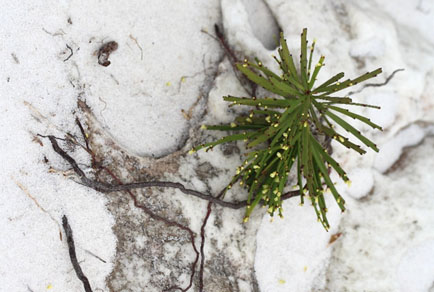
The flora of the Campos Rupestres has been increasingly studied in the municipality of Monte Azul, Minas Gerais, Brazil, a region considered a frontier of botanical knowledge, which has recently yielded new species. From this same area, we now describe two new species of Phyllanthus, along with the discovery of a distinctive anatomical trait in Phyllanthaceae: a thickened outer periclinal wall of the epidermis, rich in lipidic substances and forming pectic microchannels in one of the analyzed and described species. Although the two species are sympatric, they differ markedly in their morphological characters. Phyllanthus roseocalyx exhibits cylindrical phylloclades, distinctly pedicellate pistillate flowers, and staminate flowers with two stamens bearing horizontally dehiscent anthers. In contrast, Phyllanthus monteazulensis has flattened phylloclades, sessile pistillate flowers, and staminate flowers with three stamens and vertically dehiscent anthers. In addition, measurable characteristics of the phylloclades and flowers were used to compare the new species with other morphologically similar taxa of Phyllanthus that also bear phylloclades. This study includes morphological comparisons with similar species, a preliminary conservation assessment, illustrations, photographs, and distribution maps.
References
- Almeda, F. & Pacifico, R. (2023) New species of Microlicia (Melastomataceae) from the Espinhaço Meridional and Septentrional of Minas Gerais, Brazil. Phytotaxa 600 (3): 184–194. https://doi.org/10.11646/phytotaxa.600.3.5
- Bachman, S., Moat, J., Hill, A., de la Torre, J. & Scott, B. (2011) Supporting Red List threat assessments with GeoCAT: geospatial conservation assessment tool. ZooKeys 150: 117–126. https://doi.org/10.3897/zookeys.150.2109
- Baillon, M.H. (1858) Étude Génerale du Groupe des Euphorbiacée. Victor Masson, Paris, 684 pp. https://doi.org/10.5962/bhl.title.50439
- Benedetti, M.M., Curi, N., Sparovek, G., Carvalho Filho, A.D. & Silva, S.H.G. (2011) Updated Brazilian’s georeferenced soil database-an improvement for international scientific information exchanging. Updated Brazilian’s Georeferenced Soil Database-An Improvement for International Scientific Information Exchanging 1: 309–332.
- Bentham, G. & Hooker, J.D. (1880) Phyllanthus L. In: Genera Plantarum. London, Reeve, pp. 272–275.
- Bouman, R.W., Kessler, P.J.A., Telford, I.R.H., Bruhl, J.J. & Welzen, P.C. van. (2018) Subgeneric delimitation of the plant genus Phyllanthus (Phyllanthaceae). Blumea 63 (2): 167–198. https://doi.org/10.3767/blumea.2018.63.02.14
- Bouman, R.W., Kessler, P.J.A., Telford, I.R.H., Bruhl, J.J., Strijk, J.S., Saunders, R.M.K., Esser, H.J., Hidalgo, B.F. & Welzen, P.C. van. (2022) A revised phylogenetic classification of tribe Phyllantheae (Phyllanthaceae). Phytotaxa 540 (1): 1–100. https://doi.org/10.11646/phytotaxa.540.1.1
- Bueno, V.R., Bentes, M.S., Ramos, R., Zavatin, D.A. & Prata-Silveira (2025a) Three new species of Calea (Asteraceae, Neurolaeneae) from the sky islands of the Espinhaço Range. Phytotaxa 689 (2): 185–203. https://doi.org/10.11646/phytotaxa.689.2.2
- Bueno, V.R., Ramos, R., Almeida, M.L.C.D., Hemetrio, N.S., Santos, F.R.D., Prado, J. & Zavatin, D.A. (2025b) Novelties for Wedelia (Asteraceae, Heliantheae) in Minas Gerais, Brazil: a new species and a rediscovery after over 70 years. Phytotaxa 722 (1): 1–15. https://doi.org/10.11646/phytotaxa.722.1.1
- Colli‐Silva, M., Vasconcelos, T.N. & Pirani, J.R. (2019) Outstanding plant endemism levels strongly support the recognition of campo rupestre provinces in mountaintops of eastern South America. Journal of Biogeography 46: 1723–1733. https://doi.org/10.1111/jbi.13585
- Conceição, L.O. & Aoyama, E.M. (2016) Anatomia e histoquímica da lâmina foliar de espécies conhecidas por quebra-pedra (Euphorbia prostrata Aiton, Euphorbia hyssopifolia L., Phyllanthus amarus Schumach. & Thonn and Phyllanthus tenellus Roxb.). Revista Brasileira de Plantas Medicinais 18 (2 suppl 1): 571–581. https://doi.org/10.1590/1983-084X/15_226
- Cordeiro, I. (2012) Phyllanthaceae. In: Wanderley, M.G.L., Martins, S.E., Romanini, E.P., Melhem, T.S., Shepherd, G.J., Giulietti, A.M., Pirani, J.R., Kirizawa, M., Melo, M.M.R.F., Cordeiro, I. & Kinoshita, L.S. (Orgs.) Flora Fanerogâmica do Estado de São Paulo. Instituto de Botânica, São Paulo, pp. 245–262.
- Cronquist, A. (1981) An integrated system of classification of flowering plants. Columbia University Press, New York.
- Echternacht, L., Trovó, M., Oliveira, C.T. & Pirani, J.R. (2011) Areas of endemism in the Espinhaço range in Minas Gerais, Brazil. Flora Morphology, Distribution, Functional Ecology of Plants 206: 782–791. https://doi.org/10.1016/j.flora.2011.04.003
- Ferrari, L.T., Schaefer, C.E.G.R., Fernandes, R.B.A., Mendonça, B.A.F., Gjorup, D.F., Corrêa, G.R. & Senra, E.O. (2016) Thermic and hydric dynamics of ironstone (canga) and quartzite rupestrian grasslands in the Quadrilátero Ferrífero: the ecological importance of water. In: Ecology and conservation of mountaintop grasslands in Brazil. Cham: Springer International Publishing, pp. 71–85.
- Forster, J.R. & Forster, G. (1776) Characteres Generum Plantarum (second edition). Prostant apud B. White, T. Cadell & P. Elmsly, London, 642 pp.
- Gregory, M. & Baas, P. (1989) A survey of mucilage cells in vegetative organs of the dicotyledons. Israel Journal of Botany 38: 125–174.
- Hoffmann, P., Kathriarachchi, H. & Wurdack, K.J. (2006) A phylogenetic classification of Phyllanthaceae (Malpighiales; Euphorbiaceae sensu lato). Kew Bulletin 61: 37–53.
- Kathriarachchi, K., Hoffmann, P., Samuel, R., Wurdack, K.J. & Chase, M.W. (2005) Molecular phylogenetics of Phyllanthaceae inferred from five genes (plastid atpB, matK, 3’ndhF, rbcL, and nuclear PHYC). Molecular Phylogenetics and Evolution 36: 112–134. https://doi.org/10.1016/j.ympev.2004.12.002
- IUCN Standards and Petitions Committee. (2024) Guidelines for Using the IUCN Red List Categories and Criteria. Version 16. Prepared by the Standards and Petitions Committee. Available from: https://www.iucnredlist.org/documents/RedListGuidelines.pdf (accessed 15 November 2024)
- Jensen, W.A. (1962) Botanical histochemistry: principles and practice. W. H. Freeman, San Francisco, CA, USA, 408 pp.
- Linnaeus, C. (1753) Species Plantarum. Laurentius Salvius, Stockholm, 1200 pp.
- Linnaeus, C. (1771) Mantissa Plantarum. Holmiae, Impensis Laurentius Salvii, Stockholm, 618 pp.
- Lyshede, O.B. (1978) Studies on outer epidermal cell walls with microchannels in a xerophytic species. New Phytologist 80: 421–426. https://doi.org/10.1111/j.1469-8137.1978.tb01576.x
- Magri, R., Cabral, A., Prado, J. & Lopes, J.C. (2024) Two new critically endangered species of Vellozia (Velloziaceae) from the Campos Rupetres of Espinhaço Range, Brazil. Phytotaxa 652: 1–9. https://doi.org/10.11646/phytotaxa.652.1.1
- MapBiomas. (2024a) Collection 3 of the MapBiomas Fire. Available from: https://code.earthengine.google.com/?scriptPath=users%2Fmapbiomas%2Fuser-toolkit%3amapbiomas-user-toolkit-fire.js (accessed 10 April 2025) https://doi.org/10.58053/MapBiomas/XUFvIC
- MapBiomas. (2024b) Collection 9 of the annual Series of land Use and Coverage Maps of Brazil. Available from: https://code.earthengine.google.com/?accept_repo=users/mapbiomas/user-toolkit (accessed 10 April 2025) https://doi.org/10.58053/MapBiomas/XXUKa8
- McBride, E.F. (1963) A classification of common sandstones. Journal of Sedimentary Research 33: 664–669. https://doi.org/10.1306/74D70EE8-2B21-11D7-8648000102C1865D
- Mendes, J.C.R., Braga, J.M.A., de Fraga, C.N. & Athiê-Souza, S.M. (2024a) Phyllanthus novofriburgensis and P. pedrosae, two new species of Phyllanthus subsect. Clausseniani (Phyllanthaceae) from Southeastern Brazil. European Journal of Taxonomy 935: 293–306. https://doi.org/10.5852/ejt.2024.935.2567
- Mendes, J.C.R., de S. Secco, R. & Viana, P.L. (2024b) An account of a new and endangered tiny species of Phyllanthus (Phyllanthaceae) from Serra da Gandarela, Minas Gerais, Brazil. Brittonia 76: 26–32. https://doi.org/10.1007/s12228-024-09779-x
- Mittermeier, R.A., Turner, W.R., Larsen, F.W., Brooks, T.M. & Gascon, C. (2011) Global biodiversity conservation: the critical role of hotspots. In: Biodiversity hotspots: distribution and protection of conservation priority areas. Berlin, Heidelberg: Springer Berlin Heidelberg, pp. 3–22. https://doi.org/10.1007/978-3-642-20992-5_1
- Müller Argoviensis, J. (1863) Euphorbiaceae. Vouläufige Mittheifungen aus dem für De Candolle’s Prodromus bestimanten Manuscript über dieses Familiae. Linnaea 32: 1–786.
- Myers, N., Mittermeier, R.A., Mittermeier, C.G., Fonseca, G.A.B. & Kent, J. (2000) Biodiversity hotspots for conservation priorities. Nature 403: 853–858. https://doi.org/10.1038/35002501
- Orlandini, P., Torres, A.M., Mendes, J.C.R. & Silva, M.J. (2020) Phyllanthus. In: Flora e Funga do Brasil 2020. Jardim Botânico do Rio de Janeiro. Available from: http://floradobrasil.jbrj.gov.br/reflora/floradobrasil/FB24160 (accessed 18 January 2025)
- Orlandini, P., Silva, O.L.M., Cordeiro, I. & Souza, V.C. (2023) Phylogenetics of Brazilian phyllocladiferous Phyllanthus (Phyllanthaceae): a new section exclusive from the Atlantic Rain Forest with morphological and molecular support. Plant Systematics and Evolution 309: 1–12. https://doi.org/10.1007/s00606-023-01871-1
- Orlandini, P., Cordeiro, I., Lombardi, J.A., Zavatin, D.A. & Souza, V.C. (2024) A phyllocladiferous new species of Phyllanthus (Phyllanthaceae) from Minas Gerais, Brazil. Phytotaxa 661: 293–300. https://doi.org/10.11646/phytotaxa.661.3.6
- Pacifico, R., Almeda, F. & Kriebel, R. (2023) Microlicia delicata and Microlicia pumila (Melastomataceae), two new species from unprotected mountains with campo rupestre vegetation in eastern Brazil. Phytotaxa 599: 207–224. https://doi.org/10.11646/phytotaxa.599.4.1
- Pax, F. & Hoffmann, K. (1931) Euphorbiaceae. In: Engler, A. & Harms, H. (Eds.) Die natürlichen Pflanzenfamilien ed. 2, 19c. Wilhelm Engelmann, Leipzig, pp. 11–232.
- QGIS Development Team. (2021) QGIS geographic information system. QGIS Association (accessed 10 November 2024)
- Radford, A.E., Dickison, W.C., Massey, J.R. & Bell, C.R. (1974) Vascular Plant Systematics. Harper and Row, New York, Evanston, San Francisco and London, 891 pp.
- Rapini, A., Bitencourt, C., Luebert, F. & Cardoso, D. (2021) An escape-to-radiate model for explaining the high plant diversity and endemism in campos rupestres. Biological Journal of the Linnean Society 133: 481–498. https://doi.org/10.1093/biolinnean/blaa179
- Reflora-Herbário Virtual. (2025) Available from: http://reflora.jbrj.gov.br/reflora/herbarioVirtual/ (accessed 15 March 2025)
- Roxburg, W. (1832) Flora Indica; or Descriptions of Indian Plants, edited by William Carey. Vol. 3. Serampore, Mission Press, pp. 668. https://doi.org/10.5962/bhl.title.6633
- Sakai, W.S. (1973) Simple method for differential staining of paraffin embedded plant material using toluidine blue O. Stain Technology 48: 247–249. https://doi.org/10.3109/10520297309116632
- Samuel, R., Kathriarachchi, H., Hoffmann, P., Barfuss, M.H., Wurdack, K.J., Davis, C.C. & Chase, M.W. (2005) Molecular phylogenetics of Phyllanthaceae: evidence from plastid matK and nuclear PHYC sequences. American Journal of Botany 92: 132–141. https://doi.org/10.3732/ajb.92.1.132
- Santiago, L.J.M., Louro, R.P. & Emmerich, M. (2008) Phylloclade anatomy in Phyllanthus section Choretropsis (Phyllanthaceae). Botanical Journal of the Linnean Society 157: 91–102. https://doi.org/10.1111/j.1095-8339.2008.00780.x
- Schaefer, C.E., Candido, H.G., Corrêa, G.R., Campos, P.V., Senra, E.O., Gjorup, D.F. & Filho, E.I.F. (2023) Soils of Campos Rupestres (Rupestrian Grasslands) of the Old Brazilian Mountain Ranges. In: The Soils of Brazil. Cham: Springer International Publishing, pp. 343–362. https://doi.org/10.1007/978-3-031-19949-3_12
- Schumacher, C.F. (1827) Beskrivelse af Guineiske planter: som ere fundne af Danske botanikere, isaer af etatsraad Thonning. F. Popp. https://doi.org/10.5962/bhl.title.51454
- Silva, M.J., Alonso, A.A. & Santos, I.S. (2022) A new critically endangered species of stone breaker (Phyllanthus, Phyllanthaceae) from Central Brazil, with notes on its leaf and stem anatomy. Phytotaxa 530 (1): 53–64. https://doi.org/10.11646/phytotaxa.530.1.4
- Silva, D.N.D., Antonicelli, M.D.C.A. & Guimarães, P.J.F. (2023) Taxonomic Novelties from the Espinhaço Septentrional: Two New Species of Pleroma and the First Records of Melastomataceae from the Morro das Marombas, Minas Gerais, Brazil. Systematic Botany 48: 44–54. https://doi.org/10.1600/036364423X16758873924090
- SpeciesLink (2025) Sistema de informação distribuído para recuperação de dados de acervos de coleções biológicas e de observação em campo. Available from: http://splink.cria.org.br/ (accessed 15 March 2025)
- Stearn, W.T. (2004) Botanical Latin. 4 ed. Timber Press, Portland, 560 pp.
- Taylor, N.P., Albuquerque-Lima, S., Telhe, M. & Zappi, D.C. (2022) Further additions and corrections to Cacti of Eastern Brazil. Bradleya 2022: 61–92. https://doi.org/10.25223/brad.n40.2022.a6
- Taylor, N., Zappi, D., Olsthoorn, G. & Machado, M. (2019) Cactaceae of the Serra Geral, Monte Azul, Minas Gerais (Brazil) revisited. Bradleya 2019: 73–78. https://doi.org/10.25223/brad.n37.2019.a29
- Thiers, B. (2025 [continuously updated]) Index Herbariorum: A global directory of public herbaria and associated staff. New York Botanical Garden’s Virtual Herbarium. Available from: http://sweetgum.nybg.org/science/ih/ (accessed 30 March 2025)
- Torres, A.M. & Silva, M.J. (2023) Anatomical and macromorphological data support a new species of Phyllanthus (Phyllanthaceae) from Southeastern Brazil. Phytotaxa 601 (2): 185–196. https://doi.org/10.11646/phytotaxa.601.2.5
- Torres, A.M. & Silva, M.J. (2025) Molecular phylogeny of Phyllanthus L. sect. Phyllanthus (Phyllantheae: Phyllanthaceae) reveals the need for a reclassification of Phyllanthus subg. Phyllanthus. Botanical Journal of the Linnean Society boaf037. https://doi.org/10.1093/botlinnean/boaf037
- Versiane, A.F.A., da Rocha, M.J.R. & Romero, R. (2025) Microlicia geraizeira (Melastomataceae, Lavoisiereae): A newly discovered species from northern Minas Gerais, Brazil. Webbia 80: 43–50. https://doi.org/10.36253/jopt-17079
- Webb, P.B. (1836) Histoire Naturelle des Îles Canaries 3, (2; 2). Paris Béthune, t. 47, 480.
- Webster, G.L. (1956a) A monographic study of the West Indian species of Phyllanthus. Journal of The Arnold Arboretum 37: 91–122. https://doi.org/10.5962/p.324651
- Webster, G.L. (1956b) Studies on the Euphorbiaceae, Phyllanthoideae II. The American species of Phyllanthus described by Linnaeus. Journal of The Arnold Arboretum 37: 1–14. https://doi.org/10.5962/p.185991
- Webster, G.L. (1956c) A monographic study of the West Indian species of Phyllanthus. Journal of The Arnold Arboretum 37: 217–256. https://doi.org/10.5962/bhl.part.25737
- Webster, G.L. (1956d) A monographic study of the West Indian species of Phyllanthus. Journal of The Arnold Arboretum 37: 340–357. https://doi.org/10.5962/p.324654
- Webster, G.L. (1994) Synopsis of the genera and suprageneric taxa of Euphorbiaceae. Annals of the Missouri Botanical Garden 81: 33–144. https://doi.org/10.2307/2399909
- Zappi, D.C., Moro, M.F., Meagher, T.R. & Lughadha, E.N. (2017) Plant biodiversity drivers in Brazilian campos rupestres: insights from phylogenetic structure. Frontiers in plant science 8: 2141. https://doi.org/10.3389/fpls.2017.02141
- Zavatin, D.A., Almeida, R.B.P., Ramos, R. & Lombardi, J.A. (2023) Chionanthus monteazulensis (Oleaceae), a new species from the campo rupestre of Espinhaço Range, Brazil. Phytotaxa 603 (3): 289–296. https://doi.org/10.11646/phytotaxa.603.3.8
- Zavatin, D.A., Ramos, R., Salimena, F.R.G. & Cardoso, P.H. (2024) A new species of Lippia (Verbenaceae) from the Espinhaço Range, Minas Gerais, Brazil. Acta Botanica Brasilica 38: e20240024. https://doi.org/10.1590/1677-941x-abb-2024-0024
- Zavatin, D.A., Ramos, R., Monge, M. & Harley, R.M. (2025a) A new species of Hypenia (Lamiaceae, Hyptidinae) from the Espinhaço Range, Brazil. Phytotaxa 682 (1): 81–90. https://doi.org/10.11646/phytotaxa.682.1.5
- Zavatin, D.A., Ramos, R., Prado, J., Soares, A.S., Monge, M. & Harley, R.M. (2025b) Eriope carpotricha (Lamiaceae, Hyptidinae), a new critically endangered species from the Espinhaço Range of Minas Gerais, Brazil. Nordic Journal of Botany e04959. https://doi.org/10.1002/njb.04959
- Zavatin, D.A., Ramos, R., Prado, J., Salas, R.M. & Carmo, J.A.M.D. (2025c) Staelia fimbriata, a new species of Rubiaceae (Spermacoceae) from the Espinhaço Range of Minas Gerais, southeastern Brazil. Phytotaxa 720 (1): 46–56. https://doi.org/10.11646/phytotaxa.720.1.4