
Abstract
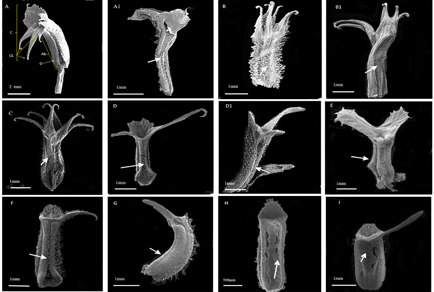
In this study, fruits characteristics of 17 species from 5 sections of the genus Valerianella from Iran were investigated using scanning electron microscopy (SEM). Multivariate analyses using unweighted pairwise groups with arithmetic mean (UPGMA) and principal component analysis (PCA) were performed to evaluate the potential contribution of variables in describing interspecific and intersectional relationships. The results showed a great diversity of micromorphological features especially the shape of calyx, ventral groove and achene, the epidermal cell shape, the anticlinal and outer periclinal layer, hair and hair papilla, wax sculpture and their epicuticular foldings. Furthermore, it has been noted that micromorphological characters have a major impact on the identification and taxonomy of Valerianella. An identification key based on the micromorphological characteristics of the fruits was presented. The results of multivariate analysis showed that the combined micro-macro morphological traits were able to identify the boundaries of the sections and define the relationships of the studied species.
References
- Akhavan Roofigar, A. & Bagheri, A. (2021) The floristic study of Golestankooh area in Isfahan Province, Iran. Nova Biologica Reperta 8 (1): 68–83. https://doi.org/10.29252/nbr.8.1.68
- Al-dabbagh, S.T. & Saeed, J.F. (2019) The phenetic study of distributed species of Valerianaceae Batsch family in Kurdistan Region-Iraq. Zanco Journal of Pure and Applied Sciences 31: 23–31. https://doi.org/10.21271/zjpas
- Al-Edhari, A.H., Al-Regawi, S., Sardar, A.S., Guda, M.A. & Almayahi, B. (2018) Morphological study for Valerianella kotschyi Boiss. and V. muricata (Stev.) Baxt. (Valerianaceae) in Kurdistan, Iraq. Plant Archive 18: 2417–2424.
- Andenberg, A.L. (1994) Atlas of seeds and small fruits of Northwest-European plant species with morphological descriptions. Resedaceae-Umbelliferae. Swedish Museum of Natural History, Stockholm, pp. 1–28.
- APG IV (2016) An update of the Angiosperm Phylogeny Group classification for the orders and families of flowering plants. Botanical Journal of the Linnean Society 181: 1–20. https://doi.org/10.1111/boj.12385
- Arnelas, I., Pérez-Collazos, E., López-Martínez, J., Devesa, J.A. & Catalán, P. (2022) Molecular Systematics of Valerianella Mill. (Caprifoliaceae): Challenging the Taxonomic Value of Genetically Controlled Carpological Traits. Plants 11: 1276. https://doi.org/10.3390/plants11101276
- Azadbakht, M. & Ghahremaninejad, F. (2023) Study of the Natural Flora of Hezar-Jarib Protected Area (Located in Mazandaran & Semnan Provinces, Iran). Taxonomy and Biosystematics 15 (2): 35–52. https://doi.org/10.22108/tbj.2023.138363.1238
- Barthlott, W. (1981) Epidermal and seed surface characters of plants: systematic applicability and some evolutionary aspects. Nordic Journal of Botany 1: 345–355.
- Barthlott, W., Mail, M., Bhushan, B. & Koch, K. (2017) Plant Surfaces: Structures and Functions for Biomimetic Innovations. Nano-Micro Letters 9: 23. https://doi.org/10.1007/s40820-016-0125-1
- Batsch, A.J.G.C. (1802) Tabula Affinitatum Regni Vegetabilis, quam delineavit, et nunc ulterius adumbratam tradit. Landes-Industrie Comptoir, Vinariae (Weimar), 286 pp.
- Baxter, W.H. (1850) A supplement to John Claudius Loudon's Hortus Britannicus. Loudon, 654 pp.
- Bell, C.D. (2007) Phylogenetic placement and biogeography of the North American species of Valerianella (Valerianaceae: Dipsacales) based on chloroplast and nuclear DNA. Molecular Phylogenetics and Evolution 44: 929–941. https://doi.org/10.1016/j.ympev.2007.03.013
- Bell, C.D., Calderon, G., Gonzalez, L., Scholz, A. & Liede-Schumann, S. (2015) Resolving relationships within Valerianaceae (Dipsacales): New insights and hypotheses from low-copy nuclear regions. Systematic Botany 40: 327–335. https://doi.org/10.1600/036364415X686611
- Bieberstein, F.M. & Dufr, A. (1811) History Natural Médicen. Family. Valérianaceae. 60 pp.
- Boissier, E. (1843) Diagnoses Plantarum Orientalium novarum, vol. 3. B. Herrmann, Lipsiae, 59 pp.
- Boissier, E. (1859) Diagnoses Plantarum Orientalium novarum, vol. 2. B. Herrmann, Lipsiae, 136 pp.
- Boissier, E. (1875) Flora Orientalis, vol 3. H. Georg, Genevae et Basileae, 1033 pp. https://doi.org/10.5962/bhl.title.20323
- Boissier, E. (1875) Flora Orientalis, vol 3. H. Georg, Genevae et Basileae, 95 pp.
- Boissier, E. (1875) Flora Orientalis, vol 3. H. Georg, Genevae et Basileae, 69 pp.
- Boisser, E. & Hohenacker, R.F. (1849) Diagnoses plantarum Orientalium novarum. Vol. 10. Lipsiae, 57 pp.
- Bojnanský, V. & Fargašová, A. (2007) Atlas of seeds and fruits Central and East-European flora, The Carpathian Mountains Region. Springer, Netherlands, pp. 1–961.
- Brullo, S., Tomaselli, V. & Wagensommer, R.P. (2015) A new species of Odontites (Orobanchaceae) from southern Italy. Phytotaxa 213 (3): 271–281. https://doi.org/10.11646/phytotaxa.213.3.7
- Candolle, A.P. de (1805) Valerianella. In: Lamarck, J.P. & Candolle, A.P. (Eds.) Flore francaise, 3rd ed., vol. 4. H. Agasse, Paris, pp. 421.
- Coode, M.J.E. & Matthew, V.A. (1972) Valerianella Miller. In: Davis, P.H. (Ed.) Flora of Turkey and East Aegean Islands, Vol. 4. Edinburg University Press, Edinburgh, pp. 559–581.
- Devesa, J.A. & López-Martínez, J. (2007) Valerianella Mill. In: Castroviejo, S., Aedo, C., Laínz Muñoz Garmendia, F., Nieto Feliner, G., Paiva, J. & Benedí, C. (Eds.) Flora iberica, Vol. 15. Real Jardín Botánico, CSIC, Madrid, pp. 233–258.
- Di Pietro, R., Di Marzio, P., Medagli, P., Misano, G., Silletti, G.N., Wagensommer, R.P. & Fortini, P. (2016) Evidence from multivariate morphometric study of the Quercus pubescens complex in southeast Italy. Botanica Serbica 40 (1): 83–100. https://doi.org/10.5281/zenodo.48865
- Dogru-koca, A., Zarei, G. & Cecen, O. (2016) Valerianella turcica (Caprifoliaceae), a new species from Turkye. Phytotaxa 272 (2): 157–164. https://doi.org/10.11646/phytotaxa.272.2.7
- Dowidar, A.E., Loutfy, M.H., Kamel, E.A., Ahamed, A.-H.M. & Hafez, H.H. (2003) Studies on the Rosaceae I. Seed and/or Achene macro and micromorphology. Pakistan Journal of Biological Sciences 6: 778–1791.
- Eggers-Ware, M.D. (1983) Genetic fruit polymorphism in North American Valerianella (Valerianaceae) and its taxonomic implications. Systematic Botany 8: 33–44.
- Ernet, D. (1978) Fruchtbau Und Verbreitungsbiologie von Valerianella Und Fedia (Valerianaceae)/Fruit morphology and dispersal biology of Valerianella and Fedia (Valerianaceae). Plant Systematics and Evolution 130: 85–126.
- Ernet, D. & Richardson, I.BK. (1976) Valerianella Mill. In: Tutin, T.G. (Ed.) Flora Europaea, Vol. 4. Cambridge University Press, Cambridge, UK, pp. 48–52.
- Faghir, M.B., Armudian, M. & Shahi Shavvon, R. (2015) Micro-macro morphology of the genus Geum L. (Rosaceae) in Iran and their taxonomic significance. Iranian Journal of Botany 21 (2): 103–117. https://doi.org/10.1111/jse.12243
- Faghir, M.B., Shamshiri, G. & Mehrmanesh, A. (2017) Micro morphological study of the tribe Agrimonieae family Rosaceae in Iran. Rostaniha 18: 198–209. https://doi.org/10.22092/botany.2018.115956
- Fischer, F.E. & Meyer, C.A. (1835) In: Index Semium (LE, Petropolitans) 2: 48.
- Fischer, F.E. & Meyer, C.A. (1835) In: Index Semium (LE, Petropolitans) 2: 51.
- Fischer, F.E. & Meyer, C.A. (1835) In: Index Semium (LE, Petropolitans) 2: 52.
- Fischer, F.E. & Meyer, C.A. (1835) In: Index Semium (LE, Petropolitans) 2: 53.
- Fischer, F.E. & Meyer, C.A. (1835) In: Index Semium (LE, Petropolitans) 2: 53.
- Fischer, F.E. & Meyer, C.A. (1835) In: Index Semium (LE, Petropolitans) 2: 263.
- Gaertner, J. (1970) De fructibus et seminibus plantarum 2: 36.
- Greger, H. & Ernet, D. (1973) Flavonoid-muster, systematik und evolution bei Valerianella. Phytochemistry 12: 1693–1699.
- Grime, J.P., Hodgson, J.G. & Hunt, R. (2014) Comparative plant ecology: a functional approach to comon British species. Springer.
- Govaerts, R. (2024) WCVP: World Checklist of Vascular Plants. Facilitated by the Royal Botanic Gardens, Kew. [https://powo.science.kew.org]
- Hasanzadeh, F., Kharazian, N. & Parishani, M.R. (2017) Floristic, Life Form, and Chorological Studies of Saldaran Protected Region, Chaharmahal and Bakhtiari Province, Iran Journal of Genetic Resources 3 (2): 113–129. https://doi.org/10.22080/jgr.2018.13639.1092
- Hidalgo, O., Mathez, J., Garcia, S., Garnatje, T., Pellice, J. & Valles, J. (2010) Genome size study in the Valerianaceae: first results and new hypotheses. Journal of Botany 2010: 797246. https://doi.org/10.1155/2010/797246
- Höck, F. (1901) Verwandtschaftsbeziehungen der Valerianaceen und Dipsacaceen. Botanische Jahrbücher für Systematik, Pflanzengeschichte und Pflanzengeographie 31 (3): 405–411.
- IPNI (2024) International Plant Name Index. Royal Botanical Garden, Kew, Harvard University Herbaria & Libraries and Australian National Herbarium. Available from: https://ipni.org/ (accessed 11 September 2024)
- Jacobs, B., Bell, C. & Smets, E. (2010) Fruits and seeds of the Valeriana clade (Dipsacales): Diversity and evolution. International Journal of Plant Science 171: 421–434. https://doi.org/10.1086/65124
- Judd, W.S., Campbell, C., Kellogg, E., Stevens, P. & Donoghue, M. (2008) Plant systematics: A phylogenetic approach, 3rd ed. Sinauer Associates, Sunderland, MA. [https://digitalcommons.library.umaine.edu/fac_monographs/76]
- Jussieu, A.L. de (1789) Genera Plantarum: Secundum Ordines Naturales Disposita, Juxta Methodum in Horto Regio Parisiensi Exaratam, Anno M. DCC. LXXIV. Herissant et Theophilum Barrois, Parisiis (Paris), 11, 498 pp.
- Karcz, J. (1996) Fruit micromorphology and anatomy of Valeriana officinalis s. str. (Valerianaceae). Nordic Journal of Botany 16 (4): 409–419. https://doi.org/10.1111/j.1756-1051.1996.tb00253.x
- Krok, T. (1864) Anteckningar till en monografi öfver våxtfamiljen Valerianeae: Valerianella, Hall. PA Norstedt & Söner.
- Kuntze, O. (1887) Trudy Glavnago Botanicheskago Sada, vol. 10. pp. 195.
- Linchevsky, I.A. (1958) Flora of the USSR. Bignoniaceae — Valerianaceae (Ed. Schischkin, B.K.), Genus Valerianella Mill., Vol. 23. Smithsonian Institution Libraries, Washington, pp. 642–681.
- Linnaeus, C. (1753) Species Plantarum, Valeriana, Stockholm, pp. 31.
- Linnaeus, C. (1753) Species Plantarum, Valeriana, Stockholm, pp. 33.
- Martin, A. & Mathez, J. (1991) Polymorphisme et taxinomie chez les Valerianaceae, quelques indications sur les Valerianelles proches de Valerianella coronata. Naturalia monspeliensia 55: 61–75. https://doi.org/10.11646/phytotaxa.272.2.7
- Meyer, C.A. (1831) In: Verzeichniss der Pflanzen Caucasus 49.
- Miller, P. (1754) The gardeners dictionary, vol. 3, 4th ed. John & James Rivington, London.
- Mirdavoodi, H.R., Marvi Mohadjer, M.R., Zahedi Amiri, F.H. & Etemad, V. (2013) Disturbance effects on plant diversity and invasive species in western oak communities of Iran (Case study: Dalab Forest, Ilam). Iranian Journal of Forest and Poplar Research 21 (1): 1–16. https://doi.org/10.22092/ijfpr.2013.3204
- Moench, C. (1794) Methodus Plantas Horti Botanici et Agri Marburgensis. Officina nova libraria academiae, Marburgi Cattarum, 368 pp. https://doi.org/10.5962/bhl.title.304
- Moussavi-Allashlou, E. (2001) Flora of Iran (Valerianaceae). Research Institute of Forests and Rangelands Publications, Tehran, 37: 15–56.
- Parnell, J. & Foley, C. (2000) Morphological variation in Valerianella (Valerianaceae) in Ireland. The Irish Naturalists' Journal 2000: 314–321.
- POWO (2024) Plants of the World online. Facilitated by the Royal Botanic Gardens, Kew. Available from: https://powo.science.kew.org/ (accessed 28 November 2024)
- Rechinger, K. (1969) Flora of the Iranian highlands and the surrounding mountains, Valerianaceae. Vol. 69. Akademische Druck- u. Verlagsanstalt Graz- Austria, pp. 2–27.
- Rechinger, K.H. & Wendelbo, P. (1976) Plants of the Kavir Protected Region, Iran, Iranian Journal of Botany 1: 23–56.
- Regel, E.A. & Schmalhausen, J.T. (1882) Izvestiya Imperatorskogo Obshchestva Lyubitelei Estestvoznaniya, Moskovskom Universitet´ 34 (2): 43.
- Sadeghi, S., Faghir, M.B., Attar, F. & ALaami, A. (2021) Achene micromorphology of the genus Potentilla L. (Rosaceae) in Iran and its systematic application. Turkish Journal of Botany 45: 15–42. https://doi.org/10.3906/bot-2007-24
- Sardar, A.S., Hussein, S.A.A. & Al-Dabbagh, S.T. (2015) Palynological Study of the Genus Valerianella Miller (Valerianaceae) in Kurdistan Region-Iraq. Journal of Zankoy Sulaimani-Part A 17: 171–178. https://doi.org/10.17656/jzs.10410
- Soyer-Willemet, H.F. Valerianella. In: Grenier, J.C.M. & Godron, D.A. (Eds.) Flore de France, vol. 2. J.B. Baillière, libraire de l'Académie.
- Stace, C. (1997) New Flora of the British Isles, edn 2. Cambridge University Press, Cambridge.
- Stevens, P.F (2017) Angiosperm Phylogeny Website. Available from: http://www.mobot.org/MOBOT/research/APweb/ (accessed 3 May 2022)
- Tsarenko, O., Shikhaleyeva, G., Minarchenko, V., Tymchenko, I. & Bulakh, O. (2021) Micromorphological Characteristics of Fruit Surfaces of Some Usable Species of the Genus Valeriana (Valerianaceae) Among Ukrainian Flora. Acta Agrobotanica 74 (7414): 1–15.
- Webb, D.A., Parnell, J. & Doogue, D. (1996) Irish Flora, 7th ed. Dundalgan Press, Dundalk.
- Weberling, F. (1970) Familie Valerianaceae. In: Wagenitz, G. (Ed.) Illustrierte Flora von Mitteleuropa. Cari Hanser, Munich, pp. 97–176.