
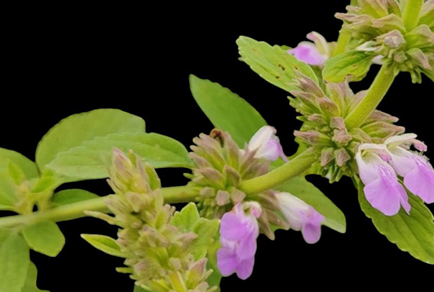

Abstract
A new species of Lamiaceae, Anisomeles tamilnadense, is described from Dindigul, Tamil Nadu, India. This species is closely related to A. indica and A. malabarica. However, several features differ, including the ovate-lanceolate and narrowly crenate leaf margin, coloured spathulate bracts, coloured calyx, <100 banded unpigmented corolla hairs and larger stigma lobes. This distinctive combination of traits allows to describe a new species within the genus, contributing to the better knowledge of the flora of the Indian subcontinent.
References
- Aluri, R.J.S. (1992) The Mint genus Anisomeles (Lamiaceae). Proceedings of the Indian National Science Academy 58: 387–393.
- Balkrishna, A., Kumar, A., Joshi, B., Srivastava, A., Arya, V., Mohammed, I. & Mishra, R. (2024) Anisomeles heyneana Benth. (Lamiaceae): A New Distributional Record for Bihar, India. Species 25: e35s1699. https://doi.org/10.54905/disssi.v25i76.e35s1699
- Bean, A.R. (2015) A taxonomic revision of Anisomeles R.Br. (Lamiaceae). Austrobaileya 9 (3): 321–381. https://doi.org/10.5962/p.299864
- Bendiksby, M., Thorbek, L., Scheen, A., Lindqvist, C. & Ryding, O. (2011) An updated phylogeny and classification of Lamiaceae subfamily Lamioideae. Taxon 60: 471–484. https://doi.org/10.1002/tax.602015
- Ben Mahmoud, K., Mezzapesa, G.N., Abdelkefi, F. & Perrino, E.V. (2024) Nutritional value and functional properties of an underexploited Tunisian wild beet (Beta macrocarpa Guss.) in relation to soil characteristics. Euro-Mediterranean Journal for Environmental Integration 9: 705–720. https://doi.org/10.1007/s41207-024-00468-5
- Bentham, G. (1830) Synopsis of the genera and species of Indian Labiatae enumerated in the Catlogue of the collections in Dr. Wallich’s charge. In: Wallich, N. (Ed.) Plantae Asiaticae Rariores 1. Treuttel & Würtz, London etc, pp. 28–31.
- Bentham, G. (1835) Labiatarum Genera et Species, Fasc. 7. James Ridgway and sons, Piccadilly, London, pp. 645–783.
- Bentham, G. (1848) Anisomeles. In: de Candolle, A.P. (ed.) Prodromus systematis naturalis regni vegetabilis, 12. Treuttel & Wurtz, Paris, pp. 455–457.
- Bhatti, G.R. & Ingrouille, M.J. (1996) The systematics of Anisomeles R.Br. (Lamiaceae). Fontqueria 44: 77–84.
- Brown, R. (1810) [1960 fascimile]. Prodromus Flora Novae Hollandiae et Insulae Van Diemen. J. Cramer: New York.
- Brullo, S., Tomaselli, V. & Wagensommer, R.P. (2015) A new species of Odontites (Orobanchaceae) from southern Italy. Phytotaxa 213 (3): 271–281. https://doi.org/10.11646/phytotaxa.213.3.7
- Chen, Y.-P., Huang, C.-Z., Zhao, Y. & Xiang, C.-L. (2021) Molecular and morphological evidence for a new species of Isodon (Lamiaceae) from southern China. Plant Diversity 43 (1): 54–62. https://doi.org/10.1016/j.pld.2020.06.004
- Di Pietro, R., Di Marzio, P., Medagli, P., Misano, G., Silletti, G.N., Wagensommer, R.P. & Fortini, P. (2016) Evidence from multivariate morphometric study of the Quercus pubescens complex in southeast Italy. Botanica Serbica 40 (1): 83–100. https://doi.org/10.5281/zenodo.48865
- Gamba, D. & Muchhala, N. (2023) Pollinator type strongly impacts gene flow within and among plant populations for six Neotropical species. Ecology 104 (1): e3845. https://doi.org/10.1002/ecy.3845
- Govaerts, R. (1995) World Checklist of Seed Plants 1 (1, 2). MIM, Anversa (Deurne).
- Govaerts, R. (2003) World Checklist of Selected Plant Families Database. The Board of Trustees of the Royal Botanic Gardens, Kew, 216203 pp.
- Harley, R.M., Atkins, S., Budantsev, A.L., Cantino, P.D., Conn, B.J., Grayer, R., Harley, M.M., Kok, R.P.J. de, Krestovskaja, T., Morales, R., Paton, A.J., Ryding, O. & Upson, T. (2004) Labiatae. In: Kubitzki, K. (ed.) The Families and Genera of Vascular Plants VI. pp. 167–275. https://doi.org/10.1007/978-3-642-18617-2_11
- IUCN (2024) Guidelines for Using the IUCN Red List Categories and Criteria. Version 16. IUCN Standards and Petitions Committee. Available from: https://www.iucnredlist.org/documents/RedListGuidelines.pdf (accessed 13 June 2025)
- Jin, G.-Z., Sheludyakova, M., Abduraimov, O., Feng, Y. & Ge, X.-J. (2025) A taxonomic revision of Artemisia subgenus Seriphidium (Asteraceae—Anthemideae) in China. Phytotaxa 686 (1): 1–103. https://doi.org/10.11646/phytotaxa.686.1.1
- Kumar, V.S., Banerjee, S., Singh, V., Pandey, R.P., Sunojkumar, P. & Lodh, P. (2020) Labiatae. Flowering Plants of India: An Annotated Checklist, Dicotyledons 2: 334–379.
- Kuntze, C.E.O. (1891) Revisio Generum Plantarum 2. pp. 512.
- Perrino, E.V., Wagensommer, R.P., Mezzapesa, G.N. & Trani, A. (2024) Stachys italica Mill.: synecology, functional compounds and potential use of an Italian endemic taxon. Planta 260: 138. https://doi.org/10.1007/s00425-024-04571-3
- POWO (2025) Plants of the World Online. Facilitated by the Royal Botanic Gardens, Kew. Published on the Internet; Available from: https://powo.science.kew.org/ (accessed 24 March 2025)
- Rajakumar, T.J.S., Selvakumari, R. & Murugesan, S. (2014) Anisomeles tirunelveliensis—A New Species of Lamiaceae from Tirunelveli District, Tamil Nadu, India. Indian Journal of Forestry 37 (4): 423–424. https://doi.org/10.54207/bsmps1000-2014-BV2IJS
- Scheen, A.C., Bendiksby, M., Ryding, O., Mathiesen, C., Albert, V.A. & Lindqvist, C. (2010) Molecular phylogenetics, character evolution, and suprageneric classification of Lamioideae (Lamiaceae) 1. Annals of the Missouri Botanical Garden 97 (2): 191–217. https://doi.org/10.3417/2007174
- Sims, J. (1819) Anisomeles malabarica, Malabar Anisomeles. Botanical Magazine 46: t. 2071.
- Subramanyam, K. & Henry, A.N. (1969) Proposal to Conserve the Generic Name 7284. Anisomeles R.Br. (1810) against Epimeredi Adans. (1763) [Labiatae]. Taxon 298: 595–596. https://doi.org/10.2307/1218410
- Thoppil, J.E. & Jose, J. (1998) Chromosome configuration and evolution of base numbers in Anisomeles R.Br. (Lamiaceae). Glimpses in Plant Research 12: 173–177.
- Uikey, J. (2024) Reviewing of plant belonging to Lamiaceae family. International Journal of Scientific Development and Research 9: 186–191. https://doi.org/10.5281/zenodo.13309903
- Xue, B., Wang, G.T., Zhou, X.X., Huang, Y., Tong, Y., Li, Y. & Chen, J. (2021) Artabotrys pachypetalus (Annonaceae), a new species from China. PhytoKeys 178: 71–80. https://doi.org/10.3897/phytokeys.178.64485