

Abstract
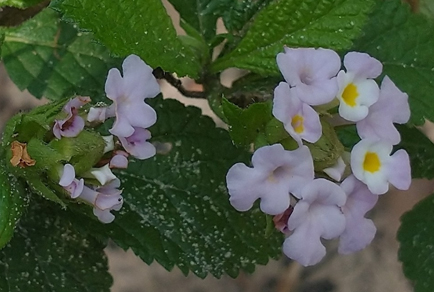
Despite their non-monophyletic status under current circumscriptions, Lantana and Lippia (Lantaneae, Verbenaceae) remain traditionally distinguished by fruit morphology. The former exhibits drupes with a single pyrene, while the second bears schizocarps that split into two cluses or drupaceous fruits with two pyrenes. While examining herbarium collections from Brazil, we discovered a new species of Lantaneae characterized by the unique combination of the following traits: leaf blades with margins entire near the base or up the middle and conspicuously dentate towards the apex, abaxial surfaces covered with abundant sessile glandular trichomes and strigose along the veins, bracts with attenuate or aristate apices, lilac or white corollas lacking eglandular trichomes externally, densely sericeous ovaries, and drupaceous fruits with a pilose external surface. We describe this species as Lippia carrascoana, endemic to the Caatinga domain in the states of Ceará, Pernambuco, and Piauí. It grows in carrasco vegetation on dystrophic red-yellow latosols, at elevations between 500 and 830 m. Although Lippia carrascoana has been collected since 1978, its specimens were either misidentified or identified only at the generic level as Lantana sp. or Lippia sp. The detailed description of the new species is accompanied by illustrations, distribution notes, an occurrence map, as well as comparisons with similar species (Lantana restingensis, Lippia brasiliensis, Lippia magentea, Lippia maximilianii), and some species that, despite being morphologically distinct, have been involved in past misidentifications (Lantana camara, Lantana canescens, Lantana fucata). A preliminary conservation status assessment suggests that Lippia carrascoana qualifies as Endangered (EN).
References
- Albuquerque, U.P., Araújo, E.L., El-Deir, A.C.A., Lima, A.L.A., Souto, A., Bezerra, B.M., Ferraz, E.M.N., Freire, E.M.X., Sampaio, E.V.S.B., Las-Casas, F.M.G., Moura, G.J.B., Pereira, G.A., Melo, J.G., Ramos, M.A., Rodal, M.J.N., Schiel, N., Lyra-Neves, R.M., Alves, R.R.N., Azevedo-Júnior, S.M., Telino Júnior, W.R. & Severi, W. (2012) Caatinga revisited: ecology and conservation of an important seasonal dry forest. The Scientific World Journal 2012: 205182. https://doi.org/10.1100/2012/205182
- Antongiovanni, M., Venticinque, E.M. & Fonseca, C.R. (2018) Fragmentation patterns of the Caatinga drylands. Landscape Ecology 33: 1353–1367. https://doi.org/10.1007/s10980-018-0672-6
- Araújo, F.S. & Martins, F.R. (1999) Fisionomia e organização de vegetação do Carrasco no Planalto da Ibiapaba, Estado do Ceará. Acta Botanica Brasilica 13: 1–13. https://doi.org/10.1590/S0102-33061999000100002
- Araújo, F.S. DE, Costa, R.C. DA, Lima, J.R., Vasconcelos, S.F., Girão, L.C., Sobrinho, M.S., Bruno, M.M.A., Nunes, E.P., Souza, S.S.G., Figueiredo, M.A., Lima-Verde, L.W. & Loiola, M.I.B. (2011) Floristics and life-forms along a topographic gradient, central-western Ceará, Brazil. Rodriguésia 62: 341–366. https://doi.org/10.1590/2175-7860201162210
- Atkins, S. (2004) Verbenaceae. In: Kubitzki, K. & Kadereit, J.W. (Eds.) The families and Genera of Vascular Plants. Vol. 7. Springer-Verlag, Berlin, pp. 449–468. https://doi.org/10.1007/978-3-642-18617-2_25
- Bachman, S., Moat, J., Hill, A.W., de la Torre, J. & Scott, B. (2011) Supporting Red List threat assessments with GeoCAT: geospatial conservation assessment tool. ZooKeys 150: 117–126. https://doi.org/10.3897/zookeys.150.2109
- Beentje, H. (2010) The Kew Plant Glossary, an illustrated dictionary of plant terms. Kew Publishing, London, Royal Botanic Gardens, 160 pp.
- Bezerra, C.L.F., Trigueiro, E.R.C., Castro, A.A.J.F. & Castro, A.S.F. (2003) Survey of the Vegetation in the State of Ceará. In: Gaiser, T., Krol, M., Frischkorn, H. & de Araújo, J.C. (Eds.) Global change and regional impacts: water availability and vulnerability of ecosystems and society in the semiarid northeast of Brazil. Springer, Berlin, Heidelberg, pp. 105–116. https://doi.org/10.1007/978-3-642-55659-3_9
- Britton, N.L. & Wilson, P. (1925) Botany of Porto Rico and the Virgin Islands: descriptive flora – Spermatophyta. In: Scientific survey of Porto Rico and the Virgin Islands. Volume 6, parts 1 & 2. New York Academy of Sciences, New York, pp. 1–316.
- Cardoso, P.H., Menini Neto, L. & Salimena, F.R.G. (2019) A new species of Lippia (Verbenaceae) from the inselbergs of Brazilian Atlantic Forest. Phytotaxa 243: 243–249. https://doi.org/10.11646/phytotaxa.406.4.3
- Cardoso, P.H., Valério, V.I.R., Menini Neto, L., Trovó, M. & Salimena, F.R.G. (2020) Novelties in Lippia (Verbenaceae) from Minas Gerais State, Brazil. Phytotaxa 455: 47–52. https://doi.org/10.11646/phytotaxa.455.1.6
- Cardoso, P.H., O’Leary, N., Olmstead, R.G., Moroni, P. & Thode, V. (2021a) An update of the Verbenaceae genera and species numbers. Plant Ecology and Evolution 154: 80–86. https://doi.org/10.5091/10.5091/plecevo.2021.1821
- Cardoso, P.H., Menini Neto, L., Trovó, M. & Salimena, F.R.G. (2021b) Checklist and a new species of Lippia (Verbenaceae) from the Diamantina Plateau, Minas Gerais, Brazil. European Journal of Taxonomy 733: 42–55. https://doi.org/10.5852/ejt.2021.733.1211
- Cardoso, P.H., Valerio, V.I.R., Menini Neto, L. & Salimena, F.R.G. (2021c) Verbenaceae in Espírito Santo, Brazil: richness, patterns of geographic distribution, and conservation. Phytotaxa 484: 1–43. https://doi.org/10.11646/phytotaxa.484.1.1
- Cardoso, P.H., Silva, G.B., Melo, P.H.A., Salimena, F.R.G. & Silva, T.R.S. (2025) Lantana calcicola: a new and threatened Verbenaceae species from Lajedão, a limestone outcrop in northern Minas Gerais state, Brazil. Phytotaxa 690: 107–115. https://doi.org/10.11646/phytotaxa.690.1.9
- Chamisso, L.K.A. (1832) Verbenaceae. Linnaea 7: 105–723.
- Claudino-Sales, V., Lima, E.C., Diniz, S.F. & Cunha, F.S.S. (2020) Megageomorfologia do Planalto da Ibiapaba, estado do Ceará: uma Introdução. William Morris Davis -Revista de Geomorfologia 1: 186–209. https://doi.org/10.48025/ISSN2675-6900.v1n1.p186-209.2020
- de Queiroz, K. (2007) Species concepts and species delimitation. Systematic Biology 56: 879–886. https://doi.org/10.1080/10635150701701083
- Endlicher, S.L. (1838) Verbenaceae. In: Genera Plantarum Secundum Ordines Naturales Disposita 8. F. Beck, Vienna, pp. 561–635.
- Gonçalves, E.G. & Lorenzi, H. (2007) Morfologia vegetal: organografia e dicionário ilustrado de morfologia das plantas vasculares. Instituto Plantarum, Nova Odessa, 416 pp.
- Goodwin, Z.A., Harris, D.J., Filer, D., Wood, J.R. & Scotland, R.W. (2015) Widespread mistaken identity in tropical plant collections. Current biology 25: R1066–R1067. https://doi.org/10.1016/j.cub.2015.10.002
- Harris, J.G. & Harris, M.W. (2003) Plant identification terminology: an illustrated glossary. 2nd ed. Spring Lake Publ., Spring Lake, 216 pp.
- IUCN (2012) IUCN Red List categories and criteria. Version 3.1. Second edition. Gland and Cambridge, IUCN Press. Available from: https://www.iucnredlist.org/resources/categories-and-criteria (accessed 8 January 2025)
- IUCN Standards and Petitions Subcommittee (2024) Guidelines for Using the IUCN Red list Categories and Criteria. Version 15.1. Prepared by the Standards and Petitions Subcommittee. Available from: http://www.iucnredlist.org/documents/RedListGuidelines.pdf (accessed February 2025)
- Kunth, K.S. (1818 [1817]) Verbenaceae. In: Humboldt, F.W.H.A. & Bonpland, A.J.A. (Eds.) Nova genera et species plantarum (quarto ed.) 2. Librariae Graeco-Latini-Germanicae, Paris, pp. 244–285.
- Leal, I.R., Da Silva, J.M.C., Tabarelli, M. & Lacher Jr., T.E. (2005) Changing the course of biodiversity conservation in the Caatinga of northeastern Brazil. Conservation Biology 19: 701–706. https://doi.org/10.1111/j.1523-1739.2005.00703.x
- Lima, S.S., Cordeiro, J.L., Teixeira, L.P., Maia, R.P., Silva, M.V.C. & Moro, M.F. (2022a) Caracterização geográfica e dinâmica de uso da terra da Ibiapaba e seu entorno, Domínio Fitogeográfico da Caatinga. Revista Brasileira de Geografia Física 15: 2500–2524. https://doi.org/10.26848/rbgf.v15.5.p2500-2524
- Lima, I.G., Santos, L.R., Costa, I.R. & Bünger, M. (2022b) Eugenia nordestina (Myrteae, Myrtaceae), a new endemic species from the Septentrional Northeast of Brazil. Phytotaxa 545: 115–120. https://doi.org/10.11646/phytotaxa.545.1.11
- Lindley, J. (1824) Miscellaneous matter. Edwards’s Botanical register 10: 778–867.
- Linnaeus, C. (1753) Species Plantarum 2. L. Salvius, Stockholm, pp. 561–1200.
- Loiola, M.I.B. (2013) A new species of Erythroxylum (Erythroxylaceae) from the Brazilian semiarid region. Phytotaxa 150: 61–64. https://doi.org/10.11646/phytotaxa.150.1.5
- Lu-Irving, P. & Olmstead, R.G. (2013) Investigating the evolution of Lantaneae (Verbenaceae) using multiple loci. Botanical Journal of the Linnean Society 171: 103–119. https://doi.org/10.1111/j.1095-8339.2012.01305.x
- Lu-Irving, P., Bedoya, A.M., Salimena, F.R., Silva, T.R.S., Viccini, L.F., Bitencourt, C., Thode, V.A., Cardoso, P.H., O’Leary, N. & Olmstead, R.G. (2021) Phylogeny of Lantana, Lippia, and related genera (Lantaneae: Verbenaceae). American Journal of Botany 108: 1354–1373. https://doi.org/10.1002/ajb2.1708
- Mendez-Santos, I. (2002) A taxonomic revision of Lantana sect. Lantana (Verbenaceae) in the Greater Antilles. Willdenowia 32: 285–301. https://doi.org/10.3372/wi.32.32210
- Miller, P. (1768) The gardeners dictionary 8th edition. P. Miller, London, pages not numbered. https://doi.org/10.5962/bhl.title.541
- Mirra, F., Moroni, P., Egea, J. & O’Leary, N. (2024) Taxonomic Revision of Lippia in Paraguay. Annals of the Missouri Botanical Garden 109: 428–489. https://doi.org/10.3417/2024926
- Moldenke, H.N. (1940) Contributions to the flora of extra-tropical South America I. Lilloa 5: 403–424.
- Moldenke, H.N. (1965a) Materials towards a monograph of the genus Lippia I. Phytologia 12: 6–72. https://doi.org/10.5962/bhl.part.10347
- Moldenke, H.N. (1965b) Materials towards a monograph of the genus Lippia II. Phytologia 12: 73–120. https://doi.org/10.5962/bhl.part.10343
- Moldenke, H.N. (1965c) Materials towards a monograph of the genus Lippia III. Phytologia 12: 130–181. https://doi.org/10.5962/bhl.part.10347
- Moldenke, H.N. (1965d) Materials towards a monograph of the genus Lippia IV. Phytologia 12: 187–242. https://doi.org/10.5962/bhl.part.10347
- Moldenke, H.N. (1965e) Materials towards a monograph of the genus Lippia V. Phytologia 12: 252–311. https://doi.org/10.5962/bhl.part.10347
- Moldenke, H.N. (1965f) Materials towards a monograph of the genus Lippia VI. Phytologia 12: 331–367. https://doi.org/10.5962/bhl.part.10347
- Moldenke, H.N. (1965g) Materials towards a monograph of the genus Lippia VII. Phytologia 12: 429–464. https://doi.org/10.5962/bhl.part.10350
- Moldenke, H.N. (1966a) Materials towards a monograph of the genus Lippia VIII. Phytologia 12: 480–506. https://doi.org/10.5962/bhl.part.10347
- Moldenke, H.N. (1966b) Materials towards a monograph of the genus Lippia IX. Phytologia 13: 1–35. https://doi.org/10.5962/bhl.part.21843
- Moldenke, H.N. (1966c) Materials towards a monograph of the genus Lippia X. Phytologia 13: 162–167. https://doi.org/10.5962/bhl.part.21843
- Moldenke, H.N. (1966d) Materials towards a monograph of the genus Lippia XI. Phytologia 13: 169–179. https://doi.org/10.5962/bhl.part.21843
- Moldenke, H.N. (1970) Further new combination and varieties of Verbenaceae. Phytologia 19: 435.
- Moldenke, H.N. (1983) New and noteworthy plants CLXVIII. Phytologia 53: 460–461. https://doi.org/10.5962/bhl.part.16812
- Moro, M.F., Nic Lughadha, E., Filer, D.L., Araújo, F.S. DE & Martins, F.R. (2014) A catalogue of the vascular plants of the Caatinga Phytogeographical Domain: a synthesis of floristic and phytosociological surveys. Phytotaxa 160: 1–118. https://doi.org/10.11646/phytotaxa.160.1.1
- Moro, M.F., Araújo, F.S., Rodal, M.J.N. & Martins, F.R. (2015a) Síntese dos estudos florísticos e fitossociológicos realizados no semiárido brasileiro. In: Eisenlohr, P.V., Felfili, J.M., Melo, M.M.R.F., Andrade, L.A. & Meira Neto, J.A.A. (Eds.) Fitossociologia no Brasil: métodos e estudos de caso, Vol. 2. Editora da Universidade Federal de Viçosa, Viçosa, pp. 412–451.
- Moro, M.F., Macedo, M.B., Moura-Fé, M.M.D., Castro, A.S.F. & Costa, R.C.D. (2015b) Vegetação, unidades fitoecológicas e diversidade paisagística do estado do Ceará. Rodriguésia 66: 717–743. https://doi.org/10.1590/2175-7860201566305
- Moro, M.F., Amorim, V.O., de Queiroz, L.P., Costa, L.R.F., Maia, R.P., Taylor, N.P. & Zappi, D.C. (2024) Biogeographical districts of the Caatinga dominion: a proposal based on geomorphology and endemism. The Botanical Review 90: 376–429. https://doi.org/10.1007/s12229-024-09304-5
- Múlgura de Romero, M.E. (2000) The species of Lippia L. sect. Dioicolippia Tronc. (Verbenaceae). Candollea 55: 227–254.
- Múlgura, M.E., O’Leary, N. & Rotman, A. (2012) Dicotyledonae. Verbenaceae. In: Anton, A.M. & Zuloaga, F.O. (Eds.) Flora Argentina 14. Estudio Sigma, Buenos Aires, pp. 1–220.
- O’Leary, N., Denham, S.S., Salimena, F. & Múlgura, M.E. (2012) Species delimitation in Lippia section Goniostachyum (Verbenaceae) using the phylogenetic species concept. Botanical Journal of the Linnean Society 170: 197–219. https://doi.org/10.1111/j.1095-8339.2012.01291.x
- O’Leary, N., Lu‐Irving, P., Moroni, P., Salimena, F.R., Silva, T.R.S., Cardoso, P.H., Mirra, F., Schaefer, J., Bedoya, A.M., Viccini, L.F., Bitencourt, C., Thode, V.A. & Olmstead, R.G. (2023) Making Lantaneae (Verbenaceae) taxonomy useful: a phylogenetic classification. Taxon 72: 572–589. https://doi.org/10.1002/tax.12934
- Rotman, A.D. (2009) El género Lantana L. (Verbenaceae-Verbenoideae) en Paraguay: sinopsis y novedades. Candollea 64: 297–301.
- Rusby, H.H. (1896) An enumeration of the plants collected in Bolivia by Miguel Bang.–III. Memoirs of the Torrey Botanical Club 6: 1–130.
- Salimena, F.R.G. & Cardoso, P.H. (2025) Lippia. In: Flora e Funga do Brasil. Jardim Botânico do Rio de Janeiro. Available from: https://floradobrasil.jbrj.gov.br/FB15170 (accessed 6 February 2025)
- Sanders, R.W. (2006) Taxonomy of Lantana sect. Lantana (Verbenaceae): I. correct application of Lantana camara and associated names. SIDA, Contributions to Botany 22: 381–421.
- Sanders, R.W. (2012) Taxonomy of Lantana sect. Lantana (Verbenaceae): II. Taxonomic revision. Journal of the Botanical Research Institute of Texas 6: 403–441.
- Santos, D., Alencar, J., Bezerra Loiola, M.I. & Buril, M.T. (2020) Ipomoea bonsai (Convolvulaceae), a magnificent new species from the Caatinga domain, Brazil. Systematic Botany 45: 652–657. https://doi.org/10.1600/036364420X15935295449907
- Santos, D., Souza, E.B. & Buril, M.T. (2021) Ipomoea lanifolia sp. nov. (Convolvulaceae), a new species endemic to the Ibiapaba plateau in northeastern Brazil. Rodriguésia 72: e00782020. https://doi.org/10.1590/2175-7860202172076
- Santos Filho, L.G.D., Reis, R.B., Souza, A.S.Q., Canuto, K.M., Brito, E.S., Castro, K.N. & Diniz, F.M. (2023) Chemical composition and biological activities of the essential oils from Lippia alba and Lippia origanoides. Anais da Academia Brasileira de Ciências 95: e20220359. https://doi.org/10.1590/0001-3765202320220359
- Schauer, J.C. (1847) Verbenaceae. In: De Candolle, A.P. (Ed.) Prodromus systematis naturalis regni vegetabilis 11. Treuttel & Würtz, Paris, pp. 522–700.
- Silva, T.R.S. (1999) Redelimitação e revisão do gênero Lantana L. (Verbenaceae) no Brasil. Universidade de São Paulo, São Paulo, 175 pp.
- Silva, T.R.S. (2001) Lippia magentea, a new species of Verbenaceae from Brazil. Novon 11: 472–474. https://doi.org/10.2307/3393162
- Silva, T.R.S. & Salimena, F.R.G. (2002) Novas combinações e novos sinônimos em Lippia e Lantana (Verbenaceae). Darwiniana 40: 57–59.
- Silva, T.R.S., Salimena, F.R.G. & Lima, C.T. (2017) Two new species of Lantana (Verbenaceae) from Brazil. Phytotaxa 299: 125–131. https://doi.org/10.11646/phytotaxa.299.1.11
- Silva, T.R.D.S., Schaefer, J. & Silva, G.B. (2025) Lantana. In: Flora e Funga do Brasil. Jardim Botânico do Rio de Janeiro. Available from: https://floradobrasil.jbrj.gov.br/FB15163 (accessed 25 January 2025)
- Silva, H.N.P., Carvalho, B.C.F., Maia, J.L.S., Becker, A.G., Baldisserotto, B., Heinzmann, B.M., Mourão, R.H.V. & Silva, L.V.F. (2019) Anesthetic potential of the essential oils of Lippia alba and Lippia origanoides in Tambaqui juveniles. Ciência Rural 49: e20181059. https://doi.org/10.1590/0103-8478cr20181059
- Teixeira, L.P., Lughadha, E.N., Silva, M.V.C.D. & Moro, M.F. (2021) How much of the Caatinga is legally protected? An analysis of temporal and geographical coverage of protected areas in the Brazilian semiarid region. Acta Botanica Brasilica 35: 473–485. https://doi.org/10.1590/0102-33062020abb0492
- Turland, N.J., Wiersema, J.H., Barrie, F.R., Greuter, W., Hawksworth, D.L., Herendeen, P.S., Knapp, S., Kusber, W.-H., Li, D.-Z., Marhold, K., May, T.W., McNeill, J., Monro, A.M., Prado, J., Price, M.J. & Smith, G.F. (2018) International Code of Nomenclature for algae, fungi, and plants (Shenzhen Code) adopted by the Nineteenth International Botanical Congress Shenzhen, China, July 2017. Regnum Vegetabile 159. Koeltz Botanical Books, Glashütten. https://doi.org/10.12705/Code.2018
- Vasconcelos, S.F., Araújo, F.S. & Lopes, A.V. (2010) Phenology and dispersal modes of wood species in the Carrasco, a tropical deciduous shrubland in the Brazilian semiarid. Biodiversity and Conservation 19: 2263–2289. https://doi.org/10.1007/s10531-010-9841-x
- Zavatin, D.A., Ramos, R., Salimena, F.R.G. & Cardoso, P.H. (2024) A new species of Lippia (Verbenaceae) from the Espinhaço Range, Minas Gerais, Brazil. Acta Botanica Brasilica 38: e20240024. https://doi.org/10.1590/1677-941x-abb-2024-0024