

Abstract
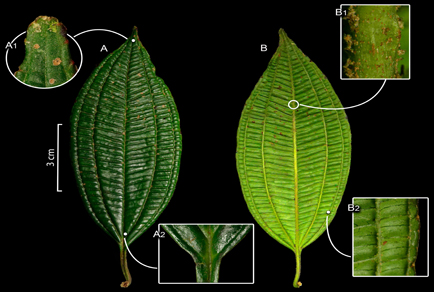
Blakea longiloba has been known only from the southern region of Colombia. During botanical explorations in Ecuador, we have encountered more populations of this species which are reported here. The new records extend the known geographic range of B. longiloba by 500 km south of the previously documented southernmost locality. In addition, the new records help to improve the taxonomic circumscription of the species. We therefore provide an updated and expanded description, a Lankester Composite Digital Plate (LCDP), information on its ecology, phenology, etymology, distribution, conservation status, and taxonomic affinities.
References
- Almeda, F. (1999) New species and new combinations in Blakea and Topobea (Melastomataceae), with an historical perspective on generic limits in the Tribe Blakeeae. Proceedings of the California Academy of Sciences 46 (14): 299–326.
- Almeda, F. (2000) A synopsis of the genus Blakea (Melastomataceae) in Mexico and Central America. Novon 10 (4): 299–319. https://doi.org/10.2307/3392974
- Almeda, F. (2013) A new epiphytic species of Blakea (Melastomataceae: Blakeeae) from the Caribbean Rainforest of Costa Rica. Selbyana 31 (1): 1–4.
- Almeda, F., Mendoza-Cifuentes, H., Penneys, D.S., Michelangeli, F.A. & Alvear, M. (2016) Melastomataceae. In: Bernal, R., Gradstein, S.R. & Celis, M. (Eds.) Catálogo de Plantas y Líquenes de Colombia (Vol. II). Instituto de Ciencias Naturales, Universidad Nacional de Colombia, Bogotá, Colombia. [http://catalogoplantasdecolombia.unal.edu.co]
- Almeda, F. & Penneys, D.S. (2018) Blakea echinata (Melastomataceae: Blakeeae): a new species from the Caribbean rainforest of Panama. Phytotaxa 372 (1): 104–110. https://doi.org/10.11646/phytotaxa.647.2.5
- Aublet, F. (1775) Histoire des plantes de la Guiane Françoise: rangées suivant la méthode sexuelle, avec plusiers mémoires sur différens objets intéressans, relatifs à la culture & au commerce de la Guiane Françoise, & une notice des plantes de l’Isle-de-France. (Vol. 1). PF Didot jeune, London, 476 pp. https://doi.org/10.5962/bhl.title.48831
- Bachman, S., Moat, J., Hill, A., De La Torre, J. & Scott, B. (2011) Supporting Red List threat assessments with GeoCAT: Geospatial conservation assessment tool. ZooKeys 150: 117–126. https://doi.org/10.3897/zookeys.150.2109
- Baillon, H.E. (1877) Histoire des Plantes VII. Paris, France, 7 pp.
- Browne, P. (1756) The civil and natural history of Jamaica in three parts. Browne, London, 323 pp.
- Cotton, E. & Matezki, S. (2003) Ecuadorian novelties in Blakea and Topobea (Melastomataceae). Brittonia 55 (1): 73–81. https://doi.org/10.1663/0007-196X(2003)055[0073:ENIBAT]2.0.CO;2
- Hewson, H. (2019) Plant indumentum: A handbook of terminology. Australian Gov. Publ. Service.
- IUCN. (2024) IUCN Red List Categories and Criteria: Version 16. Prepared by the Standards and Petitions Committee. Available from: https://www.iucnredlist.org/documents/RedListGuidelines.pdf (accessed 1 September 2024)
- Fernández-Fernández, D., Ulloa, C.U. & Penneys, D.S. (2016) A new species of Blakea (Blakeeae, Melastomataceae) from Ecuador. Phytotaxa 284 (1): 69–74. https://doi.org/10.11646/phytotaxa.284.1.7
- Fernandez-Hilario, R., Pillaca-Huacre, L., Villanueva-Espinoza, R., Riva-Regalado, S., González, R.R., Goldenberg, R. & Michelangeli, F.A. (2024) Taxonomic and chronological novelties in Blakea (Melastomataceae: Pyxidantheae) from Peru with a list of species for the country. Phytotaxa 635 (1): 1–42. https://doi.org/10.11646/phytotaxa.635.1.1
- Gleason, H.A. (1925) Studies on the flora of Northern South America - VIII. Bulletin of the Torrey Botanical Club 52 (8): 441–460. https://doi.org/10.2307/2480407
- Gleason, H.A. (1945) On Blakea and Topobea. Bulletin of the Torrey Botanical Club 72 (4): 385–393. https://doi.org/10.2307/2481538
- Judd, W.S., Majure, L.C., Michelangeli, F.A., Goldenberg, R., Almeda, F., Penneys, D.S. & Stone, R.D. (2022) Morphological variability within the Melastomataceae (Myrtales), including a discussion of the associated terminology. In: Goldenberg, R., Michelangeli, F.A. & Almeda, F. (Eds.) Systematics, Evolution, and Ecology of Melastomataceae. Springer, Cham, pp. 45–85. https://doi.org/10.1007/978-3-030-99742-7_3
- Lumer, C. (1980) Rodent pollination of Blakea (Melastomataceae) in a Costa Rican cloud forest. Brittonia 32: 512–517. https://doi.org/10.2307/2806163
- Markgraf, F. (1927) Plantae Steinbachianae II. Notizblatt des Königl. botanischen Gartens und Museums zu Berlin 9: 1146. https://doi.org/10.2307/3994447
- Penneys, D.S. & Almeda, F. (2022) An overview of Pyxidantheae (Melastomataceae). In: Goldenberg, R., Michelangeli, F.A. & Almeda, F. (Eds.) Systematics, Evolution, and Ecology of Melastomataceae. Springer Charm., pp. 291–305. https://doi.org/10.1007/978-3-030-99742-7_13
- Penneys, D.S. & Jost, L. (2009) Blakea attenboroughii (Melastomataceae: Blakeeae): a new species from Ecuador. Proceedings of the California Academy of Sciences 60 (1): 69–72.
- Penneys, D.S. & Judd, W.S. (2011) Phylogenetics and morphology in the Blakeeae (Melastomataceae). International Journal of Plant Sciences 172 (1): 78–106. https://doi.org/10.1086/657284
- Penneys, D.S. & Judd, W.S. (2013a) A revised circumscription for the Blakeeae (Melastomataceae) with associated nomenclatural adjustments. PhytoKeys 20: 17–32. https://doi.org/10.3897/phytokeys.20.4344
- Penneys, D.S. & Judd, W.S. (2013b) Combined molecular and morphological phylogenetic analyses of the Blakeeae (Melastomataceae). International Journal of Plant Sciences 174 (5): 802–817. https://doi.org/10.1086/670011
- Thiers, B. (2024) Index Herbariorum: a global directory of public herbaria and associated staff. New York Botanical Garden’s virtual herbarium. Available from: http://sweetgum.nybg.org/ih/ (accessed 18 September 2024)
- Triana, J.J. (1871) Les Mélastomacées. Transactions of the Linnean Society of London 28: 1–188. https://doi.org/10.1111/j.1096-3642.1871.tb00222.x
- Ulloa Ulloa, C., Almeda, F., Goldenberg, R., Kadereit, G., Michelangeli, F.A., Penneys, D.S., Douglas, R. & Veranso-Libalah, M.C. (2022) Melastomataceae: global diversity, distribution, and endemism. In: Goldenberg, R., Michelangeli, F.A. & Almeda, F. (Eds.) Systematics, Evolution, and Ecology of Melastomataceae. Springer, Cham, pp. 3–28. https://doi.org/10.1007/978-3-030-99742-7_1
- Urrea, J., Mendoza-Cifuentes, H. & García, N. (2023) Novedades taxonómicas y sinopsis del género Blakea (Melastomataceae, Pyxidantheae) en la Cordillera Oriental, Colombia. Acta Botanica Mexicana 130: e2172. https://doi.org/10.21829/abm130.2023.2172
- Wurdack, J.J. (1957) Certamen Melastomataceis V. Phytologia 6 (1): 1–11. https://doi.org/10.5962/bhl.part.9768
- Wurdack, J.J. (1976) Atlas of Hairs for Neotropical Melastomataceae. Smithsonian Contributions to Botany 63: 1–80. https://doi.org/10.5479/si.0081024X.63
- Wurdack, J.J. (1978) Certamen Melastomataceis XXVII. Phytologia 38 (4): 287–307.
- Wurdack, J.J. (1980) Melastomataceae. In: Harling, G. & Sparre, B. (Eds.) Flora of Ecuador 13. University of Göteborg and Riksmuseum, Stockholm, pp. 1–406.
- Wurdack, J.J. (1981) Certamen Melastomataceis XXXII. Phytologia 48 (3): 238–252.
- Wurdack, J.J. (1982) Certamen Melastomataceis XXXV. Phytologia 52 (1): 61–69.