
Abstract
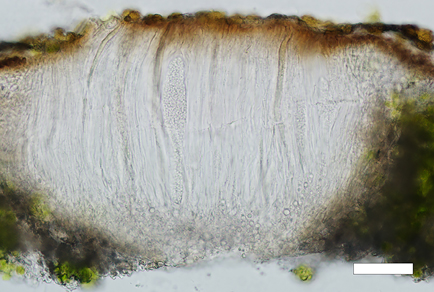
The new species Myriospora kunyuensis is described from Kunyu Mountain Nature Reserve, Shandong Province, China, based on molecular, chemical and morphological data. It is characterized by the presence of stictic acid, thick epicortex (up to 40 μm thick) and small apothecia (up to 40 μm wide). Phylogenetic analyses support the placement of the new species in Myriospora. A worldwide key to all known Myriospora species, including 13 names, is provided.
References
- Arcadia, L. & Knudsen, K. (2012) The name Myriospora is available for the Acarospora smaragdula group. Opuscula Philolichenum 11: 19–25. https://doi.org/10.5962/p.382080
- Gardes, M. & Bruns, T.D. (1993) ITS primers with enhanced specificity for basidiomycetes-application to the identification of mycorrhizae and rusts. Molecular Ecology 2: 113–118. https://doi.org/10.1111/j.1365-294X.1993.tb00005.x
- Harris, R.C. & Knudsen, K. (2006) The genus Myriospora. Opuscula Philolichenum 3: 1–4. https://doi.org/10.5962/p.381851
- Hepp, P. (1853) Abbildungen und Beschreibung der Sporen zum I. II. III. und IV. Band der Flechten Europas. Heft I, Zürich.
- Knudsen, K. (2007a) Acarospora smaragdula in North America. Evansia 24 (4): 94–97. https://doi.org/10.1639/0747-9859-24.4.94
- Knudsen, K. (2007b) Acarospora. In: Nash, T.H. III, Gries, C. & Bungartz, F. (Eds.) Lichen Flora of the Greater Sonoran Desert Region. Vol. 3. Lichens Unlimited, Arizona State University, Tempe, pp. 1–38.
- Knudsen, K. (2011) A new member of the genus Silobia (Acarosporaceae) from North America. Opuscula Philolichenum 9: 27–30. https://doi.org/10.5962/p.382025
- Knudsen, K. & Bungartz, F. (2014) Myriospora westbergii (Acarosporaceae), a new discovery from the Galapagos Islands, Ecuador. Opuscula Philolichenum 13: 177–183. https://doi.org/10.5962/p.386074
- Knudsen, K., Kocourková, J. & Schiefelbein, U. (2018) New reports of Myriospora (Acarosporaceae) from Europe. Mycotaxon 132 (4): 857–865. https://doi.org/10.5248/132.857
- Knudsen, K., Kocourková, J., Hodková, E. & Schiefelbein, U. (2021) A new species of Myriospora (Acarosporaceae) and a report of Myriospora rufescens from Central Europe. Herzogia 34 (2): 327–338. https://doi.org/10.13158/heia.34.2.2021.327
- Knudsen, K., Kocourková, J., Hodková, E., Dart, J., Huereca, A. & Malíček, J. (2023) Three new species of Trimmatothelopsis (Acarosporales, Acarosporaceae) from southwestern North America. MycoKeys 99: 251–268. https://doi.org/10.3897/mycokeys.99.102965
- Knudsen, K., Cho-Ah-Ying, J., Kocourková, J., Hodková, E., Malíček, J. & Wang, Y. (2025) The diversity of Acarosporaceae (Acarosporales, Lecanoromycetes) in California. MycoKeys 112: 183–210. https://doi.org/10.3897/mycokeys.112.138580
- Lanfear, R., Frandsen, P.B., Wright, A.M., Senfeld, T. & Calcott, B. (2016) PartitionFinder 2: new methods for selecting partitioned models of evolution for molecular and morphological phylogenetic analyses. Molecular Biology and Evolution 34 (3): 772–773. https://doi.org/10.1093/molbev/msw260
- Lazzat, N., Gulnaz, S., Reyila, R. & Abdulla, A. (2014) Study on Acarospora in central Tianshan Mountains of China. Acta Botanica Boreali-Occidentalia Sinica 34 (8): 1702–1704. https://doi.org/10.7606/j.issn.1000–4025
- Miller, M.A., Pfeiffer, W. & Schwartz, T. (2010) Creating the CIPRES Science Gateway for inference of large phylogenetic trees. In: Proceedings of the Gateway Computing Environments Workshop (GCE), 14 November 2010. New Orleans, Louisiana, pp. 1–8.
- Mishra, G.K., Nayaka, S. & Upreti, D.K. (2021) Myriospora himalayensis (Acarosporaceae, lichenized fungi), a new species from Western Himalayan region of India. Taiwania 66 (1): 89–92. https://doi.org/10.6165/tai.2021.66.89
- Orange, A., James, P.W. & White, F.J. (2001) Microchemical methods for the identification of lichens. British Lichen Society, London, 101 pp.
- Purvis, O.W., Gilbert, O.L. & James, P.W. (1985) The influence of copper mineralization on Acarospora smaragdula. The Lichenologist 17 (1): 111–114. https://doi.org/10.1017/S0024282985000123
- Purvis, O.W., Fernández-Brime, S., Westberg, M. & Wedin, M. (2018) Myriospora, a genus newly reported for Antarctica with a worldwide key to the species. The Lichenologist 50 (1): 101–112. https://doi.org/10.1017/S0024282917000652
- Rambaut, A. (2012) FigTree, v. 1.4.0 [computer program]. Institute of Evolutionary Biology, University of Edinburgh. Available from: http://tree.bio.ed.ac.uk/software/Figtree/ (accessed 10 March 2025)
- Rehner, S.A. & Samuels, G.J. (1995) Molecular systematics of the Hypocreales: a teleomorph gene phylogeny and the status of their anamorphs. Canadian Journal of Botany 73 (S1): 816–823. https://doi.org/10.1139/b95-327
- Sahedat, G., Nurtai, L., Mukhidinov, N. & Abbas, A. (2015) Newly-recorded species of Acarospora from Xinjiang. Plant Science Journal 33 (3): 291–294. https://doi.org/10.11913/PSJ.2095-0837.2015.30291
- Stamatakis, A. (2014) RAxML version 8: a tool for phylogenetic analysis and post-analysis of large phylogenies. Bioinformatics 30 (9): 1312–1313. https://doi.org/10.1093/bioinformatics/btu033
- Uloth, W. (1861) Beiträge zur Flora der Laubmoose und Flechten von Kurhessen. Flora, 44: 161–175, 177–187, 565–576, 585–592, 598–607, 617–622, 649–656, 713–716, 735–736, 745–752, 761–763.
- Vilgalys, R. & Hester, M. (1990) Rapid genetic identification and mapping of enzymatically amplified ribosomal DNA from several Cryptococcus species. Journal of Bacteriology 172 (8): 4238–4246. https://doi.org/10.1128/jb.172.8.4238-4246.1990
- Westberg, M., Crewe, A.T., Purvis, O.W. & Wedin, M. (2011) Silobia, a new genus for the Acarospora smaragdula complex (Ascomycota, Acarosporales) and a revision of the group in Sweden. The Lichenologist 43 (1): 7–25. https://doi.org/10.1017/S0024282910000617
- Westberg, M., Millanes, A.M., Knudsen, K. & Wedin, M. (2015) Phylogeny of the Acarosporaceae (Lecanoromycetes, Ascomycota, Fungi) and the evolution of carbonized ascomata. Fungal Diversity 73 (1): 145–158. https://doi.org/10.1007/s13225-015-0325-x
- Westberg, M., Wedin, M. & Svensson, M. (2024) Myriospora molybdina comb. nov. and the identity of Acarospora hysgina. Nordic Journal of Botany 2024 (6): e04269. https://doi.org/10.1111/njb.04269
- White, T., Bruns, T., Lee, S. & Taylor, J. (1990) Amplification and direct sequencing of fungal ribosomal RNA genes for phylogenetics. In: Innis, M.A., Gelfand, D.H., Sninsky, J.J. & White, T.J. (Eds.) PCR Protocols: A Guide to Methods and Applications. Academic Press, New York, pp. 315–322. https://doi.org/10.1016/B978-0-12-372180-8.50042-1
- Zhu, P., Hu, X., Zou, Q., Yang, X., Jiang, B., Zuo, J., Bai, X., Song, J., Wu, N. & Hou, Y. (2024) Shifts in fungal community diversity and potential function under natural forest succession and planted forest restoration in the Kunyu Mountains, East China. Ecology and Evolution 14 (8): e70055. https://doi.org/10.1002/ece3.70055
- Zoller, S., Scheidegger, C. & Sperisen, C. (1999) Pcr primers for the amplification of mitochondrial small subunit ribosomal DNA of lichen-forming ascomycetes. The Lichenologist 31 (5): 511–516. https://doi.org/10.1006/lich.1999.0220