
Abstract
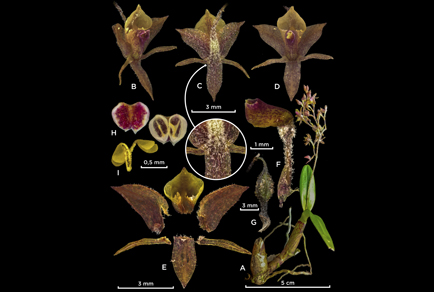
The Andean and Amazonian forests of Colombia are renowned for their high biodiversity, with nearly 2500 orchid species in the Andes and 355 species in the Amazon. We propose and describe two new species of Epidendrum from Caquetá, Colombia: one from the cloud forests on the eastern slopes of the Andes, and the other found on trees in a city park in Florencia. Epidendrum fernandoi resembles E. rocioae, from which it differs by tall (11.7–17.0 vs. 25 cm), narrowly ovoid subterete pseudobulbs (vs. cylindrical to oval), smaller flowers ovary shorter (3.3 vs. 10–17 mm long). Epidendrum mambe resembles E. platypetalonocturnum, from which it differs by petals (35–36 × 4.8–5.0 vs. 40–42 × 9–10 mm) and sepals (36–37 × 6.4–7.6 vs. 40–44 × 8.5–9.0 mm) shorter and narrower, the longer (24 vs. 18.5 mm) and narrower (1.8–1.9 vs. 2.3–3.0 mm) central lobe of the lip, and the longer calli (8 vs. 4–5 mm).
References
- Arias, T., Chaux-Varela, J., Camero, M.D.P., Calderón-Álvarez, R.A., Trujillo, A.C., Correa-Munera, M.A., Zuluaga, A., Perdomo, O., Pérez-Escobar, O.A., Trujillo-Trujillo, E. & Valencia-D, J. (2023) Checklist of Orchidaceae from Caquetá, Colombia. PhytoKeys 229: 21–46. https://doi.org/10.3897/phytokeys.229.102737
- Baltazar-Bernal, O., Zavala-Ruiz, J. & Hernández-García, A. (2024) Orchid diversity (Orchidaceae) in two urban sites in the state of Veracruz, Mexico. Agrociencia 58: 571–583. https://doi.org/10.47163/agrociencia.v58i5.3125
- Bentham, G. (1881) Notes on Mimoseae, with a synopsis of species. Journal of the Linnean Society, Botany 18: 287. https://doi.org/10.1111/j.1095-8339.1881.tb01258.x
- Brown, R. (1813) Cyrtopodium. In: Aiton, W.T. (Ed.) Hortus Kewensis. Longman, Hurst, Rees, Orme & Brown, London, pp. 216.
- Calderón Álvarez, R.A. & Bonilla Morales, M.M. (2023) A new species of Catasetum (Cymbidieae: Catasetinae) from the Colombian Amazonia. Lankesteriana 23: 469–475. https://doi.org/10.15517/lank.v23i3.54462
- Carnevali, G. & Romero, G.A. (1996) Orchidaceae Dunstervillorum VII: the Epidendrum nocturnum alliance in the Venezuelan Guayana and the Guianas. Lindleyana 11: 239–249.
- Chase, M.W., Cameron, K.M., Freudenstein, J.V., Pridgeon, A.M., Salazar, G., van den Berg, C. & Schuiteman, A. (2015) An updated classification of Orchidaceae. Botanical Journal of the Linnean Society 177: 151–174. https://doi.org/10.1111/boj.12234
- Dressler, R.L. (1982) Die Abgrenzung der Gattungen im Epidendrum-Komplex. Die Orchidee 33: 177–185.
- Dressler, R.L. (1984) La delimitación de géneros en el complejo Epidendrum. Orquídea 9: 277–298.
- Dressler, R.L. (1967) The genera Amblostoma, Lanium and Stenoglossum (Orchidaceae). Brittonia 19: 237–243. https://doi.org/10.2307/2805773
- Dressler, R.L. (1981) The Orchids, Natural History and Classification. Harvard University Press, Cambridge, 332 pp.
- Gaertner, J. (1788) Syzygium. De Fructibus et Seminibus Plantarum 1: 166. https://doi.org/10.5962/bhl.title.102753
- González-González, A., Villegas, J.C., Clerici, N. & Salazar, J.F. (2021) Spatial-temporal dynamics of deforestation and its drivers indicate need for locally-adapted environmental governance in Colombia. Ecological Indicators 126: 107695. https://doi.org/10.1016/j.ecolind.2021.107695
- Hágsater, E. (2004) The genus Epidendrum, Part 4. A Fourth Century of New Species in Epidendrum. Icones Orchidacearum 7: 701–800.
- Hágsater, E. (1985) Towards an understanding of the genus Epidendrum. In: Kiat, W.T. (Ed.) Proceedings of the 11th World Orchid Conference. Inc. Miami, pp. 195–201.
- Hágsater, E. & Krahl, A. (2020) Epidendrum deditae, a new species of Orchidaceae (Laeliinae) from northern Brazil. Phytotaxa 440: 225–231. https://doi.org/10.11646/phytotaxa.440.3.4
- Hágsater, E. & Sánchez-Saldaña, L. (Eds.) (2008) The genus Epidendrum, Part 7. Species new & old in Epidendrum. Icones Orchidacearum 11: 1101–1200.
- Hágsater, E. & Sánchez-Saldaña, L. (Eds.) (2010) The genus Epidendrum, Part 9. Species new & old in Epidendrum. Icones Orchidacearum 13: 1301–1400.
- Hágsater, E. & Soto-Arenas, M.A. (2005) Epidendrum L. In:: Pridgeon, A.M., Cribb, P., Chase, M.W. & Rasmussen, F.N. (Eds.) Genera Orchidacearum, 4. Epidendroideae (Part One). Oxford University, Oxford, pp. 236–251.
- Hágsater, E. & Sánchez-Saldaña, L. (2015) The genus Epidendrum, part 11. Species new & old in Epidendrum. Icones orchidacearum 15: 1501–1568.
- Hágsater, E. & Santiago, E. (Eds.) (2021) The genus Epidendrum, Part 14. In: Icones Orchidacearum 18. Instituto Chinoin, A. C., Mexico City, pp. 849–1900.
- Hágsater, E., Santiago, E. & Rodríguez-Martínez, L. (2016) Epidendrum lasiostachyum (Orchidaceae): A new Colombian species of the Epidendrum macrostachyum Group. Lankesteriana 16: 27–37. https://doi.org/10.15517/lank.v16i1.23621
- Hágsater, E. & Sánchez-Saldaña, L. (2007) The genus Epidendrum part 6. Species new & old in Epidendrum. Icones orchidacearum 9: 901–1000.
- Hágsater, E. & Sánchez-Saldaña, L. (2010) The genus Epidendrum, part 9. Species new & old in Epidendrum. Icones orchidacearum 13: 1301–1400.
- Hágsater, E. & Sánchez-Saldaña, L. (2016) The genus Epidendrum, part 11. Species new & old in Epidendrum. Icones orchidacearum 15: 1569–1600.
- Hágsater, E. & Santiago, E. (Eds.) (2018a) The genus Epidendrum, Species new & old in Epidendrum. Icones Orchidacearum 16: 144.
- Hágsater, E. & Santiago, E. (Eds.) (2018b) The genus Epidendrum, Species new & old in Epidendrum. Icones Orchidacearum 16: 76.
- Hágsater, E. & Santiago, E. (2019) The genus Epidendrum, part 13. Species new & old in Epidendrum. Icones orchidacearum 17: 1701–1756.
- Hágsater, E. & Vásquez, R. (2019) Epidendrum rocioae Hágsater & Vásquez. In: Hágsater, E. & Santiago, E. (Eds.) The Genus Epidendrum, Part 13. Icones Orchidacearum 17: t. 1752.
- Hooker, W. (1824) Polystachya. In: Exotic Flora 2: 103.
- IUCN (2012) The IUCN red list of threatened species, version 3.1, 2nd ed. IUCN Red List Unit, Cambridge U.K. Available from: http://www.iucnredlist.org/ (accessed 19 May 2024)
- Izuddin, M., Srivathsan, A., Lee, A.L., Yam, T.W. & Webb, E.L. (2019) Availability of orchid mycorrhizal fungi on roadside trees in a tropical urban landscape. Scientific reports 9: 19528. https://doi.org/10.1038/s41598-019-56049-y
- Kunth, C.S. (1822) Catasetum. In: Synopsis Plantarum, quas, in itinere ad plagam aequinoctialem orbis novi, collegerunt Al. de Humboldt et Am. Bonpland 1: 330–331.
- Lindley, J. (1833) Dichaea. In: The Genera and Species of Orchidaceous Plants. London: Ridgways, pp. 208.
- Lindley, J. (1881) Epidendrum (sect. Lanium). In: Hooker, W.J. (Ed.) Hooker's Icones Plantarum 14: 24–25.
- Lindley, J. (1840) Epidendrum microphyllum. Journal of Botany, being a Second Series of the Botanical Miscellany 3: 85.
- Linnaeus, C. (1763) Epidendrum. In: Species Plantarum: exhibentes plantas rite cognitas, ad genera relatas, cum differentiis specificis, nominibus trivialibus, synonymis selectis, locis natalibus, secundum systema sexuale digestas, Volume 2. Impensis G.C. Nauk, Berolini, pp. 785–1684. https://doi.org/10.5962/bhl.title.65726
- Linnaeus, C. (1767) Ficus benjamina. Mantissa Plantarum 1: 129.
- López-Floriano, O., Claros-Calderón, B., Hágsater, E. & Santiago, E. (2024) A new species of Epidendrum (Orchidaceae) of the Albertii group of the Eastern Andes in Colombia. Phytotaxa 668: 279–285. https://doi.org/10.11646/phytotaxa.668.3.7
- Ministerio de Ambiente y Desarrollo Sostenible y Universidad Nacional de Colombia (MADS & UN). (2015) Plan para el estudio y la conservación de las orquídeas en Colombia. Textos: Betancur, J., H. Sarmiento-L., L. Toro-González & J. Valencia. Ministerio de Ambiente y Desarrollo Sostenible, Colombia; Universidad Nacional de Colombia, Bogotá D.C., 336 pp.
- Moosburg, M.E., Hágsater, R. & Ochse, M. (2014) Ökologische Zusammenhänge anhand von Sammlungsexemplaren erkennen: Adhemarius sexoculata Grote, 1867, als Bestäuber bei der Orchideengattung Epidendrum Linnaeus, 1753 (Lepidoptera: Sphingidae). Entomologische Zeitschrift Stuttgart 124: 2013–2014.
- Moreno, J., Hoyos, D., Rincón, M., Sierra-Ariza, M., Valencia, M. & Gutiérrez, N. (2022) Lepanthes florenciana (Orchidaceae: Pleurothallidinae), a new species from the Eastern Andes of Colombia. Phytotaxa 559: 55–63. https://doi.org/10.11646/phytotaxa.559.1.6
- Parra-Sanchez, E., Freckleton, R.P., Hethcoat, M.G., Ochoa-Quintero, J.M. & Edwards, D.P. (2024) Transformation of natural habitat disrupts biogeographical patterns of orchid diversity. Biological Conservation 292: 110538. https://doi.org/10.1016/j.biocon.2024.110538
- Perdomo, O., Trujillo-Trujillo, E. & Karremans, P.A. (2023) Masdevallia leonor-baeziana (Orchidaceae: Pleurothallidinae): new species from the Andean-Amazonian foothills of Caquetá, Colombia. Lankesteriana 23: 139–144. https://doi.org/10.15517/lank.v23i2.54019
- Perdomo, O., Singer, R. & Pessoa, E. (2024) Campylocentrum luzmariae (Vandeae, Orchidaceae), a new species from the Andean cloud forest of Colombia. Phytotaxa 642: 279–284. https://doi.org/10.11646/phytotaxa.642.4.6
- Poeppig, E.F. & Endlicher, S.L. (1835) Nova Genera ac Species Plantarum 1: 58.
- Pfitzer, E.H.H. (1889) Orchidaceae. Cohniella. In:: Engler, A. & Prantl, K. (Eds.) Die natürlichen Pflanzenfamilien, Teil II, Abt. 6. Wilhelm Engelmann, Leipzig, 2: 194.
- Reichenbach, H.G. (1861) Epidendrum sect. Nocturnum. Annales Botanices Systematicae 6: 393.
- Rewicz, A., Bomanowska, A., Shevera, M.V., Kurowski, J.K., Krasoń, K. & Zielińska, K.M. (2017) Cities and disturbed areas as man-made shelters for orchid communities. Notulae Botanicae Horti Agrobotanici Cluj-Napoca 45: 126–139. https://doi.org/10.15835/nbha45110519
- Thiers, B.M. (Ed.) (2021) [continuously updated]. Index Herbariorum: A global directory of public herbaria and associated staff. New York Botanical Garden's Virtual Herbarium. Available from: http://sweetgum.nybg.org/ih/ (accessed 16 November 2024)
- Wright, W. (1787) Geoffroea inermis. London Medical Journal 8: 254.