
Abstract
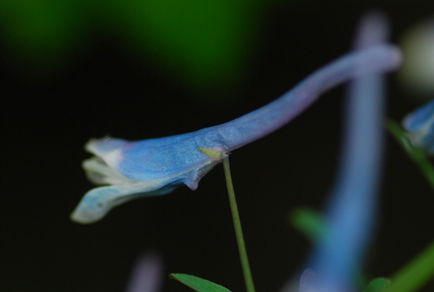
Corydalis xideensis (Corydalieae, Papaveraceae), a new species from the Xiaoxiangling Mountains, Xide County, southern Sichuan, China, is described and illustrated. C. xideensis is similar to C. schusteriana, but differs from the latter by having 3–12 cm long stolons, bluish green leaves adaxially, pale yellow corolla with yellow apex, outer petals without crest, shorter corolla, shorter spur, larger sepals and very obvious on young flowers, no bulbil in axils of upper cauline leaves.
References
- Chen, J.T. (2022) Molecular phylogeny and biogeography of Corydalis (Papaveraceae) of the world. Kunming Institute of Botany, Chinese Academy of Sciences.
- Chen, J.T., Lidén, M., Huang, X.H., Yang, S.Q., Zhang, X.J., Liu, Q., Su, Q.L., Hua, G.J., Luo, J. & Deng, T. (2024) Corydalis sunhangii (Papaveraceae): A new species from Xizang, China, based on plastome and morphological data. Ecology and Evolution 14: e11225. https://doi.org/10.1002/ece3.11225
- Chen, J.T., Lidén, M., Huang, X.H., Zhang, L., Zhang, X.J., Kuang, T.H., Landis, J.B., Wang, D., Deng, T. & Sun, H. (2023) An updated classification for the hyper-diverse genus Corydalis (Papaveraceae: Fumarioideae) based on phylogenomic and morphological evidence. Journal of Integrative Plant Biology 65: 2138–2156. https://doi.org/10.1111/jipb.13499
- De Candolle, A.P. (1805) Corydalis. In: De Candolle, A.P. & Lamarck, J.-B.-P.-A. de M. de (Ed.) Flore Francaise ed. 3. ou Descriptions Succinctes de Toutes les Plantes qui Croissent Naturellement en France (Vol. 4). A Paris, chez Desary, Libraire, pp. 636–638.
- Liu, Y.Y., Cao, J.L., Kan, S.L., Wang, P.H., Wang, J.L., Cao, Y.N., Wang, H.W. & Li, J.M. (2024) Phylogenomic analyses sheds new light on the phylogeny and diversification of Corydalis DC. in Himalaya-Hengduan Mountains and adjacent regions. Molecular Phylogenetics and Evolution 193: 108023. https://doi.org/10.1016/j.ympev.2024.108023
- Peng, H.W., Ling, Y.Y., Xiang, K.L., Erst, A.S., Li, X.Q., Lian, L., Liu, B., Erst, T.V., Del C Ortiz, R., Jabbour, F. & Wang, W. (2025) Repeated Evolution of Storage Root and Invasions of Alpine Biome Drove Replicated Radiations of the Megadiverse Corydalis (Papaveraceae) in the Qinghai-Tibet Plateau. Systematic Biology. https://doi.org/10.1093/sysbio/syaf014
- IUCN Standards and Petitions Committee. (2022) Guidelines for Using the IUCN Red List Categories and Criteria. Version 15.1. Prepared by the Standards and Petitions Committee. [https://www.iucnredlist.org/documents/RedListGuidelines.pdf]
- Pérez-Gutiérrez, M.A., Romero-García, A.T., Fernández, M.C., Blanca, G., Salinas-Bonillo, M.J. & Suárez-Santiago, V.N. (2015) Evolutionary history of fumitories (subfamily Fumarioideae, Papaveraceae): An old story shaped by the main geological and climatic events in the Northern Hemisphere. Molecular Phylogenetics and Evolution 88: 75–92. https://doi.org/10.1016/j.ympev.2015.03.026
- Wang, Y.W. (2006) Systematics of Corydalis DC. Institute of Botany, Chinese Academy of Sciences.
- Wu, Z.Y., Zhuang, X. & Su, Z.Y. (1999) Corydalis DC. In: Wu, Z.Y. (Ed.) Flora Reipublicae Popularis Sinicae, Vol. 32. Beijing: Science Press.
- Wu, Z.Y., Zhuang, X. & Su, Z.Y. (1996) The systematic evolution of Corydalis in relation to florogenesis and floristic regionalization in the world. Acta Botanica Yunnanica 18: 267.
- Xu, X.D., Li, X.X. & Wang, D. (2022) New insights into the backbone phylogeny and character evolution of Corydalis (Papaveraceae) based on plastome data. Frontiers in Plant Science 13: 926574. https://doi.org/10.3389/fpls.2022.926574
- Zhang, M.L., Su, Z.Y., Lidén, M. & Grey-Wilson, C. (2008) Corydalis DC. In: Wu, Z.Y., Raven, P.H. & Hong, D.Y. (Eds.) Flora of China 7: 261.
- Zhao, X.L. (2011) Studies on seed micro-morphology characteristics and its systematic significance in Papaveraceae s.l. from China. Nanjing Normal University.