

Abstract
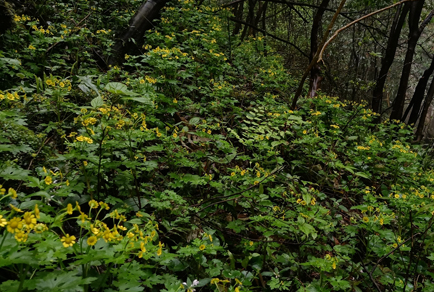
Sinosenecio ranunculoides (Asteraceae, Senecioneae), a new species from northeastern Jiangxi, China, is described on the basis of morphological and molecular evidence. This narrowly endemic species shares leafy stems and absent pappus with S. palmatisectus, S. phalacrocarpus and S. globigerus, yet it is clearly distinguished by its Ranunculus-like leaves with dense white arachnoid hairs on the adaxial surface, 5-ribbed hollow stems, biseriate phyllaries, and achenes that are densely covered with clavate trichomes and prominently 9-ribbed. Phylogenetic analysis using nuclear ribosomal DNA internal transcribed spacer (ITS) sequences confirms the placement of S. ranunculoides within the S. oldhamianus-Nemosenecio clade and supports its recognition as a distinct species, separate from all other members of this section.
References
- Anisimova, M., Gil, M., Dufayard, J.F., Dessimoz, C. & Gascuel, O. (2011) Survey of branch support methods demonstrates accuracy, power, and robustness of fast likelihood-based approximation schemes. Systematic Biology 60: 685–699. https://doi.org/10.1093/sysbio/syr041
- Blattner, F.R. (1999) Direct amplification of the entire ITS region from poorly preserved plant material using recombinant PCR. BioTechniques 27: 1180–1186. https://doi.org/10.2144/99276st04
- Burland, T.G. (2000) DNASTAR’s Lasergene sequence analysis software. Methods in Molecular Biology 132: 71–91. https://doi.org/10.1385/1-59259-192-2:71
- Chen, B., Liu, Y., Luo, J.-X., Wang, Q. & Yang, Q.-E. (2022) Sinosenecio jiuzhaigouensis (Asteraceae, Senecioneae), a new species from Sichuan, China. Phytotaxa 544: 289–294. https://doi.org/10.11646/phytotaxa.544.3.3
- Chen, Y.L., Liu, Y., Yang, Q.E., Nordenstam, B. & Jeffrey, C. (2011) Sinosenecio B. Nord. In: Wu, C.Y. & Raven, P. (Eds.) Flora of China, vols. 20–21. Science Press, Beijing & Missouri Botanical Garden Press, St. Louis, pp. 464–481.
- Guindon, S., Dufayard, J.F., Lefort, V., Anisimova, M., Hordijk, W. & Gascuel, O. (2010) New algorithms and methods to estimate maximum-likelihood phylogenies: assessing the performance of PhyML 3.0. Systematic Biology 59: 307–321. https://doi.org/10.1093/sysbio/syq010
- Jeffrey, C. & Chen, Y.L. (1984) Taxonomic Studies on the Tribe Senecioneae (Compositae) of Eastern Asia. Kew Bulletin 39: 205–446. https://doi.org/10.2307/4110124
- Kalyaanamoorthy, S., Minh, B.Q., Wong, T.K.F., von Haeseler, A. & Jermiin, L.S. (2017) ModelFinder: fast model selection for accurate phylogenetic estimates. Nature Methods 14: 587–589. https://doi.org/10.1038/nmeth.4285
- Katoh, K. & Standley, D.M. (2013) MAFFT multiple sequence alignment software version 7: improvements in performance and usability. Molecular Biology and Evolution 30: 772–780. https://doi.org/10.1093/molbev/mst010
- Liu, Y., Xu, Y. & Yang, Q.-E. (2019) Sinosenecio peltatus (Asteraceae, Senecioneae), a remarkably distinctive new species from Guangdong, China. Phytotaxa 406: 206–212. https://doi.org/10.11646/phytotaxa.406.3.7
- Liu, Y. & Yang, Q.-E. (2012) Sinosenecio jiangxiensis (Asteraceae), a new species from Jiangxi, China. Botanical Studies 53: 401–414.
- Minh, B.Q., Nguyen, M.A. & von Haeseler, A. (2013) Ultrafast approximation for phylogenetic bootstrap. Molecular Biology and Evolution 30: 1188–1195. https://doi.org/10.1093/molbev/mst024
- Nguyen, L.T., Schmidt, H.A., von Haeseler, A. & Minh, B.Q. (2015) IQ-TREE: a fast and effective stochastic algorithm for estimating maximum-likelihood phylogenies. Molecular Biology and Evolution 32: 268–274. https://doi.org/10.1093/molbev/msu300
- Nordenstam, B. (1978) Taxonomic studies in the tribe Senecioneae (Compositae). Opera Botanica 44: 1–84.
- Peng, J.-Y., Zhang, D.-G., Deng, T., Huang, X.-H., Chen, J.-T., Meng, Y., Wang, Y. & Zhou, Q. (2022) Sinosenecio yangii (Asteraceae), a new species from Guizhou, China. PhytoKeys 210: 1–13. https://doi.org/10.3897/phytokeys.210.89480
- Su, X.-J., Fei, W.-Q., Zhao, D., Liu, Y. & Yang, Q.-E. (2023a) Sinosenecio minshanicus (Asteraceae, Senecioneae), a new species from south-eastern Gansu and northern Sichuan, China. PhytoKeys 218: 79–91. https://doi.org/10.3897/phytokeys.218.97475
- Su, X.-J., Fei, W.-Q., Zhao, D., Liu, Y. & Yang, Q.-E. (2023b) Sinosenecio pingwuensis (Asteraceae, Senecioneae), a new species from northern Sichuan, China. PhytoKeys 218: 109–116. https://doi.org/10.3897/phytokeys.218.97485
- Talavera, G. & Castresana, J. (2007) Improvement of phylogenies after removing divergent and ambiguously aligned blocks from protein sequence alignments. Systematic Biology 56: 564–577. https://doi.org/10.1080/10635150701472164
- White, T.J., Bruns, T., Lee, S. & Taylor, J. (1990) Amplification and Direct Sequencing of Fungal Ribosomal RNA Genes for Phylogenetics. In: Innis, M.A., Gelfand, D.H., Sninsky, J.J. & White, T.J. (Eds.) PCR Protocols. Academic Press, San Diego, pp. 315–322.
- Zou, C.-Y., Liu, Y. & Liu, Y. (2020) Sinosenecio ovatifolius (Asteraceae), a new species from Guangxi, China. Phytotaxa 460: 149–159. https://doi.org/10.11646/phytotaxa.460.2.5