

Abstract
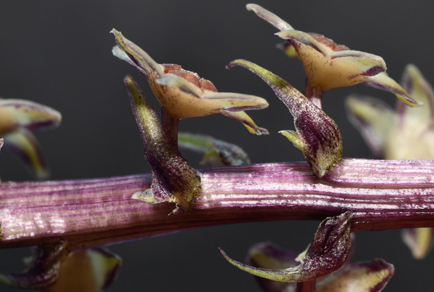
Peliosanthes qixingkengensis, a new species from Guangdong Province, southern China, is distinguished by a unique combination of morphological traits: (1) a flattened and split corona; (2) a 3–6-lobed stigma and a 3–6-locular ovary. Furthermore, persistent cataphylls (membranous sheaths encasing petioles, up to 14 cm long) provide additional diagnostic characters differentiating it from congeners.
References
- Andrews, H.C. (1810) Peliosanthes teta. Botanists’ repository, for new, and rare plants 9: t. 605.
- APG IV (2016) An update of the angiosperm phylogeny group classification for the orders and families of flowering plants: APG IV. Botanical Journal of the Linnean Society 181: 1‒20. https://doi.org/10.1111/boj.12385
- Averyanov, L.V., Tanaka, N. & Luu, H.T. (2013) New Species of Ophiopogon and Peliosanthes (Asparagaceae) from Cambodia and Vietnam. Taiwania 58 (4): 233‒241. https://doi.org/10.6165/tai.2013.58.4.233
- Averyanov, L.V., Tanaka, N. & Nguyen, S.K. (2014) New Species of Peliosanthes and Rohdea (Asparagaceae) from Eastern Indochina. Taiwania 59 (1): 18–25. https://doi.org/10.6165/tai.2014.59.18
- Averyanov, L.V., Tanaka, N., Nguyen, K.S., Nguyen, Q.N., Maisak, T.V. & Nguyen, T.H. (2017) New species of Peliosanthes, Rohdea and Tupistra (Asparagaceae) from Laos and Vietnam. Nordic Journal of Botany 35: 697–710. https://doi.org/10.1111/njb.01660
- Chase, M.W., Reveal, J.L. & Fay, M.F. (2009) A subfamilial classification for the expanded asparagalean families Amaryllidaceae, Asparagaceae and Xanthorrhoeaceae. Botanical Journal of the Linnean Society 161 (2): 132‒136. https://doi.org/10.1111/j.1095-8339.2009.00999.x
- Craib, W.G. (1912) Ophiopogon gracilipes. In: Contributions to the flora of Siam II. Bulletin of Miscellaneous Information 1912 (10): 411. https://doi.org/10.2307/4104593
- Dahlgren, R.M.T. & Clifford, H.T. (1982) The Monocotyledons: a comparative study. Academic Press, London, 378 pp.
- Dahlgren, R.M.T., Clifford, H.T. & Yeo, P.F. (1985) The Families of the Monocotyledons. Springer-Verlag, Berlin, 519 pp.
- Hance, H.F. (1885) Spicilecia florae Sinensis: diagnose of new and habitats of rare or hitherto unrecorade, Chinese plants. Journal of botany 23: 321–330.
- Jessop, J.P. (1976) A revision of Peliosanthes (Liliaceae). Blumea 23: 141–159.
- Ker Gawler, J.B. (1807) Ophiopogon. Curtis’s Botanical Magazine 27: t. 1063. [https://www.biodiversitylibrary.org/page/472608#page/9/mode/1up]
- Krause, K. (1930) Liliaceae. Die Natürlichen Pflanzenfamilien 15: 227–386.
- Kroupsky, I.A., Lyskov, D.F., Nguyen, K.S., Pham, T.K.T., Nguyen, C.H., Kuznetsov, A.N., Kuznetsov, S.P., Vislobokov, N.A., Tanaka, N. & Nuraliev, M.S. (2023) Peliosanthes linearifolia (Asparagaceae), a new species with linear leaves from Vietnam. Phytotaxa 607 (1): 95–104. https://doi.org/10.11646/phytotaxa.607.1.8
- Loureiro, J.de (1790) Flora cochinchinensis: sistens plantas in regno Cochinchina nascentes. Quibus accedunt aliae observatae in Sinensi imperio, Africa Orientali, Indiaeque locis variis. Ulyssipone, Typis, et expensis academicis, 353 pp. https://doi.org/10.5962/bhl.title.560
- Luu, H.T., Nguyen, H.C., Nao, D.P., Nguyen, T.Q.T. & Nguyen-Le, X.B. (2024) Peliosanthes thachii (Asparagaceae), a new species from Vietnam. Phytotaxa 662 (2): 170–176. https://doi.org/10.11646/phytotaxa.662.2.5
- Ridley, H.N. (1911) An account of a botanical expedition to lower Siam. Journal of the Straits Branch of the Royal Asiatic Society 59: 27–234.
- Rodriguez, L. (1934) Hémodoracées. In: Lecomte, H., Humbert, H. & Gagnepain, F. (Eds.) Flore Générale de l’Indo-Chine, vol. 6. Masson et Cie., Paris, pp. 654–673.
- Shaw, J.M.H. (2009) A new Peliosanthes in cultivation. A recent introduction to the UK has been identifed as a new species from Thailand. Plantsman 8 (4): 248–249.
- Tamura, M.N., Poopath, M. & Sirimongkol, S. (2013) Petiosanthe brevicoronata (Asparagaceae), a new species from Thailand. Acta Phytotaxonomica et Geobotanica 64 (2): 107–111.
- Takhtajan, A. (1987) Systema Magnoliophytorum. Nauka, Leningrad, 439 pp.
- Tanaka, N. (2004) Inclusion of Neolourya in Peliosanthes (Convallariaceae). Novon 14 (3): 360–364.
- Tanaka, N., Murata, J. & Wu, S.K. (2013) A new species of Peliosanthes (Asparagaceae) from Yunnan, China. Journal of Japanese Botany 88: 133–139.
- Tanaka, N. & Kalyushniy, S.S. (2020) A new species and a new record of Peliosanthes (Asparagaceae) from eastern Thailand. Phytotaxa 470 (4): 290–297. https://doi.org/10.11646/phytotaxa.470.4.3
- Tanaka, N. & Nguyen, K.S. (2023) Nolinoideae (Asparagaceae) in APG III needs replacing with Convallarioideae. Phytotaxa 583 (3): 297–299. https://doi.org/10.11646/phytotaxa.583.3.9
- Thorne, R.F. (1968) Synopsis of a putatively phylogenetic classification of the flowering plants. Aliso 6 (4): 57–66. https://doi.org/10.5642/aliso.19680604.06
- Thorne, R.F. (1976) A phylogenetic classification of the Angiospermae. Evolutionary Biology 9: 35–106. https://doi.org/10.1007/978-1-4615-6950-3_2
- Vislobokov, N.A. (2016) Peliosanthes separata (Asparagaceae), a new species from Laos with rare structure of androecium. Phytotaxa 275 (2): 186–188. https://doi.org/10.11646/phytotaxa.275.2.11
- Vislobokov, N.A., Romanov, M.S., Kuzmichev, E.A., Kuznetsova, S.P. & Kuznetsov, A.N. (2020) Description of a species Peliosanthes curviandra (Asparagaceae) from Vietnam with focus on androecium structure and leaf micromorphology. Phytotaxa 464 (1): 69–76. https://doi.org/10.11646/phytotaxa.464.1.5
- Wang, F.T. & Tang, T. (1978) Flora Reipublicae Popularis Sinicae 15. Science Press, Beijing, pp. 253–254.