

Abstract
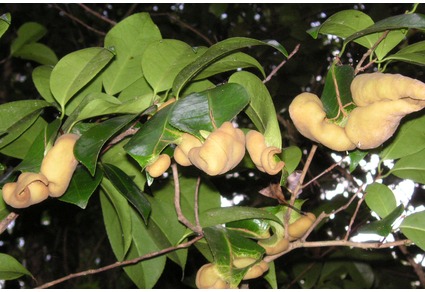
A Muribasidiospora species forming unusually large leaf galls on Camellia japonica was discovered in Miyazaki Prefecture, Japan. Morphological characteristics of this fungus correspond to those described for Exobasidium giganteum, indicating that the species should be transferred to Muribasidiospora. A similar large leaf gall was subsequently found on C. japonica var. macrocarpa in Yakushima Island, and its morphology was identical to that of E. giganteum. Phylogenetic analyses based on concatenated ITS and LSU sequences confirmed that isolates from both host varieties represent the same taxon. We therefore propose the new combination Muribasidiospora gigantea comb. nov.
References
- Bauer, R., Begerow, D., Oberwinkler, F., Piepenbring, M. & Berbee, M.L. (2001) Ustilaginomycetes. In: McLaughlin, D.J., McLaughlin, E.G. & Lemke, P.A. (Eds.) Mycota VII Part B. Systematics and Evolution. Springer Verlag, Heidelberg, New York, pp. 57–83. https://doi.org/10.1007/978-3-662-10189-6_3
- Begerow, D., Bauer, R. & Oberwinkler, F. (2001) Muribasidiospora: Microstromatales or Exobasidiales? Mycological Research 105: 798–810. https://doi.org/10.1017/s0953756201004208
- Begerow, D., Bauer, R. & Oberwinkler, F. (2002) The Exobasidiales: an evolutionary hypothesis. Mycological Progress 1: 187–199. https://doi.org/10.1007/s11557-006-0018-7
- Crous, P.W., Groenewald, J.Z. & Carroll, G. (2003) Muribasidiospora indica causing a prominent leaf spot disease on Rhus lancea in South Africa. Australasian Plant Pathology 32: 313–316. https://doi.org/10.1071/ap03007
- Donk, M.A. (1974) Check list of European hymenomycetous Heterobasidiae. Supplement and corrections. Persoonia—Molecular Phylogeny and Evolution of Fungi 8 (1): 33–50.
- Ezuka, A. (1990) Notes on some species of Exobasidium in Japan (I). Transactions of Mycological Society of Japan 31: 375–388.
- Fahrenkrog, A.M., Matsumoto, G.O., Toth, K., Jokipii-Lukkari, S., Salo, H.M., Häggman, H., Benevenuto, J. & Munoz, P.R. (2022) Chloroplast genome assemblies and comparative analyses of commercially important Vaccinium berry crops. Scientific Reports 12: 21600. https://doi.org/10.1038/s41598-022-25434-5
- Felsenstein, J. (1985) Confidence limits on phylogenies: an approach using the bootstrap. Evolution 39: 783–791. https://doi.org/10.1111/j.1558-5646.1985.tb00420.x
- Gardes, M. & Bruns, T.D. (1993) ITS primers with enhanced specificity for basidiomycetes—application to the identification of mycorrhizae and rusts. Molecular Ecology 2 (2): 113–118. https://doi.org/10.1111/j.1365-294x.1993.tb00005.x
- Hirata, S. (1981) A new species of Exobasidium causing giant galls on Camellia japonica. Transactions of Mycological Society of Japan 22: 393–395.
- Hsieh, H.J., Fu, C.H. & Shih, H.H. (2008) Muribasidiospora gordoniae sp. nov. occurring on Gordonia axillaris in Taiwan. Botanical Studies 49: 277–280.
- Kirk, P.M., Cannon, P.F., David, J.C. & Stalpers, J.A. (Eds.) (2001) Dictionary of the Fungi. 9th Edition. CABI Publishing, Wallingford, pp. 193, 332–333.
- Kurashige, Y., Etoh, J.I., Handa, T., Takayanagi, K. & Yukawa, T. (2001) Sectional relationships in the genus Rhododendron (Ericaceae): evidence from matK and trnK intron sequences. Plant Systematics and Evolution 228: 1–14. https://doi.org/10.1007/s006060170033
- McNabb, R.F.R. (1962) The genus Exobasidium in New Zealand. Transactions of the Royal Society of New Zealand 1: 259–268.
- Madeira, F., Pearce, M., Tivey, A.R.N., Basutkar, P., Lee, J., Edbali, O., Madhusoodanan, N., Kolesnikov, A. & Lopez, R. (2022) Search and sequence analysis tools services from EMBL-EBI in 2022. Nucleic Acids Research 50 (W1): W276–W279. https://doi.org/10.1093/nar/gkac240
- Minato, S. (2000) Yamane tte shitteru? Tsukiji Shokan Publishing Co., Ltd., pp. 126. (In Japanese.)
- Nagao, H., Ezuka, A., Ohkubo, H. & Kakishima, M. (2001) A new species of Exobasidium causing witches’ broom on Rhododendron wadanum. Mycoscience 42: 549–554. https://doi.org/10.1007/BF02460953
- Nagao, H. & Kasuya, T. (2023) The host-pathogen association of Exobasidium in Japan inferred from molecular phylogeny of ITS and large subunit rDNA sequences. The Hiyoshi Review of Natural Science 70: 1–21.
- Nagao, H., Orihara, T. & Kasuya, T. (2025) Exobasidium setsutaiense sp. nov. (Exobasidiaceae) causing leaf blister on Rhododendron semibarbatum in Japan. Phytotaxa 684 (1): 78–92. https://doi.org/10.11646/phytotaxa.684.1.4
- Nannfeldt, J.A. (1981) Exobasidium a taxonomic reassessment applied to the European species. Symbolae Botanicae Upsalienses 23 (2): 1–72.
- O’Donnell, K.L. (1993) Fusarium and its near relatives. In: Reynolds, D.R. & Taylor, J.W. (Eds.) The Fungal Holomorph: Mitotic, Meiotic, and Pleomorphic Speciation in Fungal Systematics. CAB International, Wallingford, pp. 225–233.
- Ramakrishnan, T.S. & Ramakrishnan, K. (1949) Exobasidium from South India. Proceedings of the Indian Academy of Sciences Section B 29 (1): 5–12. https://doi.org/10.1007/bf03049983
- Rajendren, R.B. (1968) Muribasidiospora—A new genus of the exobasidiaceae. Mycopathologia et Mycologia Applicata 36: 218–222. https://doi.org/10.1007/BF02049690
- Saccardo, P.A. (1925) Sylloge fungorum 23: 554–555.
- Shirai, M. (1896) Descriptions of some new Japanese species of Exobasidium. Botanical Magazine, Tokyo 10: 51–54. https://doi.org/10.15281/jplantres1887.10.113_51
- Suyama, Y., Kawamuro, K., Kinoshita, I., Yoshimura, K., Tsumura, Y. & Takahara, H. (1996) DNA sequence from a fossil pollen of Abies spp. from Pleistocene peat. Genes & Genetic Systems 71: 145–149. https://doi.org/10.1266/ggs.71.145
- Swofford, D.L. (1998) PAUP*4.0. Phylogenetic Analysis Using Parsimony. Sinauer Associates, Sunderland, Massachusetts.
- Tanaka, K. (1992) Sousa–densi–kenbikyo–gijutu. Koudansya, Tokyo. (In Japanese.)
- Virtudazo, E.V., Nakamura, H. & Kakishima, M. (2001) Phylogenetic analysis of sugarcane rusts based on sequences of ITS, 5.8S rDNA and D1/D2 regions of LSU rDNA. Journal of General Plant Pathology 67 (1): 28–36. https://doi.org/10.1007/PL00012983
- Wan, Q.–M., Begerow, D., Groenewald, M., Liu, X.–Z., Theelen, B., Bai, F.–Y. & Boekhout, T. (2015) Multigene phylogeny and taxonomic revision of yeasts and related fungi in the Ustilaginomycotina. Studies in Mycology 81: 55–83. https://doi.org/10.1016/j.simyco.2015.10.004
- White, T.J., Bruns, T., Lee, S.B. & Taylor, J. (1990) Amplification and direct sequencing of fungal ribosomal RNA genes for phylogenetics. In: Gelfand, M., Sninsky, D. & White, T. (Eds.) PCR Protocols: A Guide to Methods and Applications. Academic Press, San Diego, pp. 315–322. https://doi.org/10.1016/b978-0-12-372180-8.50042-1
- Zeller, S.M. (1934) Some new or noteworthy fungi on Ericaceous hosts in the Pacific Northwest. Mycologia 26 (4): 291–304. https://doi.org/10.1080/00275514.1934.12020725