

Abstract
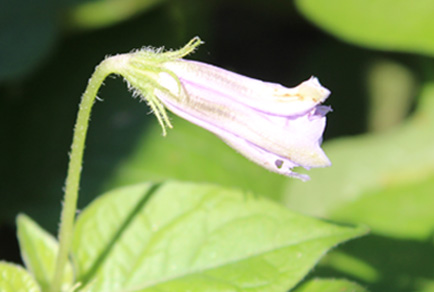
Phylogenetic and phylogeographic analyses indicate that populations of Lycianthes dejecta from the Sierra de La Laguna, Baja California Sur, represent an independent lineage. A detailed morphological revision of the collected plants and herbarium specimens confirmed the existence of a new species in Lycianthes series Meizonodontae. Here, we describe and illustrate Lycianthes peninsularis, an endemic species of the Sierra de la Laguna. Lycianthes peninsularis differs from the continental L. dejecta by its prostrate habit, round, ovoid or conic light green berry, and calyx appendages not reflexed in fruit.
References
- Anguiano-Constante, M.A., Munguía-Lino, G., Ortiz, E., Villaseñor, J.L.& Rodríguez, A. (2018) Riqueza, distribución geográfica y conservación de Lycianthes serie Meizonodontae (Capsiceae, Solanaceae). Revista Mexicana de Biodiversidad 89: 516–529. https://doi.org/10.22201/ib.20078706e.2018.2.2340
- Anguiano-Constante, M.A., Dean, E., Starbuck, T., Rodríguez, A.& Munguía-Lino, G. (2021) Diversity, species richness distribution and centers of endemism of Lycianthes (Capsiceae, Solanaceae) in Mexico. Phytotaxa 514: 39–60. https://doi.org/10.11646/phytotaxa.514.1.3
- Anguiano-Constante, M.A., Zamora-Tavares, P., Ruiz-Sanchez, E., Dean, E., Rodríguez, A.& Munguía-Lino, G. (2021a) Population differentiation and phylogeography in Lycianthes moziniana (Solanaceae: Capsiceae), a perennial herb endemic to the Mexican Transition Zone. Biological Journal of Linnean Society 132: 359–373. https://doi.org/10.1093/biolinnean/blaa198
- Anguiano-Constante, M.A. (2025) Diversificación de Lycianthes serie Meizonodontae. Tesis Doctoral. Doctorado en Biosistemática, Ecología y Manejo de Recursos Naturales y Agrícolas (BEMARENA). Universidad de Guadalajara.
- Bachman, S., Moat, J., Hill, A.W., de la Torre, J.& Scott, B. (2011) Supporting Red List threat assessments with GeoCAT: geospatial conservation assessment tool. ZooKeys 150: 117–126. https://doi.org/10.3897/zookeys.150.2109
- Bitter, G. (1919) Die Gattung Lycianthes. Abhandlungen herausgegeben vom Naturwissenschaftlichen Vereins zu Bremen 24: 292–520.
- Britton, N.L.& Rose, J.N. (1922) The Cactaceae, descriptions and illustrations of plants of the cactus family. The Carnegie Institution of Washington, Washington, 255 pp.
- Chincoya, D.A., Arias, A., Vaca-Paniagua, F., Dávila, P.& Solórzano, S. (2023) Phylogenomics and Biogeography of the Mammilloid Clade Revealed an Intricate Evolutionary History Arose in the Mexican Plateau. Biology 12: 512. https://doi.org/10.3390/biology12040512
- D’Arcy, W.G. (1986) The calyx in Lycianthes and some other genera. Annals of the Missouri Botanical Garden 73: 117–127. https://doi.org/10.2307/2399143
- Dean, E. (1994) Lycianthes stabuckii and Lycianthes rzedowskii (Solanaceae), two new species of perennial herbs from Mexico. Novon 4: 324–329. https://doi.org/10.2307/3391439
- Dean, E. (2004) A taxonomic revision of Lycianthes series Meizonodontae (Solanaceae). Botanical Journal of the Linnean Society 145: 385–424. https://doi.org/10.1111/j.1095-8339.2004.00296.x
- Dean, E., Poore, J., Anguiano-Constante, M.A., Nee, M.H., Kang, H., Starbuck, T., Rodríguez, A.& Conner, M. (2020) The genus Lycianthes (Solanaceae, Capsiceae) in Mexico and Guatemala. Phytokeys 168: 1–333. https://doi.org/10.3897/phytokeys.168.51904
- Dolby, G.A., Bennet, S.E., Lira-Noriega, A., Wilder, B.T.& Munguía-Vega, A. (2015) Assessing the geological and climatic forcing of biodiversity and evolution surrounding the Gulf of California. Journal of the Southwest 57: 391–455. https://doi.org/10.1353/jsw.2015.0005
- Dupin, J., Matzke, N.J., Särkinen, T., Knapp, S., Olmstead, R.G., Bohs, L.& Smith, S. (2017) Bayesian estimation of the global biogeographical history of the Solanaceae. Journal of Biogeography 44: 887–899. https://doi.org/10.1111/jbi.12898
- Goldman, E.A. (1916) Plant records of an expedition to lower California. Contributions from the United States National Herbarium 16: 309–372.
- González-Abraham, C.E., Garcillán, P.P., Ezcurra, E.& GTE. (2010) Ecorregiones de la península de Baja California: una síntesis. Boletín de la Sociedad Botánica Mexicana 87: 69–82. https://doi.org/10.17129/botsci.302
- Hassler, E. (1917) Solanaceae Austro-Americanae Imprimis Paraguariensis. Annuaire du Conservatoire et du Jardin Botaniques de Genève 20: 173–183.
- Hunziker, A.T. (2001) The Genera of Solanaceae. A.R.G. Gantner Verlag K.G., Germany, 500 pp.
- IUCN. (2022) Guidelines for Using the IUCN Red List Categories and Criteria. Available from: https://www.iucnredlist.org/resources/redlistguidelines (accessed 24 April 2024)
- Knapp, S. (2020) A revision of Lycianthes (Solanaceae) in Australia, New Guinea, and the Pacific. Phytokeys 209: 1–134. https://doi.org/10.3897/phytokeys.209.87681
- Liebmann, F.M. (1854) Oversigt over det Kongelige Fanske videnskabernes selskabs forhandlinger og dets Medlemmers Arbejder 4: 92–224.
- Linnaeus, C. (1753) Species plantarum. Impensis Laurentii Salvii, 560 pp.
- McCauley, R.S., Cortés-Palomec, A.& Oyama, K. (2010) Distribution, genetic structure, and conservation status of the rare microendemic species Guaiacum unijugum (Zygophyllaceae) in the Cape Region of Baja California, Mexico. Revista Mexicana de Biodiversidad 81: 745–758. https://doi.org/10.22201/ib.20078706e.2010.003.646
- Moore, H.E. (1975) Nomenclature notes for hortus third. Baileya 19: 163–171.
- Morrone, J.J. (2021) Biogeographic regionalization of the Baja California biogeographic province, Mexico: a review. Journal of Natural History 55: 365–379. https://doi.org/10.1080/00222933.2021.1903111
- Morrone, J.J., Acosta, R.& Fernández, J.A. (2022) Biogeographic units in the Chihuahuan Desert: implications for regionalization and area nomenclature. Revista Mexicana de Biodiversidad 93: e933907. https://doi.org/10.22201/ib.20078706e.2022.93.3907
- Nason, J.D., Hamrick, J.L.& Fleming, T.H. (2007) Historical vicariance and postglacial colonization effects on the evolution of genetic structure in Lophocereus, a Sonoran Desert columnar cactus. Evolution 56: 2214–2226. https://doi.org/10.1111/j.0014-3820.2002.tb00146.x
- Passni, M.F. (1987) The endemic pinyon of lower California: Pinus lagunae M.-E Passini. Phytologia 63: 337–338.
- Poczai, P., D’Agostino, N., Deanna, R.& Portis, E. (2022) Editorial: Solanaceae VII: Biology, Genetics, and Evolution. Frontiers in Genetics 13: 932421. https://doi.org/10.3389/fgene.2022.932421
- QGIS Development Team. (2017) QGIS Geographic Information System. Open Source Geospatial Foundation Project. Available from: http://qgis.osgeo.org
- Riemann, H.& Ezcurra, E. (2005) Plant endemism and natural protected areas in the peninsula of Baja California, Mexico. Biological Conservation 122: 141–150. https://doi.org/10.1016/j.biocon.2004.07.008
- Riemann, H.& Ezcurra, E. (2007) Endemic regions of the vascular flora of the peninsula of Baja California, Mexico. Journal of Vegetation Science 18: 327–336. https://doi.org/10.1111/j.1654-1103.2007.tb02544.x
- Särkinen, T., Olmstead, R.G., Bohs, L.& Knapp, S. (2013) A phylogenetic framework for evolutionary study of the nightshades (Solanaceae): A dated 1000-tip tree. BMC Evolutionary Biology 13: e214. https://doi.org/10.1186/1471-2148-13-214
- Schneider, C.K. (1904) Illustriertes Handbuch der Laubholzkunde. Vol. 1. Gustav Fischer, Jena.
- Sosa, V.& De-Nova, J.A. (2012) Endemic angiosperm linages in Mexico: hotspots for conservation. Acta Botanica Mexicana 100: 293–315. https://doi.org/10.21829/abm100.2012.38
- Thiers, B. (2024) Index Herbariorum: a global directory of public herbaria and associated staff. New York Botanical Garden’s Virtual Herbarium. Available from: http://sweetgum.nybg.org/science/ih/ (accessed 24 April 2024)
- Trelease, W. (1924) The American oaks. Memoirs of the National Academy of Sciences 20: 1–681. https://doi.org/10.5962/bhl.title.142965
- Villaseñor, J.L. (2016) Checklist of the native vascular plants of Mexico. Revista Mexicana de Biodiversidad 87: 559–902. https://doi.org/10.1016/j.rmb.2016.06.017
- Wiggins, I.L. (1980) Flora of Baja California. Stanford University Press, Stanford, 1025 pp.
- Wight, R.& Arnott, G.A.W. (1834) Prodromus Florae Peninsulae Indiae Orientalis: containing abridged descriptions of the plants found in the peninsula of British India, arranged according to the natural system. Parbury, Allen & Co., 272 pp. https://doi.org/10.5962/bhl.title.252