

Abstract
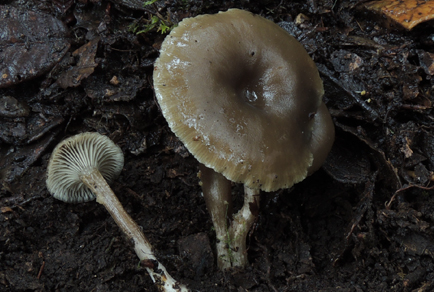
A new saprophytic species from southwestern China, namely Clitolyophyllum paraumbilicatum, is described and illustrated based on morphological characteristics and multi-locus phylogenetic analyses from the nuclear ribosomal internal transcribed spacer (ITS), the large subunit of the nuclear ribosomal RNA (nrLSU), the RNA polymerase II second largest subunit (rpb2), and the translation elongation factor 1-alpha (tef1-a). The new species is characterized by its omphalinoid basidiomata with relatively small beige-brown to dark brown and hygrophanous pileus, central and slender stipes, decurrent lamellae, broadly ellipsoid to ovoid or pyriform basidiospores (6–10 × 3.5–5.5 μm), relatively narrow basidia, and flexuose to cylindrical or irregularly branched terminal cells in pileipellis and stipitipellis occasionally with several excrescences or weakly coralloid. Color photos of fresh basidiomata, line drawings of microscopic features and its comparison with allied taxa are presented.
References
- Alvarado, P., Moreno, G., Vizzini, A., Consiglio, G., Manjón, J.L. & Setti, L. (2015) Atractosporocybe, Leucocybe and Rhizocybe: three new clitocyboid genera in the Tricholomatoid clade (Agaricales) with notes on Clitocybe and Lepista. Mycologia 107 (1): 123–136. https://doi.org/10.3852/13-369
- Bigelow, H.E. (1976) Studies on some lignicolous Clitocybes. Memoirs of the New York Botanical Garden 28: 9–15.
- Bon, M. (1995) Novitates – Lyophylloideae (comb. et st. nov.). Documents Mycologiques 25 (97): 4–4.
- Donk, M.A. (1962) The generic names proposed for Agaricaceae. Nova Hedwigia Beihefte 5: 320.
- Edler, D., Klein, J., Antonelli, A. & Silvestro, D. (2021) raxmlGUI 2.0: A graphical interface and toolkit for phylogenetic analyses using RAxML. Methods in Ecology and Evolution 12: 373–377. https://doi.org/10.1101/800912
- Gulden, G. & Larsson, E. (2016) Atractosporocybe polaris – a new clitocyboid agaric described from arctic-alpine and northern boreal regions in Svalbard and Scandinavia. Agarica 37: 33–44.
- He, Z.M., Chen, Z.H., Bau, T., Wang, G.S. & Yang, Z.L. (2023) Systematic arrangement within the family Clitocybaceae (Tricholomatineae, Agaricales): phylogenetic and phylogenomic evidence, morphological data and muscarine-producing innovation. Fungal Diversity 123: 1–47. https://doi.org/10.1007/s13225-023-00527-2
- Hou, J.X., Qi, Y., Lyu, J.X., Xu, A.G., Zhao, J.C., Guo, H.B., Yang, R.H. & Yu, X.D. (2025) Tephrocybella calocyboides sp. nov. from Liaoning Province, China and an identification key for Tephrocybella. Phytotaxa 695 (1): 115–122. https://doi.org/10.11646/phytotaxa.695.1.6
- Kalyaanamoorthy, S., Minh, B.Q., Wong, T.K.F., Vonhaeseler, A. & Jermiin, L.S. (2017) ModelFinder: fast model selection for accurate phylogenetic estimates. Nature Methods 14 (6): 587–589. https://doi.org/10.1038/nmeth.4285
- Kornerup, A. & Wanscher, J.H. (1981) Taschenlexikon der Farben (3rd ed.). Muster-Schmidt Verlag, Gottingen.
- Liu, Y.J., Whelen, S. & Hall, B.D. (1999) Phylogenetic relationships among ascomycetes: evidence from an RNA polymerse II subunit. Molecular Biology and Evolution 16 (12): 1799–1808. https://doi.org/10.1093/oxfordjournals.molbev.a026092
- Matheny, P.B. (2005) Improving phylogenetic inference of mushrooms with RPB1 and RPB2 nucleotide sequences (Inocybe; Agaricales). Molecular Phylogenetics and Evolution 35 (1): 1–20. https://doi.org/10.1016/j.ympev.2004.11.014
- Musumeci, E. & Contu, M. (2014) Tephroderma (Agaricomycetidae, Tricholomatoid clade), un nuovo genere di basidiomiceti lamellati dalla Francia. Bolletino Associazione Mycologica ed Ecologica Romana 91: 20–30.
- Rehner, S.A. & Buckley, E. (2005) A Beauveria phylogeny inferred from nuclear ITS and EF1-alpha sequences: evidence for cryptic diversification and links to Cordyceps teleomorphs. Mycologia 97 (1): 84–98. https://doi.org/10.3852/mycologia.97.1.84
- Ronquist, F., Teslenko, M., Vandermark, P., Ayres, D.L., Darling, A., Höhna, S., Larget, B., Liu, L., Suchard, M.A. & Huelsenbeck, J.P. (2012) MrBayes 3.2: efficient Bayesian phylogenetic inference and model choice across a large model space. Systematic Biology 61: 539–542. https://doi.org/10.1093/sysbio/sys029
- Sesli, E., Vizzini, A., Ercole, E. & Contu, M. (2016) Clitolyophyllum akcaabatense gen. nov., sp. nov. (Agaricales, Tricholomatineae); a new fan-shaped clitocyboid agaric from Turkey. Botany 94: 73–80. https://doi.org/10.1139/cjb-2015-0172
- Vilgalys lab (1992) Conserved primer sequences for PCR amplification of fungal rDNA. Vilgalys Mycology Lab–Duke University. Available from: https://sites.duke.edu/vilgalyslab/files/2017/08/rDNA-primers-for-fungi.pdf (accessed 16 January 2025).
- Vizzini, A., Alvarado, P., Consiglio, G., Marchetti, M. & Xu, J. (2024) Family matters inside the order Agaricales: systematic reorganization and classification of incertae sedis clitocyboid, pleurotoid and tricholomatoid taxa based on an updated 6-gene phylogeny. Studies in mycology 107: 67–148. https://doi.org/10.3114/sim.2024.107.02
- White, T.J., Bruns, T., Lee, S. & Taylor, J.W. (1990) Amplification and direct sequencing of fungal ribosomal RNA genes for phylogenetics. In: Innis, M.A., Gelfand, D.H., Sninsky, J.J. & White, T.J. (Eds.) PCR protocols: a guide to methods and applications. Academic Press, New York, pp. 315–322.
- Xu, J., Yu, X., Suwannarach, N., Jiang, Y., Zhao, W. & Li, Y. (2021) Additions to Lyophyllaceae s.l. from China. Journal of Fungi 7 (12): 1101. https://doi.org/10.3390/jof7121101
- Zhang, D., Gao, F., Jakovlić, I., Zou, H., Zhang, J., Li, W.X. & Wang, G.T. (2020) PhyloSuite: An integrated and scalable desktop platform for streamlined molecular sequence data management and evolutionary phylogenetics studies. Molecular Ecology Resources 20 (1): 348–355. https://doi.org/10.1111/1755-0998.13096