

Abstract
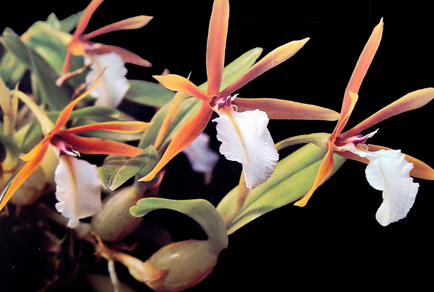
A new nothogenus in Orchidaceae Juss. is described, resulting from the natural cross between Dinema and Nidema, for which the name × Dinedema is proposed. The putative species involved in this intergeneric cross are Dinema polybulbon and Nidema boothii. The resulting nothospecies from this cross is described here as × Dinedema mariae, which originated in the central region of Veracruz, Mexico, where its parental species coexist sympatrically. A description, plate, habitat information, and phenology of the new nothospecies is provided, along with a morphological comparison with its parental species. A spatial distribution model for D. polybulbon and N. boothii is presented, showing their overlap in the area where the hybrid originated.
References
- Anderson, J. (1868) New plants. The Gardener´s Chronicle & Agricultural Gazzete January 11: 27.
- Archila, F., Chiron, G. & Veliz, M. (2013) Encyclia rodolfoi & Encyclia scaeferi, nuevas especies para la subtribu Laeliinae. Revista Guatemalensis 16: 1–11.
- Bersweden, L., Viruel, J., Schatz, B., Harland, J., Gargiulo, R., Cowan, R.S., Calevo, J., Juan, A., Clarkson, J., Leitch, A.R. & Fay, M. (2021) Microsatellites and petal morphology reveal new patterns of admixture in Orchis hybrid zones. American Journal of Botany 108: 1388–1404. https://doi.org/10.1002/ajb2.1710
- Beutelspacher, C.R. & Moreno-Molina, I. (2014) Hallazgos de híbridos naturales entre Prosthechea cochleata (L.) W.E.Higgins y P. radiata (Lindl.) W.E.Higgins (Orchidaceae), en Chiapas, México. Lacandonia 8: 51–56.
- Bolom-Huet, R., Pacheco, X.P., Muñoz-Alonso, A. & Sunny, A. (2022) Potential distribution and connectivity for two plethodontid salamanders: conservation areas and landscape corridors for two endemic species of México and Guatemala. Environmental Management 70: 965–977. https://doi.org/10.1007/s00267-022-01700-0
- Britton, N. & Milspaugh, C.F. (1920) The Bahama Flora. The New York Printing Company, New York, 695 pp. https://doi.org/10.5962/bhl.title.54084
- Brown, R. (1813) Clasis XX. Gynandria. Monandria. In: Aiton, W.T. (Ed.) Hortus Kewensis; or a Catalogue of the Plants Cultivated in the Royal Botanic Garden at Kew, Ed. 2. Vol. V. Richard Taylor & Co., London, pp. 188–220.
- Carnevali, G., Tapia-Muñoz, J.L., Jiménez-Machorro, R., Sánchez-Saldaña, L., Ibarra-González, L., Ramírez, I.M. & Gómez, M.P. (2001) Notes on the flora of the Yucatan Peninsula II: A synopsis of the orchid flora of the Mexican Yucatan Peninsula and a tentative checklist of the Orchidaceae of the Yucatan Peninsula Biotic Province. Harvard Papers in Botany 5: 383–466.
- Cetzal-Ix, W., Balam, R. & Carnevali, G. (2012) A new nothogenus and new nothospecies in the Oncidiinae (Orchidaceae) from Quintana Roo, Mexico. Nordic Journal of Botany 30: 40–46. https://doi.org/10.1111/j.1756-1051.2011.01261.x
- Cetzal-Ix, W., Carnevali, G., Noguera-Saveli, E., Mo, E., Cash-Arcia, N. & Basu, S. (2018) Natural hybridization in Lophiaris (Orchidaceae: Oncidiinae). Systematic Botany 43: 930–949. https://doi.org/10.1600/036364418X697599
- Cetzal-Ix, W., Carnevali, G., Jiménez-Machorro, E. & Pérez-García, E.A. (2020) Laelia × meavei: A new natural hybrid between L. dawsonii fo. dawsonii and L. rubescens fo. peduncularis (Orchidaceae: Laeliinae) from Oaxaca, Mexico. Phytotaxa 446: 81–94. https://doi.org/10.11646/phytotaxa.446.2.1
- Cracraft, J. (1983) Species concepts and speciation analysis. Current Ornithology 1: 159–187. https://doi.org/10.1007/978-1-4615-6781-3_6
- Crawshay, D.B. (1902) Laelia anceps and its varieties. The Gardeners’ Chronicle 3 (ser. 3): 414.
- Christenson, E.A. (1999) The return of Cohniella (Orchidaceae: Oncidiinae). Lindleyana 14: 176–177.
- Dressler, R.L. (2023) Orchidaceae. In: Ulloa-Ulloa, C., Hernández, H.M., Davidse, G., Barrie, F.R. & Knapp, S. (eds.) Flora Mesoamericana Volumen 7, Parte 2. Missouri Botanical Garden, Saint Louis, pp. 1–842.
- Fick, S.E. & Hijmans, R.J. (2017) WorldClim 2: new 1-km spatial resolution climate surfaces for global land areas. International Journal of Climatology 37: 4302–4315. https://doi.org/10.1002/joc.5086
- GBIF, (2025) GBIF homepage. Available from: https://www.gbif.org (accessed 15 April 2025)
- Halbinger, F. (1993) Dos nuevas formas de Laelia: Laelia rubescens f. peduncularis y L. autumnalis f. atrorubens. Orquídea (Mexico City n.s.) 13: 294.
- Hernández, C.M., Alanís-Méndez, J.L., Chagoya-Fuentes, J.L. & Enciso-Díaz, O.J. (2022) Potential distribution of six endemic species of Stanhopea (Orchidaceae) genus in Mexico. Current Botany 13: 81–88. https://doi.org/10.25081/cb.2022.v13.7772
- Hijmans, R.J., Phillips, S., Leathwick, J. & Elith, J. (2017) Dismo: Species Distribution Modeling. R Package Version 1.3–14. https://doi.org/10.1002/joc5086
- Higgins, W.E. (1998) A reconsideration of the genus Prosthechea (Orchidaceae). Phytologia 82: 370–383. https://doi.org/10.5962/bhl.part.29044
- Hooker, W.J. (1828) Curti’s Botanical Magazine, Vol II of the new series. Printed by Edward Couchman, London, pl. 2791–2875.
- Hörandl, E. (2022) Approaches for species concepts and delimitation in polyploids and hybrids. Plants 11: article 204. https://doi.org/10.3390/plants11020204
- Hunt, P.F. (1971) × Pseudorhiza nieschalkii (Senghas) P.F.Hunt. Orchid Review 79: 142.
- iNaturalits (2025a) iNaturalistMex. Available from: https://mexico.inaturalist.org (accessed 15 Abril 2025)
- iNaturalits (2025b) Dinema polybulbon observation. iNaturalistMex. Available from: https://www.inaturalist.org/observations/208893709 (accessed 20 November 2024)
- iNaturalits (2025c) Nidema boothii observation. iNaturalistMex. Available from: https://www.inaturalist.org/observations/73523548 (accessed 20 November 2024)
- INEGI (2022) Catálogo de metadatos geográficos. Comisión Nacional para el Conocimiento y Uso de la Biodiversidad, Mexico City. Available from: http://geoportal.conabio.gob.mx/metadatos/doc/html/dest22gw.html (accessed 10 November 2024)
- Johnson, S.D. (2018) Natural hybridization in the orchid flora of South Africa: Comparisons among genera and floristic regions. South African Journal of Botany 118: 290–298. https://doi.org/10.1016/j.sajb.2018.01.011
- Jussieu, A.L. (1789) Genera Plantarum Secundu Ordines Naturales. Apud Viduam Hérissant et Théophile Barrois, Paris, 498 pp.
- Kass, J.M., Vilela, B., Aiello-Lammens, M.E., Muscarella, R., Merow, C. & Anderson, R.P. (2018) Wallace: A flexible platform for reproducible modeling of species niches and distributions built for community expansion. Methods in Ecology and Evolution 9: 1151–1156. https://doi.org/10.1111/2041-210X.12945
- Kindlmann, P., Kull, T. & McCormick, M. (2023) The distribution and diversity of orchids. Diversity 15: article 810. https://doi.org/10.3390/d15070810
- Knowles, G.B. & Westcott, F. (1838) The Floral Cabinet and Magazine of Exotic Botany. Volume II. Bradbury and Evans Printers, London, 188 pp.
- Kunth, K.S. (1815) Nova Genera et Species Plantarum Tome I. Librariae Greco-Latino-Germanicae, Paris, 377 pp.
- León-Peralta, C., Salmerón-Barrera, E. & Pérez-García, E. (2023) Encyclia × tixtlensis (Orchidaceae: Laeliinae), a possible natural hybrid between E. meliosma and E. atrorubens in Guerrero, Mexico. Phytotaxa 613: 249–260. https://doi.org/10.11646/phytotaxa.613.3.4
- Lexarza, J.J. (1825) Orchidianum Opusculum, In: de la Llave, P & Lexarza, J. Novorum Vegetabilium Descriptiones Fasciculus II. Apud Martinum Riverum, Mexico City, pp. 1–10.
- Lindley, J. (1831) The Genera and Species of Orchidaceous Plants. Printed by W. Nicoli, London, 554 pp. https://doi.org/10.5962/bhl.title.120492
- Lindley, J. (1835) Laelia anceps. Two edged Laelia. Edwards’s Botanical Register 21: pl. 1751.
- Lindley, J. (1838) Miscellaneous notices. Edwards’s Botanical Register 24: 1–95.
- Lindley, J. (1839a) Miscellaneous notices. Edwards’s Botanical Register 25: 1–95.
- Lindley, J. (1839b) Laelia furfuracea. Scurfy-stalked Laelia. Edwards’s Botanical Register 25: pl. 26.
- Lindley, J. (1841) Miscellaneous notices. Edwards’s Botanical Register 27: 1–92.
- Lindley, J. (1842) Oncidium longifolium. Long-leaved Oncidium. Edwards’s Botanical Register 28: pl. 4.
- Lindley, J. (1844) Miscellaneous matter of the Botanical Register. Edwards’s Botanical Register 30: 1–92.
- Linnaeus, C. (1753) Species Plantarum Exhibentes Planta Rite Cognitas, ad Genera Relatas, cum Differentiis Specificis, Nominibus Trivialibus, Synonymis Selectis, Locis Natalibus, Secundum Sistema Sexuale Digesta. Tomus II. Impensis Laurentii Salvii, Holmiae, 1200 pp. https://doi.org/10.5962/bhl.title.59734
- Linnaeus, C. (1763) Species Plantarum Exhibentes Planta Rite Cognitas, ad Genera Relatas, cum Differentiis Specificis, Nominibus Trivialibus, Synonymis Selectis, Locis Natalibus, Secundum Sistema Sexuale Digesta. Tomus II. Editio Secunda. Impensis Laurentii Salvii, Holmiae, 1684 pp. https://doi.org/10.5962/bhl.title.65726
- Maddison, W.P. & Maddison, D.R. (2021) Mesquite: a modular system for evolutionary analysis. Version 3.70. Available from: http://www.mesquiteproject.org (accessed 5 November 2024)
- Martius, C.F.P. (1830) Auswahl Merkwürdiger Pflanzen des K. Botanischen Gartens zu München. Treuttel et Wurtz, München, 26 pp.
- Mayr, E. (1942) Systematics and the Origin of Species from the Viewpoint of a Zoologist. Columbia University Press, Cambridge, 334 pp.
- Mó, E., Cetzal-Ix, W., Carnevali, G., Pérez-García, E.A. & Basu, S. (2014) A new natural hybrid between Prosthechea cochleata and P. radiata (Orchidaceae) from Alta Verapaz, Guatemala. Turkish Journal of Botany 38: 988–998. https://doi.org/10.3906/bot-1312-86
- Muscarella, R., Galante, P.J., Soley-Guardia, M., Boria, R.A., Kass, J.M., Uriarte, M. & Anderson, R.P. (2014) ENMeval: an R package for conducting spatially independent evaluations and estimating optimal model complexity for Maxent ecological niche models. Methods in Ecology and Evolution 5: 1198–1205. https://doi.org/10.1111/2041-210X.12261
- Pérez-Garcia, E.A., Archila, F., Hágsater, E. & Jimenez-Machorro, R. (2023) ×Proslia salvatoriorum (Orchidaceae, Epidendroideae, Laeliinae), un nuevo nototaxón de flores vistosas. Revista Guatemalensis 25: 1–13.
- Phillips, S.J. & Dudik, M. (2018) Modeling of species distributions with Maxent: new extensions and a comprehensive evaluation. Ecography 31: 161–175. https://doi.org/10.1111/j.0906-7590.2008.5203.x
- Pinheiro, F., De Barros, F., Palma-Silva, C., Meyer, D., Fay, M.F., Susuki, R.M., Lexer, C. & Cozzolino, S. (2010) Hybridization and introgression across different ploidy level in the Neotropical orchids Epidendrum fulgens and E. puniceolatum (Orchidaceae). Molecular Ecology 19: 3381–3994. https://doi.org/10.1111/j.1365-294X.2010.04780.x
- R Development Core Team (2019) R: a language and environment for statistical computing. R Foundation for Statistical Computing, Vienna. Available from: https://cran.r-project.org/doc/manuals/r-release/fullrefman.pdf (accessed 25 November 2024)
- Rafinesque, C.S. (1838) Flora Telluriana, Pars IV et Ult. H. Probasco, Philadelphia, 136 pp.
- Regel, E.A. (1856) Adnotationes botanicae de Orchidaceis. Annales des Sciences Naturalles: Botanique 6: 373–378.
- Reichenbach, H.G. (1854) Notulae Orchidaceae. Bonplandia 2: 89–93.
- Reichenbach, H.G. (1869) New plants. The Gardener´s Chronicle & Agricultural Gazzete September 11: 988–989.
- RHS (2025) RHS plant registration. Royal Horticultural Society. Available from: https://www.rhs.org.uk/plants/plantsmanship/plant-registration/orchid-hybrids (accessed 14 April 2025)
- Rolfe, R.A. (1896) New orchids. Decade 16. Bulletin of Miscellaneous Information 46: 44–47. https://doi.org/10.2307/4118412
- Salazar, G.A., Reyes-Santiago, J., Brachet, C. & Pérez-Crisanto, J. (2006) Orquídeas y otras Plantas Nativas de la Cañada Cuicatlán, Oaxaca, México. Instituto de Biología, Universidad Nacional Autonoma de Mexico, Mexico City, 175 pp.
- Salazar, G.A., Jiménez, R., Huerta-Espinoza, H.M. & Hágsater, E. (2014) A new species and a new natural hybrid of Laelia (Orchidaceae) from Oaxaca, Mexico. Phytotaxa 178: 161–170. https://doi.org/10.11646/phytotaxa.178.3.1
- Schlechter, F.R.R. (1913) Orchidaceae. In: Urban, I. (ed.) Symbollae Antillanae seu Fundamenta Florae Indiae Occidentalis Vol. 7. Lipsiae Fratres Borntraeger, Paris, pp. 492–498.
- Schlechter, F.R.R. (1914) Die Orchideen ihre Beschreibung, Kultur und Züchtung Handbuch für Orchideenliebhaber, Kultivateure und Botaniker. Verlagsbuschhandlung Paul Parey, Berlin, 837 pp.
- Schlechter, F.R.R. (1918) Kritische Aufzählung der bisher aus Zentral-Amerika bekanntgewodenen Orchidaceae. Beihefte zum Botanischen Centralblatt 36: 321–520.
- Schlechter, F.R.R. (1920) Die orchideenfloren der Südamerikanishen Kordillerenstaaten. Repertorium Specierum Novarum Regni Vegetabilis 7: 1–301.
- Schlechter, F.R.R. (1922) Beiträge zur Orchideenkunde von Zentralamerika I. Orchidaceae Powellianae Panamenses. Repertorium Specierum Novarum Regni Vegetabilis 17: 1–95. https://doi.org/10.1002/fedr.19210171918
- SEMARNAT (2010) Norma Oficial Mexicana NOM-059-SEMARNAT-2010. Protección ambiental-Especies nativas de México de flora y fauna silvestres-Categorías de riesgo y especificaciones para su inclusión, exclusión o cambio-lista de especies en riesgo. Diario Oficial de la Federación. Secretaria de Medio Ambiente y Recursos Naturales, Mexico City. Available from: https://www.dof.gob.mx/normasOficiales/4254/semarnat/semarnat.htm (accessed 10 November 2024)
- SEINet (2025) Arizona-New Mexico chapter. Available from: https://swbiodiversity.org/seinet/index.php (accessed 15 April 2025)
- Shaw, J.M.H. (2004) Supplement of new orchid hybrids, May-July 2004. The Orchid Review 112 (suppl.): 1–77.
- Shaw, J.M.H. (2011) Supplement of new orchid hybrids, May-July 2004. The Orchid Review 119 (suppl.): 1–77.
- Solano, R., Huerta-Espinoza, H., Cruz-García, G. & Ortíz-Riveros, F. (2019) A new natural hybrid in the genus Laelia (Orchidaceae) from Oaxaca, Mexico. Phytotaxa 402: 232–240. https://doi.org/10.11646/phytotaxa.402.5.2
- Solano, R. & Licona, E. (2023) The genus Anathallis (Pleurothallidiane) in Mexico. Lankesteriana 23: 633–676. https://doi.org/10.15517/lank.v23i3.56884
- Swartz, O. (1788) Nova Genera et Species Plantarum seu Prodromus. M. Swederi, Upsala, 158 pp.
- Thiers, B. (2025 [continuously updated]) Index Herbariorum: A global directory of public herbaria and associated staff. New York Botanical Garden’s Virtual Herbarium. Available from: http://sweetgum.nybg.org/science/ih/ (accessed 30 March 2025)
- Turland, N.J., Wiersema, J.H., Barrie, F.R., Greuter, W., Hawksworth, D.L., Herendeen, P.S., Knapp, S., Kusber, W.-H., Li, D.-Z., Marhold, K., May, T.W., McNeill, J., Monro, A.M., Prado, J., Price, M.J. & Smith, G.F. (eds.) (2018) International Code of Nomenclature for algae, fungi, and plants (Shenzhen Code) adopted by the Nineteenth International Botanical Congress Shenzhen, China, July 2017. Regnum Vegetabile 159. Glashütten: Koeltz Botanical Books. https://doi.org/10.12705/Code.2018
- UNAM (2025) IBData v4: Base de datos de biodiversidad. Instituto de Biología, Universidad Nacional Autónoma de México, Mexico City. Available from: https://www.ibdatav4pgsql.virtualhalls.net/web/ (accessed 10 April 2025)
- van Den Berg, C., Higgins, W.E., Dressler, R.L., Whitten, M.W., Soto-Arenas, M.A. & Chase, M.W. (2009) A phylogenetic study of Laeliinae (Orchidaceae) based on combined nuclear and plastid DNA sequences. Annals of Botany 104: 417–430. https://doi.org/10.1093/aob/mcp101
- Warren, D.L. & Seifert, S.N. (2011) Ecological niche modeling in Maxent: the importance of model complexity and the performance of model selection criteria. Ecology Applied 21: 335–342.
- https://doi.org/10.1890/10-1171.1
- Whitner, C.L. (1998) The Cattleyas and Their Relatives Volume V. Timber Pres, Portland, 198 pp.
- Yam, T.W. & Arditti, J. (2009) History of Orchid Propagation: a Mirror of the History of Biotechnology. Plants Biotechnology Reports 3: 1–56. https://doi.org/10.1007/s11816-008-0066-3