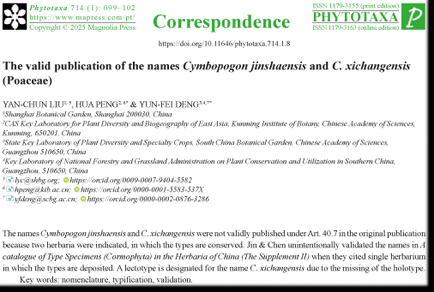

Abstract
N/A
References
- Bertea, C.M. & Maffei, M.E. (2010) The genus Cymbopogon: botany including anatomy, physiology, biochemistry, and molecular biology. In: Akhila, A. (ed.) Essential Oil Bearing Grasses: The genus Cymbopogon. CRC Press, Boca Raton, FL, pp. 1–24.
- Camus, A.A. (1925) Gramiées d’Indochine pouvany donner de la pâte à papier. Revue de Botanique Appliquée et d'Agriculture Coloniale 5: 204–211.
- Chen, S.L. & Phillips, S.M. (2006) Cymbopogon. In: Wu, Z.Y., Raven, P. & Hong, D.Y. (eds.) Flora of China 22. Science Press, Beijing, and Missouri Botanical Garden Press, St Louis, pp. 624–631.
- Deng, Y.F. (2023) The valid publication of the name Malus leioclyca (Rosaceae). Phytotaxa 594 (1): 85–88. https://doi.org/10.11646/phytotaxa.594.1.9
- He, L., Liao, S., Applequist,W. & Chen, S.P. (2019) The valid publication of Salix suchowensis (Salicaceae). PhytoKeys 131: 27–35. https://doi.org/10.3897/phytokeys.131.37065
- Jin, S.Y. & Chen, Y.L. (1994) A catalogue of type specimens (Cormophyta) in the herbaria of China. Sciences Press, Beijing, 716 pp.
- Jin, S.Y. & Chen, Y.L. (1999) A catalogue of type specimens (Cormophyta) in the herbaria of China (The supplement). China Forestry Publishing House, Beijing, 264 pp.
- Jin, S.Y. & Chen, Y.L. (2007) A catalogue of type specimens (Cormophyta) in the herbaria of China (The Supplement II). Science Press, Beijing, 205 pp.
- Li, B. (2018) Two illegitimate superfluous names in Premna (Lamiaceae, Premnoideae). Phytotaxa 347 (2): 189–190. https://doi.org/10.11646/phytotaxa.347.2.7
- Liao, S., He, L., Shang, C. & Zhang, Z.X. (2015a) Lectotypification and identity of Xylosma fasciculiflora (Salicaceae). Taxon 64 (2): 378–381. https://doi.org/10.12705/642.1
- Liao, S., Ji, X.Y., Peng, Y.S., Liang, T.J. & Zhang, Z.X. (2015b) The identity of Casearia membranacea f. nigrescens (Salicaceae). Phytotaxa 218 (1): 97–100. https://doi.org/10.11646/phytotaxa.218.1.9
- McNeil, J. (2014) Holotype specimens and type citations: General issues. Taxon 63 (5): 1112–1113. https://doi.org/10.12705/635.7
- Steudel, E.G. (1855) Synopsis Plantarum Glumacearum 1 (4–5). J. B. Metzler, Stuttgartiae, Pars 1, pp. 341–400.
- Qin, H.N., Liu, H.Y., He, Q. & Shan, Z.J. (2019) Index Herbariorum Sinicorum (Second Edition). Science Press, Beijing, 340 pp.
- Sprengel, K.P. (1815) Plantarum minus cognitarum pugillus 2. C.A. Kümmelium, Halae, 70 pp.
- Soreng, R.J., Peterson, P.M., Zuloaga, F.O., Romaschenko, K., Clark, L.G., Teisher, J.K., Gillespie, L.J., Barberá, P., Welker, C.A.D., Kellogg, E.A., Li, D.Z. & Davidse, G. (2022) A worldwide phylogenetic classification of the Poaceae (Gramineae) III: An update. Journal of Systematics and Evolution 60 (3): 476–521. https://doi.org/10.1111/jse.12847
- Sun, B.X. (2003) Cymbopogon. In: Wu, C.Y. (ed.) Flora Yunnanica 9. Science Press, Beijing, pp. 679–693.
- Thiers, B. (2025 [continuously updated]) Index Herbariorum: A global directory of public herbaria and associated staff. New York Botanical Garden’s Virtual Herbarium. Available from: http://sweetgum.nybg.org/science/ih/ (accessed 3 January 2025)
- Turland, N.J., Wiersema, J.H., Barrie, F.R., Greuter, W., Hawksworth, D.L., Herendeen, P.S., Knapp, S., Kusber, W.H., Li, D.Z., Marhold, K., May, T.W., McNeill, J., Monro, A.M., Prado, J., Price, M.J. & Smith, G.F. (2018) International Code of Nomenclature for algae, fungi, and plants (Shenzhen Code). Regnum Vegetabile 159. Glashütten: Koeltz Botanical Books. https://doi.org/10.12705/Code.2018
- Watson, W. (1882) A list of the flora of Kumaon and Kumaon Bhábar. In: Atkinson, E.T. (ed.) Himálayan districts of the North-Western Provinces of India. North-western Province and Oud II Government Press, Allahabad, pp. 327–402.
- Yang, Y. (2016) Is Ephedra lepidosperma (Ephedraceae) a validly published name? Phytotaxa 275 (2): 189–190. https://doi.org/10.11646/phytotaxa.275.2.12
- Yu, W.B., Wang, H. & Li, D.Z. (2011) Names of Chinese seed plants validly published in A Catalogue of Type Specimens (Cormophyta) in the Herbaria of China and its two supplements. Taxon 60 (4): 1168–1172. https://doi.org/10.1002/tax.604019
- Yu, W.B. (2013) Valid publication of the name Anaphalis hymenolepis (Asteraceae). Phytotaxa 138 (1): 58–60. https://doi.org/10.11646/phytotaxa.138.1.7
- Yu, W.B. & He, F. (2013) Nomenclatural notes on Rhododendron sparsifolium (Ericaceae). Nordic Journal of Botany 31: 309–311. https://doi.org/10.1111/j.1756-1051.2012.01620.x
- Yu, W.B. & Li, D.Z. (2014) Valid publication of the name Sarcococca longipetiolata (Buxaceae): Third time lucky. Taxon 63 (4): 925–928. https://doi.org/10.12705/634.11
- Zhang, J.H., Du, C., Applequist,W.L. & Liao, S. (2023) An overview on the valid publication and typification of Dryoathyrium chinense and Deparia chinensis (Athyriaceae, Aspleniineae, Polypodiales). Phytotaxa 579 (1): 67–69. https://doi.org/10.11646/phytotaxa.579.1.8
- Zhang, R., Li, C.H., Su, Z.W. & Sun, B.X. (1993) Two new species of Cymbopogon Spreng. of Poaceae from Yunnan and Sichuan Provinces. Journal of Plant Resources and Environment 2 (2): 39–43.