

Abstract
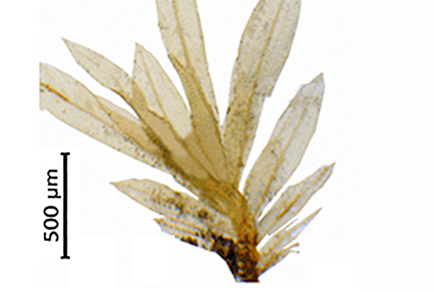
The Trindade Island is located in the South Atlantic, about 1,200 km from the Brazilian coast. Although is a small island, area totaling 9.28 km², Trindade hosted high number of endemic species, including 15 endemic plants. The flora is compost mainly by angiosperms, but 32 species of bryophytes, distributes in three botany divisions, live in the island. Fissidentaceae is the second largest family of mosses from Brazil, with 72 species distributed in all Brazilian biomes, and two species were recognized to Trindade Island. Studies with Fissidentaceae from Brazil, made is possible to recognize a new species of Fissidens from Trindade Island and a new occurrence of Fissidens was found in the Martin Vaz Archipelago. Here we propose the new species, Fissidens trindadensis, the name was used in a previous publication, but as an invalid name according the International Code of Nomenclature for algae, fungi, and plants. Now the taxa are here described, illustrated and compared with morphologically similar species.
References
- Alves, R.J.V. (2006) Terrestrial vascular floras of Brazil’s Oceanic Archipelagos. In: Alves, R.J.V. & Castro, J.W.A. (Eds.) Ilhas Oceânicas Brasileiras—da pesquisa ao manejo. Ministério do Meio Ambiente, Brasília, DF, pp. 85–103.
- Alves, R.J.V. (1998) Ilha da Trindade & Arquipélago Martin Vaz—um Ensaio Geobotânico. Serviço de Documentação da Marinha, Rio de Janeiro, RJ, pp. 144 pp.
- Anderson, L.E. (1954) Hoyer’s solution as a rapid permanent mounting medium for bryologists. The Bryologist 57: 242–244. https://doi.org/10.1639/0007-2745(1954)57[242:HSAARP]2.0.CO;2
- Bordin, J. & Yano, O. (2013) Fissidentaceae (Bryophyta) do Brasil. Boletim do Instituto de Botânica 22: 1–72.
- Bordin, J. (2015) Fissidentaceae in Lista de Espécies da Flora do Brasil. Jardim Botânico do Rio de Janeiro. [http://floradobrasil.jbrj.gov.br/jabot/floradobrasil/FB96294]
- Faria, A.L.A., Carvalho-Silva, M., Costa, D.P. & Câmara, P.E.A.S. (2012) The bryophytes of Trindade Island, South Atlantic, Brazil. Acta botanica Brasilica 26: 783–793. https://doi.org/10.1590/S0102-33062012000400008
- Flora e Funga do Brasil (2025) Jardim Botânico do Rio de Janeiro. Available from: http://floradobrasil.jbrj.gov.br/ (accessed 9 January 2025)
- Goffinet, B., Buck, W.R. & Shaw, A.J. (2008) Morphology, anatomy and classification of the Bryophyte. In: Goffinet, B. & Shaw, A.J. (Eds.) Bryophyte Biology. Cambridge University Press, Cambridge, pp. 55–138. https://doi.org/10.1017/CBO9780511754807
- IUCN (2024) Guidelines for Using the IUCN Red List Categories and Criteria. Version 16. Prepared by the Standards and Petitions Committee. Available from: http://www.iucnredlist.org/documents/RedListGuidelines.pdf (accessed 9 January 2025)
- Pursell, R.A. (2007) Fissidentaceae. Flora Neotropica, Monograph 101: 1–278.
- Santos, A.C.S., Oliveira, A.L., Bevilaqua, L.A., Rocha-Júnior, E.R.V., Rodrigues, S.W.O., Mendes, J.C. & Jeck, I.K. (2022) Martin Vaz Archipelago. In: Santos, A.C. & Hackspacher, P.C. (Eds.) Meso-Cenozoic Brazilian Offshore Magmatism. Academic Press, pp. 391–432. https://doi.org/10.1016/B978-0-12-823988-9.00013-7
- Serafini, T.Z., França, G.B. & Andrigueto-Filho, J.M. (2010) Ilhas oceânicas brasileiras: Biodiversidade conhecida e sua relação com o histórico de uso e ocupação humana. Revista de Gestão Costeira Integrada 10 (3): 281–301. https://doi.org/10.5894/rgci178
- Silva, N.G. & Alves, R.J.V. (2020) Plantas nativas da Ilha da Trindade. Infocirm 32: 18.
- Stuessy, T.F. & Ono, M. (2007) Evolution and Speciation of Island Plants. Cambridge University Press, Cambridge, 376 pp.
- Stuessy, T.F., Takayama, K., López-Sepúlveda, P. & Crawford, D.J. (2014) Interpretation of patterns of genetic variation in endemic plant species of oceanic islands. Botanical Journal of the Linnean Society 174: 276–288. https://doi.org/10.1111/boj.12088
- Suzuki, T., Inoue, Y. & Tsubota, H. (2018) Molecular phylogeny of the genus Fissidens (Fissidentaceae, Bryophyta) and a refinement of the infrageneric classification. Molecular Phylogenetics and Evolution 127: 190–202. https://doi.org/10.1016/j.ympev.2018.05.020
- Teixeira, T.P.O., Faria, A.L.A., Bordin, J. & Carvalho-Silva, M. (2022) Phylogeny and morphology of Fissidentaceae Schimp. in the South Atlantic Islands and description of a new species. Cryptogamie, Bryologie 43 (1): 1–8. https://doi.org/10.5252/cryptogamie-bryologie2022v43a1
- Thiers, B.M. (2023) Index Herbariorum. Available from: http://sweetgum.nybg.org/science/ih/ (accessed 9 January 2025)
- Turland, N.J., Wiersema, J.H., Barrie, F.R., Greuter, W., Hawksworth, D.L., Herendeen, P.S., Knapp, S., Kusber, W.-H., Li, D.-Z., Marhold, K., May, T.W., McNeill, J., Monro, A.M., Prado, J., Price, M.J. & Smith, G.F. (2018) International Code of Nomenclature for algae, fungi, and plants (Shenzhen Code) adopted by the Nineteenth International Botanical Congress Shenzhen, China, July 2017. Regnum Vegetabile 159. Glashütten: Koeltz Botanical Books. https://doi.org/10.12705/Code.2018