

Abstract
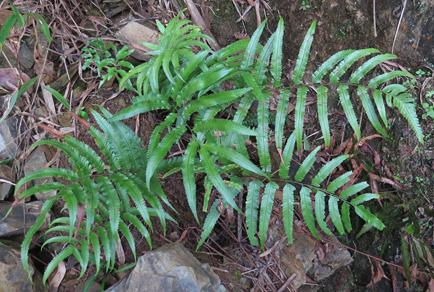
Arachniodes mira, a new sexual diploid species of Dryopteridaceae from southeastern Yunnan, China, is described and illustrated. This species is unique within the genus for its fronds transitioning from pinnate with a caudate-acuminate apex when young to either imparipinnate or to bipinnate with a terminal pinna when mature. This new species may have arisen from hybridization between A. neopodophylla and an unknown bipinnate species, displaying a combination of morphological features between these two species. The only found population is facing with extinction due to habitat destruction.
References
- Blume, C.L. von (1828) Enumeratio Plantarum Javae et insularum adjacentium: minus cognitarum vel novarum ex herbariis Reinwardtii, Kohlii, Hasseltii et Blumii. Fasc. 2. F. & H. Hartmann, Den Haag, pp. 165–241. https://doi.org/10.5962/bhl.title.44901
- Ching, R.-C. (1938) A revision of the Chinese and Sikkim-Himalayan Dryopteris with reference to some species from neighboring regions. Bulletin of the Fan Memorial Institute of Biology: Botany 8 (6): 363–507.
- Ching, R.-C. (1962) On the nomenclature of the compound-leaved polysticha. Acta Botanica Sinica 10 (3): 253–263.
- Ching, R.-C. (1964) Notes on some confused species of Arachniodes Bl. Acta Phytotaxonomica Sinica 9 (4): 383–385.
- Ching, R.-C. (1987) Some additions and corrections to the fern genus Phanerophlebiopsis Ching. Bulletin of Botanical Research 7 (1): 71–75.
- Crevost, C. & Lemarié, C. (1917) Catalogue des produits de l'Indochine. Vol 1. Produits Alimentaires. Government Général de L'Indochine, Hanoi, 300 pp.
- De Boer, H., Newman, M., Poulsen, A.D., Droop, A.J., Fér, T., Thu Hiền, L.T., Hlavatá, K., Lamxay, V., Richardson, J.E., Steffen, K. & Leong-Škorničková, J. (2018) Convergent morphology in Alpinieae (Zingiberaceae): Recircumscribing Amomum as a monophyletic genus. Taxon 67 (1): 6–36. https://doi.org/10.12705/671.2
- He, H., Wu, S.-G., Xiang, J.-Y. & Barrington, D.S. (2013) Arachniodes Blume. In: Wu, Z.-Y., Raven, P.H. & Hong, D.-Y. (Eds.) Flora of China. Vols. 2–3. Science Press, Beijing & Missouri Botanical Garden Press, St. Louis, pp. 542–558.
- IUCN. (2012) Red List Categories and Criteria: version 3.1. Second edition. Gland, Switzerland and Cambridge, UK: IUCN, iv+32 pp. Available from: https://www.iucnredlist.org/ (accessed 10 May 2024)
- Kurata, S. (1965) Notes on Japanese ferns (36) Journal of Geobotany; or the Hokuriku Journal of Botany 13 (4): 98–101.
- Léveillé, H. (1914–1915) Flore du Kouy-Tchéou. 456 pp. Available from: https://www.biodiversitylibrary.org/item/9613#page/443/mode/1up (accessed 16 June 2025)
- Li, Z.-Y., Li, L.-Q., Su, Z.-Y., Wang, Y.-M., Wu, T.-L. & Zhao, Z.-C. (1995) Pteridophyta. In: Wang, W.-T. (Ed.) Keys to the Vascular Plants of the Wuling Mountains. Science Press, Beijing, pp. 572–573.
- Lu, N.T., Ebihara, A., He, H., Zhang, L., Zhou, X.-M., Knapp, R., Kamau, P., Lorence, D., Gao, X.-F. & Zhang, L.-B. (2019) A plastid phylogeny of the fern genus Arachniodes (Dryopteridaceae). Molecular Phylogenetics and Evolution 133: 214–235. https://doi.org/10.1016/j.ympev.2018.12.013
- Makino, T. (1899) Plantæ Japonenses novæ vel minus cognitæ. The Botanical Magazine, Tokyo 13 (146): 49–58. https://doi.org/10.15281/jplantres1887.13.147_61
- Miquel, F.A.W. (1867) Prolusio florae iaponicae. Annales Musei Botanici Lugduno-Batavi 3: 91–209.
- Nakaike, T. (1975) Aspidiaceae. In: Enumeratio Pteridophytarum Japonicarum. University of Tokyo Press, Tokyo, pp. 183–194.
- Nakaike, T. (2001) A synoptical study on the fern genus Arachniodes Blume (Dryopteridaceae). Journal of Phytogeography and Taxonomy 49 (1): 7–30. https://doi.org/10.24517/00055346
- Rosenstock, E. (1914) XXXV. Filices extremi orientis novae. II. Repertorium Specierum Novarum Regni Vegetabilis 13 (355–358): 129–135. https://doi.org/10.1002/fedr.19140130902
- Wei, H.-J. (2024) Selliguea quinquefida (Polypodiaceae), a new calciphilous species from a karst area in Guangxi, China. Phytotaxa 649 (3): 279–285. https://doi.org/10.11646/phytotaxa.649.3.5
- Wei, H.-J., Le, X.-G. & Chen, B. (2023) Arachniodes breviaristata (Dryopteridaceae): a new species from Jiangxi, China. Phytotaxa 629 (3): 283–289. https://doi.org/10.11646/phytotaxa.629.3.10
- Wei, H.-J., Zhou, X.-L., Chen, B. & Yang, Q.-H. (2019) New records for ferns from Guizhou, China (II). Journal of Guangxi Normal University (Natural Science Edition) 37 (2): 152–157.
- Wu, S.-F. (1993) A new species of Phanerophlebiopsis from Hunan. Acta Botanica Yunnanica 15 (3): 255–256.
- Zhao, C.-F., Wei, R., Zhang, X.-C. & Xiang, Q.-P. (2020) Backbone phylogeny of Lepisorus (Polypodiaceae) and a novel infrageneric classification based on the total evidence from plastid and morphological data. Cladistics 36 (3): 235–258. https://doi.org/10.1111/cla.12403