
Abstract
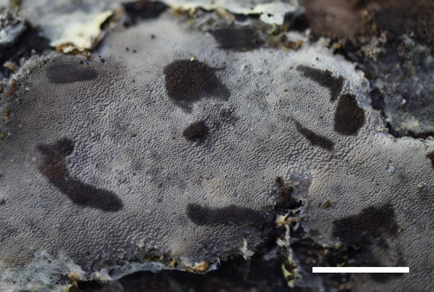
A new genus Septocystis gen. nov. was set up during the macrofungal diversity survey in southern China. Phylogenetic analyses of ITS+nLSU+RPB2 dataset showed that the new genus belongs to the family Polyporaceae. Furthermore, it is sister to Pseudomegasporoporia in the core polyporoid clade of Polyporales with a monophyletic lineage. Distinguishing characters of the new genus are its basidiomata resupinate; hyphal system dimitic; generative hyphae bearing clamp connections, skeletal hyphae frequently branched, usually well differentiated from the main part in trama; dendrohyphidia absent, hyphal pegs present; cystidia fusoid, long clavate to flask shaped, usually with 1–3 septa at tip; cystidioles fusoid, long clavate to flask shape; basidia barrel-shaped to cylindrical; basidiospores cylindrical, IKI−, CB+. A new species Septocystis minor is described. Taxonomic descriptions and illustrations are presented.
References
- Adanson, M. (1763) Familles des plantes. Vincent, Paris. https://doi.org/10.5962/bhl.title.271
- Chen, J.J., Cui, B.K., Zhou, L.W., Korhonen, K. & Dai, Y.C. (2015) Phylogeny, divergence time estimation, and biogeography of the genus Heterobasidion (Basidiomycota, Russulales). Fungal Diversity 71: 185–200. https://doi.org/10.1007/s13225-014-0317-2
- Chen, J.Z., Yang, X. & Zhao, C.L. (2020) Vanderbylia cinnamomea sp. nov. from southwestern China. Mycotaxon 135 (2): 371–382, pl. 12. https://doi.org/10.5248/135.371
- Chen, Y.Y. & Cui, B.K. (2016) Phylogenetic analysis and taxonomy of the Antrodia heteromorpha complex in China. Mycoscience 57 (1): 1–10. https://doi.org/10.1016/j.myc.2015.07.003
- Chen, Y.Y., Wu, F., Wang, M. & Cui, B.K. (2017) Species diversity and molecular systematics of Fibroporia (Polyporales, Basidiomycota) and its related genera. Mycological Progress 16: 521–533. https://doi.org/10.1007/s11557-017-1285-1
- Cui, B.K. & Dai, Y.C. (2013) Molecular phylogeny and morphology reveal a new species of Amyloporia (Basidiomycota) from China. Antonie Van Leeuwenhoek 104 (5): 817–27. https://doi.org/10.1007/s10482-013-9994-1
- Cui, B.K., Li, H.J., Ji, X., Zhou, J.L., Song, J., Si, J., Yang, Z.L. & Dai, Y.C. (2019) Species diversity, taxonomy and phylogeny of Polyporaceae (Basidiomycota) in China. Fungal Diversity 97: 137–392. https://doi.org/10.1007/s13225-019-00427-4
- Dai, Y.C. (2010) Hymenochaetaceae (Basidiomycota) in China. Fungal Diversity 45 (1): 131–343. https://doi.org/10.1007/s13225-010-0066-9
- Dai, Y.C., Cui, B.K. & Liu, X.Y. (2010) Bondarzewia podocarpi, a new and remarkable polypore from tropical China. Mycologia 102 (4): 881–886. https://doi.org/10.3852/09-050
- Dai, Y.C., Yang, Z.L., Cui, B.K., Wu, G., Yuan, H.S., Zhou, L.W., He, S.H., Ge, Z.W., Wu, F., Wei, Y.L., Yuan, Y. & Si, J. (2021) Diversity and systematics of the important macrofungi in Chinese forests. Mycosystema 40: 770–805. https://10.13346/j.mycosystema.210036
- Decock, C., Valenzuela, R. & Castillo, G. (2010) Studies in Perenniporia s. l. Perenniporiella tepeitensis comb. nov., an addition to Perenniporiella: Evidence from morphological and molecular data. Cryptogamie Mycologie 31: 419–429.
- Donk, M.A. (1960) The generic names proposed for Polyporaceae. Persoonia 1: 173–302.
- Donk, M.A. (1964) The conspectus of the families of the Aphyllophorales. Persoonia 3: 199–324.
- Fries, E. (1838) Epicrisis systematis mycologici. Typographia Academica, Upsaliae.
- Gilbertson, R.L. & Ryvarden, L. (1986) North American polypores 1. Fungiflora, Oslo.
- Gilbertson, R.L. & Ryvarden, L. (1987) North American polypores 2. Fungiflora, Oslo.
- Gorjón, S.P., Bobadilla-Peñaló, E.M. & Bobo-Pinilla, J. (2020) Phylogeny of Podofomes trogii reveals its relationships with Datronia in the Polyporaceae (Basidiomycota). Sydowia 73: 13–19. https://doi.org/10.12905/0380.SYDOWIA72-2020-0013
- Han, M.L., Chen, Y.Y., Shen, L.L., Song, J., Vlasák, J., Dai, Y.C. & Cui, B.K. (2016) Taxonomy and phylogeny of the brown-rot fungi: Fomitopsis and its related genera. Fungal Diversity 80: 343–373. https://doi.org/10.1007/s13225-016-0364-y
- He, M.Q., Zhao, R.L., Hyde, K.D., Begerow, D., Kemler, M., Yurkov, A., McKenzie, E.H.C., Raspé, O., Kakishima, M., Sánchez-Ramírez, S., Vellinga, E.C., Halling, R., Papp, V., Zmitrovich, I.V., Buyck, B., Ertz, D., Wijayawardene, N.N., Cui, B.-K., Schoutteten, N., Liu, X.-Z., Li, T.-H., Yao, Y.-J., Zhu, X.-Y., Liu, A.-Q., Li, G.-J., Zhang, M.-Z., Ling, Z.-L., Cao, B., Antonín, V., Boekhout, T., da Silva, B.D.B., De Crop, E., Decock, C., Dima, B., Dutta, A.K., Fell, J.W., Geml, J., Ghobad-Nejhad, M., Giachini, A.J., Gibertoni, T.B., Gorjón, S.P., Haelewaters, D., He, S.-H., Hodkinson, B.P., Horak, E., Hoshino, T., Justo, A., Lim, Y.W., Menolli Jr., N., Mešić, A., Moncalvo, J.-M., Mueller, G.M., Nagy, L.G., Nilsson, R.H., Noordeloos, M., Nuytinck, J., Orihara, T., Ratchadawan, C., Rajchenberg, M., Silva-Filho, A.G.S., Sulzbacher, M.A., Tkalčec, Z., Valenzuela, R., Verbeken, A., Vizzini, A., Wartchow, F., Wei, T.-Z., Weiß, M., Zhao, C.-L. & Kirk, P.M. (2019) Notes, outline and divergence times of Basidiomycota. Fungal Diversity 99: 105–367. https://doi.org/10.1007/s13225-019-00435-4
- Hibbett, D.S. & Donoghue, M.J. (1995) Progress toward a phylogenetic classification of the Polyporaceae through parsimony analysis of mitochondrial DNA sequences. Canadian Journal of Botany 73 (S1): 853–861. https://doi.org/10.1139/b95-331
- Ji, X., Zhou, J.L., Song, C.G., Xu, T.M., Wu, D.M. & Cui, B.K. (2022) Taxonomy, phylogeny and divergence times of Polyporus (Basidiomycota) and related genera. Mycosphere 13 (1): 1–52. https://doi.org/10.5943/mycosphere/13/1/1
- Ji, X.H. & Wu, F. (2017) Pseudomegasporoporia neriicola gen. et sp. nov. (Polyporaceae, Basidiomycota) from East Asia. Nova Hedwigia 105 (3–4): 435–443. https://doi.org/10.1127/nova_hedwigia/2017/0424
- Justo, A. & Hibbett, D.S. (2011) Phylogenetic classification of Trametes (Basidiomycota, Polyporales) based on a five–marker dataset. Taxon 60: 1567–1583. https://doi.org/10.1002/tax.606003
- Justo, A., Miettinen, O., Floudas, D., Ortiz-Santana, B., Sjökvist, E., Lindner, D., Nakasone, K., Niemelä, T., Larsson, K.H., Ryvarden, L. & Hibbett, D.S. (2017) A revised family-level classification of the Polyporales (Basidiomycota). Fungal Biology 121 (9): 798–824. https://doi.org/10.1016/j.funbio.2017.05.010
- Kirk, P.M., Cannon, P.F., Minter, D.W. & Stalpers, J.A. (2008) Dictionary of the fungi, 10th edition. CABI, Wallingford.
- Li, H.J. & Cui, B.K. (2013) Taxonomy and phylogeny of the genus Megasporoporia and its related genera. Mycologia 105 (2): 368–383. https://doi.org/10.3852/12-114
- Li, H.J., Cui, B.K. & Dai, Y.C. (2014) Taxonomy and multi-gene phylogeny of Datronia (Polyporales, Basidiomycota). Persoonia 32: 170–182. https://doi.org/10.3767/003158514X681828
- Lira, C.R.S., Alvarenga, R.L.M., Soares, A.M.S., Ryvarden, L. & Gibertoni, T.B. (2021) Phylogeny of Megasporoporia s.lat. and related genera of Poyporaceae: New genera, new species and new combinations. Mycosphere 12 (1): 1262–1289. https://doi.org/10.5943/mycosphere/12/1/16
- Liu, S., Chen, Y.Y., Sun, Y.F., He, X.L., Song, C.G., Si, J., Liu, D.M., Gates, G. & Cui, B.K. (2023) Systematic classification and phylogenetic relationships of the brown-rot fungi within the Polyporales. Fungal Diversity 118: 1–94. https://doi.org/10.1007/s13225-022-00511-2
- Liu, Y.J., Whelen, S. & Hall, B.D. (1999) Phylogenetic relationships among ascomycetes: evidence from an RNA polymerse II subunit. Molecular Biology and Evolution 16 (12): 1799–808. https://doi.org/10.1093/oxfordjournals.molbev.a026092
- Mao, W.L., Wu, Y.D., Liu, H.G., Yuan, Y. & Dai, Y.C. (2023) A contribution to Porogramme (Polyporaceae, Agaricomycetes) and related genera. IMA Fungus 14: 5. https://doi.org/10.1186/s43008-023-00110-z
- Melo, I., Salcedo, I., Garcia, C.A. & Olariaga, I. (2023) Two new species of resupinate poroid fungi (Basidiomycota, Polyporaceae) from São Tomé and Príncipe Archipelago. Phytotaxa 607 (1): 41–56. https://doi.org/10.11646/phytotaxa.607.1.4
- Micheli, P.A. (1729) Nova Plantarum Genera. B. Paperninii, Florence.
- Munsell Color (Firm) (2019) Munsell Soil Color Charts: with Genuine Munsell Color Chips. 2009 year revised, 2019 production. Munsell Color, Grand Rapids, MI.
- Nunez, M. & Ryvarden, L. (1995) Polyporus (Basidiomycotina) and related genera. Synopsis Fungorum 10: 1–85.
- Nunez, M. & Ryvarden, L. (2001) East Asian polypores 2. Synopsis Fungorum 14: 170–522.
- Nylander, J.A.A. (2004) MrModeltest v2. Program distributed by the author. Evolutionary Biology Centre, Uppsala University.
- Posada, D. & Crandall, K.A. (1998) Modeltest: testing the model of DNA substitution. Bioinformatics 14: 817–818. https://doi.org/10.1093/bioinformatics/14.9.817
- Razzaq, F., Murtaza, R., Usman, M., Khalid, A.N., Ashraf, S. & Li, Q. (2024) Pseudomegasporoporia margallensis sp. nov. and Microporellus subadustus (Polyporaceae, Basidiomycota) newly described and recorded from Pakistan. BMC Microbiology 24 (1): 484. https://doi.org/10.1186/s12866-024-03567-z
- Robledo, G.L., Amalfi, M., Castillo, G., Rajchenberg, M. & Decock, C. (2009) Perenniporiella chaquenia sp. nov. and further notes on Perenniporiella and its relationships with Perenniporia (poriales, basidiomycota). Mycologia 101 (5): 657–73. https://doi.org/10.3852/08-040
- Ronquist, F. & Huelsenbeck, J.P. (2003) MRBAYES 3: Bayesian phylogenetic inference under mixed models. Bioinformatics 19: 1572–1574. https://doi.org/10.1093/bioinformatics/btg180
- Ryvarden, L. (1991) Genera of polypores. Nomenclature and taxonomy. Synopsis Fungorum 5: 1–363.
- Ryvarden, L. & Gilbertson, R.L. (1993) European polypores 1. Synopsis Fungorum 6: 1–387.
- Ryvarden, L. & Gilbertson, R.L. (1994) European polypores 2. Synopsis Fungorum 7: 394–743.
- Ryvarden, L. & Johansen, I. (1980) A preliminary polypore flora of East Africa. Fungiflora, Oslo.
- Ryvarden, L., Wright, J.E. & Rajchenberg, M. (1982) Megasporoporia, a new genus of resupinate polypores. Mycotaxon 16 (1): 172–182.
- Ortiz-Santana, B., Lindner, D.L., Miettinen, O., Justo, A. & Hibbett, D.S. (2013) A phylogenetic overview of the antrodia clade (Basidiomycota, Polyporales). Mycologia 105 (6): 1391–411. https://doi.org/10.3852/13-051
- Shen, L.L., Wang, M., Zhou, J.L., Xing, J.H., Cui, B.K. & Dai, Y.C. (2019) Taxonomy and phylogeny of Postia. Multi-gene phylogeny and taxonomy of the brown-rot fungi: Postia (Polyporales, Basidiomycota) and related genera. Persoonia 42: 101–126. https://doi.org/10.3767/persoonia.2019.42.05
- Song, J., Chen, Y.Y., Cui, B.K., Liu, H.G. & Wang, Y.Z. (2014) Morphological and molecular evidence for two new species of Laetiporus (Basidiomycota, Polyporales) from southwestern China. Mycologia 106 (5): 1039–50. https://doi.org/10.3852/13-402
- Sotome, K., Hattori, T. & Ota, Y. (2011) Taxonomic study on a threatened polypore, Polyporus pseudobetulinus, and a morphologically similar species, P. subvarius. Mycoscience 52: 319–326. https://doi.org/10.1007/s10267-011-0111-x
- Sotome, K., Hattori, T., Ota, Y., Lee, S., Sabaratnam, V., Abdullah, N. & Kakishima, M. (2009a) Taxonomic study of Asian species of Echinochaete (Polyporaceae, Basidiomycota) and description of E. maximipora sp. nov. Mycological Progress 8: 123–132. https://doi.org/10.1007/s11557-009-0584-6
- Sotome, K., Hattori, T., Ota, Y., To-anun, C., Salleh, B. & Kakishima, M. (2008) Phylogenetic relationships of Polyporus and morphologically allied genera. Mycologia 100 (4): 603–15. https://doi.org/10.3852/07-191R
- Sotome, K., Kakishima, M., Hattori, T. & Ota, Y. (2009b) Second report of Polyporus longiporus and its phylogenetic position. Mycoscience 50: 415–420. https://doi.org/10.1007/s10267-009-0506-0
- Stöver, B.C. & Müller, K.F. (2010) TreeGraph 2: Combining and visualizing evidence from different phylogenetic analyses. BMC Bioinformatics 11: 7.
- Sun, Y.F., Xing, J.H., He, X.L., Wu, D.M., Song, C.G., Liu, S., Vlasák, J., Gates, G., Gibertoni, T.B. & Cui, B.K. (2022) Species diversity, systematic revision and molecular phylogeny of Ganodermataceae (Polyporales, Basidiomycota) with an emphasis on Chinese collections. Studies in Mycology 101 (1): 287–415, pl. 129. https://doi.org/10.3114/sim.2022.101.05
- Swofford, D.L. (2002) PAUP*, phylogenetic analysis using parsimony, ver. 4.0b10. Sunderland (MA): Sinauer Associates.
- Tamura, K., Peterson, D., Peterson, N., Stecher, G., Nei, M. & Kumar, S. (2011) MEGA5: molecular evolutionary genetics analysis using maximum likelihood, evolutionary distance, and maximum parsimony methods. Molecular Biology and Evolution 28: 2731–2739. https://doi.org/10.1093/molbev/msr121
- Thompson, J.D., Gibson, T.J., Plewniak, F., Jeanmougin, F. & Higgins, D.G. (1997) The Clustal_X windows interface: flexible strategies for multiple sequence alignment aided by quality analysis tools. Nucleic Acids Research 25: 4876–4882. https://doi.org/10.1093/nar/25.24.4876
- Vilgalys, R. & Hester, M. (1990) Rapid genetic identification and mapping of enzymatically amplified ribosomal DNA from several Cryptococcus species. Journal of Bacteriology 172: 4238–4246. https://doi.org/10.1128/jb.172.8.4238-4246.1990
- Wang, Y.R., Dai, Y.C., Liu, H.G., Vlasák, J., Buchanan, P., Yuan, Y. & Wu, Y.D. (2022) A new contribution to Megasporoporia sensu lato: Six newspecies and three new combinations. Frontiers in Microbiology 13: 1046777. https://doi.org/10.3389/fmicb.2022.1046777
- Wang, Y.R., Wu, Y.D., Vlasák, J., Yuan, Y. & Dai, Y.C. (2021) Phylogenetic analysis demonstrating four new species in Megasporoporia sensu lato (Polyporales, Basidiomycota). Mycosphere 12 (1): 1012–1037. https://doi.org/10.5943/mycosphere/12/1/11
- White, T.J., Bruns, T., Lee, S. & Taylor, J. (1990) Amplification and direct sequencing of fungal ribosomal RNA genes for phylogenetics. In: Innis, M.A., Gelfand, D.H., Sninsky, J.J. & White, T.J. (Ed.) PCR Protocols: a guide to methods and applications. Academic Press, San Diego, California, USA. https://doi.org/10.1016/B978-0-12-372180-8.50042-1
- Wijayawardene, N.N., Hyde, K.D. & Al-Ani, L.K.T. et al. (2020) Outline of Fungi and fungus-like taxa. Mycosphere 11: 1060–1456. https://doi.org/10.5943/mycosphere/11/1/8
- Wu, F., Man, X.W., Tohtirjap, A. & Dai, Y.C. (2022a) A comparison of polypore funga and species composition in forest ecosystems of China, North America, and Europe. Forest Ecosystems 9: 100051. https://doi.org/10.1016/j.fecs.2022.100051
- Wu, F., Zhou, L.W., Vlasák, J. & Dai, Y.C. (2022b) Global diversity and systematics of Hymenochaetaceae with poroid hymenophore. Fungal Diversity 113: 1–192. https://doi.org/10.1007/s13225-021-00496-4
- Xing, J.H., Sun, Y.F., Han, Y.L., Cui, B.K. & Dai, Y.C. (2018) Morphological and molecular identification of two new Ganoderma species on Casuarina equisetifolia from China. MycoKeys 34: 93–108. https://doi.org/10.3897/mycokeys.34.22593
- Yuan, Y., Ji, X.H., Chen, J.J. & Dai, Y.C. (2017) Three new species of Megasporia (Polyporales, Basidiomycota) from China. MycoKeys 20: 37–50. https://doi.org/10.3897/mycokeys.20.11816
- Zhao, C.L., Cui, B.K. & Dai, Y.C. (2013a) New species and phylogeny of Perenniporia based on morphological and molecular characters. Fungal Diversity 58: 47–60. https://doi.org/10.1007/s13225-012-0177-6
- Zhao, C.L., Cui, B.K. & Steffen, K. (2013b) Yuchengia, a new polypore genus segregated from Perenniporia (Polyporales) based on morphological and molecular evidence. Nordic Journal of Botany 31: 331–338. https://doi.org/10.1111/j.1756-1051.2012.00003.x
- Zhao, H., Wu, Y.D., Yang, Z.R., Liu, H.G., Wu, F., Dai, Y.C. & Yuan, Y. (2024) Polypore funga and species diversity in tropical forest ecosystems of Africa, America and Asia, and a comparison with temperate and boreal regions of the Northern Hemisphere. Forest Ecosystems 11: 100200. https://doi.org/10.1016/j.fecs.2024.100200
- Zhao, J.D. (1998) Flora fungorum sinicorum 3, Polyporaceae. Science Press, Beijing, 456 pp. [in Chinese]
- Zhou, J.L., Chen, H. & Cui, B.K. (2016a) Podoserpula ailaoshanensis sp. nov. (Amylocorticiales, Basidiomycota) from China based on morphological and sequence analyses. Mycoscience 57 (4): 295–301. https://doi.org/10.1016/j.myc.2016.04.003
- Zhou, J.L., Zhu, L., Chen, H. & Cui, B.K. (2016b) Taxonomy and Phylogeny of Polyporus Group Melanopus (Polyporales, Basidiomycota) from China. Public Library of Science 11 (8): e0159495. https://doi.org/10.1371/journal.pone.0159495
- Zhou, L.W., Cao, Y., Wu, S.H., Vlasák, J., Li, D.W., Li, M.J. & Dai, Y.C. (2015) Global diversity of the Ganoderma lucidum complex (Ganodermataceae, Polyporales) inferred from morphology and multilocus phylogeny. Phytochemistry 114: 7–15. https://doi.org/10.1016/j.phytochem.2014.09.023
- Zmitrovich, I.V. (2018) Conspectus systematis Polyporacearum v. 1.0. Folia Cryptogamica Petropolitana 6: 3–145.
- Zmitrovich, I.V. & Kovalenko, A.E. (2016) Lentinoid and polyporoid fungi, two generic conglomerates containing important medicinal mushrooms in molecular perspective. International Journal of Medicinal Mushrooms 18: 23–38. https://doi.org/10.1615/IntJMedMushrooms.v18.i1.40