
Abstract
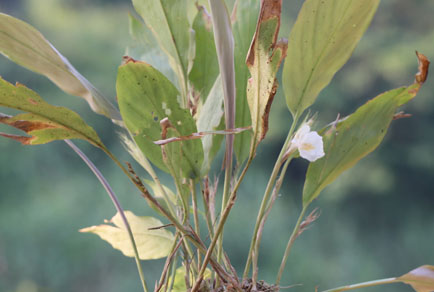
A new species, namely Monolophus unifolius, from Northern Myanmar is described and illustrated. Its systematic placement was confirmed through molecular phylogenetic analyses using nuclear ribosomal ITS sequences. Morphologically, this new species is notably distinct from other Monolophus species in having only one leaf blade per leafy shoot and white labellum tinged with yellow spot at the throat. A key to the Monolophus species currently recorded in Myanmar is also provided.
References
- Baker, J.G. (1890) Kaempferia. In: Hooker, J.D. (Ed.) The Flora of British India. L. Reeve, London, pp. 218–224.
- Barbhuiya, H.A., Dey, S., Verma, D. & Moaakum (2018) Nomenclatural notes on some taxa of Monolophus (Zingiberaceae). NeBIO 9 (2): 175–176.
- Beentje, H. (2016) The Kew Plant Glossary, An Illustrated Dictionary of Plant Terms (second edition). Royal Botanic Gardens Kew, Kew Publishing, 184 pp.
- Darriba, D., Taboada, G.L., Doallo, R. & Posada, D. (2012) jModelTest 2: more models, new heuristics and parallel computing. Nature Methods 9 (8): 772. https://doi.org/10.1038/nmeth.2109
- Delafosse, G., Guillemin, J.A. & Kuhn (1830) Table Générale. Bulletin des Science Naturelles et de Geologie 23: 1–50.
- Ding, H.B., Yang, B., Maw, M.B., Win, P.P. & Tan, Y.H. (2020) A new species and two new combinations of Monolophus (Zingiberaceae) from Indo-Burma. PhytoKeys 138: 155–162. https://doi.org/10.3897/phytokeys.138.39217
- Doyle, J.J. & Doyle, J.L. (1987) A rapid DNA isolation procedure for small quantities of fresh leaf tissue. Phytochemistry 19: 11–15.
- Gagnepain, F. (1903) Zingibérées de L’herbier du muséum. Bulletin de la Société Botanique de France 50 (3): 257–263.
- Hance, H.F. (1870) Sertulum Chinense quintum: a fifth decade of new Chinese plants. Journal of Botany 8: 71–77.
- IUCN Standards and Petitions Committee (2022) Guidelines for Using the IUCN Red List Categories and Criteria. Version 15.1. Prepared by the Standards and Petitions Committee. Available from: https://www.iucnredlist.org/documents/RedListGuidelines.pdf (accessed 31 March 2024)
- Jin, J.J., Yu, W.B., Yang, J.B., Song, Y., dePamphilis, C., Yi, T.S. & Li, D.Z. (2020) GetOrganelle: a fast and versatile toolkit for accurate de novo assembly of organelle genomes. Genome Biology 21 (1): 241. https://doi.org/10.1101/256479
- Katoh, K. & Standley, D.M. (2013) MAFFT multiple sequence alignment software Version 7: improvements in performance and usability. Molecular Biology and Evolution 30: 772–780.
- Larsen, K. (1964) Studies in Zingiberaceae Ⅳ. Caulokaempferia, a new genus. Botanisk Tidsskrift 60: 165–179.
- Larsen, K. (2002) Three new species of Caulokaempferia (Zingiberaceae) from Thailand with a discussion of the generic diversity. Nordic Journal of Botany 22 (4): 409–417. https://doi.org/10.1111/j.1756-1051.2002.tb01392.x
- Leong-Škorničková, J. & Newman, M. (2015) Gingers of Cambodia, Laos and Vietnam. Singapore Botanic Gardens, National Parks Board, Singapore, 229 pp.
- Linnaeus, C. (1753) Species Plantarum, vol. 1. Laurentius Salvius, Stockholm, 560 pp. https://doi.org/10.5962/bhl.title.37656
- Mokkamul, P. & Picheansoonthon, C. (2004) A new Caulokaempferia (Zingiberaceae) from southern Thailand. Folia Malaysiana 5: 187–194.
- Mood, J.D., Veldkamp, J.F., Dey, S. & Prince, L.M. (2014) Nomenclatural changes in Zingiberaceae: Caulokaempferia is a superfluous name for Monolophus and Jirawongsea is reduced to Boesenbergia. Gardens’ Bulletin Singapore 66 (2): 215–231.
- Newman, M.F., Barfod, A.S., Esser, H.J., Simpson, D.A. & Parnell, J.A.N. (2023) Zingiberaceae. In: Chayamarit, K & Balslev, H. (ed.) Flora of Thailand. Vol. 16 (2). The Forest Herbarium, Department of National Parks, Wildlife and Plant Conservation, Bangkok, 747 pp.
- Rambaut, A. & Drummond, A.J. (2013) Tracer v1.6. Available from: http://tree.bio.ed.ac.uk/software/tracer/ (accessed 26 July 2024)
- Ronquist, F., Teslenko, M., van der Mark, P., Ayres, D.L., Darling, A., Höhna, S., Larget, B., Liu, L., Suchard, M.A. & Huelsenbeck, J. (2012) MrBayes 3.2: efficient Bayesian phylogenetic inference and model choice across a large model space. Systematic Biology 61 (3): 539–542. https://doi.org/10.1093/sysbio/sys029
- Roxburgh, W. (1820) Flora Indica, or, Descriptions of Indian plants, vol. 1. Mission Press, Serampore, 493 pp.
- Sangnark, S., Prasarn, S., Phokham, B., Wongsuwan, P. & Picheansoonthon, C. (2016) The genus Caulokaempferia (Zingiberaceae) in Myanmar part 1: two new species from south Myanmar. Journal of Japanese Botany 91: 133–140.
- Singh, S.K. & Patil, S. (2025) Clarifying the Caulokaempferia vs. Monolophus Nomenclature Dilemma. Phytotaxa 693 (1): 107–111. https://doi.org/10.11646/phytotaxa.693.1.9
- Stamatakis, A. (2014) RAxML version 8: a tool for phylogenetic analysis and postanalysis of large phylogenies. Bioinformatics 30 (9): 1312–1313.
- Teijsmann, J.E. & Binnendijk, S. (1864) Plantae novae V. minus cognitae in horto Bogoriensi cultae, auctoribus. Natuurkundig Tijdschrift voor Nederlandsch-Indië 27: 15–58.
- Turland, N.J., Wiersema, J.H., Barrie, F.R., Greuter, W., Hawksworth, D.L., Herendeen, P.S., Knapp, S., Kusber, W.H., Li, D.Z., Marhold, K., May, T.W., McNeill, J., Monro, A.M., Prado, J., Price, M.J. & Smith, G.F. (eds.) (2018) International Code of Nomenclature for algae, fungi, and plants (Shenzhen Code) adopted by the Nineteenth International Botanical Congress Shenzhen, China, July 2017. Regnum Vegetabile 159. Koeltz Botanical Books, Glashütten. https://doi.org/10.12705/Code.2018
- Wallich, N. (1830) Plantae Asiaticae rariores, or, Descriptions and figures of a select number of unpublished East Indian plants, vol. 1. Treuttel and Würtz, London, 84 pp., pl. 100.
- Wallich, N. (1832) A numerical list of dried specimens of plants in the East India Company’s Museum, collected under the superintendence of Dr. Wallich, of the Company’s Botanic Garden at Calcutta (The Wallich Catalogue). London, pp. 6591–6593.
- Wu, T.L. & Chen, S.J. (1978) Materials for Chinese Zingiberaceae. Acta Phytotaxonomica Sinica 16 (3): 25–46.