

Abstract
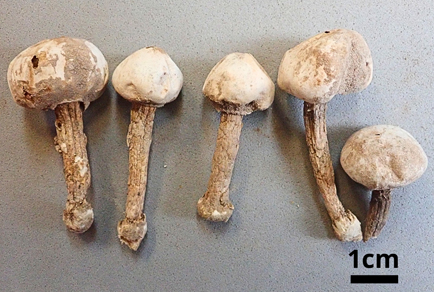
A taxonomic and phylogenetic study of Tulostoma specimens deposited in the MEXU Fungal Collection of the National Herbarium is presented. Eleven collections were morphologically characterized with light microscopy (LM) and Scanning Electron Microscopy (SEM). DNA was extracted with a CTAB 3% protocol. The nrITS (ITS1-5.8S-ITS2), nrLSU (28S), and partial tef1-α were amplified and sequenced from both directions. The phylogenetic analysis consisted of Maximum Likelihood and Bayesian Inference Analysis of the ITS+28S, and a concatenated matrix of ITS+28S+tef1-α. Both analyses recovered 11 clades. T. exasperatum, T. rufum, and T. simulans are confirmed species in the Mexican Funga. T. obscurum materials correspond with T. punctatum, a new record for Mexico. Three new species are described: T. elvirae, T. evangelinae, and T. teophili. Photographs of specimens and micrographs of light and electron scanning microscopy are provided. Comparison with related taxa is discussed. With the new additions, 56 species are currently known in Mexico.
References
- Akata, İ., Sahi̇n, E., Altuntaş, D. & Kabaktepe, Ş. (2021) Two New Additions to Turkish Tulostoma. Kahramanmaraş Sütçü İmam Üniversitesi Tarım ve Doğa Dergisi 24: 1104–1110. https://doi.org/10.18016/ksutarimdoga.vi.839465
- Altés, A. & Moreno, G. (1993) Tulostoma beccarianum Bres., the correct name for T. simulans Lloyd. Mycotaxon 48: 223–227.
- Ayala, N., Ochoa, C. & Guzmán, G. (1985) Los hongos de la Península de Baja California, II. Las especies conocidas de Tulostoma. Revista Mexicana de Micología 1: 465–469.
- Baseia, I.G. & Galvão, T.C. de O. (2002) Some interesting Gasteromycetes (Basidiomycota) in dry areas from northeastern Brazil. Acta botanica Brasilica 16: 1–8. https://doi.org/10.1590/s0102-33062002000100002
- Baseia, I.G. & Milanez, A.I. (2002) Tulostoma Persoon (Gasteromycetes) from the cerrado region, State of São Paulo, Brazil. Acta botanica Brasilica 16: 09–14. https://doi.org/10.1590/s0102-33062002000100003
- Begerow, D., Nilsson, H., Unterseher, M. & Maier, W. (2010) Current state and perspectives of fungal DNA barcoding and rapid identification procedures. Applied microbiology and biotechnology 87: 99–108. https://doi.org/10.1007/s00253-010-2585-4
- Bergsten, J. (2005) A review of long-branch attraction. Cladistics: the international journal of the Willi Hennig Society 21: 163–193. https://doi.org/10.1111/j.1096-0031.2005.00059.x
- Bononi, V.L., Guzmán, G. & Capelari, M. (1984) Basidiomycetos do Parque Estadual da Ilha do Cardoso. V: Gasteromycetos. Rickia 11: 91–97.
- Cabral, T.S., Silva, B.D.B. da, Vargas-Isla, R., Oliveira, J.J.S. de, Ferreira, J.A. da S., Castro, L., Martín, M.P. & Ishikawa, N.K. (2023) Diversity of Neotropical stalked-puffball: Two new species of Tulostoma with reticulated spores. PloS one 18: e0294672. https://doi.org/10.1371/journal.pone.0294672
- Calonge, F.D. (2000) Validation or confirmation of some new taxa recently published. Mycological Research 103: 301–302.
- Calonge, F.D. & Almeida, M.G. (1992) Tulostoma lusitanicum sp. nov. (Gasteromycetes). Bulletin de la Sociedad Micológica de Madrid 16: 109–113.
- Calonge, F.D., Guzmán, G. & F. Ramírez-Guillén, G. (2004) Observaciones sobre los Gasteromycetes de México depositados en los herbarios XAL y XALU. Boletin de la Sociedad Micológica de Madrid 28: 337–370.
- Calonge, F.D., Llimona, X. & Martin, M.P. (2007) Nuevos datos sobre el género Tulostoma (Gasteromycetes) en España. IV. Revista Catalana de Micología 29: 1–16.
- Calonge, F.D., Vidal, J.M. & Altés, A. (2013) Tulostoma exasperatum Mont., from Singapore. Boletin de la Sociedad Micológica de Madrid 37: 59–63.
- Cooke, M.C. & Ellis, J.B. (1878) New Jersey fungi. Grevillea 6: 81–96.
- Cunningham, G.H. (1925) Gasteromycetes of Australasia II. A revision of the genus Tulostoma. Proceedings of the Linnean Society of New South Wales 50: 245–259.
- Degnan, J.H. & Rosenberg, N.A. (2009) Gene tree discordance, phylogenetic inference and the multispecies coalescent. Trends in ecology & evolution 24: 332–340. https://doi.org/10.1016/j.tree.2009.01.009
- Dennis, R.W.G. (1970) Fungus flora of Venezuela and adjacent countries. H.M. Stationery Office, London, 531 pp.
- Doyle, J.J. & Doyle, J.L. (1987) A rapid DNA isolation procedure for small quantities of fresh leaf tissue. Phytochemical bulletin 19: 11–15.
- Esqueda, M., Coronado, M., Sánchez, A., Pérez-Silva, E. & Herrera, T. (2006) Macromycetes of pinacate and great altar desert biosphere reserve, Sonora, Mexico. Mycotaxon 95: 81–90.
- Esqueda, M., Gutiérrez, A., Coronado, M.L., Lizárraga, M., Raymundo, T. & Valenzuela, R. (2012) Distribución de algunos hongos gasteroides (Agaricomycetes) en la planicie central del Desierto Sonorense. Revista Mexicana de Micología 36: 1–8.
- Esqueda, M., Moreno, G., Perez-Silva, E., Sanchez, A. & Altes, A. (2004) The genus Tulostoma in Sonora, Mexico. Mycotaxon 90: 409–422.
- Esqueda, M., Pérez-Silva, E., Herrera, T., Coronado, M. & Estrada-Torres, A. (2000) Composición de gasteromicetos en un gradiente de vegetación de Sonora, México. Anales del Instituto de Biología. Serie Botánica 71: 39–62.
- Esqueda-Valle, M., Pérez-Silva, E., Herrera, T., Altés, A. & Moreno, G. (1998) Tulostoma portoricense (Tulostomatales, Gasteromycetes) from Mexico. Mycotaxon 68: 499–503.
- Finy, P., Jeppson, M., Knapp, D.G., Papp, V., Albert, L., Ölvedi, I., Bóka, K., Varga, D., Kovács, G.M. & Dima, B. (2023) Exploring diversity within the genus Tulostoma (Basidiomycota, Agaricales) in the Pannonian sandy steppe: four fascinating novel species from Hungary. MycoKeys 100: 153–170. https://doi.org/10.3897/mycokeys.100.112458
- Fries, E.M. (1829) Systema Mycologicum. Sumptibus Ernesti Mauritii, Greifswald, 259 pp.
- Fries, R.E. (1908) Über einige Gasterinyceten aus Bolicia und Argentinien. Arkiv för botanik 8: 1–31.
- Gardes, M. & Bruns, T.D. (1993) ITS primers with enhanced specificity for basidiomycetes—application to the identification of mycorrhizae and rusts. Molecular ecology 2: 113–118. https://doi.org/10.1111/j.1365-294x.1993.tb00005.x
- Gorbunova, I.A. & Rebriev, Y.A. (2016) New data to biota Gasteromycetes of the Altai-Sayan mountain-region. Rastitelnyy mir Aziatskoy Rossii [Plant Life of Asian Russia] 2: 3–7.
- Guzmán, G. & Herrera, T. (1969) Macromicetos de las zonas áridas de México, II Gasteromicetos. Anales del Instituto de Biología, UNAM, Serie Botánica 40: 1–92.
- Guzmán, G. & Herrera, T. (1973) Especies de macromicetos de México citadas IV. Gasteromicetos. Boletín de la Sociedad Mexicana de Micología 7: 105–119.
- Guzmán, G., Montoya, L. & Bandala, V. (1992) Adiciones al conocimiento del género Tulostoma (basidiomycotina, Gasteromycetes) en México y descripción de una nueva especie. Boletín de la Sociedad Argentina de Botánica 28: 113–121.
- Heim, R. & Herrera, T. (1961) Una nueva especie de Podocrea y una nueva combinación para el nombre de un hongo mexicano del género Battarreoides. Anales del Instituto de Biología de la Universidad Nacional Autónoma de México 32: 29–31.
- Hernández Caffot, M.L., Domínguez, L.S. & Hosaka, K. (2011) Tulostoma domingueziae sp. nov. from Polylepis australis woodlands in Córdoba Mountains, central Argentina. Mycologia 105: 1047–1054. https://doi.org/10.3852/10-266
- Hernández-Caffot, M.L., Vaira, M. & Domínguez, L.S. (2023) Hongos de Argentina evaluados por la UICN (Unión Internacional para la Conservación de las Especies y status de Rickiella edulis basada en un nuevo registro en Jujuy, Argentina. Lilloa 60: 287–308. https://doi.org/10.30550/j.lil/1853
- Hernández-Navarro, E. (2023) First record of Tulostoma exasperatum (Agaricomycetes, Agaricales) in Mexico. Acta Botanica Mexicana 130: e2171. https://doi.org/10.21829/abm130.2023.2171
- Hernández-Navarro, E. & Cappello-García, S. (2024) Tulostoma subreticulatum (Agaricomycetes, Agaricales): a new species of stalked puffball from Mexico. Phytotaxa 653: 101–114. https://doi.org/10.11646/phytotaxa.653.2.1
- Hernández-Navarro, E., Gutiérrez, A., Coronado, M.L., Álvarez-Bajo, O., Andrade, S., Barredo-Pool, F. & Esqueda, M. (2020) Diversity, morphological variability, and distribution of tulostomataceous fungi (Agaricomycetes) in Sonora, Mexico. Revista Mexicana de Biodiversidad 91: e913246. https://doi.org/10.22201/ib.20078706e.2020.91.3246
- Hernández-Navarro, E., Gutiérrez, A., Ramírez-Prado, J.H., Sánchez-Teyer, F. & Esqueda, M. (2018) Tulostoma rufescens sp. nov. from Sonora, Mexico. Mycotaxon 133: 459–471. https://doi.org/10.5248/133.459
- Hernández-Navarro, E., Gutiérrez-Saldaña, A., Barredo-Pool, F. & Esqueda, M. (2015) Especies de Tulostoma (Basidiomycetes, Agaricomycetes) en un matorral espinoso de Sonora, México. Revista Mexicana de Micología 41: 65–72.
- Herrera, T. (1959) Battarraea y Tylostoma en el Valle de México. Anales del Instituto de Biología, Universidad Nacional Autónoma de México. Serie botánica 1: 21–33.
- Holec, J. & Beran, M. (2006) Červený seznam hub (makromycetů) České republiky [Red list of fungi (macromycetes) of the Czech Republic]. Příroda 24: 282.
- Honan, A.H. (2021) An Evolutionary and Ecological Investigation into the Enigmatic Stalked Puffball Genus Tulostoma. Doctorate Dissertation. University of Washington, 218 pp.
- Hussain, S., Yousaf, N., Afshan, N.-U.-S., Niazi, A.R., Ahmad, H. & Khalid, A.N. (2016) Tulostoma ahmadii sp. nov. and T. squamosum from Pakistan. Turkish journal of botany 40: 218–225. https://doi.org/10.3906/bot-1501-9
- Index Fungorum (2025) Index Fungorum. Available from: http://www.indexfungorum.org/Names (accessed August 2025)
- Jeppson, M., Altés, A., Moreno, G., Nilsson, R.H., Loarce, Y., Bustos, A. & Larsson, E. (2017) Unexpected high species diversity among European stalked puffballs–a contribution to the phylogeny and taxonomy of the genus Tulostoma (Agaricales). Mykokeys 21: 33–88. https://doi.org/10.3897/mycokeys.21.12176
- Kalyaanamoorthy, S., Minh, B.Q., Wong, T.K.F., von Haeseler, A. & Jermiin, L.S. (2017) ModelFinder: fast model selection for accurate phylogenetic estimates. Nature methods 14: 587–589. https://doi.org/10.1038/nmeth.4285
- Katoh, K., Misawa, K., Kuma, K.-I. & Miyata, T. (2002) MAFFT: a novel method for rapid multiple sequence alignment based on fast Fourier transform. Nucleic acids research 30: 3059–3066. https://doi.org/10.1093/nar/gkf436
- Katoh, K., Rozewicki, J. & Yamada, K.D. (2019) MAFFT online service: multiple sequence alignment, interactive sequence choice and visualization. Briefings in bioinformatics 20: 1160–1166. https://doi.org/10.1093/bib/bbx108
- Katoh, K. & Standley, D.M. (2013) MAFFT multiple sequence alignment software version 7: improvements in performance and usability. Molecular biology and evolution 30: 772–780. https://doi.org/10.1093/molbev/mst010
- Kers, L.E. (1978) Tulostoma niveum sp. nov. (Gasteromycetes) described from Sweden. Botaniska Notiser 131: 411–417.
- Kim, C.S., Jo, J.W., Kwag, Y.N., Sung, G.H., Han, J.G., Kim, S.Y. & Oh, S. (2016) Two new Lycoperdon species collected from Korea: L. albiperidium and L. subperlatum spp. nov. Phytotaxa 260: 101–115. https://doi.org/10.11646/phytotaxa.260.2.1
- Kornerup, A. & Wanscher, J.H. (1978) Methuen handbook of colour. Eyre Methuen, London, UK, 252 pp.
- Krisai-Greilhuber, I. (1999) Rote Liste gefährdeter Großpilze Österreichs 2. Fassung. In: Niklfeld, H. (Ed.) Rote Listen gefährdeter Pflanzen Österreichs, 2. Auflage. Grüne Reihe des Bundesministeriums für Umwelt, Jugend und Familie, pp. 229–266.
- Kropp, B.R., Albee-Scott, S., Castellano, M.A. & Trappe, J.M. (2012) Cryptolepiota, a new sequestrate genus in the Agaricaceae with evidence for adaptive radiation in western North America. Mycologia 104: 164–174. https://doi.org/10.3852/11-046
- Kuhar, F., Greslebin, A. & Pfister, D. (2020) Tulostoma domingueziae. The IUCN Red List of Threatened Species 2020: e.T172742153A172861262. https://doi.org/10.2305/IUCN.UK.2020-2.RLTS.T172742153A172861262.en
- Larsson, A. (2014) AliView: a fast and lightweight alignment viewer and editor for large datasets. Bioinformatics 30: 3276–3278. https://doi.org/10.1093/bioinformatics/btu531
- Lebel, T. & Vellinga, E.C. (2013) Description and affinities of a sequestrate Lepiota (Agaricaceae) from Australia. Mycological progress 12: 525–532. https://doi.org/10.1007/s11557-012-0859-1
- Li, J.X., Cao, B., Phurbu, D., He, M., Zhu, X.Y., Parra, L.A. & Zhao, R.L. (2024) The revision of the taxonomic system of Lycoperdaceae. Mycosphere, journal of fungal biology 15: 4919–5016. https://doi.org/10.5943/mycosphere/15/1/22
- Lima, A., Melanda, G., Marinho, P., Martín, M.P. & Baseia, I. (2023) Two new species of Tulostoma (Agaricales, Basidiomycota) from the Neotropics. Turkish journal of botany 47: 399–407. https://doi.org/10.55730/1300-008x.2777
- Lloyd, C.G. (1906) The Tylostomeae. Mycological Writings 2: 1–28.
- Lloyd, C.G. (1920) Mycological notes 64. Mycological Writings 64: 985–1029.
- Long, W.H. (1944) Studies in the gasteromycetes X. Seven new species of Tylostoma. Mycologia 36: 318–339. https://doi.org/10.1080/00275514.1944.12017555
- Long, W.H. (1946) Studies in the gasteromycetes XII. Five species of Tylostoma with membranous exoperidia. Mycologia 38: 77–90. https://doi.org/10.1080/00275514.1946.12024041
- Long, W.H. (1947) Studies in the Gasteromycetes: XV. Notes on new or rare species of Tylostoma. Lloydia 10: 115–135.
- Long, W.H. & Ahmad, S. (1947) The genus Tylostoma in India. Farlowia 3: 225–267. https://doi.org/10.5962/p.316027
- Mallet, J., Besansky, N. & Hahn, M.W. (2016) How reticulated are species? BioEssays: news and reviews in molecular, cellular and developmental biology 38: 140–149. https://doi.org/10.1002/bies.201500149
- Masse, G.A. monograph of British Gasteromycetes. Annals of botany 4: 1–103. https://doi.org/10.1093/oxfordjournals.aob.a090544
- Media Cybernetics (2024) Image-Pro Plus v. 7.0. Rockville, EUA. [https://mediacy.com/image-pro/]
- Minh, B.Q., Nguyen, M.A.T. & von Haeseler, A. (2013) Ultrafast approximation for phylogenetic bootstrap. Molecular biology and evolution 30: 1188–1195. https://doi.org/10.1093/molbev/mst024
- Montagne, C. (1837) Centurie de plantes cellulaires exotiques nouvelles. Annales des sciences naturelles 8: 345–370.
- Morando, M., Avila, L.J., Baker, J. & Sites Jr, J.W. (2004) Phylogeny and phylogeography of the Liolaemus darwinii complex (Squamata: Liolaemidae): evidence for introgression and incomplete lineage sorting. Evolution; international journal of organic evolution 58: 842–861. https://doi.org/10.1111/j.0014-3820.2004.tb00416.x
- Moreno, G., Altés, A., Ochoa, C. & Wright, J.E. (1995) Contribution to the study of the Tulostomataceae in Baja California, Mexico. I. Mycologia 87: 96–120. https://doi.org/10.1080/00275514.1995.12026509
- Moreno, G., Altés, A. & Wright, J. (1992) Tulostoma pseudopulchellum sp. nov. (Tulostomatales, Gasteromycetes) and allied species. Mycotaxon 43: 479–486.
- Moreno, G., Heykoop, M., Esqueda, M. & Olariaga, I. (2015) Another lineage of secotioid fungi is discovered: Psathyrella secotioides sp. nov. from Mexico. Mycological progress 14. https://doi.org/10.1007/s11557-015-1057-8
- Moreno, G., Lizárraga, M., Esqueda, M. & Coronado, M.L. (2010) Contribution to the study of gasteroid and secotioid fungi of Chihuahua, Mexico. Mycotaxon 112: 291–315. https://doi.org/10.5248/112.291
- Morgan, A.P. (1890) North American fungi. The gasteromycetes III. The Journal of the Cincinnati Society of Natural History 12: 8–22.
- Niazi, A.R., Ghafoor, A., Afshan, N. & Moreno, G. (2022) Tulostoma loonbanglaense: A new species from Azad Jammu and Kashmir using light and scanning electron microscopy and DNA barcoding technique. Microscopy research and technique 85: 3720–3725. https://doi.org/10.1002/jemt.24240
- Nilsson, R.H., Kristiansson, E., Ryberg, M., Hallenberg, N. & Larsson, K.H. (2008) Intraspecific ITS variability in the kingdom fungi as expressed in the international sequence databases and its implications for molecular species identification. Evolutionary bioinformatics online 4: 193–201. https://doi.org/10.4137/EBO.S653
- Oliva, M.A. (2000) Contribución al conocimiento de los hongos (Macromicetos) de La Laguna de Sayula, Jalisco. Zapopan, México. Bachelor thesis. Universidad de Guadalajara.
- Paloi, S., Suwannarach, N., Kumla, J., Phonrob, W., Karunarathna, S.C. & Lumyong, S. (2023) An update on species diversity, distribution and sequence data of Tulostoma in Asia with the addition of Tulostoma exasperatum, a new record for Thailand. Chiang Mai Journal of Science 50: 1–14. https://doi.org/10.12982/CMJS.2023.018
- Pardavé, L.M. (1991) Gasteromicetos del Estado de Aguascalientes. Scientia fungorum 7: 71–77.
- Patouillard, N. (1907) Champignons nouveaux du Tonkin. Bulletin trimestriel de la Société mycologique de France 23: 69–79.
- Peck, C.H. (1906) New species of fungi. Bulletin of the Torrey Botanical Club 23: 411–420. https://doi.org/10.2307/2477789
- Persoon, C.H. (1794) Dispositio methodica fungorum in classes, ordines, Familias et Genera. Neues Magazin für die Botanik, Ziegler u. Söhne, Zürich: 63–128.
- Persoon, C.H. (1801) Synopsis Methodica Fungorum (A Methodical Synopsis of the Fungi). Henricus Dieteric, Germany, Göttingen.
- Petri, L. (1904) Sul valore diagnostico del capillizio nel genere “Tylostoma” Pers. Annales Mycologici 2: 412–438.
- Piña, C., Esqueda, M., Altés, A. & Gutierrez, A. (2010) First record of Tulostoma gracilipes (Agaricales, Agaricaceae) for the Americas. Mycotaxon 113: 371–376. https://doi.org/10.5248/113.371
- Pouzar, Z. (1958) Tulostoma. In: Pilat, A. (ed.) Flora CSR: Gasteromycetes. Prace Ceskoslovenské Akademie Ved. Praha, pp. B: 589–613; 810–815.
- Rambaut, A., Drummond, A.J., Xie, D., Baele, G. & Suchard, M.A. (2018) Posterior summarization in Bayesian phylogenetics using tracer 1.7. Systematic biology 67: 901–904. https://doi.org/10.1093/sysbio/syy032
- Rehner, S.A. & Buckley, E. (2005) A Beauveria phylogeny inferred from nuclear ITS and EF1-α sequences: evidence for cryptic diversification and links to Cordyceps teleomorphs. Mycologia 97: 84–98. https://doi.org/10.1080/15572536.2006.11832842
- Rick, J. (1961) Basidiomycetes eubasidii in Rio Grande do Sul-Brasilia 6. Iheringia Sér Bot 9: 451–479.
- Rodríguez Alcántar, O., Figueroa-García, D., Ruíz-Sanchez, E., Zamora-Tavares, P., Herrera-Fonseca, M.J., Esqueda, M. & Vargas-Ponce, O. (2024) Advances in the phylogeny of the genus Tulostoma in Mexico, new records for the country, Jalisco and Zacatecas. e-CUCBA 12: 34–51. https://doi.org/10.32870/e-cucba.vi24.375
- Ronquist, F., Teslenko, M., van der Mark, P., Ayres, D.L., Darling, A., Höhna, S., Larget, B., Liu, L., Suchard, M.A. & Huelsenbeck, J.P. (2012) MrBayes 3.2: efficient Bayesian phylogenetic inference and model choice across a large model space. Systematic biology 61: 539–542. https://doi.org/10.1093/sysbio/sys029
- Rusevska, K., Calonge, F.de D., Karadelev, M. & Martín, M.P. (2019) Fungal DNA barcode (ITS nrDNA) reveals more diversity than expected in Tulostoma from Macedonia. Turkish journal of botany 43: 102–115. https://doi.org/10.3906/bot-1804-38
- Saccardo, P.A. (1887) Sylloge Fungorum 5: i–iii, Saccardo, P.A., Italy, Padua, 1146 pp.
- Saccardo, P.A. (1888) Sylloge Fungorum 7 (1–2): i. Saccardo, P.A., Italy, Pavia, 882 pp.
- Sánchez-Jácome, M.R. & Guzmán-Dávalos, L. (2011) Hongos citados para Jalisco, II. Ibugana: Boletín del Instituto de Botánica 1: 25–60.
- Schoch, C.L., Seifert, K.A., Huhndorf, S., Robert, V., Spouge, J.L., Levesque, C.A., Chen, W., Bolchacova, E., Voigt, K., Crous, P.W., Miller, A.N., Wingfield, M.J., Aime, M.C., An, K.-D., Bai, F.-Y., Barreto, R.W., Begerow, D., Bergeron, M.-J., Blackwell, M., Boekhout, T., Bogale, M., Boonyuen, N., Burgaz, A.R., Buyck, B., Cai, L., Cai, Q., Cardinali, G., Chaverri, P., Coppins, B.J., Crespo, A., Cubas, P., Cummings, C., Damm, U., de Beer, Z.W., de Hoog, G.S., Del-Prado, R., Dentinger, B., Diéguez-Uribeondo, J., Divakar, P.K., Douglas, B., Dueñas, M., Duong, T.A., Eberhardt, U., Edwards, J.E., Elshahed, M.S., Fliegerova, K., Furtado, M., García, M.A., Ge, Z.-W., Griffith, G.W., Griffiths, K., Groenewald, J.Z., Groenewald, M., Grube, M., Gryzenhout, M., Guo, L.-D., Hagen, F., Hambleton, S., Hamelin, R.C., Hansen, K., Harrold, P., Heller, G., Herrera, C., Hirayama, K., Hirooka, Y., Ho, H.-M., Hoffmann, K., Hofstetter, V., Högnabba, F., Hollingsworth, P.M., Hong, S.-B., Hosaka, K., Houbraken, J., Hughes, K., Huhtinen, S., Hyde, K.D., James, T., Johnson, E.M., Johnson, J.E., Johnston, P.R., Jones, E.B.G., Kelly, L.J., Kirk, P.M., Knapp, D.G., Kõljalg, U., Kovács, G.M., Kurtzman, C.P., Landvik, S., Leavitt, S.D., Liggenstoffer, A.S., Liimatainen, K., Lombard, L., Luangsa-ard, J.J., Lumbsch, H.T., Maganti, H., Maharachchikumbura, S.S.N., Martin, M.P., May, T.W., McTaggart, A.R., Methven, A.S., Meyer, W., Moncalvo, J.-M., Mongkolsamrit, S., Nagy, L.G., Nilsson, R.H., Niskanen, T., Nyilasi, I., Okada, G., Okane, I., Olariaga, I., Otte, J., Papp, T., Park, D., Petkovits, T., Pino-Bodas, R., Quaedvlieg, W., Raja, H.A., Redecker, D., Rintoul, T.L., Ruibal, C., Sarmiento-Ramírez, J.M., Schmitt, I., Schüßler, A., Shearer, C., Sotome, K., Stefani, F.O.P., Stenroos, S., Stielow, B., Stockinger, H., Suetrong, S., Suh, S.-O., Sung, G.-H., Suzuki, M., Tanaka, K., Tedersoo, L., Telleria, M.T., Tretter, E., Untereiner, W.A., Urbina, H., Vágvölgyi, C., Vialle, A., Vu, T.D., Walther, G., Wang, Q.-M., Wang, Y., Weir, B.S., Weiß, M., White, M.M., Xu, J., Yahr, R., Yang, Z.L., Yurkov, A., Zamora, J.-C., Zhang, N., Zhuang, W.-Y. & Schindel, D. (2012) Nuclear ribosomal internal transcribed spacer (ITS) region as a universal DNA barcode marker for Fungi. Proceedings of the National Academy of Sciences 109: 6241–6246. https://doi.org/10.1073/pnas.1117018109
- Schubert, H. & Specht, P. (2013) Seltene Gasteromyceten in Deutschland IV – Tulostoma winterhoffii, ein neuer Stielbovist. Zeitschrift für Mykologie 79: 417–430.
- SEMARNAT (2003) Informe de la Situación del Medio Ambiente en México. Procuraduría Ambiental y del Ordenamiento Territorial de la Ciudad de México. Available from: https://paot.org.mx/centro/ine-semarnat/informe02/estadisticas_2000/informe_2000/03_Suelos/3.3_Fragiles/index.htm#desertificacion (accessed 16 July 2024)
- SEMARNAT (2006) Programa Nacional Manejo Sustentable de Tierras. [https://www.gob.mx/cms/uploads/attachment/file/31167/pnacdd.pdf]
- Spegazzini, C. (1927) Gasteromycetas Argentinas. Physis 8: 421–435.
- Stielow, J.B., Lévesque, C.A., Seifert, K.A., Meyer, W., Iriny, L., Smits, D., Renfurm, R., Verkley, G.J.M., Groenewald, M., Chaduli, D., Lomascolo, A., Welti, S., Lesage-Meessen, L., Favel, A., Al-Hatmi, A.M.S., Damm, U., Yilmaz, N., Houbraken, J., Lombard, L., Quaedvlieg, W., Binder, M., Vaas, L.A.I., Vu, D., Yurkov, A., Begerow, D., Roehl, O., Guerreiro, M., Fonseca, A., Samerpitak, K., van Diepeningen, A.D., Dolatabadi, S., Moreno, L.F., Casaregola, S., Mallet, S., Jacques, N., Roscini, L., Egidi, E., Bizet, C., Garcia-Hermoso, D., Martín, M.P., Deng, S., Groenewald, J.Z., Boekhout, T., de Beer, Z.W., Barnes, I., Duong, T.A., Wingfield, M.J., de Hoog, G.S., Crous, P.W., Lewis, C.T., Hambleton, S., Moussa, T.A.A., Al-Zahrani, H.S., Almaghrabi, O.A., Louis-Seize, G., Assabgui, R., McCormick, W., Omer, G., Dukik, K., Cardinali, G., Eberhardt, U., de Vries, M. & Robert, V. (2015) One fungus, which genes? Development and assessment of universal primers for potential secondary fungal DNA barcodes. Persoonia-Molecular Phylogeny and Evolution of Fungi 35: 242–263. https://doi.org/10.3767/003158515X689135
- Varga, T., Krizsán, K., Földi, C., Dima, B., Sánchez-García, M., Sánchez-Ramírez, S., Szöllősi, G.J., Szarkándi, J.G., Papp, V., Albert, L., Andreopoulos, W., Angelini, C., Antonín, V., Barry, K.W., Bougher, N.L., Buchanan, P., Buyck, B., Bense, V., Catcheside, P., Chovatia, M., Cooper, J., Dämon, W., Desjardin, D., Finy, P., Geml, J., Haridas, S., Hughes, K., Justo, A., Karasiński, D., Kautmanova, I., Kiss, B., Kocsubé, S., Kotiranta, H., LaButti, K.M., Lechner, B.E., Liimatainen, K., Lipzen, A., Lukács, Z., Mihaltcheva, S., Morgado, L.N., Niskanen, T., Noordeloos, M.E., Ohm, R.A., Ortiz-Santana, B., Ovrebo, C., Rácz, N., Riley, R., Savchenko, A., Shiryaev, A., Soop, K., Spirin, V., Szebenyi, C., Tomšovský, M., Tulloss, R.E., Uehling, J., Grigoriev, I.V., Vágvölgyi, C., Papp, T., Martin, F.M. & Nagy, L.G. (2019) Megaphylogeny resolves global patterns of mushroom evolution. Nature ecology & evolution 3: 668–678. https://doi.org/10.1038/s41559-019-0834-1
- Vlasenko, V.A. & Vlasenko, A.V. (2023) A new species of Tulostoma genus from Siberia. Phytotaxa 600: 25–34. https://doi.org/10.11646/phytotaxa.600.1.4
- White, T.J., Bruns, T., Lee, S. & Taylor, J.W. (1990) Amplification and direct sequencing of fungal ribosomal RNA genes for phylogenetics. PCR Protocols: A guide to methods and applications 18: 315–322. https://doi.org/10.1016/B978-0-12-372180-8.50042-1
- White, V.S. (1901) The Tylostomaceae of North America. Bulletin of the Torrey Botanical Club 28: 421–444. https://doi.org/10.2307/2478590
- Whitfield, J.B. & Lockhart, P.J. (2007) Deciphering ancient rapid radiations. Trends in ecology & evolution 22: 258–265. https://doi.org/10.1016/j.tree.2007.01.012
- Wong, T.K.F., Ly-Trong, N., Ren, H., Baños, H., Roger, A.J., Susko, E., Bielow, C., De Maio, N., Goldman, N. & Hahn, M.W. (2025) IQ-TREE 3: Phylogenomic Inference Software using Complex Evolutionary Models. [https://iqtree.github.io/] https://doi.org/10.32942/X2P62N
- Wright, J.E. (1983) Tulostoma exasperatosporum, a new species with reticulate spores from South Africa. South African Journal of Botany 2: 126–128. https://doi.org/10.1016/S0022-4618(16)30126-7
- Wright, J.E. (1987) The Genus Tulostoma (Gasteromycetes)—A World Monograph. J. Cramer, 338 pp.
- Wright, J.E., Herrera, T. & Guzmán, G. (1972) Estudios sobre el género Tulostoma en México (Fungi, Gasteromycetes). Ciencia 27: 109–122.