
Abstract
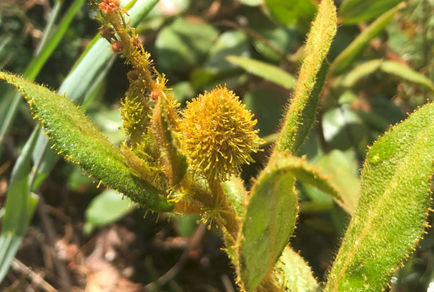
A new species of Croton endemic to the Cerrado hotspot (Brazil) is here described and illustrated. Croton rizzoi is assigned to section Barhamia subsect. Medea due to its foliage not viscid, entire leaf margins, pinnate venation, glandular stipules and sepals of pistillate flowers. The new species is most closely related to C. arirambae from the Northern region of Brazil, but differs by having stipules with stipitate-capitate glands with subglobose or ovoid secretory portion, elongate thyrses (up to 11 cm long), anthers 1.4–1.7 mm long, with papillose surface and 2-fid styles. Croton rizzoi has its geographic distributions, morphological relationships, phenology conservation status, and systematic position presented.
References
- Bachman, S., Moat, J., Hill, A.W., de la Torre, J. & Scott, B. (2011) Supporting Red List threat assessments with GeoCAT: geospatial conservation assessment tool. ZooKeys 150: 117–126. https://doi.org/10.3897/zookeys.150.2109
- Baillon, H.E. (1858) Étude générale du groupe des Euphorbiacées. Librairie de Victor Masson, Paris, 684 pp. https://doi.org/10.5962/bhl.title.50439
- Baillon, H.E. (1864) Species Euphorbiacearum. Euphorbiacées Américaines. Première partie: Amérique austro-orientale. Adansonia 4: 257–377.
- Barbosa, B.L.R., Oliveira, R.P., Mascarenhas, A.A.S., Dórea, M.D.C., Martins, F.M. & Carneiro-Torres, D.S. (2018) Croton aemulus and C. graomogolensis (Euphorbiaceae): Two new species from Minas Gerais, Brazil, based on distinct lines of evidence and their relation to C. muscicapa and C. longibracteatus. Phytotaxa 365 (3): 259–272. https://doi.org/10.11646/phytotaxa.365.3.4
- Berry, P.E., Hipp, A.L., Wurdack, K.J., van Ee, B. & Riina, R. (2005) Molecular phylogenetics of the giant genus Croton and tribe Crotoneae (Euphorbiaceae sensu stricto) using ITS and trnL-trnF DNA sequence data. American Journal of Botany 92: 1520–1534. https://doi.org/10.3732/ajb.92.9.1520
- Carneiro-Torres, D.S. (2009) Diversidade de Croton L. (Euphorbiaceae) no bioma Caatinga. Doctoral thesis. Universidade Estadual de Feira de Santana, Feira de Santana, 296 pp.
- Caruzo, M.B.R. & Cordeiro, I. (2007) Sinopse da tribo Crotoneae Dumort. (Euphorbiaceae s.s.) no Estado de São Paulo, Brazil. Hoehnea 34: 571–585. https://doi.org/10.1590/S2236-89062007000400011
- Caruzo, M.B.R., Secco, R.S., Medeiros, D., Riina, R., Torres, D.S.C., Santos, R.F.D., Pereira, A.P.N., Rossine, Y., Lima, L.R., Muniz Filho, E., Valduga, E., Burilli, N.G. & Sodré, R.C. (2024) Croton. In: Flora e Funga do Brasil. Jardim Botânico do Rio de Janeiro. Available from: http://floradobrasil.jbrj.gov.br/reflora/floradobrasil/FB17497 (accessed 30 November 2024)
- Huber, J. (1914) Plantae Duckeanae Austro-Guyanenses. Euphorbiaceae. Bulletin de la Société Botanique de Genève, Sér. 2 6: 179–212.
- IUCN (2024) Guidelines for using the IUCN red list categories and criteria. Version 16. Prepared by the Standards and Petitions Subcommittee of the IUCN Species Survival Commission. IUCN, Gland and Cambridge. Available from: http://cmsdocs.s3.amazonaws.com/RedListGuidelines.pdf (accessed 1 May 2025)
- Klotzsch, J.F. (1841) Neue und weniger gekannte südamerikanische Euphorbiaceen-Gattungen. Archiv für Naturgeschichte 7 (1): 175–204.
- Klotzsch, J.F. (1853) Euphorbiaceae. In: Seemann, B.C. (Ed.) The botany of the voyage of H.M.S. Herald. Reeve & Co., London, pp. 99–106.
- Linnaeus, C. (1753) Species plantarum. Laurentius Salvius, Stockholm, 1200 pp.
- MapBiomas (2025) Projeto MapBiomas – Coleção 9 da Série Anual de Mapas de Cobertura e Uso da Terra do Brasil. Available from: https://plataforma.brasil.mapbiomas.org/ (accessed 1 May 2025)
- Medeiros, D., Senna, L., Esser, H.-J. & Alves, R.J.V. (2016) Floristic and taxonomic treatment of Croton subsect. Medea (Euphorbiaceae) from Brazilian campos rupestres. Phytotaxa 263: 167–201. https://doi.org/10.11646/phytotaxa.263.3.1
- Müller Argoviensis, J. (1873) Euphorbiaceae. In: Martius, C.F.P. von & Eichler, A.W. (Eds.) Flora Brasiliensis 11 (2). Fleischer, München, 752 pp.
- Pax, F. (1890) Euphorbiaceae. In: Engler, A. & Prantl, K. (Eds.) Die Natürlichen Pflanzenfamilien 3 (5). Engelmann, Leipzig, 119 pp.
- Pereira, A.P.N., Riina, R., Valduga, E. & Caruzo, M.B.R. (2022) A new species of Croton (Euphorbiaceae) endemic to the Brazilian Pampa and its phylogenetic affinities. Plant Systematic and Evolution 308: 14. https://doi.org/10.1007/s00606-021-01803-x
- Pereira, A.P.N. (2023) Sistemática de Croton sect. Barhamia subsect. Medea (Euphorbiaceae). Doctoral thesis. Instituto de Pesquisas Ambientais, São Paulo.
- Pinto-Silva, N.P., De Souza, K.F., Silva, O.L.M., Vitarelli, N.C., Pereira, A.P.N., Soares, D.A., Sodré, R.C., Medeiros, D., Caruzo, M.B.R., Carneiro-Torres, D.S., Silva, M.J., Meira, R.M.S.A., Riina, R. & Feio, A.C. (2023) Trichomes in the megadiverse genus Croton (Euphorbiaceae): a revised classification, identification parameters and standardized terminology. Botanical Journal of the Linnean Society 203: 37–49. https://doi.org/10.1093/botlinnean/boad008
- Riina, R., Van Ee, B.W., Caruzo, M.B.R., Carneiro-Torres, D.S., dos Santos, R.F. & Berry, P.E. (2021) The neotropical Croton sect. Geiseleria (Euphorbiaceae): classification update, phylogenetic framework, and seven new species from South America. Annals of Missouri Botanical Garden 106: 111–166. https://doi.org/10.3417/2021669
- Secco, R.S. (2008) Sinopse das espécies de Croton L. (Euphorbiaceae) na Amazônia brasileira: um ensaio taxonômico. Museu Paraense Emílio Goeldi, Belém, 169 pp.
- Silva, M.J., Sodré, R.C. & Berry, P.E. (2015) Novelties in Croton (Euphorbiaceae) from Goiás, Brazil. Systematic Botany 40: 162–167. https://doi.org/10.1600/036364415X686468
- Sodré, R.C., Berry, P.E. & Silva, M.J. (2017) The tribe Crotoneae (Euphorbiaceae, Crotonoideae) in the Chapada dos Veadeiros, Goiás, Brazil. Phytotaxa 321: 1–59. https://doi.org/10.11646/phytotaxa.321.1.1
- Thiers, B. (2024) [continuously updated] Index Herbariorum: a global directory of public herbaria and associated staff. New York Botanical Garden’s Virtual Herbarium. Available from: http://sweetgum.nybg.org/ih/ (accessed 7 January 2018)
- van Ee, B.W., Riina, R. & Berry, P.E. (2011) A revised infrageneric classification and molecular phylogeny of New World Croton (Euphorbiaceae). Taxon 60: 791–823. https://doi.org/10.1002/tax.603013
- Valduga, E., Molz, M., Cordeiro, I. & Iganci, J. (2021) Novelties in Croton (Euphorbiaceae) from southern South America. Phytotaxa 496: 189–194. https://doi.org/10.11646/phytotaxa.496.2.8