

Abstract
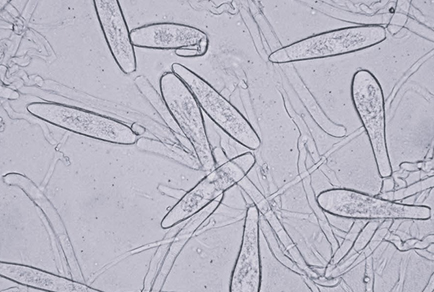
Two new powdery mildew species found in Mexico are described and illustrated based on morphological and molecular evidence. Phyllactinia passiflorae-adenopodae on Passiflora adenopoda, is characterized by having typically falciform to asymmetrically ellipsoid-ovoid or ellipsoid-lanceolate conidia. Phyllactinia sennae on Senna didymobotrya is characterized by having lanceolate to ellipsoid-lanceolate primary conidia, combined with clavate secondary conidia, and conidiophores with mainly helicoidal basal cells. Teleomorph was not observed in any of both fungi. Phylogenetic analyzes using nuclear rDNA ITS sequences showed that both powdery mildews form each an independent and strongly supported lineages, which enables their recognition as new species.
References
- Bolay, A., Clerc, P., Braun, U., Götz, M. & Takamatsu, S. (2021) New species, new records and first sequence data of powdery mildews (Erysiphaceae) from Europe with special emphasis on Switzerland. Austrian Journal of Mycology 28: 131–160. [https://www.myk.univie.ac.at/wp-content/uploads/2021/03/OZP_28_-Bolay_Erysiphales.pdf]
- Bojórquez-Ramos, C., León-Félix, J., Allende-Molar, R., Muy-Rangel, M.D., Carrillo-Facio, J.A., Soto-López, F.S.M., García-López, A.M. & García-Estrada, R.S. (2014) First report of Phyllactinia (Ovulariopsis cf. insolita) in Mexico. Mycoscience 55: 108–112. https://doi.org/10.1016/j.myc.2013.06.003
- Braun, U. & Cook, R.T.A. (2012) Taxonomic manual of the Erysiphales (powdery mildews). CBS Biodiversity Series 11. CBS-KNAW Fungal Biodiversity Centre, Utrecht, The Netherlands, 707 pp.
- Braun, U. & Yáñez-Morales, M.J. (2009) Phyllactinia and Ovulariopsis species on Legumes. Mycotaxon 109: 145–160. https://doi.org/10.5248/109.145
- Calderón, R.G., Rzedowski, J. & MacDougal, J.M. (2004) Flora del bajío y de regiones adyacentes, Fascículo 121, Passifloraceae. Instituto de Ecología A.C., Centro Regional del Bajío Pátzcuaro, Michoacán, México, 41 pp.
- Félix-Gastélum, R., Leyva-Madrigal, K.Y., Quiroz-Figueroa, F.R., Rodríguez-Mora, N., Maldonado-Mendoza, I.E., Espinosa-Matías, S. & Mora-Romero, G.A. (2021) First report of Phyllactinia chubutiana, nom. cons., on Vallesia glabra (Apocynaceae) in Mexico. Botany 99: 281–287. https://doi.org/10.1139/cjb-2020-0211
- Fernández-Pavía, S.P., Rodríguez-Alvarado, G., Gerónimo-Magaña, J., Cabrera, M.G., Gómez-Dorantes, N. & Braun, U. (2014) Powdery mildew on Bougainvillea spectabilis in Mexico with a cryptic generic affinity. Mycotaxon 129: 223–228. https://doi.org/10.5248/129.223
- Gregorio-Cipriano, R., González, D., Félix-Gastélum, R. & Chacón, S. (2020) Neoerysiphe sechii (Ascomycota: Erysiphales): A new species of powdery mildew found on Sechium edule and Sechium mexicanum (Cucurbitaceae) in Mexico. Botany 98: 185–195. https://doi.org/10.1139/cjb-2019-0193
- Havrylenko, M., Takamatsu, S., Divarangkoon, R. & Braun, U. (2006) Phyllactinia chubutiana: a new species of Erysiphales from Patagonia (Argentina). Mycoscience 47: 237–241. https://doi.org/10.1007/S10267-006-0301-0
- Index-Fungorum (2024) Available from: http://www.indexfungorum.org/names/Names.asp (accessed 1 August 2024)
- Kalyaanamoorthy, S., Minh, B.Q., Wong, T.K.F., Haeseler, A. von & Jermiin, L.S. (2017) ModelFinder: Fast model selection for accurate phylogenetic estimates. Nature Methods 14: 587–589. https://doi.org/10.1038/nmeth.4285
- Katoh, K., Rozewicki, J. & Yamada, K.D. (2019) MAFFT online service: Multiple sequence alignment, interactive sequence choice and visualization. Briefings in Bioinformatics 20: 1160–1166. https://doi.org/10.1093/bib/bbx108
- Khodaparast, S.A., Takamatsu, S., Harada, M., Abbasi, M. & Samadi, S. (2012) Additional rDNA ITS sequences and its phylogenetic consequences for the genus Leveillula with emphasis on conidium morphology. Mycological Progress 11: 741–752. https://doi.org/10.1007/s11557-011-0785-7
- Marmolejo, J., Siahaan, S.A.S., Takamatsu, S. & Braun, U. (2018) Three new records of powdery mildews found in Mexico with one genus and one new species proposed. Mycoscience 59: 1–7. https://doi.org/10.1016/j.myc.2017.06.010
- Meeboon, J. & Takamatsu, S. (2017) First found of Erysiphe elevata on Eucalyptus camaldulensis and Phyllactinia lagerstroemiae sp. nov. on Lagerstroemia from Thailand. Mycoscience 58: 253–260. https://doi.org/10.1016/j.myc.2017.02.007
- Meeboon, J., Kokaew, J. & Takamatsu, S. (2018) Notes on powdery mildews (Erysiphales) in Thailand VI. Phyllactinia and Leveillula. Mycological Progress 17: 701–718. https://doi.org/10.1007/s11557-018-1383-8
- Minh, B.Q., Schmidt, H.A., Chernomor, O., Schrempf, D., Woodhams, M.D., Haeseler, A. von & Lanfear, R. (2020) IQ-TREE 2: New Models and Efficient Methods for Phylogenetic Inference in the Genomic Era. Molecular Biology and Evolution 37: 1530–1534. https://doi.org/10.1093/molbev/msaa015
- Monkhung, S. & To-anun, C. (2017) Molecular Phylogenetic and Morphological Analysis of a Powdery Mildew Found on Dalbergia lanceolaria in Thailand. Chiang Mai Journal of Science 44: 350–357. Available from: https://epg.science.cmu.ac.th/ejournal/journal-detail.php?id=8009 (accessed 21 July 2025)
- Monkhung, S., Takamatsu, S. & To-anun, C. (2013) Molecular and morphological characterization of Phyllactinia cassiae-fistulae (Erysiphaceae; Ascomycota) from Thailand. African Journal of Biotechnology 12: 109–114. https://doi.org/10.5897/AJB12.2355
- Mori, Y., Sato, Y. & Takamatsu, S. (2000) Evolutionary analysis of the powdery mildew fungi (Erysiphales) using nucleotide sequences of the nuclear ribosomal DNA. Mycologia 92: 74–93. https://doi.org/10.2307/3761452
- Müller, J., Müller, K., Neinhuis, C. & Quandt, D. (2010) PhyDE -Phylogenetic Data Editor, version 0.9971. Available from: http://www.phyde.de (accessed 1 September 2024)
- Nguyen, L.T., Schmidt, H.A., Haeseler, A. von & Minh, B.Q. (2015) IQTREE: A fast and effective stochastic algorithm for estimating maximum-likelihood phylogenies. Molecular Biology and Evolution 32: 268–274. https://doi.org/10.1093/molbev/msu300
- Pereira, C.M., Pereira da Silva, N.M. & Barreto, R.W. (2024) Novel powdery mildew of cotton (Gossypium hirsutum) caused by Phyllactinia gossypina sp. nov. in Brazil. Brazilian Journal of Microbiology 55: 2845–2854. https://doi.org/10.1007/s42770-024-01423-w
- Rambaut, A. (2018) FigTree version 1.4.4 software. Institute of Evolutionary Biology, University of Edinburgh, Edinburgh, UK. Available from: http://tree.bio.ed.ac.uk/software/figtree/ (accessed 1 September 2024)
- Ronquist, F., Teslenko, M., van der Mark, P., Ayres, D.L., Darling, A., Höhna, S., Larget, B., Liu, L., Suchard, M.A. & Huelsenbeck, J.P. (2012) Mrbayes 3.2: Efficient bayesian phylogenetic inference and model choice across a large model space. Systematic Biology 61: 539–542. https://doi.org/10.1093/sysbio/sys029
- Sánchez-Blanco, J., Sánchez-Blanco, C., Sousa, S., Espinosa-García, M. & Francisco, J. (2012) Assessing introduced leguminosae in Mexico to identify potentially high impact invasive species. Acta Botanica Mexicana 100: 41–77. https://doi.org/10.21829/abm100.2012.31
- Shirouzu, T., Takamatsu, S., Hashimoto, A., Meeboon, J. & Ohkuma, M. (2020) Phylogenetic Overview of Erysiphaceae based on nrDNA and MCM7 sequences. Mycoscience 61: 249–258. https://doi.org/10.1016/j.myc.2020.03.006
- Takamatsu, S., Inagaki, M., Niinomi, S., Khodaparast, S.A., Shin, H.D., Grigaliunaite, B. & Havrylenko, M. (2008) Comprehensive molecular phylogenetic analysis and evolution of the genus Phyllactinia (Ascomycota: Erysiphales) and its allied genera. Mycological Research 112: 299–315. https://doi.org/10.1016/j.mycres.2007.11.014
- Takamatsu, S., Siahaan, S.A.S., Moreno-Rico, O., de Álvarez, M.G.C. & Braun, U. (2016) Early evolution of endoparasitic group in powdery mildews: Molecular phylogeny suggests missing link between Phyllactinia and Leveillula. Mycologia 108: 837–850. https://doi.org/10.3852/16-010
- Voytyuk, S.O., Heluta, V.P., Wasser, S.P., Nevo, E. & Takamatsu, S. (2009) Biodiversity of the powdery mildew fungi (Erysiphales, Ascomycota) of Israel. A.R.G. Gantner Verlag K.G., Ruggell, Germany, 290 pp.
- White, T.J., Bruns, T., Lee, S. & Taylor, J.W. (1990) Amplification and direct sequencing of fungal ribosomal RNA genes for phylogenetics. In: Innis, M.A., Gelfand, D.H., Sninsky, J.J. & White, T.J. (Eds.) PCR Protocols: A Guide to Methods and Applications. Academic Press, Inc., New York, USA, pp. 315–322. https://doi.org/10.1016/B978-0-12-372180-8.50042-1
- Zhang, Z., Schwartz, S., Wagner, L. & Miller, W. (2000) A greedy algorithm for aligning DNA sequences. Journal of Computational Biology 7 (1–2): 203–214. https://doi.org/10.1089/10665270050081478