

Abstract
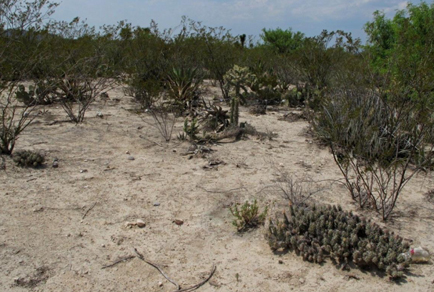
Grusonia pulvinata, a sibling new species endemic to alluvial plains of northern San Luis Potosì and adjacent area of Zacatecas (Mexico), is hereby described. The new species is morphologically very similar to G. vilis, from which differs by its strong joint junctions, high propensity to sexual reproduction, ecology, kariology and other minor traits with some affinities with Grusonia aggeria. A new combination is also proposed here: Grusonia grahamii subsp. vilis comb. et stat. nov.
References
- Abdelaziz, M., Lorite, J., Muñoz-Pajares, A.J., Herrador, M.B., Perfecti, F. & Gómez, J.M. (2011) Using complementary techniques to distinguish cryptic species: a new Erysimum Brassicaceae species from North Africa. American Journal of Botany 98: 1049–1060. https://doi.org/10.3732/ajb.1000438
- Allen, L.J.S., Allen, E.J., Kunst, C.R.G. & Sosebee, R.E. (1991) A diffusion model for dispersal of Opuntia imbricata cholla on rangeland. Journal of Ecology 79: 1123–1135. https://doi.org/10.2307/2261103
- Anderson, E.F. (1986) A revision of the genus Neolloydia B. and R. Cactaceae. Bradleya 4: 1–28. https://doi.org/10.25223/brad.n4.1986.a1
- Anderson, E.F. (1999) Some nomenclatural changes in the Cactaceae, subfamily Opuntioideae. Cactus and Succulent Journal. US. 71: 324–325.
- Anthony, M. (1954) Ecology of Opuntieae in the big bend region of Texas. Ecology 35: 334–347. https://doi.org/10.2307/1930096
- Arrigo, N., de La Harpe, M., Litsios, G., Zozomová-Lihová, J., Španiel, S., Marhold, K., Barker, M.S. & Alvarez, N. (2016) Is hybridization driving the evolution of climatic niche in Alyssum montanum? American Journal of Botany 103: 1348–1357. https://doi.org/10.3732/ajb.1500368
- Baker, M.A. & Pinkava, D.J. (2018) Chromosome Numbers in Some Cacti of Western North America—IX. Haseltonia 25: 2–29. https://doi.org/10.2985/026.025.0103
- Bárcenas, R.T. (2016) A molecular phylogenetic approach to the systematics of Cylindropuntieae. Opuntioideae, Cactaceae. Cladistics 32: 351–359. https://doi.org/10.1111/cla.12135
- Bárcenas, R.T. & Hawkins, J.A. (2007) The discovery of a previously unknown isotype of Opuntia vilis Rose. Opuntioideae: Cactaceae. Haseltonia 13: 83–88. https://doi.org/10.2985/1070-0048(2007)13[83:TDOAPU]2.0.CO;2
- Bárcenas, R.T., Yeson, C. & Hawkins, J.A. (2011) Molecular systematics of the Cactaceae. Cladistics 27: 1–20. https://doi.org/10.1111/j.1096-0031.2011.00350.x
- Beest, M., Roux, J.J., Richardson, D.M., Brysting, A.K., Suda, J., Kubešová, M. & Pyšek, P. (2012) The more the better? The role of polyploidy in facilitating plant invasions. Annals of Botany 109: 19–45. https://doi.org/10.1093/aob/mcr277
- Benson, L.D. (1969) The cacti of the United States and Canada—new names and nomenclatural combinations. Cactus and Succulent Journal. US. 41: 124.
- Benson, L.D. (1982) The cacti of the United States and Canada. Stanford University Press, Stanford, 1044 pp.
- Bickford, D., Lohman, D.J., Sodhil, N.S., Ng, P.K.L., Meier, R., Winker, K., Ingram, K.K. & Das, I. (2007) Cryptic species as a window on diversity and conservation. Trends in Ecology and Evolution 22: 148–155. https://doi.org/10.1016/j.tree.2006.11.004
- Bobich, E.G. (2005) Vegetative reproduction, population structure, and morphology of Cylindropuntia fulgida var. mamillata in a desert grassland. International Journal of Plant Sciences 167: 97–104. https://doi.org/10.1086/425665
- Bobich, E.G. & Nobel, P.S. (2001a) Biomechanics and anatomy of cladode junctions for two Opuntia Cactaceae species and their hybrid. American Journal of Botany 88: 391–400. https://doi.org/10.2307/2657103
- Bobich, E.G. & Nobel, P.S. (2001b) Vegetative reproduction as related to biomechanics, morphology and anatomy of four cholla cactus species in the Sonoran Desert. Annals of Botany 87: 485–493. https://doi.org/10.1006/anbo.2000.1360
- Donati, D. (2010) Una nuova eccezionale specie appartenente al genere Corynopuntia Knuth: Corynopuntia guccinii D.Donati sp. nov. Piante Grasse 30: 115–119.
- Donati, D. (2011) Nuovo studio sul gruppo clavata del genere Corynopuntia: riscoperta di C. agglomerata Knuth e descrizione di C. bulbispina subsp. basileocephala D.Donati subsp. nov. Piante Grasse 31: 2–17.
- Donati, D. (2012) A new species belonging to the genus Corynopuntia Knuth: Corynopuntia nigrispina D.Donati sp. nov. Piante Grasse 32: 2–7.
- Donati, D. (2013) New data from the habitats of Corynopuntia marenae and Corynopuntia reflexispina. CactusWorld 31: 55–60.
- Donati, D. (2017a) Corynopuntia halophila Cactaceae, a new species from Coahuila, Mexico. Plant Biosystems 152 (3): 386–397. https://doi.org/10.1080/11263504.2017.1297332
- Donati, D. (2017b) Corynopuntia deinacantha Cactaceae, a new species from Coahuila, Mexico. Webbia 72 (1): 105–112. https://doi.org/10.1080/00837792.2017.1309743
- Donati, D., Bianchi, C., Pezzi, G., Conte, L., Hofer, A. & Chiarucci, C. (2017) Biogeography and ecology of the genus Turbinicarpus, Cactaceae: environmental controls of taxa richness and morphology. Systematics and Biodiversity 15: 361–371. https://doi.org/10.1080/14772000.2016.1251504
- Fenstermacher, J. (2016) Club chollas of the big bend 3.0: refining species concepts and distributions for the Corynopuntia [Opuntia, Grusonia] schottii complex of western Texas via new chromosome counts, pollen stainability, and morphologic data. Phytoneuron 2016-1: 1–58.
- Flores-Torres, A. & Montaña, C. (2012) Recruiting mechanish of Cylindropuntia leptocaulis Cactaceae in the Southern Chihuahuan Desert. Journal of Arid Environments 84: 63–70. https://doi.org/10.1016/j.jaridenv.2012.04.006
- Flores, F.J.A. & Yeaton, I.R. (2000) La importancia de la competencia en la organisacion de las comunidades vegetales en el altiplano mexicano. Interencia 23: 365–371.
- Flores, F.J.A. & Yeaton, I.R. (2003) The replacement of arborescent cactus species along the climatic gradient in the Southern Chihuahuan Desert: competitive hierarchies and response to freezing temperatures. Journal of Arid Environments 55: 583–594. https://doi.org/10.1016/S0140-1963(02)00288-4
- Garcia, E. (1973) Modificaciones al sistema de clasificación climática de Koeppen. Instituto de Geografía, Universidad Nacional Autónoma de México, 90 pp.
- Griffith, M.P. (2002) Grusonia pulchella classification and its impacts on the genus Grusonia: morphological and molecular evidence. Haseltonia 9: 86–93.
- Griffith, M.P. & Porter, J.M. (2009) Phylogeny of Opuntioideae. Cactaceae. International Journal of Plant Sciences 170: 107–116. https://doi.org/10.1086/593048
- Hendry, A.P., Lohmann, L.G., Conti, E., Cracraft, J., Crandall, K.A., Faith, D.P., Häuser, C., Joly, C.A., Kogure, K., Larigauderie, A., Magallon, S., Moritz, C., Tillier, S., Zardoya, R. & Prieur-Richard, A. (2010) Evolutionary biology in biodiversity science, conservation, and policy: a call to action. Evolution 64: 1517–1528. https://doi.org/10.1111/j.1558-5646.2010.00947.x
- Holthe, P.A. & Szarek, S.R. (1985) Physiological potential for survival of propagules of crassulacean acid metabolism species. Plant Physiology 79: 219–224. https://doi.org/10.1104/pp.79.1.219
- Hunt, D. (2006) The New Cactus Lexicon. DH Books, Millborne Port, 527 pp.
- Hunt, D. (2015) Draft list of genera to be included in the CITES Cactaceae Checklist ed. 3°. Cactaceae Systematics Initiatives 33: 5–15.
- Hunt, D. & Taylor, N. (2002) Studies in the Opuntioideae Cactaceae. Succulent Plants Researches 6: 59–98.
- International Union for Conservation of Nature and Natural Resources. (2001) IUCN Red List Categories and Criteria: Version 3.1. Gland and Cambridge, 30 pp.
- International Union for Conservation of Nature and Natural Resources. (2012) IUCN Red List Categories and Criteria: Version 3.1. 2nd ed. Gland and Cambridge, 32 pp.
- Janzen, D.H. (1986) Chihuahuan Desert nopaleras: Defaunated big mammal vegetation. Annual Review of Ecology and Systematics 17: 595–636. https://doi.org/10.1146/annurev.es.17.110186.003115
- Kahn-Jetter, Z., Evans, L.S., Liclican, E. & Pastore, M. (2001) Compressive/tensile stresses and lignified cells as resistance components in joints between stem segments of Opuntia fulgida and Opuntia versicolor Cactaceae. International Journal of Plant Sciences 162: 579–587. https://doi.org/10.1086/320134
- Knuth, F.M. (1930) Den nye Kaktusbog. Gyldendal, Copenhagen, 136 pp.
- Knuth, F.M. (1935) Kaktus-ABC. Gyldendals Forlagstrykkeri, Copenhagen, 432 pp.
- Laport, R.G., Minckley, R.L. & Ramsey, J. (2016) Ecological distributions, phenological isolation, and genetic structure in sympatric and parapatric populations of the Larrea tridentata polyploid complex. American Journal of Botany 103: 1358–1374. https://doi.org/10.3732/ajb.1600105
- Lichtenzveig, J., Abbo, S., Nerd, A., Tel-Zur, N. & Mizrahi, Y. (2000) Cytology and mating systems in the climbing cacti Hylocereus and Selenicereus. American Journal of Botany 87: 1058–1065. https://doi.org/10.2307/2657005
- Mandujano, M.C., Montaña, C., Méndez, J. & Golubov, J. (1998) The relative contributions of sexual reproduction and clonal propagation in Opuntia rastrera from two habitats in the Chihuahuan Desert. Journal of Ecology 86: 911–921. https://doi.org/10.1046/j.1365-2745.1998.00308.x
- Mayr, E. (1970) Morphological species characters and sibling species. Populations, Species, and Evolution. The Belknap Press of Harvard University Press, Cambridge, 453 pp.
- Miller, P. (1754) The Gardeners Dictionary: containing methods of cultivating and improving all sorts of trees, plants, and flowers, for the kitchen, fruit, and pleasure gardens, as also those which are used in medicine: with directions for the culture of vineyards, and making of wine in England: in which likewise are included the practical parts of husbandry, ed. 4. Published by the author, London, without pagination. https://doi.org/10.5962/bhl.title.79061
- Niklas, K.J. (1992) Plant biomechanics: an engineering approach to plant form and function. University of Chicago Press, Chicago, 630 pp.
- Nobel, P.S. & Meyer, R.W. (1991) Biomechanics of cladodes and cladode junctions for Opuntia ficus-indica Cactaceae. American Journal of Botany 78: 1252–1259. https://doi.org/10.1002/j.1537-2197.1991.tb11418.x
- Nobel, P.S., Geller, G.N., Kee, S.C. & Zimmerman, A.D. (1986) Temperatures and thermal tolerances for cacti exposed to high temperatures near the soil surface. Plant Cell and Environment 9: 279–288. https://doi.org/10.1111/j.1365-3040.1986.tb01740.x
- Racine, C.H. & Downhover, J.F. (1974) Vegetative and reproductive strategies of Opuntia Cactaceae in Galapagos Islands. Biotropica 6: 175–186. https://doi.org/10.2307/2989650
- Ralston, B.E. & Hilsenbeck, R.A. (1989) Taxonomy of the Opuntia schottii complex. Cactaceae in Texas. Madroño 36: 221–231.
- Ralston, B.E. & Hilsenbeck, R.A. (1992) Opuntia densispina Cactaceae: A new club cholla from the Big Bend Region of Texas. Madroño 39: 281–284.
- Robinson, H.E. (1973) New combinations in the Cactaceae subfamily Opuntioideae. Phytologia 26: 175–176.
- Rose, J.N. (1909) Studies of Mexican and Central American Plants—No. 6. Contributions from the US National Herbarium 12 (7): 259–302.
- Ross, R. (1981) Chromosome counts and cytology in the Cactaceae. American Journal of Botany 68: 463–470. https://doi.org/10.1002/j.1537-2197.1981.tb07790.x
- Rzedowski, J. (1978) Vegetación de Mexico. Editorial Limusa, Mexico D.F., 432 pp.
- Schumann, K. (1894) Monatsschrift für Kakteenkunde. IV. Berlin, 160 pp.
- Sivarajan, V.V. (1991) Introduction to the principles of plant taxonomy. 2nd ed. Cambridge University Press, Cambridge, 308 pp.
- Strother, J.L. (1972) Chromosome studies in north-western North American Compositae. American Journal of Botany 59: 242–247. https://doi.org/10.1002/j.1537-2197.1972.tb10088.x
- Strother, J.L. & Nesom, G.L. (1997) Conventions for reporting plant chromosome numbers. Sida 17: 829–831.
- Thiers, B. (2025 [continuously update]) Index herbariorum: a global directory of public herbaria and associated staff. New York: New York Botanical Garden’s Virtual Herbarium. Available from: http://sweetgum.nybg.org/ih (accessed 19 July 2025)
- Timoshenko, S. & Young, D.H. (1962) Elements of strength of materials. 4th ed. Van Nostrand, New York, 388 pp.
- Yeaton, I.R. (1978) A cyclical relationship between Larrea tridentata and Opuntia leptocaulis in the Northern Chihuahuan Desert. Journal of Ecology 66: 651–656. https://doi.org/10.2307/2259156
- Yeaton, I.R. & Romero-Manzanares, A. (1986) Organization of vegetation mosaic in Acacia schaffneri-Opuntia streptacantha association, Southern Chihuahuan Desert, Mexico. Journal of Ecology 74: 211–217. https://doi.org/10.2307/2260359