

Abstract
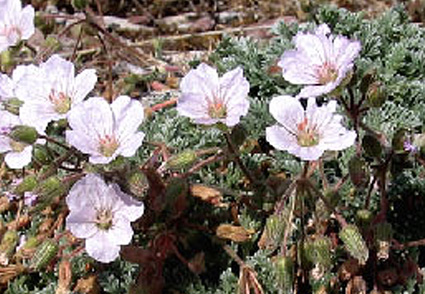
Erodium hakanguriii, from the Altınyayla district of Sivas Province in the eastern part of inner Anatolia (Turkey) is described as a new species based on morphological evidence. It resembles E. sibthorpianum from the calcareous areas of north-west Anatolia, but can be distinguished by several morphological characteristics including longer stems, leaf blades, beak of fruits, and the number of peduncles in each stem. Diagnostic morphological characters, a full description, a revised key to the Absinthoides species group in Turkey, as well as pollen and seed micrographs are provided. Furthermore, the IUCN Red List category of the new species is assessed as Critically Endangered (CR) due to its limited distribution and agricultural pressure.
References
- Aiton, W. (1789) Hortus Kewensis, Vol. 2. Nicol, London, 460 pp.
- Alarcón, M.L., Roquet, C. & Aldasoro, J.J. (2011) Evolution of pollen/ovule ratios and breeding system in Erodium (Geraniaceae). Systematic Botany 36 (3): 661–676. https://doi.org/10.1600/036364411X583637
- Alarcón, M.L., Vargas, P., Sáez, L., Molero, J. & Aldasoro, J.J. (2012) Genetic diversity of mountain plants: Two migration episodes of Mediterranean Erodium (Geraniaceae). Molecular phylogenetics and evolution 63 (3): 866–876. https://doi.org/10.1016/j.ympev.2012.02.031
- Aldasoro, J.J., Navarro, C., Vargas, P., Saez, L. & Aedo, C. (2001) California, a new genus of Geraniaceae endemic to the southwest of North America. Anales Del Jardín Botánico De Madrid 59 (2): 209–216. https://doi.org/10.3989/ajbm.2001.v59.i2.128
- Alpınar, K. (1994) Some contributions to the Turkish flora. Edinburgh Journal of Botany 51: 65–73. https://doi.org/10.1017/S0960428600001724
- Barrett, S.C., Yakimowski, S.B., Field, D.L. & Pickup, M. (2010) Ecological genetics of sex ratios in plant populations. Philosophical Transactions of the Royal Society B: Biological Sciences 365 (1552): 2549–2557. https://doi.org/10.1098/rstb.2010.0002
- Ben Mahmoud, K., Mezzapesa, G.N., Abdelkefi, F. & Perrino, E.V. (2024) Nutritional value and functional properties of an underexploited Tunisian wild beet (Beta macrocarpa Guss.) in relation to soil characteristics. Euro-Mediterranean Journal for Environmental Integration 9: 705–720. https://doi.org/10.1007/s41207-024-00468-5
- Boissier, E.D. (1843) Diagnoses Plantarum Orientalium novarum Ser. 1. Vol. 1. Leipzig, 60 pp.
- Brumhard, P. (1905) Monographische Übersicht der Gattung Erodium. Breslau: Arbeit aus dem Botan. Garten der Universitát Breslau, Breslau, 59 pp.
- Çoşkunçelebi, K., Terzioğlu, S., Karaköse, M. & Güzel, M.E. (2012) Contributions to the description and molecular properties of Erodium hendrikii Alpınar (Geraniaceae), endemic to Turkey. Turkish Journal of Botany 36 (5): 455–461. https://doi.org/10.3906/bot-1202-46
- Davis, P.H. (1967) Erodium L’Hérit. In: Davis, P.H. (Eds.) Flora of Turkey and East Egean Islands, Volume 2. Edinburgh Univ. Press, Edinburgh, UK, pp. 475–487.
- Davis, P.H. (1971) Distribution patterns in Anatolia with particular reference to endemism. In: Davis, P.H., Harper, P.C. & Hedge, I.C. (Eds.) Plant Life of South-West Asia. Edinburgh, UK: The Botanical Society of Edinburgh, pp. 15–27.
- Dumlupınar, İ., Gür, H. & Özüdoğru, B. (2023) Distributional ecology of Noccaea vesicaria in relation to the Anatolian Diagonal. Turkish Journal of Botany 47 (4): 267–277. https://doi.org/10.55730/1300-008X.2765
- Ekim, T. (2012) Erodium L’Hér. In: Güner, A., Aslan, S., Ekim, T., Vural, M. & Babaç, M.T. (Eds.) Türkiye Bitkileri Listesi (Damarlı Bitkiler). İstanbul, Turkey: Nezahat Gökyiğit Botanik Bahçesi ve Flora Araştırmaları Derneği Yayını, pp. 515–517. [in Turkish]
- Fiz, O., Vargas, P., Alarcón, M.L. & Aldasoro, J.J. (2006) Phylogenetic relationships and evolution in Erodium (Geraniaceae) based on trnL-trnF sequences. Systematic Botany 31 (4): 739–763. https://doi.org/10.1600/036364406779695906
- Fiz, O., Vargas, P., Alarcón, M.L, Aedo, C., García, J.L. & Aldasoro, J.J. (2008) Phylogeny and historical biogeography of Geraniaceae in relation to climate changes and pollination ecology. Systematic Botany 33 (2): 326–342. https://doi.org/10.1600/036364408784571482
- Fiz-Palacios, O., Vargas, P., Vila, R., Papadopulos, A.S. & Aldasoro, J.J. (2010) The uneven phylogeny and biogeography of Erodium (Geraniaceae): radiations in the Mediterranean and recent recurrent intercontinental colonization. Annals of Botany 106 (6): 871–884. https://doi.org/10.1093/aob/mcq184
- Gemici, Y. & Leblebici, E. (1995) Seven new species for the Flora of Turkey. Candollea 50: 41–50.
- Guittonneau, G.G. (1972) Contribution à l’étude biosystématique du genre Erodium L’Hér. dans le bassin méditérranéen occidental. Boissiera 20: 1–154.
- Guittonneau, G.G. (1990) Taxonomy, ecology and phylogeny of genus Erodium L’Her. in the Mediterranean region. In: Vorster, P. (Ed.) Proceedings of the International Geraniaceae Symposium. Stellenbosch, South Africa: University of Stellenbosch, pp. 71–91.
- Güner, A. (2000) Erodium L’Hérit. In: Güner, A., Özhatay, N., Ekim, T. & Başer, K.H.C. (Eds.) Flora of Turkey and the East Aegean Islands (Supplement II). Vol. 11. Edinburgh University Press, Edinburgh, pp. 74–75.
- Gür, H. (2016) The Anatolian diagonal revisited: testing the ecological basis of a biogeographic boundary. Zoology in the Middle East 62: 189–199. https://doi.org/10.1080/09397140.2016.1226544
- İlarslan, R. & Yurdakulol, E. (1994) A new species of Erodium (Geraniaceae) from Turkey. Flora Mediterranea 4: 167–170.
- IUCN (2024) Guidelines for using the IUCN Red List Categories and Criteria. Version 16. Prepared by the Standards and Petitions Committee. Available from: http://www.iucnredlist.org/documents/RedListGuidelines.pdf (accessed 30 November 2024)
- Jussieu, A.L. de (1789) Genera Plantarum. T. Barrois, Paris, 268 pp.
- Linnaeus, C. (1753) Species Plantarum, vols. 1–2. L. Salvius, Stockholm, 1200 pp.
- Linnaeus, C. (1767) Systema Naturae, ed.12, 2. L. Salvius, Stockholm, 736 pp.
- Naggar, S.E. (1992) Seed morphology and taxonomy of the Egyptian species of Erodium L’Herit. (Geraniaceae). Feddes Repertorium 103 (5–6): 345–350. https://doi.org/10.1002/fedr.19921030509
- Özüdoğru, B., Aygören Uluer, D., Tarıkahya Hacıoğlu, B. & Yıldırım, H. (2022) Phylogeny, biogeography, and character evolution in the genus Scilla sl and its close relatives Chionodoxa, Gemicia, Puschkinia, and Prospero (Asparagaceae). Plant Systematics and Evolution 308 (6): 44. https://doi.org/10.1007/s00606-022-01835-x
- Peşmen, H. (1968) Apportationes ad floram turcicam, 1–2. Candollea 23: 267–274.
- Remy, J. (1847) Analecta Boliviana. Annales des sciences naturelles. Botanique ser. 3, v.8: 224–239.
- Sweet, R. (1826) Hortus Britannicus, part 1. Ridgway, London, 240 pp.
- Thiers, B. (2024) Index Herbariorum: A global directory of public herbaria and associated staff. New York Botanical Garden’s Virtual Herbarium. Available from: http://sweetgum.nybg.org/science/ih/ (accessed 30 November 2024)
- Wagensommer, R.P., Bartolucci, F., Fiorentino, M., Licht, W., Peccenini, S., Perrino, E.V. & Venanzoni, R. (2017) First record for the flora of Italy and lectotypification of the name Linum elegans (Linaceae). Phytotaxa 296 (2): 161–170. https://doi.org/10.11646/phytotaxa.296.2.5
- Wagensommer, R.P., Perrino, E.V., Albano, A., Medagli, P. & Passalacqua, N.G. (2016) Lectotypification of four Lacaita’s names in the genus Centaurea (Asteraceae). Phytotaxa 269 (1): 54–58. https://doi.org/10.11646/phytotaxa.269.1.7
- WFO (2024) World Flora Online. Available from: http://www.worldfloraonline.org (accessed 30 September 2024)
- Yazici, C., Çiftçi, A., Mollman, R., Harpke, D. & Erol, O. (2024) Diversity of Crocus gargaricus sl: resolving longstanding debates and discovering a new species. Plant Systematics and Evolution 310 (4): 28. https://doi.org/10.1007/s00606-024-01910-5
- Yıldırımlı, Ş. & Doğru-Koca, A. (2004) A new species from Turkey, Erodium aytacii Yıldırımlı & A. Doğru-Koca (Geraniaceae). Ot sistematik Botanik Dergisi 11: 1–6.