

Abstract
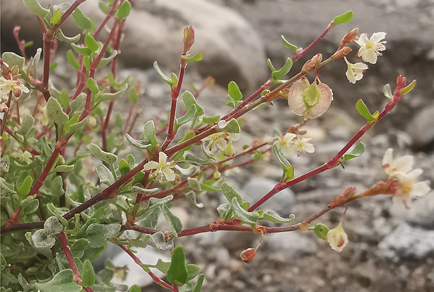
Fagopyrum tibeticum is a small woody shrub, which was initially classified under the genus Parapteropyrum (Polygonaceae) as Parapteryrum tibeticum. However, recent molecular evidences has shown that it should belong to Fagopyrum. By integrating cytological, morphological, and molecular biology evidences, we compare F. tibetium with the other Fagopyrum species, once again proving that F. tibeticum should belong to the Fagopyrum genus. Moreover, F. tibeticum is the only existing hexaploid species in the genus Fagopyrum. The speciation of F. tibeticum may be related to the uplift of the Qinghai Tibet Plateau and the distinctive climate environment.
References
- Bolger, A.M., Lohse, M. & Usadel, B. (2014) Trimmomatic: a flexible trimmer for Illumina sequence data. Bioinformatics 30 (15): 2114‒2120. https://doi.org/10.1093/bioinformatics/btu170
- Bureau, L.É. & Franchet, A.R. (1891) Plantes nouvelles du Thibet et la Chine occidentale: recueillies pendant le voyage de M. Bonvalot et du Prince Henri D’Orleans en 1890 (Suite.) Journal de Botanique (Morot) 5: 150–151.
- Dammer, U. (1892) Die natürlichen Pflanzenfamilien III(1a). In: Engler, H.G.A. & Prantl, K.A.E. (Eds.) Die natürlichen Pflanzenfamilien III(1a). Verlag von Wilhelm Engelmann, Leipzig, pp. 8, 23.
- Diels, L. (1900) Die flora von Central China. Botanische Jahrbücher für Systematik, Pflanzengeschichte und Pflanzengeographie 29: 31–169.
- Ding, M., Zhang, K., Tang, Y., Wang, J., Li, F., Yang, K., Wen, W. & Zhou, M. (2021) Newly discovered tetraploid Fagopyrum homotropicum in Tibet, China. Phytotaxa 528 (3): 202–208. https://doi.org/10.11646/phytotaxa.528.3.4
- Fan, Y., Jin, Y., Ding, M., Tang, Y., Cheng, J., Zhang, K. & Zhou, M. (2021) The Complete Chloroplast Genome Sequences of Eight Fagopyrum Species: Insights into Genome Evolution and Phylogenetic Relationships. Frontiers in Plant Science 12: 799904. https://doi.org/10.3389/fpls.2021.799904
- Forbes, F.B. & Hemsley, W.B. (1891) An Enumeration of all the plants known from China Proper, Formosa, Hainan, the Corea, the Luchu Archipelago, and the island of Hongkong: together with their distribution and synonymy (continued Vol. 23). Botanical Journal of the Linnean Society 26 (176): 332–358.
- Gaertner, J. (1791) De fructibus et seminibus plantarum. Sumtibus Auctoris, Typis Academiae Carolinae, Stutgardiae, 520 pp.
- Gross, M.H. (1913) Remarques sur les polygonees del ′Asie orientale. Bulletin of the Torrey Botanical Club 23: 7–32.
- Hong, S. (1995) Pollen morphology of Parapteropyrum and some putatively related genera (Polygonaceae–Atraphaxideae). Grana 34: 153–159. https://doi.org/10.1080/00173139509429039
- Hutchinson, J. & Dandy, J.E. (1926) A new genus from Uganda. Bulletin Miscellaneous Information 8 (8): 363–365. https://doi.org/10.2307/4118200
- Jin, J., Yu, W., Yang, J., Song, Y., dePamphilis, C.W., Yi, T. & Li, D. (2020) GetOrganelle: a fast and versatile toolkit for accurate de novo assembly of organelle genomes. Genome Biology 21 (1): 241. https://doi.org/10.1186/s13059-020-02154-5
- Li, A. (1981) Parapteropyrum A. J. Li-Unum genus novum Polygonacearum sinicum. Journal of Systematics and Evolution 19: 330–332.
- Linnaeus, C. (1753) Species plantarum. Laurentius Salvius, Stockholm, 560 pp.
- Meisner, C.D.F. (1832) Polygonaceae. In: Wallich, N. (Ed.) Plantae asiaticae rariores: or, descriptions and figures of a select number of unpublished East Indian plants, Vol. 3. Treuttel & Würtz, London, pp. 51–65.
- Miller, P. (1754) The gardener’s dictionary. 4th ed., vol 3. Printed by the Author, London, without pagination.
- Min, D., Shi, W., Dehshiri, M., Gou, Y., Li, W., Zhang, K., Zhou, M. & Li, B. (2023) The molecular phylogenetic position of Harpagocarpus (Polygonaceae) sheds new light on the infrageneric classification of Fagopyrum. PhytoKeys 220: 109–126. https://doi.org/10.3897/phytokeys.220.97667
- Moench, C. (1794) Methodus plantas horti botanici et agri Marburgensis: a staminum situ describendi. Officina Nova Libraria Academiae, Marburgi Cattorum, 290 pp. https://doi.org/10.5962/bhl.title.304
- Nakamura, T., Yamada, K., Tomii, K. & Katoh, K. (2018) Parallelization of MAFFT for large-scale multiple sequence alignments. Bioinformatics 34 (14): 2490–2492. https://doi.org/10.1093/bioinformatics/bty121
- Ohnishi, O. (1995) Discovery of new Fagopyrum species and its implication for the studies of evolution of Fagopyrum and of the origin of cultivated buckwheat. In: Matano, T. & Ujihara, A. (Eds.) Current Advances in Buckwheat Research. Vol. I–III. Proceedings of the 6th International Symposium on Buckwheat in Shinshu, 24-29 August 1995. Shinshu University Press, pp. 175–190.
- Ohnishi, O. & Matsuoka, Y. (1996) Search for the wild ancestor of buckwheat II. Taxonomy of Fagopyrum (Polygonaceae) species based on morphology, isozymes and cpDNA variability. Genes & Genetic Systems 71 (6): 383–390. https://doi.org/10.1266/ggs.71.383
- POWO (2025) Plants of the World Online. Royal Botanic Gardens, Kew. Available from: https://powo.science.kew.org/taxon/urn:lsid:ipni.org:names:331606-2 (accessed 13 June 2025)
- Rice, A., Šmarda, P., Novosolov, M., Drori, M., Glick, L., Sabath, N., Meiri, S., Belmaker, J. & Mayrose, I. (2019) The global biogeography of polyploid plants. Nature Ecology & Evolution 3 (2): 265–273. https://doi.org/10.1038/s41559-018-0787-9
- Sanchez, A., Schuster, T. & Kron, K. (2009) A large-scale phylogeny of Polygonaceae based on molecular data. International Journal of Plant Sciences 170: 1044–1055. https://doi.org/10.1086/605121
- Stewad, A. (1930) The Polygoneae of eastern Asia. Contributions from the Gray Herbarium of Harvard University 88: 1–129.
- Sun, Y. & Zhang, M. (2011) Study on phylogeny of four polygonaceae genera from arid and semiarid areas. Arid Zone Research 28 (5): 849–853. https://doi.org/10.13866/j.azr.2011.05.016
- Tang, Y., Shao, J. & Zhou, M. (2019) A Taxonomic Revision of Fagopyrum Mill from China. Journal of Plant Genetic Resources 20 (3): 646–653. https://doi.org/10.13430/j.cnki.jpgr.20181210001
- Tavakkoli, S., Osaloo, S. & Maassoumi, A. (2010) The phylogeny of Calligonum and Pteropyrum (Polygonaceae) based on nuclear ribosomal DNA ITS and chloroplast trnL-F sequences. Iranian Journal of Biotechnology 8 (1): 7–15.
- Tian, X., Liu, R., Bin, T. & Liu, J. (2009) Karyological studies of Parapteropyrum and Atraphaxis (Polygonaceae). Caryologia 62 (4): 261–266. https://doi.org/10.1080/00087114.2004.10589691
- Tian, X., Luo, J., Wang, A., Mao, K. & Liu, J. (2011) On the origin of the woody buckwheat Fagopyrum tibeticum (Parapteropyrum tibeticum) in the Qinghai-Tibetan Plateau. Molecular Phylogenetics and Evolution 61: 515–520. https://doi.org/10.1016/j.ympev.2011.07.001
- Treviranus, L.C. (1826) Horti botanici Vratislaviensis plantarum vel novarum vel minus cognitarum manipulus: descripsit et observationibus nec non tabulis tribus illustravit. Nova Acta Physico-medica Academiae Caesareae Leopoldino-Carolinae Naturae Curiosorum Exhibentia Ephemerides sive Observationes Historias et Experimenta 13 (5): 165–208.
- Van de Peer, Y., Ashman, T.L., Soltis, P.S. & Soltis, D.E. (2021) Polyploidy: an evolutionary and ecological force in stressful times. The Plant cell 33 (1): 11–26. https://doi.org/10.1093/plcell/koaa015
- Yamane, K. & Ohnishi, O. (2001) Phylogenetic relationships among natural populations of perennial buckwheat, Fagopyrum cymosum Meisn., revealed by allozyme variation. Genetic Resources and Crop Evolution 48: 69–77. https://doi.org/10.1023/a:1011265212293
- Yang, B., Li, L., Liu, J. & Zhang, L. (2020) Plastome and phylogenetic relationship of the woody buckwheat Fagopyrum tibeticum in the Qinghai-Tibet Plateau. Plant diversity 43 (3): 198–205. https://doi.org/10.1016/j.pld.2020.10.001
- Ye, N. & Guo, G. (1992) Classification, origin and evolution of genus Fagopyrum in China. Proceedings 5th Intl. Symp. Buckwheat, Ina: 19–28.
- Yukio, D. (1960) Cytological studies in polygonum and related Genera I. Shokubutsugaku Zasshi 73 (867): 337–340. https://doi.org/10.15281/jplantres1887.73.337
- Zhang, K., Fan, Y., Weng, W., Tang, Y. & Zhou, M. (2021) Fagopyrum longistylum (Polygonaceae), a new species from Sichuan, China. Phytotaxa 482 (2): 173–182. https://doi.org/10.11646/phytotaxa.482.2.5
- Zhao, L., Xie, D., Huang, L., Zhang, S. & Hao, M. (2021) Integrating the physical and genetic map of bread wheat facilitates the detection of chromosomal rearrangements. Journal of Integrative Agriculture 20 (9): 2333–2342. https://doi.org/10.1016/S2095-3119(20)63289-0
- Zhou, M., Tang, Y. & Fang, W. (2021) Color atlas of Fagopyrum in China. Science Press, Beijing, 6 pp.