
Abstract
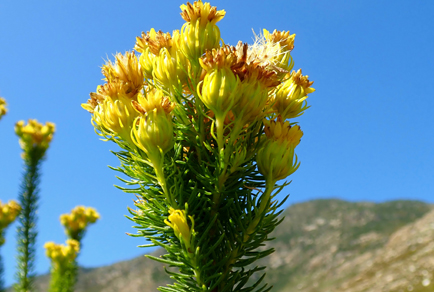
Pteronia is a large genus of shrubs or woody perennials with more than 70 species. The genus is largely restricted to southern Africa, with one species in Zambia. The last taxonomic treatment of Pteronia was published in 1917 by J. Hutchinson and E. P. Phillips. In South Africa, where most of the species occur, the genus has been identified as one of the top priority genera for taxonomic research. Its taxa are poorly known in terms of their distribution and morphological variation within and among species. Morphological and anatomical studies revealed variation in characters such as leaf size, shape and vestiture, capitula shape, involucre shape, pappus series, cypselae shape, size and vestiture, presence or absence and type of trichomes, number of vascular bundles, type of secretory structure in the mesophyll, epidermal glands, epidermal cell shape in the leaves and cypselae (in transverse section) as well as the number of ribs and type of cells associated with vascular bundles at the ribs in the cypselae (in transverse section). A detailed taxonomic treatment is presented with descriptions, nomenclature, diagnostic characters, geographical distribution and maps, ecological information, as well as an updated key to the species. A total of 76 accepted and one imperfectly known species are recognised within the genus. Several species are treated as synonyms, and all names are typified, with justification presented for the choice of lectotypes.
References
- Aiton, W. (1789) Hortus kewensis: or a catalogue of the plants cultivated in the Royal Botanic Garden Kew. G. Nicol, London. https://doi.org/10.5962/bhl.title.116053
- Archer, F.M. (1994) Ethnobotany of Namaqualand: The Richtersveld. Unpubl. M.A. thesis, Dept. of Archaeology, University of Cape Town.
- Banks, M.S.S. (1900) Alabastra Diversa. The Journal of Botany 38: 153–160.
- Bello, A.O. (2018) A systematic study of Pteronia L. (Asteraceae). Unpubl. PhD thesis, Dept. of Botany & Plant Biotechnology, University of Johannesburg.
- Bello, A.O., Boatwright, J.S., Tilney, P.M., Van der Bank, M. & Magee, A.R. (2017) A taxonomic revision of the Pteronia camphorata group (Astereae, Asteraceae). South African Journal of Botany 113: 277–287. https://doi.org/10.1016/j.sajb.2017.08.017
- Bello, A.O., Boatwright, J.S., Van der Bank, M. & Magee, A.R. (2020) Four new species of Pteronia (Astereae, Asteraceae) from South Africa. Phytotaxa 430 (1): 25–32. https://doi.org/10.11646/phytotaxa.430.1.4
- Bello, A.O., Boatwright, J.S., Van der Bank, M. & Magee, A.R. (2021) Taxonomic revision of the Pteronia adenocarpa group (Astereae, Asteraceae). Phytotaxa 523 (1): 73–88. https://doi.org/10.11646/phytotaxa.523.1.4
- Bello, A.O., Boatwright, J.S., Van der Bank, M. & Magee, A.R. (2022) Taxonomic revision of the Pteronia uncinata group (Asteraceae: Astereae) and the resurrection of Pteronia trigona. Kew Bulletin 77 (1): 271–292. https://doi.org/10.1007/s12225-022-10004-9
- Bello, A.O., Boatwright, J.S., Magee, A.R., Bergh, N. & Van der Bank, M. (2026) Evolution of the Resin Daisies: Biogeography of the Genus Pteronia L. (Astereae, Asteraceae) in the Arid and Semi-Arid Habitats of Southern Africa. Journal of Biogeography 53: e70172. https://doi.org/10.1111/jbi.70172
- Bentham, G. & Hooker, J.D. (1873) Genera Plantarum ad exemplaria imprimis in herbariis Kewensibus servata delineata, vol 2. Reeve & Co., London.
- Bergius, P.J. (1767) Descriptiones Plantarum ex Capite Bonæ Spei. L. Salvius, Stockholm.
- Bremer, K. (1994) Asteraceae: Cladistics and Classification. Timber Press, Portland, Oregon.
- Brouillet, L., Lowrey, T.K., Urbatsch, L., Karaman-Castro, V., Sancho, G., Wagstaff, S. & Semple, J.C. (2009) Astereae. In: Funk, V.A., Susanna, A., Stuessy, T.F. & Bayer, R.J. (Eds.) Systematics, evolution and biogeography of Compositae. International Association of Plant Taxonomy, Vienna, pp. 589–629.
- Brown, N.E. (1906) Diagnoses Africanae XVI. Bulletin of Miscellaneous Information, Kew 4: 98–109. https://doi.org/10.2307/4113278
- Bruns, K. & Meiertoberens, M. (1987) Volatile constituents of Pteronia incana (Compositae). Flavour and Fragrance Journal 2: 157–162. https://doi.org/10.1002/ffj.2730020404
- Brusse, F.A. (1990) A new species of Pteronia L. (Asteraceae) from Limestone areas of the southwestern Cape, South Africa. Bulletin du Jardin Botanique National Belgique 60: 151–154. https://doi.org/10.2307/3668337
- Burman, N.L. (1768) Flora Indica: cui accedit series zoophytorum indicorum, nec non Prodromus Florae Capensis. C. Haek, Lugduni Batavorum. https://doi.org/10.5962/bhl.title.60581
- Burtt Davy, J. (1912) A first checklist of the flowering plants and ferns of the Transvaal and Swaziland. Annals of the Transvaal Museum 3: 119–182.
- Candolle, A.P. de (1836) Prodromus Systematis Naturalis Regni Vegetabilis, vol. 5. Treuttel & Würtz, Paris.
- Cassini, A.H.G. (1825) Paquerolle, Bellium. In: Cuvier, F. (Ed.) Dictionnaire des Sciences Naturelles, vol. 37. Levrault, F.G., Strasbourg & Le Normant, Paris, pp. 484–495.
- Cassini, A.H.G. (1828) Turritelle, Turritella. In: Cuvier, F. (Ed.) Dictionnaire des Sciences Naturelles, vol. 56. Levrault, F.G., Strasbourg & Le Normant, Paris, pp. 150–165.
- Chumová, Z., Belyayev, A., Mandáková, T., Zeisek, V., Hodková, E., Šemberová, K., Euston-Brown, D. & Trávníček, P. (2022) The relationship between transposable elements and ecological niches in the Greater Cape Floristic Region: A study on the genus Pteronia (Asteraceae). Frontiers in Plant Science 13: e982852. https://doi.org/10.3389/fpls.2022.982852
- Compton, R.H. (1931) The flora of the Whitehill district. Transactions of the Royal Society of South Africa 19: 313–315.
- Coovadia, Z.H. (2007) The antimicrobial properties and chemical composition of leaf extracts and essential oils of indigenous Pteronia species. Unpubl. MSc thesis, Faculty of Health Sciences, University of the Witwatersrand, Johannesburg.
- Dinter, K. (1921) Index der aus Deutsch-Südwestafrika bis zum Jahre 1917 bekannt gewordenen Pflanzenarten VII. Repertorium Specierum Novarum Regni Vegetabilis 17: 185–192. https://doi.org/10.1002/fedr.19210170829
- Dinter, K. (1926) Index der aus Deutsch-Südwestafrika bis zum Jahre 1917 bekannt gewordenen Pflanzenarten XX. Repertorium Specierum Novarum Regni Vegetabilis 23: 130–133. https://doi.org/10.1002/fedr.19260231207
- Dinter, K. (1931) Kurzer Bericht über meine Reise 1929 in die Küstenwüste SW.-Afrikas, spez. die Buchuberge. Repertorium Specierum Novarum Regni Vegetabilis 29: 163–170. https://doi.org/10.1002/fedr.19310291104
- Dinter, K. (1932) Diagnosen neuer Südwestafrikanischer Pflanzen. 2. Fortsetzung. Repertorium Specierum Novarum Regni Vegetabilis 30: 180–184. https://doi.org/10.1002/fedr.19320300907
- Drège, J.F. (1843) Zwei pflanzengeographische Documente. Flora 26 (2, Besondere Beigabe): 1–230. https://doi.org/10.5962/bhl.title.87612
- Edwards, D. & Leistner, O.A. (1971) A degree reference system for citing biological records in southern Africa. Mitteilungen des Botanische Staatssammlung München 10: 501–509.
- Feder, N. & O’Brien, T.P. (1968) Plant microtechnique: some principles and new methods. American Journal of Botany 55: 123–142. https://doi.org/10.1002/j.1537-2197.1968.tb06952.x
- Fourcade, H.G. (1932) Contributions to the flora of the Knysna and neighbouring Divisions. Transactions of the Royal Society of South Africa 21: 75–102. https://doi.org/10.1080/00359193209518876
- Goswami, S. (2024) System of plant classification: 3 types, Biology Discussion. Available from: http://www.biologydiscussion.com/plants/classifications/system-of-plant-classification-3-types/30330 (accessed 10 August 2024)
- Harvey, W.H. (1865) Compositae. In: Harvey, W.H. & Sonder, O.W. (Eds.) Flora Capensis Volume III, Rubiaceae to Campanulaceae. Hodges, Smith and Co., Dublin. [Pteronia L. on pp. 95–111]
- Herman, P.P.J. (2003) Pteronia. In: Germishuizen, G. & Meyer, N.L. (Eds.) Plants of southern Africa: an annotated checklist. Strelitzia 14: 276–279.
- Hoffmann, O. (1890) Tubuliflorae-Astereae. In: Engler, A. & Prantl, K. (Eds.) Die natürlichen Pflanzenfamilien, vol. 4. Wilhelm Engelmann, Leipzig, pp. 142–172.
- Hoffmann, O. (1893) Pteronia polygalifolia. In: Schinz, H. (Ed.) Beiträge zur Kenntnis der Afrikanischen Flora. Bulletin de L’Herbier Boisser 1: 73.
- Hulley, I.M., Viljoen, A.M., Tilney, P.M., Van Vuuren, S.F., Kamatou, G.P.P. & Van Wyk, B.-E. (2010a) Ethnobotany, leaf anatomy, essential oil composition and antibacterial activity of Pteronia onobromoides (Asteraceae). South African Journal of Botany 76: 43–48. https://doi.org/10.1016/j.sajb.2009.06.012
- Hulley, I.M., Viljoen, A.M., Tilney, P.M., Van Vuuren, S.F., Kamatou, G.P.P. & Van Wyk, B.-E. (2010b) The ethnobotany, leaf anatomy, essential oil variation and biological activity of Pteronia incana (Asteraceae). South African Journal of Botany 76: 668–675. https://doi.org/10.1016/j.sajb.2010.08.007
- Hulley, I.M., Viljoen, A.M., Tilney, P.M., Van Vuuren, S.F., Kamatou, G.P.P. & Van Wyk, B.-E. (2011) Pteronia divaricata (Asteraceae): A newly recorded Cape herbal medicine. South African Journal of Botany 77: 66–74. https://doi.org/10.1016/j.sajb.2010.05.010
- Hulley, I.M., Tilney, P.M., Van Vuuren, S.F., Kamatou, G.P.P., Nortje, J.M., Viljoen, A.M. & Van Wyk, B.-E. (2016) San and Nama indigenous knowledge: The case of ǀnhora (Pteronia camphorata) and its medicinal use. South African Journal of Science 112 (9/10): 84–92. https://doi.org/10.17159/sajs.2016/20160044
- Humbert, L. (1923) Les Composées de Madagascar. E. Lanier, Caen, France, 286 pp.
- Hutchinson, J. (1931) General Smuts’ botanical expedition to Northern Rhodesia. Bulletin of Miscellaneous Information (Royal Botanical Garden, Kew) 5: 225–254. https://doi.org/10.2307/4102484
- Hutchinson, J. & Phillips, E.P. (1917) A revision of the genus Pteronia (Compositae). Annals of the South African Museum 9: 277–329.
- Hutchinson, J. & Phillips, E.P. (1922) Diagnoses Africanae: LXXXVI. Bulletin of Miscellaneous Information, Kew 1922: 193–198. https://doi.org/10.2307/4107463
- Klatt, F.W. (1896) Compositae. In: Schinz, H. (Ed.) Beiträge zur Kenntnis der Afrikanischen Flora. Bulletin de L’Herbier Boisser 4: 824–845.
- Kolberg, H. & Van Slageren, M. (2014) A synopsis of the genus Pteronia (Compositae: Astereae) in Namibia including the resurrection of Pteronia quadrifaria. Kew Bulletin 69: 1–44. https://doi.org/10.1007/s12225-014-9488-y
- Leistner, O.A. (2000) Seed Plants of Southern Africa: Families and Genera. Strelitzia, vol. 10. National Botanical Institute, Pretoria, 775 pp.
- Leistner, O.A. & Morris, J.M. (1976) Southern African place names. Annals of the Cape Province Museum, Grahamstown, South Africa, 565 pp.
- Lessing, C.F. (1831) De plantis in expeditione speculatoria Romanzoffiana: Synanthereae Rich. Linnaea 6: 83–170.
- Lessing, C.F. (1832) Sysnopsis Generum Compositarum Earumque Dispositionis Novae Tentamen Monographiis Multarum Capensium Interjectis. Sumtibus Dunckeri et Humblotii, Berlin, 473 pp. https://doi.org/10.5962/bhl.title.51470
- Linnaeus, C. (1753) Species plantarum. L. Salvius, Stockholm, 1200 pp.
- Linnaeus, C. (1760) Plantae Rariores Africanæ. L. Salvius, Stockholm.
- Linnaeus, C. (1763a) Amoenitates academicæ, vol. 6. L. Salvius, Stockholm.
- Linnaeus, C. (1763b) Species plantarum (ed. 2), vol. 2. L. Salvius, Stockholm, pp. 785–1684.
- Linnaeus, C. (1767) Systema Naturæ (ed. 12), vol. 2. L. Salvius, Stockholm, 742 pp.
- Linnaeus filius, C. (1782) Supplementum Plantarum. Impensis Orphanotrophei, Brunsvigæ, 467 pp.
- Lowrey, T.K. (1998) Typification of Linnaean specific and varietal names. In: Jarvis, C.E. & Turland, N.J. (Eds.) The Compositae (Asteraceae). Taxon 47 (2): 347–370. https://doi.org/10.2307/1223764
- Manning, J.C. & Goldblatt, P. (2012) Plants of the Greater Cape Floristic Region 1: the Core Cape flora. Strelitzia, 29. South African National Biodiversity Institute, Pretoria.
- Merxmüller, H. (1952) Compositen Studien II. Mitteilungen Botanischen Staatssammlung München 1: 120–129.
- Merxmüller, H. (1955) Taxa Praecipue Africana. Mitteilungen Botanischen Staatssammlung München 2: 67–83.
- Merxmüller, H. (1967) Asteraceae. In: Merxmüller, H. (Ed.) Prodromus einer Flora von Südwestafrika, vol. 139. J. Cramer, Lehre, pp. 150–159.
- Merxmüller, H. & Roessler, H. (1984) Compositen-Studien XI. Neue Übersicht der Compositen Südwestafrikas. Mitteilungen Botanischen Staatssammlung München 20: 61–96.
- Moore, S. (1900) Alabastra diversa VI. Journal of Botany 38: 153–160.
- Moore, S. (1902) A contribution to the Composite flora of Africa. Journal of the Linnean Society, Botany 35: 305–366.
- Moore, S. (1904) Compositae. Bulletin de L’Herbier Boissier Ser. II. 4: 1011–1013.
- Muschler, R. (1911a) Compositae africanae novae. 1. Botanische Jahrbücher für Systematik, Pflanzengeschichte und Pflanzengeographie 46: 51–124.
- Muschler, R. (1911b) LXXXVII. Vernonia De Wildermaniana Muschler, nom. nov. Repertorium Specierum Novarum Regni Vegetabilis 9: 384. https://doi.org/10.1002/fedr.19110092316
- Nesom, G.L. (1993) Madagaster (Asteraceae: Astereae), a new genus of subtribe Hinterhuberinae. Phytologia 75 (1): 94–99.
- Nesom, G.L. (2020) Revised subtribal classification of Astereae (Asteraceae). Phytoneuron 53: 1–39.
- Nesom, G.L. & Robinson, H. (2007) Tribe Asterae. In: Kadereit, J.W. & Jeffrey, C. (Eds.) Kubitzki’s Families and Genera of Vascular Plants, vol. 8. Springer, Berlin & Heidelberg, pp. 315–376.
- Nordenstam, B. (1971) New South African Compositae. Botaniska Noriser 124: 9–15.
- Noyes, R.D. & Rieseberg, L.H. (1999) ITS sequence data support a single origin for North American Astereae (Asteraceae) and reflect deep geographic divisions in Aster s. l. American Journal of Botany 86 (3): 398–412. https://doi.org/10.2307/2656761
- Poiret, J.L.M. (1804) Pteronia. In: Poiret, J.L.M. (Ed.) Encyclopedie Methodique. Botanique, vol. 5. H. Agasse, Paris, pp. 730–734.
- Plug, C. (2026) S2A3 Biographical database of southern African science. Available from: http://www.s2a3.org.za/bio/Biograph_final.php?serial=1017 (accessed 30 March 2026)
- Plukenet, L. (1700) Almagesti Botanici Mantissa. Sumptibus auctoris, London, 191 pp.
- Range, P. (1935) Die flora des Namalandes VIII. Repertorium Specierum Novarum Regni Vegetabilis 38: 256–280. https://doi.org/10.1002/fedr.19350381310
- Roessler, H. & Merxmüller, H. (1982) Weitere Neufunde aus Südwestafrika. Mitteilungen Botanischen Staatssammlung München 18: 187–200.
- Saupe, S.G. (2024) Phenetic classification systems. Available from: http://employees.csbsju.edu/ssaupe/biol308/Lecture/Classification/phenetic_class.htm (accessed 10 August 2024)
- Schlechter, R. (1899) Plantae Schlechterianae novae vel minus cognitae describuntur. II. Botanische Jahrbücher für Systematik, Pflanzengeschichte und Pflanzengeographie 27: 86–220.
- Shearing, D. (1997) Karoo. South African Wild Flower Guide 6. Botanical Society of South Africa, Kirstenbosch, Claremont.
- Smith, C.A. (1966) Common names of South African plants. Memoirs of the Botanical Survey of South Africa 35. Department of Agricultural Technical Services, Pretoria, 642 pp.
- Snijman, D.A. (Ed.) (2013) Plants of the Greater Cape Floristic Region, Vol. 2: the Extra Cape flora. Strelitzia 30. South African National Biodiversity Institute, Pretoria.
- Sprengel, C. (1826) Systema Vegetabilium, vol. 3. Sumtibus Librariae Dieterichianae, Göttingen, Gottingae, 936 pp.
- Stace, C.A. (1989) Plant Taxonomy and Biosystematics, ed. 2. Cambridge University Press, Cambridge.
- Stafleu, F.A. & Cowan, R.S. (1976) Taxonomic literature: A selective guide to botanical publications and collections with dates, commentaries, and types, ed. 2, vol. 1. Bohn, Scheltema & Holkema, Utrecht, 1192 pp. https://doi.org/10.5962/bhl.title.48631
- Stafleu, F.A. & Cowan, R.S. (1979) Taxonomic literature: A selective guide to botanical publications and collections with dates, commentaries, and types, ed. 2, vol. 2. Bohn, Scheltema & Holkema, Utrecht; Dr. W. Junk b.v., Publishers, The Hague, 1028 pp.
- Stafleu, F.A. & Cowan, R.S. (1981) Taxonomic literature: A selective guide to botanical publications and collections with dates, commentaries, and types, ed. 2, vol. 3. Bohn, Scheltema & Holkema, Utrecht; Dr. W. Junk b.v., Publishers, The Hague, 1000 pp.
- Stafleu, F.A. & Cowan, R.S. (1986) Taxonomic literature: A selective guide to botanical publications and collections with dates, commentaries, and types, ed. 2, vol. 6. Bohn, Scheltema & Holkema, Utrecht/Antwerpen; Dr. W. Junk b.v., Publishers, The Hague/Boston, 940 pp.
- Stuessy, T.F. (2009) Plant Taxonomy: the Systematic Evaluation of Comparative Data, ed. 2. Columbia University Press, New York.
- Thiers, B. (2024) Index Herbariorum: A global directory of public herbaria and associated staff. New York Botanical Garden’s Virtual Herbarium. Available from: http://sweetgum.nybg.org/science/ih/ (accessed 11 August 2024)
- Thunberg, C.P. (1800) Prodromus Plantarum Capensium, vol. 2. Joh. Fr. Edman, Uppsala, pp. 85–191.
- Thunberg, C.P. (1823) Flora capensis, vol. 1. Sumtibus J. G. Cottae, Stuttgart, 352 pp.
- Turczaninow, N.S. (1851) Synanthereae quaedam hucusque indescriptae. Bulletin de la Société Impériale des Naturalistes de Moscou 24 (2): 59–95.
- Van Wyk, B.-E. (2008) A review of Khoi-San and Cape Dutch medical ethnobotany. Journal of Ethnopharmacology 119: 331–341. https://doi.org/10.1016/j.jep.2008.07.021
- Victor, J.E. & Smith, G.F. (2011) The conservation imperative and setting plant taxonomic research priorities in South Africa. Biodiversity and Conservation 20: 1501–1505. https://doi.org/10.1007/s10531-011-0041-0
- Victor, J.E., Hamer, M. & Smith, G.F. (2013) A Biosystematics Research Strategy for the Algae, Animals, Bacteria and Archaea, Fungi and Plants of South Africa, 2013–2018. SANBI Biodiversity Series 23. South African National Biodiversity Institute, Pretoria.
- Viljoen, A.M., Kamatou, G.P.P., Coovadia, Z.H., Özek, T. & Başer, K.H.C. (2010) Rare sesquiterpenes from South African Pteronia species. South African Journal of Botany 76: 146–152. https://doi.org/10.1016/j.sajb.2009.07.012
- Von Staden, L., Raimondo, D. & Dayaram, A. (2013) Taxonomic research priorities for the conservation of the South African flora. South African Journal of Science 109: 1–10. https://doi.org/10.1590/sajs.2013/1182
- Walpers, G.G. (1843) Repertorium Botanices Systematicae, vol. 2. F. Hofmeister, Lipsiae, 1052 pp.
- Wild, H. (1975) The Compositae of the Flora Zambesiaca area, 4 Astereae. Kirkia 10 (1): 1–72.
- Willkomm, M. & Lange, J. (1870) Prodromus Florae Hispanicae, vol. 2. E. Schweizerbart, Stuttgart.