
Abstract
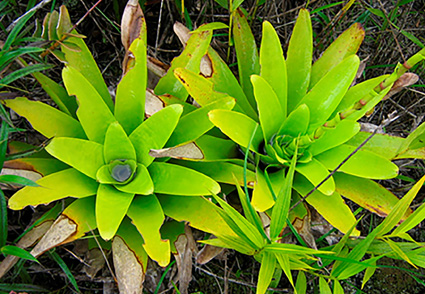
We describe, discuss, and illustrate Vriesea serraourensis, a new species from the Chapada Diamantina in the municipality of Barra da Estiva and Ituaçu, Bahia, Brazil, here considered a critically endangered species. The new species is morphologically related to V. bahiana but clearly differs from it by its larger size, longer and fewer leaves, inflorescence branches forming an internal angle of 30o–45o with the main axis, sepals yellow and ovate, petals narrowly obovate, whitish-yellow towards the base and yellow at the apex, and basal petal appendages with acuminate or irregularly bidentate apex. Additionally, we provide the phenology of the new species.
References
- Bachman, S., Moat, J., Hill, A.W., Torre, J. & Scott, B. (2011) Supporting red list threat assessments with GeoCAT: geospatial conservation assessment tool. In: Smith, V. & Penev, L. (Eds.) e-Infrastructures for data publishing in biodiversity science. ZooKeys 150: 117–126. https://doi.org/10.3897/zookeys.150.2109
- Barfuss, M.H.J., Samuel, R., Till, W. & Stuessy, T.F. (2005) Phylogenetic relationships in subfamily Tillandsioideae (Bromeliaceae) based on DNA sequence data from seven plastid regions. American Journal of Botany 92: 337–351. https://doi.org/10.3732/ajb.92.2.337
- Barfuss, M.H.J., Till, W., Leme, E.M.C., Pinzón, J.P., Manzanares, J.M., Halbritter, H., Samuel, R. & Brown, G.K. (2016) Taxonomic revision of Bromeliaceae subfam. Tillandsioideae based on a multi-locus DNA sequence phylogeny and morphology. Phytotaxa 279: 1–97. https://doi.org/10.11646/phytotaxa.279.1.1
- Calfo, V., Eppinhaus, A., Fernandez, E.P. & Estevão da Silva, L.A. (2021) ProFlora—Sistema Nacional para Conservação da Flora. Centro Nacional de Conservação da Flora, Diretoria de Pesquisas, Instituto de Pesquisas Jardim Botânico do Rio de Janeiro.
- Convention on Biological Diversity (1993) Article 9. Available from The Secretariat of the Convention on Biological Diversity website: https://www.cbd.int/ (accessed 26 May 2024)
- Costa, A.F., Moura, R.L., Neves, B., Machado, T.M., Kessous, I.M., Uribbe, F.P., Couto, D.R. & Gomes-da-Silva, J. (2024) Vriesea. In: Flora e Funga do Brasil. Jardim Botânico do Rio de Janeiro. Available from: https://floradobrasil.jbrj.gov.br/FB6414/ (accessed 26 May 2024)
- Costa, A.F., Gomes-da-Silva, J. & Wanderley, M.G.L. (2014) Vriesea (Bromeliaceae, Tillandsioideae): taxonomic history, and morphology of the Brazilian lineage. Journal of the Torrey Botanical Society 141: 338–352. https://doi.org/10.3159/TORREY-D-13-00070.1
- Couto, D.R., Kessous, I.M., Neves, B., Paixão-Sousa, B., Faria, C.G., Barfuss, M.H.J., Salgueiro, F., Sá-Haiad, B. & Costa, A.F. (2022) Molecular phylogenetics and trait evolution in Stigmatodon (Bromeliaceae, Tillandsioideae), an endemic genus to Brazilian rocky outcrops. Systematic Botany 47: 347–362. https://doi.org/10.1600/036364422X16512564801696
- ESRI (2023) QGIS Geographic Information System. Open Source Geospatial Foundation Project. Available from: https://qgis.org/en/site/ (accessed 18 June 2024)
- Fidalgo, O. & Bononi, V.L.R. (1984) Técnicas de coleta, preservação e herborização de material botânico, Manual n° 4. Instituto de Botânica, São Paulo, 62 pp.
- Funch, R.R., Harley, R.M. & Funch, L.S. (2009) Mapping and evaluation of the state of conservation of the vegetation in and surrounding the Chapada Diamantina National Park, NE Brazil. Biota Neotropica 9: 21–30. https://doi.org/10.1590/S1676-06032009000200001
- Givnish, T.J., Barfuss, M.H.J., Ee, B.V., Riina, R., Schulte, K., Horres, R., Gonsiska, P.A., Jabaily, R.S., Crayn, D.M., Smith, A.C., Winter, K., Brown, G.K., Evans, T.M., Holst, B.K., Luther, H., Till, W., Zizka, G., Berry, P.E. & Sytsma, K.J. (2011) Phylogeny, adaptive radiation, and historical biogeography in Bromeliaceae: insights from an eight-locus plastid phylogeny. American Journal of Botany 98: 872–895. https://doi.org/10.3732/ajb.1000059
- Gomes-da-Silva, J., Vargens, F.A., Arruda, R.C.O. & Costa, A.F. (2012) A morphological cladistic analysis of the Vriesea corcovadensis group (Bromeliaceae: Tillandsioideae), with anatomical descriptions: new evidence of the non-monophyly of the genus. Systematic Botany 37: 641–654. https://doi.org/10.1600/036364412X648599
- Gonçalves, C.N. & Gonçalves, C.F.A. (2023) A preliminary checklist of vascular plants endemic to the Chapada Diamantina, Bahia, Brazil, with comments on their extinction threats status. Biodiversidade Brasileira 13: 1–23. https://doi.org/10.37002/biodiversidadebrasileira.v13i4.2264
- Gouda, E.J., Butcher, D. & Gouda, C.S. (2024 [continuously updated]) Encyclopaedia of Bromeliads, version 3. Encyclopedia University Botanical Garden, Utrech. Available from: http://bromeliad.nl/ (accessed 31 December 2024).
- Harms, H. (1930) Bromeliaceae. In: Engler, H.G.A. & Prantl, K.A.E (Eds.) Die natürlichen Pflanzenfamilien nebst ihren Gattungen und wichtigeren Arten, insbesondere den Nutzpflanzen. Ed. 2. Vol. 15a. W. Engelmann, Leipzig, pp. 65–159.
- Hawksworth, D.L. (2010) Terms used in bionomenclature, the name of organisms (and plant communities). Global Biodiversity Information Facility, Copenhagen, 215 pp. https://doi.org/10.3897/zookeys.150.2109
- INPE (2024) Banco de Dados de queimadas. Available from: http://www.inpe.br/queimadas/bdqueimadas (accessed 18 June 2024)
- IUCN (2001) IUCN Red List Categories and Criteria: Version 3.1. IUCN Species Survival Commission.
- IUCN (2022) Standards Petitions Sub-committee. Guidelines for using the IUCN Red List Categories and Criteria. Version 9.0. Available from: http://www.iucn.org (accessed 18 June 2024)
- Jordão, L.A., Ferreira, G.C., Bicalho, M., Wimmer, F., Gomes, M., Aragão, L.A., Mello, P.H.A., Amorim, E.T., Fernandez, E.P. & Laque, T. (2022) O MapBiomas e a avaliação do risco de extinção da flora brasileira. Available from: http://mapbiomas-br-site.s3.amazonaws.com/Trabalhos%20vencedores%204ed/MencaoHonrosa_CategoriaDestaqueAplicacoesEmPoliticasPublicas_LucasSBJordao.pdf (accessed 18 June 2024).
- Kessous, I.M., Salgueiro, F. & Costa, A.F. (2024) A total evidence phylogeny sheds light on a new Vriesea (Tillandsioideae, Bromeliaceae) species from the Brazilian Atlantic Forest. Plant Systematics and Evolution 310: 6. https://doi.org/10.1007/s00606-023-01885-9
- Leme, E.M.C. (1999) New species of Brazilian Bromeliaceae: a tribute to Lyman B. Smith. Harvard Papers in Botany 4: 136–168.
- Leme, E.M.C. (2001) A new ornamental species of Vriesea from Bahia. Bromélia 6: 4–6.
- Leme, E.M.C. & Kollmann, L.J.C. (2013) Miscellaneous new species of Brazilian Bromeliaceae. Phytotaxa 108: 1–40. https://doi.org/10.11646/phytotaxa.108.1.1
- Leme, E.M.C. (2012) Revision of the lithophytic Vriesea species from Minas Gerais (and vicinities), Brazil—Part V: Two tubolaciniate stigma-type new species. Journal of the Bromeliad Society 62: 16–19.
- Leme, E.M., Halbritter, H. & Barfuss, M.H. (2017) Waltillia, a new monotypic genus in Tillandsioideae (Bromeliaceae) arises from a rediscovered, allegedly extinct species from Brazil. Phytotaxa 299: 1–35. https://doi.org/10.11646/phytotaxa.299.1.1
- Lima, C.C.U. & Nolasco, M.C. (2015) Chapada Diamantina: A remarkable landscape dominated by mountains and plateaus. In: Vieira, B., Salgado, A. &Santos, L. (Eds.) Landscapes and landforms of Brazil. World Geomorphological Landscapes. Springer, Dordrecht. pp. 211–220. https://doi.org/10.1007/978-94-017-8023-0_19
- Linnaeus, C. von (1753) Species Plantarum. Impensis Laurentii Salvii, Stockholm, 560 pp. https://doi.org/10.5962/bhl.title.669
- Lindley, J. (1843) Vriesia psittacina, Parrot flowered Vriesia. Edwards’s Botanical Register 29: 10–11.
- Machado, T.M. (2017) Aplicação de Next Generation na filogenia da subfamília Tillandsioideae e estudos taxonômicos no complexo Vriesea itatiaiae. Tese de Doutorado, Universidade Federal de Minas Gerais, Belo Horizonte, 98 pp.
- Machado, T.M., Loiseau, O., Paris, M., Weigand, A., Versieux, L.M., Stehmann, J.R., Lexer, J. R C. & Salamin, N. (2020) Systematics of Vriesea (Bromeliaceae): phylogenetic relationships based on nuclear gene and partial plastome sequences. Botanical Journal of the Linnean Society 192: 656–674. https://doi.org/10.1093/botlinnean/boz102
- MapBiomas (2022a) Projeto MapBiomas—Coleção 6 da Série Anual de Mapas de Cobertura e Uso de Solo do Brasil, dados de 2020. Município: Barra da Estiva (BA); Ituaçu (BA). Available from: https://https://mapbiomas.org (accessed 14 June 2024)
- MapBiomas (2022b) Projeto MapBiomas—Coleção 6 da Série Anual de Mapas de Cobertura e Uso de Solo do Brasil, dados de 1985 e 2020. Available from: https://https://mapbiomas.org (accessed 15 June 2024)
- Mez, C. (1896) Bromeliaceae. In: De Candolle, C. (Ed.) Monographiae Phanerogamarum 9. Sumptibus Masson & Ciae, Paris, pp. 1–990. https://doi.org/10.5962/bhl.title.45961
- Mez, C.C. (1894) Bromeliaceae. In: Martius, C.F.P. von, Eichler, A.W. & Urban, I. (Eds.) Flora Brasiliensis. Vol. 3. pp. 566.
- Moura, R.L. & Costa, A.F. (2014) Taxonomic notes on Vriesea Sect. Xiphion (Bromeliaceae) with descriptions of three new species. American Society of Plant Taxonomists 39: 791–803. https://doi.org/10.1600/036364414X681536
- Neves, B., Kessous, I.M., Moura, R.L., Couto, D.R., Zanella, C.M., Antonelli, A., Bacon, C.D., Salgueiro, F. & Costa, A.F. (2020) Pollinators drive floral evolution in an Atlantic Forest genus. AoB PLANTS 12: p.plaa046. https://doi.org/10.1093/aobpla/plaa046
- Scharf, U. & Gouda, E.J. (2008) Bringing Bromeliaceae back to homeland botany. Journal of the Bromeliad Society 58: 123–129.
- Schultes, J.A. & Schultes, J.H. (1830) Bromeliaceae. Systema Vegetabilium 7: 1193–1287.
- Smith, L.B. (1933) Studies in the Bromeliaceae IV. Contributions from the Gray Herbarium of Harvard University 102: 145–152. https://doi.org/10.5962/p.336152
- Smith, L.B. (1966) Notes on Bromeliaceae, XXIV. Phytologia 13: 458. https://doi.org/10.5962/bhl.part.21852
- Smith, L.B. (1970) Notes on Bromeliaceae, XXX. Phytologia 19: 281–290. https://doi.org/10.5962/bhl.part.14773
- Smith, L.B. & Read, R.W. (1977) Notes on Bromeliaceae, XXXIX. Phytologia 38: 137. https://doi.org/10.5962/bhl.part.28884
- Smith, L.B. & Downs, R.J. (1977) Tillandsioideae (Bromeliaceae). Flora Neotropica 14: 659–1492.
- Terry, R.G., Brown, G.K. & Olmstead, R.G. (1997) Phylogenetic relationships in subfamily Tillandsioideae (Bromeliaceae) using ndhF se- quences. Systematic Botany 22: 333–345. https://doi.org/10.2307/2419461
- Thiers, B.M. (2024 [continuously updated]) Index Herbariorum. New York Botanical Garden. Available from: http://sweetgum.nybg.org/science/ih/ (accessed 24 May 2024)
- Turland, N.J., Wiersema, J.H., Barrie, F.R., Greuter, W., Hawksworth, D.L., Herendeen, P.S., Knapp, S., Kusber, W.-H., Li, D.-Z., Marhold, K., May, T.W., McNeill, J., Monro, A.M., Prado, J., Price, M.J. & Smith, G.F. (eds.) (2018) International Code of Nomenclature for algae, fungi, and plants (Shenzhen Code) adopted by the Nineteenth International Botanical Congress, Shenzhen, China, July 2017. Regnum Vegetabile 159. Glashütten: Koeltz Botanical Books. https://doi.org/10.12705/Code.2018
- Ule, E. (1908) Beiträge zur Flora von Bahia. I. Botanische Jahrbücher für Systematik, Planzengeschichte und Pflanzengeographie 42: 191‒238.
- Wawra, H. (1880) Die Bromeliaceen-Ausbeute vor der Reizen der Prinzen August und Ferdinand von Sachsen-Coburg nach Brasilien 1879. Oesterreichische botanische Zeitschrift; gemeinütziges Organ für Botanik 30: 218‒225. https://doi.org/10.1007/BF01636106
- Wittmack, L. (1891) Die von Bernoullii und Cario 1866–1878 in Guatemala gesammelten Bromeliaceen. Botanischer Jahrbücher für Systematik, Planzengeschichte und Pflanzengeographie 14: 1‒8.