

Abstract
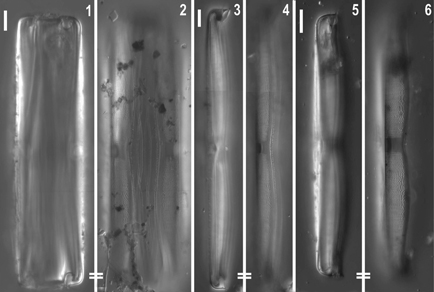
During a survey of the diatoms present in aerophilic microhabitats associated with waterfalls in Misiones province (Argentina), aimed to explore the diatom flora occurring in these particular environments, we found a diatom belonging to the genus Stauroneis which does not match to previously recorded taxa and it is therefore described here as a new species, Stauroneis alegrensis. The new species was recorded from a sample of rock scrapings in a site affected by the waterfalls’ spray and documented with light and scanning electron microscopy. The new species was compared to other morphologically similar large species with pseudosepta from other regions of the world. Although sharing with the latter the main features of valve morphology, S. alegrensis can be distinguished by its unique combination of morphometric characters.
References
- Avigliano, E., Rosso, J.J., Lijtmaer, D., Ondarza, P., Piacentini, L., Izquierdo, M., Cirigliano, A., Romano, G., Nuñez–Bustos, E., Porta, A., Mabragaña, E., Grassi, E., Palermo, J., Bukowski, B., Tubaro, P. & Schenone, N. (2019) Biodiversity and threats in non–protected areas: A multidisciplinary and multi–taxa approach focused on the Atlantic Forest. Heliyon 5: 1–13.
- Bahls, L. (2010) Stauroneis in the Northern Rockies—50 species of Stauroneis sensu stricto from western Montana, northern Idaho, northeastern Washington and southwestern Alberta, including 16 species described as new. In: Bahls, L. (Ed.) Northwest Diatoms, Montana Diatom Collection, Vol. 4. Helena, pp. 1–179.
- Bahls, L. (2012) Five new species of Stauroneis (Bacillariophyta, Stauroneidaceae) from the northern Rocky Mountains, USA. Phytotaxa 67: 1–8. https://doi.org/10.11646/phytotaxa.67.1.1
- Barber, H.G. & Haworth, E.Y. (1981) A guide to the morphology of the diatom frustule with a key to the British freshwater genera. Freshwater Biological Association, Scientific Publication 44: 1–112.
- Boyer, C.S. (1927) Synopsis of North American Diatomaceae, Supplement, Part 2. Naviculatae, Surirellatae. Proceedings of the Academy of Natural Sciences of Philadelphia 79: 229–583.
- Bruder, K. & Medlin, L.K. (2008) Morphological and molecular investigations of naviculoid diatoms. II. Selected genera and families. Diatom Research 23: 283–329. https://doi.org/10.1080/0269249X.2008.9705759
- Casa, V., Mataloni, G. & Van de Vijver, B. (2017) Stauroneis fuegiana, a new Stauroneis species (Bacillariophyta) from Tierra del Fuego, southern Argentina. Phytotaxa 311: 085–092. https://doi.org/10.11646/phytotaxa.311.1.8
- Cleve, P.T. (1894) Synopsis of the naviculoid diatoms. Part I. Kongliga Svenska Vetenskapsakademiens Handlingar, series 4, 26: 1–194.
- Cochero, J., Licursi, M. & Gómez, N. (2015) Changes in the epipelic diatom assemblage in nutrient rich streams due to the variations of simultaneous stressors. Limnologica 51: 15–23. https://doi.org/10.1016/j.limno.2014.10.004
- Cox, E.J. (2001) What constitutes a stauros? A morphogenetic perspective. In: Jahn, R., Witkowski, A. & Compère, P. (Eds.) Festschrift für H. Lange-Bertalot. A.R.G. Gantner Verlag K.G, Ruggell, Liechtenstein, pp. 303–316.
- Cox, E.J. (2012) Ontogeny, homology, and terminology – wall morphogenesis as an aid to character recognition and character state definition for pennate diatom systematics. Journal of Phycology 48: 1–31. https://doi.org/10.1111/j.1529-8817.2011.01081.x
- Cox, E.J. (2015) Diatoms. In: Frey, W. (Ed.) Syllabus of Plant Families - A. Engler’s Syllabus der Pflanzenfamilien Part 2/1: Photoautotrophic eukaryotic Algae. Glaucocystophyta, Cryptophyta, Dinophyta/Dinozoa, Haptophyta, Heterokontophyta/Ochrophyta, Chlorarachniophyta/Cercozoa, Euglenophyta/Euglenozoa, Chlorophyta, Streptophyta p.p. Borntraeger Science Publishers. Stuttgart, pp. 64–102.
- Cranwell, M.M. (1974) Síntesis geográfica de la provincia de Misiones. In: Relevamiento cultural de la provincia de Misiones. Informes del Instituto Nacional de Antropología, Buenos Aires, pp. 45–63.
- Di Bitetti, M.S., Placci, G. & Dietz, L.A. (2003) Una Visión de Biodiversidad para la Ecorregión del Bosque Atlántico del Alto Paraná: Diseño de un Paisaje para la Conservación de la Biodiversidad y prioridades para las acciones de conservación. World Wildlife Fund, Washington D.C., 154 pp.
- Ehrenberg, C.G. (1832) Über die Entwickelung und Lebensdauer der Infusionsthiere; nebst ferneren Beiträgen zu einer Vergleichung ihrer organischen Systeme. Abhandlungen der Königlichen Akademie Wissenschaften zu Berlin, Physikalische Klasse 1831: 1–154.
- Ehrenberg, C.G. (1843) Verbreitung und Einfluss des mikroskopischen Lebens in Süd- und Nord-Amerika. Abhandlungen der Königlichen Akademie der Wissenschaften zu Berlin 1841: 291–445.
- Escandell, A. & Espinosa, M.A. (2012) Evolución paleoambiental de estuarios mesomareales de Patagonia. Las diatomeas como indicadores ambientales durante el Holoceno en la costa norpatagónica argentina. Editorial Académica Española, 92 pp.
- Frenguelli, J. (1933) Contribución al conocimiento de las Diatomeas Argentinas. Diatomeas de la región de los Esteros del Yberá (en la Provincia de Corrientes). Anales del Museo Nacional de Historia Natural Bernardino Rivadavia 37 (Protistología 3): 365–476.
- Frenguelli, J. (1953) XIX Contribución al conocimiento de las diatomeas argentinas. Diatomeas del territorio nacional de Misiones. Revista del Museo de la Ciudad Eva Perón, Nueva Serie, Sección Botánica 8: 63–86.
- Grunow, A. (1860) Über neue oder ungenügend gekannte Algen. Erste Folge, Diatomeen, Familie Naviculaceen. Verhandlungen der kaiserlich-königlichen zoologisch-botanischen Gesellschaft in Wien 10: 503–582.
- Grunow, A. (1868 '1867') Algae. In: Fenzl, E. et al. (Eds.) Reise der österreichischen Fregatte Novara um die Erde in den Jahren 1857, 1858, 1859 unter den Befehlen des Commodore B. von Wüllerstorf-Urbair. Botanischer Theil. Erster Band. Sporenpflanzen. Wien [Vienna]: Aus der Kaiserlich Königlichen Hof- und Staatsdruckeri in Commission bei Karl Gerold's Sohn, pp. 1–104.
- Herbst, N. & Maidana, N.I. (1989) Diatoms of Chaco (República Argentina). Nova Hedwigia 49: 207–232.
- Hustedt, F. (1959) Die Kieselalgen Deutschlands, Österreichs und der Schweiz, 2. Teil. In: Rabenhorst, L. (Ed.) Kryptogamen-Flora von Deutschlands, Österreichs und der Schweiz. Band VII(2), Reprint 1977, Otto Koeltz Science Publishers, Koenigstein, 845 pp.
- Joh, G. (2014) Diatom flora of genus Stauroneis (Bacillariophyta) from mainly the mountain peatlands of Korea. Journal of Ecology and Environment 37: 257–270. https://doi.org/10.5141/ecoenv.2014.030
- Jüttner, I., Kociolek, J.P., Gurung, S., Gurung, A., Sharma, C., Levkov, Z., Williams, D.M. & Ector, L. (2018) The genus Gomphonema (Bacillariophyta) in Rara Lake, Nepal: taxonomy, morphology, habitat distribution and description of four new species. Diatom Research 33: 283–320. https://doi.org/10.1080/0269249X.2018.1528182
- Kociolek, J.P., Blanco, S., Coste, M., Ector, L., Liu, Y., Karthick, B., Kulikovskiy, M., Lundholm, N., Ludwig, T., Potapova, M., Rimet, F., Sabbe, K., Sala, S., Sar, E., Taylor, J., Van de Vijver, B., Wetzel, C.E., Williams, D.M., Witkowski, A. & Witkowski, J. (2024) DiatomBase. Stauroneis C.G. Ehrenberg, 1843. Available from: http://www.diatombase.org/aphia.php?p=taxdetails&id=149077 (accessed 20 May 2024)
- Kociolek, J.P., Stoermer, E.F. & Bahls, L.L. (1986) Observations on North American Gomphoneis (Bacillariophyceae). III. Gomphoneis septa (Mogh.) comb. nov. Canadian Journal of Botany 64: 2764–2768. https://doi.org/10.1139/b86-367
- Krammer, K. & Lange-Bertalot, H. (1986) Bacillariophyceae 1. Teil: Naviculaceae. In: Ettl, H., Gerloff, J., Heynig, H & Mollenhauer, D. (Eds.) Süsswasserflora von Mitteleuropa. VEB G. Fisher Verlag, Jena, 876 pp.
- Kulikovskiy, M., Maltsev, Y., Andreeva, S., Glushchenko, A., Gusev, E., Podunay, Y., Ludwig, T.V., Tusset, E. & Kociolek, J.P. (2019) Description of a new diatom genus Dorofeyukea gen. nov. with remarks on phylogeny of the family Stauroneidaceae. Journal of Phycology 55: 173–185. https://doi.org/10.1111/jpy.12810
- Lagerstedt, N.G.W. (1873) Sötvatens-Diatomaceer fran Spetsbergen och Beeren Eiland. Bihang till Kongliga Svenska Vetenskaps-Akademiens Handlingar 1: 1–52.
- Levkov, Z., Caput Mihalić, K. & Ector, L. (2010) A taxonomical study of Rhoicosphenia Grunow (Bacillariophyceae) with a key for identification of selected taxa. Fottea 10: 145–200. https://doi.org/10.5507/fot.2010.010
- Levkov, Z., Tofilovska, S., Jovanovska, E., Cvetkoska, A. & Metzeltin, D. (2016) Revision of the Stauroneis smithii Grunow (Bacillariophyceae) species complex from Macedonia. Botanica Serbica 40: 167–178. https://doi.org/10.5281/zenodo.162215
- Licursi, M., Gómez, N. & Donadelli, J. (2010) Ecological optima and tolerances of coastal benthic diatoms in the freshwater-mixohaline zone of the Río de la Plata estuary. Marine Ecology-Progress Series 418: 105–117.
- Lissa, M.G. (1986) Las diatomeas de cuerpos de agua de la provincia de Corrientes. FACENA 6: 179–202.
- Lowe, R.L., Kociolek, P., Johansen, J.R., Van de Vijver, B., Lange-Bertalot, H. & Kopalová, K. (2014) Humidophila gen. nov., a new genus for a group of diatoms (Bacillariophyta) formerly within the genus Diadesmis: species from Hawai'i, including one new species. Diatom Research 29: 351–360. https://doi.org/10.1080/0269249X.2014.889039
- Maidana, N.I. (1981) Estudio taxonómico de las diatomeas de Misiones. Lilloa 35: 103–113.
- Maidana, N.I. (1983) Estudio taxonómico de las diatomeas de Misiones (Argentina): II. Lilloa 36: 151–158.
- Maidana, N.I. & Herbst, N. (1994) Diatomeas del Chaco (Argentina): II. Boletín de la Sociedad Argentina de Botánica 30: 25–42.
- Maidana, N.I. & Seeligmann, C.T. (2014) Phytoplankton in high mountain wetlands of Argentina. Advances in Limnology 65: 23–35. https://doi.org/10.1127/1612-166X/2014/0065-0032
- Metzeltin, D. & Lange-Bertalot, H. (1998) Tropical diatoms of South America I: About 700 predominantly rarely known or new taxa representative of the neotropical flora. In: Lange-Bertalot, H. (Ed.) Iconographia Diatomologica 5. Koeltz Scientific Books. Königstein, 695 pp.
- Metzeltin, D. & Lange-Bertalot, H. (2007) Tropical Diatoms of South America II. Special Remarks on Biogeographic Disjunction. In: Lange-Bertalot, H. (Ed.) Iconographia Diatomologica 18. A.R.G. Gantner Verlag K.G., Ruggell, 877 pp.
- Metzeltin, D., Lange-Bertalot, H. & García-Rodríguez, F. (2005) Diatoms of Uruguay. Iconographia Diatomologica 15. A.R.G. Gantner Verlag K.G., Ruggell, 736 pp.
- Nieva, A., Seeligmann, C.T. & Maidana, N.I. (2019) Diatomeas perifíticas de un río de montaña (Tucumán, Argentina). Lilloa 56: 64–91. https://doi.org/10.30550/j.lil/2019.56.1/5
- Noga, T., Rybak, M. & Ector, L. (2017) Description of Stauroneis saprophila sp. nov. (Bacillariophyta), a new diatom species from anthropogenic environment. Phytotaxa 327: 269–275. https://doi.org/10.11646/phytotaxa.327.3.6
- Rabenhorst, L. (1859) Pleurostauron (Pleurostaurum) Rbh. Hedwigia 2 (3): 17, pl. 1.
- Round, F.E., Crawford, R.M. & Mann, D.G. (1990) The Diatoms: Biology and morphology of the genera. Cambridge University Press, Cambridge, 747 pp.
- Salusso, M.M. & Moraña, L.B. (2005) Características físicas, químicas y fitoplancton del ríos y embalses de la alta cuenca del Río Juramento (Salta, Argentina). Natura Neotropicalis 31: 29–44.
- Schmidt, A. (1903) Atlas der Diatomaceen-kunde Series VI: Heft [61]. Bearbeitet von Dr. M. Schmidt. Leipzig: O.R. Reisland, pl. 241–244.
- Seeligmann, C.T. & Maidana, N.I. (2019) Consideraciones sobre la comunidad de diatomeas en relación a gradientes de altitud y salinidad en humedales de la Puna y los Altos Andes (Catamarca y Jujuy, Argentina). Boletín de la Sociedad Argentina de Botánica 52: 475–486. https://doi.org/10.31055/1851.2372.v54.n4.23902
- Simonato, J. (2025) Sistemática y distribución del género Luticola D.G.Mann (Bacillariophyta) en Argentina. Tesis Doctoral UNLP, 195 pp. [https://repositoriosdigitales.mincyt.gob.ar/vufind/Record/SEDICI_91fcca2ae7ec5870f3852af2878e1442]
- Simonato, J., Sala, S.E. & Kociolek, J.P. (in press) Neoluticola (Bacillariophyceae) a new genus of colonial diatoms from tropical America. Fottea.
- Swenson, J. (2020) Diatoms of the Esteros del Iberá: A Taxonomic and Ecological Comparison of Historic and Contemporary Collections. Master’s thesis, University of Colorado, Boulder, 90 pp.
- Taboada, M.Á., Mirande, M.J. & Gavriloff, I.J.C. (2021) Primer relevamiento de la riqueza algal de una laguna de montaña del Noroeste Argentino. Bonplandia 30: 37–60. https://doi.org/10.30972/bon.3014589
- Thomas, E.W., Kociolek, J.P., Lowe, R.L. & Johansen, J.R. (2009) Taxonomy, ultrastructure and distribution of Gomphonemoid diatoms (Bacillariophyceae) from Great Smoky Mountains National Park (U.S.A.). Nova Hedwigia, Beihefte 135: 201–237.
- Van de Vijver, B., Beyens, L. & Lange-Bertalot, H. (2004) The genus Stauroneis in Arctic and Antarctic locations. Bibliotheca Diatomologica 50: 1–311.
- Van de Vijver, B., Gremmen, N.J.M. & Beyens, L. (2005) The genus Stauroneis (Bacillariophyceae) in the Antarctic region. Journal of Biogeography 32: 1791–1798. https://doi.org/10.1111/j.1365-2699.2005.01325.x
- van der Werff, A. (1953) A new method of concentrating and cleaning diatoms and other organisms. SIL Proceedings, 1922–2010. Internationale Vereinigung für Theoretische und Angewandte Limnologie: Verhandlungen 12: 276–277.
- Vouilloud, A.A. (2003) Catálogo de diatomeas continentales y marinas de Argentina. Asociación Argentina de Ficología, La Plata, 308 pp.
- Vouilloud, A.A., Guerrero, J.M., Palladino, M.B. & Lamaro, A.A. (2021) Revision of the type materials of Stauroneis schinzii var. argentina Frenguelli and S. schinzii var. maxima Frenguelli (Bacillariophyceae). Phytotaxa 478: 119–130. https://doi.org/10.11646/phytotaxa.478.1.8
- Vouilloud, A.A., Guerrero, J.M., Sala, S.E., Simonato, J. & Kociolek, J.P. (2022) Taxonomy and valve morphology of Humidophila species (Bacillariophyceae) from aerophilous habitats in northeastern Argentina, with the description of four new species. Fottea 22: 56–77. https://doi.org/10.5507/fot.2021.016
- Wadmare, N., Kociolek, J.P. & Karthick, B. (2021) Three new species of the genus Stauroneis Ehrenberg (Bacillariophyceae: Stauroneidaceae) from the Northern Western Ghats, India. Fottea 21: 220–234. https://doi.org/10.5507/fot.2021.007
- Wadmare, N., Van de Vijver, B. & Karthick, B. (2023) A critical analysis of the type material and taxonomic revision of the Indian Stauroneis acuta complex (Bacillariophyta) with the separation of two new species. Nova Hedwigia 117: 351–380. https://doi.org/10.1127/nova_hedwigia/2023/0844
- Zidarova, R., Kopalová, K. & Van de Vijver, B. (2014) The genus Stauroneis (Bacillariophyta) from the South Shetland Islands and James Ross Island (Antarctica). Fottea 14: 201–207. https://doi.org/10.5507/fot.2014.015