
Abstract
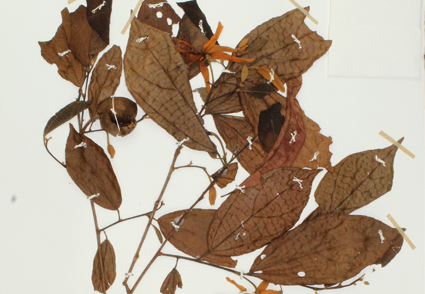
Here we describe a new species from the Brazilian Amazon, Mollia trimera. This species is mainly distinguished from other species of the genus by flowers with trimerous external whorls (calyx, corolla, and outer androecium), a rare morphological characteristic in Malvaceae. Morphological description, taxonomic comments, illustrations, distribution, habitat, preliminary conservation status, and phenology are provided.
References
- Alverson, W.S., Whitlock, B.A., Nyffeler, R., Bayer, C. & Baum, D.A. (1999) Phylogeny of the core Malvales based on sequences of ndhF. American Journal of Botany 86: 1474–1486. https://doi.org/10.2307/2656928
- APG (1998) An ordinal classification for the families of flowering plants. Annals of the Missouri Botanical Garden 85: 531–553. https://doi.org/10.2307/2992015
- Aublet, J.B.C.F. (1775) Histoire des Plantes de la Guiane Françoise 1. Londres, P. F. Didot jeune, pp. 538–541. https://doi.org/10.5962/bhl.title.674
- Bachman, S., Moat, J., Hill, A., de la Torre, J. & Scott, B. (2011) Supporting Red List threat assessments with GeoCAT: geospatial conservation assessment tool. ZooKeys 150: 117–126. https://doi.org/10.3897/zookeys.150.2109
- Baehni, C. (1934) Revision du genre Mollia Mart. & Zucc. Candollea 5: 403–426.
- Baum, D.A., Alverson, W.S. & Nyffeler, R. (1998) A durian by any other name: taxonomy and nomenclature of the core Malvales. Harvard Papers in Botany 3: 313–330.
- Beentje, H.J. (2016) The Kew Plant Glossary, an illustrated dictionary of plant terms (second edition). Royal Botanic Gardens Kew, Kew, 184 pp.
- Bentham, G. (1861) Notes on Tiliaceae. Journal of the Proceedings of the Linnean Society, Botany 5 (Suppl. 2): 52–74. https://doi.org/10.1111/j.1095-8339.1861.tb01276.x
- Britton, N.L. (1889) An enumeration of the plants collected by Dr. H. H. Rusby in South America, 1885–1886, VI. Bulletin of the Torrey Botanical Club 16: 156.
- Brown, R. (1824) Entelea arborescens. New Zealand Entelea. Curtis’s Botanical Magazine 51: t. 2480.
- Brunken, U. & Muellner, A.N. (2012) A new tribal classification of Grewioideae (Malvaceae) based on morphological and molecular phylogenetic evidence. Systematic Botany 37: 699–711. https://doi.org/10.1600/036364412X648670
- Blume, C.L. (1825) Bijdragen tot de flora van Nederlandsch Indië (2). Batavia, Ter Lands Drukkerij, pp. 56–57. https://doi.org/10.5962/bhl.title.395
- Burret, M. (1926) Beiträge zur Kenntnis der Tiliaceen. Notizblatt des Botanischen Gartens und Museums zu Berlin-Dahlem 9: 592–880. https://doi.org/10.2307/3994327
- Costa, M.T.R., Bovini, M.G. & Guimarães, E.F. (2021) Nomenclatural synopsis and typifications in Mollia (Malvaceae: Grewioideae). Brittonia 73: 438–445. https://doi.org/10.1007/s12228-021-09681-w
- De Craene, L.R. (2016) Meristic changes in flowering plants: How flowers play with numbers. Flora 221: 22–37. https://doi.org/10.1016/j.flora.2015.08.005
- Dorr, L.J. & Wurdack, K. (2024) Re-evaluating monotypic Eleutherostylis from New Guinea and the Moluccas and its inclusion in Grewia (Malvaceae, Grewioideae). PhytoKeys 237: 91–102. https://doi.org/10.3897/phytokeys.237.114105
- Endress, P.K. (1996) Homoplasy in angiosperm flowers. In: Sanderson, M.J. & Hufford, L. (Eds.) Homoplasy: The Recurrence of Similarity in Evolution. Academic Press, San Diego, pp. 303–325. https://doi.org/10.1016/B978-012618030-5/50014-9
- Hernández-Gutiérrez, R., van den Berg, C., Mendoza, C.G., Cevallos, M.P., Freire-M, E., Lemmon, E.M., Lemmon, A.R. & Magallón, S. (2022) Localized Phylogenetic Discordance Among Nuclear Loci Due to Incomplete Lineage Sorting and Introgression in the Family of Cotton and Cacao (Malvaceae). Frontiers in Plant Science 13: 850521. https://doi.org/10.3389/fpls.2022.850521
- Hijmans, R.J., van Etten, J., Cheng, J., Mattiuzzi, M., Sumner, M., Greenberg, J.A., Lamigueiro, O.P., Bevan, A., Racine, E.B. & Shortridge, A. (2023) raster: Geographic data analysis and modeling. R package version 3.6-20. Available from: https://CRAN.R-project.org/package=raster (accessed 28 January 2025)
- Grisebach, A.H.R. (1866) Catalogus plantarum cubensium exhibens collectionem Wrightianam aliasque minores ex insula Cuba missas. Lipsae, Apud Gulielmum Engelmann, 301 pp. https://doi.org/10.5962/bhl.title.177
- MapBiomas (2021) MapBiomas Project—Collection 6 of Brazilian Land Cover & Use Map Series. Available from: https://mapbiomas.org (accessed 28 January 2025)
- MapBiomas (2022) MapBiomas Project—Collection 7 of Brazilian Land Cover & Use Map Series. Available from: https://mapbiomas.org (accessed 28 January 2025)
- iNaturalist community (2023) Observations of Mollia (Malvaceae) in November, 2023. Exported from: https://www.inaturalist.org (accessed 15 November 2023)
- IUCN (2012) IUCN Red List Categories and Criteria, version 3.1. International Union for Conservation of Nature and Natural Resources, Gland, Switzerland and Cambridge, 32 pp.
- IUCN (2024) Guidelines for Using the IUCN Red List Categories and Criteria, version 16. Prepared by IUCN Standards and Petitions Committee. Available from: http://www.iucnredlist.org/ (accessed 20 April 2024)
- Kitazawa, M.S. & Fujimoto, K. (2016) Stochastic occurrence of trimery from pentamery in floral phyllotaxis of Anemone (Ranunculaceae). Acta Societatis Botanicorum Poloniae 85 (4): 1–10. https://doi.org/10.5586/asbp.3530
- Martius, C.F.P. & Zuccarini, J.G. (1826, dt. 1824) Nova Genera et Species Plantarum Brasiliensium, Vol. 1. Typis Lindaueri, Monachii [Munich].
- Mei, T., Wang, Y., Chen, T. & Hu, W. (2018) basicTrendline: Add Trendline and Confidence Interval of Basic Regression Models to Plot. R package version 2.0. Available from: https://cran.r-project.org/src/contrib/Archive/basicTrendline/ (accessed 28 January 2025)
- Meijer, W. (1978) Mollia (Tiliaceae): A revision of the South American species. In: B. Maguire & col., The Botany of the Guyana Highland, Part X. Memoirs of the New York Botanical Garden 29: 68–82.
- Pebesma, E. (2018) sf: Simple Features for R. R package version 0.6-1. Available from: https://CRAN.R-project.org/package=sf (accessed 28 January 2025)
- QGIS Development Team (2015) QGIS Geographic Information System version 2.8.2 ‘Wien’. Open Source Geospatial Foundation Project. Available from: http://www.qgis.org/ (accessed 28 January 2025)
- R Development Core Team (2022) R: A language and environment for statistical computing. R Foundation for Statistical Computing, Vienna, Austria. Available from: https://www.R-project.org (accessed 28 January 2025)
- Reyes, E., Nadot, S., von Balthazar, M., Schönenberger, J. & Sauquet, H. (2018) Testing the impact of morphological rate heterogeneity on ancestral state reconstruction of five floral traits in angiosperms. Scientific Reports 8: 9473. https://doi.org/10.1038/s41598-018-27750-1
- Souza, S.N.G. (2023) Estrutura filogenética de comunidades arbóreas ao longo do gradiente de inundação em florestas de água preta na Amazônia Central e Oriental. MSc Dissertation, Instituto Nacional de Pesquisas da Amazônia, Manaus, Brazil, 69 pp.
- Thiers, B. (2024) Index Herbariorum: A global directory of public herbaria and associated staff. New York Botanical Garden’s Virtual Herbarium. http://sweetgum.nybg.org/ih/ (accessed 1 July 2024)
- Vasconcelos, T.N.C., Chartier, M., Prenner, G., Martins, A.C., Schnenberger, J., Wingler, A. & Lucas, E. (2019) Floral uniformity through evolutionary time in a species-rich tree lineage. New Phytologist 221: 1597–1608. https://doi.org/10.1111/nph.15453
- Zhou, T., Ning, K., Zhang, W., Chen, H., Lu, X., Zhang, D., El‑Kassaby, Y.A. & Bian, J. (2021) Phenotypic variation of floral organs in flowering crabapples and its taxonomic significance. BMC Plant Biology 21: 503. https://doi.org/10.1186/s12870-021-03227-8