
Abstract
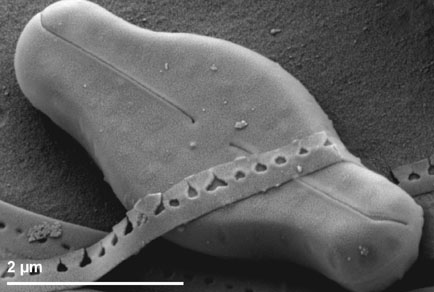
Chamaepinnularia is a small and diverse genus comprises of almost 70 species, whose origin remains uncertain, including taxa previously classified as Navicula and others Pinnularia. A new Chamaepinnularia species (Bacillariophyeceae) was found for Neotropical region, which still harbors significant taxonomic gaps for the genus. Named Chamaepinnularia mirim sp. nov it is distinguished from other Chamaepinnularia species by its wider central inflation along the median portion of the valve, extending towards the apices, and by a more radiant striation pattern.This new species occurs in epiphytic habitats in subtropical coastal lakes of Brazil. Morphological details were documented using both light and scanning electron microscopy, and insights into its differences from closely related species are discussed.
References
- Alvares, C.A., Stape, J.L., Sentelhas, P.C., Gonçalves, J.D.M. & Sparovek, G. (2013) Köppen’s climate classification map for Brazil. Meteorologische Zeitschrift 22: 711–728. https://doi.org/10.1127/0941-2948/2013/0507
- Association, American Public Health (2012) Standard Methods for the Examination of Water and Wastewater, 21st ed. American Public Health Association, Washington, DC.
- Bory, J.B.G.M. (1822) navicule. Navicula. N. (V. pl. de ce Dict., Bacillariées, fig. 5). In: Bory de Saint-Vincent, M. (Ed.) Dictionnaire Classique d’Histoire naturelle 2. Tome second [ASA–CAC], Rey et Gravier; Baudoin frères, Paris, pp. 127–129. https://doi.org/10.5962/bhl.title.33901
- Bourrelly, P. & Manguin, E. (1952) Algues d'eau douce de la Guadeloupe et dépendances: recueillies par la Mission P. Allorge en 1936. Centre National de la Recherche Scientifique, Société d'Edition d'Enseignement Supérieur, Paris, 282 pp. https://doi.org/10.2307/2257052
- Cantonati, M. & Lange-Bertalot, H. (2009) On the ultrastructure of Chamaepinnularia schauppiana Lange-Bertalot & Metzeltin (Naviculaceae s.l.). Diatom Research 24: 225–231. https://doi.org/10.1080/0269249x.2009.9705793
- Coste, M. & Ricard, M. (1982) Contribution a l'étude des diatomées d'eau douce des Seychelles et de l'Ile Maurice. Cryptogamie, Algologie 3: 279–313.
- Cui, N., Liu, Q., Liu, X., Nan, F., Kociolek, J.P. & Xie, S. (2023) Chamaepinnularia taihangensis sp. nov. (Bacillariophyceae), a new diatom species from Taihang Valley, Shanxi province, China. Phytotaxa 587: 184–192. https://doi.org/10.11646/phytotaxa.587.2.7
- Dillenburg, S.R. & Hesp, P.A. (2008) Geology and geomorphology of Holocene coastal barriers of Brazil (Vol. 107). Springer Science & Business Media. https://doi.org/10.1007/978-3-540-44771-9
- Ehrenberg, C.G. (1843a) Mittheilungen über 2 neue asiatische Lager fossiler Infusorien-Erden aus dem russischen Trans-Kaukasien (Grusien) und Sibirien. Bericht über die zur Bekanntmachung geeigneten Verhandlungen der Königlich-Preussischen Akademie der Wissenschaften zu Berlin 1843: 43–49. https://doi.org/10.1515/9783112391648-011
- Ehrenberg, C.G. (1843b) Verbreitung und Einfluss des mikroskopischen Lebens in Süd- und Nord-Amerika. Abhandlungen der Königlichen Akademie der Wissenschaften zu Berlin 1841: 291–445. https://doi.org/10.5962/bhl.title.82563
- Guimarães, T.D.F.R., Hartz, S.M. & Becker, F.G. (2014) Lake connectivity and fish species richness in southern Brazilian coastal lakes. Hydrobiologia 740: 207–217. https://doi.org/10.1007/s10750-014-1954-x
- Guiry, M.D. (2024) How many species of algae are there? A reprise. Four kingdoms, 14 phyla, 63 classes and still growing. Journal of Phycology 00: 1–15. https://doi.org/10.1111/jpy.13431
- Hartz, S.M., Rocha, E.A., Brum, F.T., Luza, A.L., FR,T.D. & Becker, F.G. (2019) Influences of the area, shape and connectivity of coastal lakes on the taxonomic and functional diversity of fish communities in Southern Brazil. Zoologia 36: e23539. https://doi.org/10.3897/zoologia.36.e23539
- Hustedt, F. (1942) Aërophile Diatomeen in der nordwestdeutschen Flora. Berichte der Deutschen botanischen Gesellschaft 60: 55–73. https://doi.org/10.1111/j.1438-8677.1942.tb00439.x
- Hustedt, F. (1955) Marine littoral diatoms of Beaufort, North Carolina. Duke University Marine Station, Bulletin, 6, 1–67.
- Hustedt, F. (1962) Die Kieselalgen Deutschlands, Österreichs und der Schweiz unter Berücksichtigung der übrigen Länder Europas sowie der angrenzenden Meeresgebiete. In: Rabenhorst, L. (ed.) Kryptogamen Flora von Deutschland, Österreich und der Schweiz. Akademische Verlagsgesellschaft m.b.h. Leipzig, 7 (Teil 3, Lief. 2): 161–348. https://doi.org/10.5962/bhl.title.100894
- Junqueira, M.G., Crossettti, L.O. & Wetzel, C.E. (2024) Planothidium minuanum sp. nov., a new diatom (Bacillariophyceae) species fromsouthern Brazilian coastal lakes. Phytotaxa 676: 126–138. https://doi.org/10.11646/phytotaxa.676.2.2
- Krasske, G. (1925) Die Bacillariaceen-Vegetation Niederhessens. Abhandlungen und Bericht des Vereins für Naturkunde zu Kassel 56: 1–119.
- Krasske, G. (1929) Beiträge zur Kenntnis der Diatomeenflora Sachsens. Botanisches Archiv 27: 348–380.
- Kulikovskiy, M. & Lange-Bertalot, H. (2010) Morphology and distribution of Naviculadicta witkowskii Lange-Bertalot & Metzeltin and its transfer to the genus Chamaepinnularia Lange-Bertalot & Krammer. Diatom Research 25: 67–76. https://doi.org/10.1080/0269249X.2010.9705829
- Lai, G.G., Ector, L., Padedda, B.M., Lugliè, A. & Wetzel, C.E. (2019) Chamaepinnularia thermophila (Bacillariophyceae): synonymy with Navicula tongatensis Hustedt and update of its geographic distribution and ecology. Oceanological and Hydrobiological Studies 48: 105–115. https://doi.org/10.1515/ohs-2019-0011
- Lange-Bertalot, H. & Genkal, S.I. (1999) Diatoms from Siberia I - Islands in the Arctic Ocean (Yugorsky-Shar Strait). Iconographia Diatomologica 6: 1–303.
- Lange-Bertalot, H. & Metzeltin, D. (1996) Indicators of oligotrophy - 800 taxa representative of three ecologically distinct lake types. Carbonate buffered - Oligodystrophic - Weakly buffered soft water. Iconographia Diatomologica 2: 1–390. https://doi.org/10.2216/i0031-8884-36-3-255.1
- Mereschkowsky, C. (1902) On Sellaphora, a new genus of diatoms. Annals and Magazine of Natural History, Series 79: 185–195. https://doi.org/10.1080/00222930208678565
- Metzeltin, D. & Lange-Bertalot, H. (1998) Tropical diatoms of South America I: About 700 predominantly rarely know taxa representative of the neotropical flora. Iconographia Diatomologica 5: 1–695.
- Metzeltin, D. & Lange-Bertalot, H. (2007) Tropical diatoms of South America II: Special remarks on biogeography disjunction. Iconographia Diatomologica 18: 1–877.
- Morales, E.A. (2001) Morphological studies in selected fragilarioid diatoms (Bacillariophyceae) from Connecticut waters (USA). Proceedings of the academy of natural sciences of Philadelphia 151: 105–120. https://doi.org/10.1635/0097-3157(2001)151[0105:msisfd]2.0.co;2
- Moser, G., Lange-Bertalot, H. & Metzeltin, D. (1998) Insel der Endemiten Geobotanisches Phänomen Neukaledonien (Island of endemics New Caledonia - a geobotanical phenomenon). Bibliotheca Diatomologica 38: 1–464.
- Petersen, J.B. (1928) The aërial algae of Iceland. In: Rosenvinge, L.K. & Warming, E. (Eds.) The Botany of Iceland, Vol. 2, part 2, no. 8. Kobenhavn, J. Frimodt, pp. 325–447.
- Schimani, K., Abarca, N., Zimmermann, J., Skibbe, O., Jahn, R., Kusber, W.H., Leya, T. & Mora, D. (2023) Molecular phylogenetics coupled with morphological analyses of Arctic and Antarctic strains place Chamaepinnularia (Bacillariophyta) within the Sellaphoraceae. Fottea 24: 1–22. https://doi.org/10.5507/fot.2023.002
- Smith, W. (1856) Synopsis of British Diatomaceae. John Van Voorst, London, 107 pp., pls. 32–60, 61–62, A–E.
- Soják, J. (1972) Časopis Národního Musea. Oddíl přírodovědný. Prague 140 (3–4): 127. Available from: https://archive.org/details/asopisnrodnhomu00unkngoog (accessed 22 October 2025)
- Van de Vijver, B. & Cox, E.J. (2013) New and interesting small-celled naviculoid diatoms (Bacillariophyceae) from a lava tube cave on Île Amsterdam (TAAF, Southern Indian Ocean). Cryptogamie, Algologie 34: 37–47. https://doi.org/10.7872/crya.v34.iss2.2013.149
- Van de Vijver, B., Frenot, Y. & Beyens, L. (2002) Freshwater diatoms from Île de la Possession (Crozet Archipelago, Subantarctica). Bibliotheca Diatomologica 46: 1–412. https://doi.org/10.1007/s003000050408
- Van de Vijver, B., Kopalová, K., Zidarova, R. & Cox, E.J. (2013) New and interesting small-celled naviculoid diatoms (Bacillariophyta) from the Maritime Antarctic Region. Nova Hedwigia 97: 189–208. https://doi.org/10.1127/0029-5035/2013/0101
- Van de Vijver, B., Sterken, M., Vyverman, W., Mataloni, G., Nedbalová, L., Kopalová, K., Elster, J., Verleyen, E. & Sabbe, K. (2010) Four new non-marine diatom taxa from the subantarctic and Antarctic regions. Diatom Research 25: 431–443. https://doi.org/10.1080/0269249X.2010.9705861
- Wetzel, C.E., Martínez-Carreras, N., Hlúbiková, D., Hoffmann, L. & Ector, L. (2013) New combinations and type analysis of Chamaepinnularia species (Bacillariophyceae) from aerial habitats. Cryptogamie, Algologie 34: 149–168. https://doi.org/10.7872/crya.v34.iss2.2013.149
- Wetzel, C.E. & Ector, L. (2016) On the identity of Chamaepinnularia thermophila comb. nov. (Bacillariophyceae) from a Neotropical thermal spring. Phytotaxa 260: 95–97. https://doi.org/10.11646/phytotaxa.260.1.11
- Witkowski, A., Lange-Bertalot, H. & Metzeltin, D. (2000) Diatom flora of marine coasts I. Iconographia Diatomologica 7: 1–925.