

Abstract
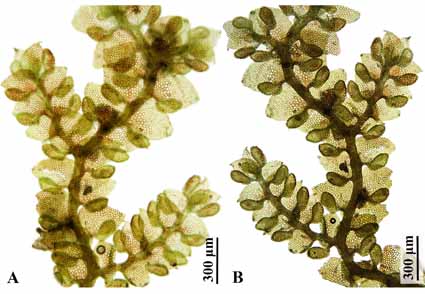
Frullania iriomotensis (Frullaniaceae), a rare liverwort previously known only from the type locality in Japan, was newly discovered in a rainforest in southern China. The first phylogenetic analyses based on the nuclear ribosomal ITS region and two chloroplast regions (rbcL, trnL–F) of F. iriomotensis reveal that it is sister to the tropical Asian F. repandistipula in the Diastaloba II group of F. subg. Diastaloba. Androecia and gynoecia are described and illustrated for the first time for this species and a proposal for conservation is presented.
References
<p align="justify"><span style="color: #000000;"><span style="font-family: Times New Roman, serif;"><span style="font-size: small;">Atwood, J.J. & Mamontov, Yu.S. (2021) Frullania tibetica (Frullaniaceae), a new species from Tibet, China. Novon 29: 305–310. https://doi.org/10.3417/2021715</span></span></span>
<p align="justify"><span style="color: #000000;"><span style="font-family: Times New Roman, serif;"><span style="font-size: small;">Atwood, J.J., Espinoza-Prieto, B. & Gradstein, S.R. (2018) A new species of Frullania (Marchantiophyta: Frullaniaceae) from the Andes of Peru, and a range extension for F. holostipula to Bolivia. Bryophyte Diversity & Evolution 40: 68–78. https://doi.org/10.11646/bde.40.2.5</span></span></span>
<p align="justify"><span style="color: #000000;"><span style="font-family: Times New Roman, serif;"><span style="font-size: small;">Atwood, J.J., Vilnet, A.A. & Mamontov, Yu.S. (2021) The taxonomic position and lectotypification of Frullania diversitexta Steph. (Frullaniaceae, Marchantiophyta) and its synonyms, with notes on the placement of F. ignatovii Sofronova, Mamontov & Potemkin. Cryptogamie, Bryologie 42: 19–31. https://doi.org/10.5252/cryptogamie-bryologie2021v42a3</span></span></span>
<p align="justify"><span style="color: #000000;"><span style="font-family: Times New Roman, serif;"><span style="font-size: small;">Bachman, S., Moat, J., Hill, A.W., de la Torre, J. & Scott, B. (2011) Supporting Red List threat assessments with GeoCAT: geospatial conservation assessment tool. In: Smith, V. & Penel, L. (Eds.) E-Infrastructures for data publishing in biodiversity science. ZooKeys 150 (Special Issue). PenSoft Publishers LTD, Sofia, pp. 117–126. https://doi.org/10.3897/zookeys.150.2109</span></span></span>
<p align="justify"><span style="color: #000000;"><span style="font-family: Times New Roman, serif;"><span style="font-size: small;">Bakalin, V.A. & Nguyen, V.S. (2016) The checklist of liverworts (Hepaticae) and hornworts (Anthocerotae) of Vietnam updated based on literature survey. Tap Chi Sinh Hoc 38 (4): 480–91. https://doi.org/10.15625/0866-7160/v38n4.8771</span></span></span>
<p align="justify"><span style="color: #000000;"><span style="font-family: Times New Roman, serif;"><span style="font-size: small;">Dandotiya, D., Govindapyari, H., Suman, S. & Uniyal, P.L. (2011) Checklist of the bryophytes of India. Archive for Bryology 88: 1–126.</span></span></span>
<p align="justify"><span style="color: #000000;"><span style="font-family: Times New Roman, serif;"><span style="font-size: small;">Dumortier, B.C. (1831) Sylloge Jungermannidearum Europae Indigenarum. J. Casterman, Tournay. 100 pp.</span></span></span>
<p align="justify"><span style="color: #000000;"><span style="font-family: Times New Roman, serif;"><span style="font-size: small;">Evans, A.W. (1906) Notes on Japanese hepaticae. Proceedings of the Washington Academy of Sciences 8: 141–166.</span></span></span>
<p align="justify"><span style="color: #000000;"><span style="font-family: Times New Roman, serif;"><span style="font-size: small;">Feldberg, K., Müller, A.S., Schaefer-Verwimp, A., Konrat, M., Schmidt, A. & Heinrichs, J. (2018) Frullania grabenhorstii sp. nov., a fossil liverwort (Jungermanniopsida: Frullaniaceae) with perianth from Bitterfeld amber. Bryophyte Diversity and Evolution 40: 91–103. https://doi.org/10.11646/bde.40.2.7</span></span></span>
<p align="justify"><span style="color: #000000;"><span style="font-family: Times New Roman, serif;"><span style="font-size: small;">Hattori, S. (1977) Dr. H. Hürlimann’s collection of New Caledonian Frullaniaceae. Journal of the Hattori Botanical Laboratory 43: 409–438.</span></span></span>
<p align="justify"><span style="color: #000000;"><span style="font-family: Times New Roman, serif;"><span style="font-size: small;">Hattori, S. (1980) Notes on Frullania species of Iriomote and Ishigaki Islands, the Ryukyu Archipelago. The Journal of Japanese Botany 55: 132–135.</span></span></span>
<p align="justify"><span style="color: #000000;"><span style="font-family: Times New Roman, serif;"><span style="font-size: small;">Hattori, S. (1986) A Synopsis of New Caledonian Frullaniaceae. Journal of the Hattori Botanical Laboratory 60: 203–237.</span></span></span>
<p align="justify"><span style="color: #000000;"><span style="font-family: Times New Roman, serif;"><span style="font-size: small;">Hattori, S. & Piippo, S. (1986) Bryophyte flora of the Huon Peninsula, Papua New Guinea. XV. Frullania (Frullaniaceae, Hepaticae). Acta Botanica Fennica 133: 25–58.</span></span></span>
<p align="justify"><span style="color: #000000;"><span style="font-family: Times New Roman, serif;"><span style="font-size: small;">Hentschel, J., von Konrat, M.J., Pócs, T., Schäfer-Verwimp, A., Shaw, A.J., Schneider, H. & Heinrichs, J. (2009) Molecular insights into the phylogeny and subgeneric classification of Frullania Raddi (Frullaniaceae, Porellales). Molecular Phylogenetics and Evolution 52: 142–156. https://doi.org/10.1016/j.ympev.2008.12.021</span></span></span>
<p align="justify"><span style="color: #000000;"><span style="font-family: Times New Roman, serif;"><span style="font-size: small;">Hentschel, J., von Konrat, M., Söderström, L., Hagborg, A., Larraín, J., Sukkharak, P., Uribe, J. & Zhang, L. (2015) Notes on early land plants today. 72. Infrageneric classification and new combinations, new names, new synonyms in Frullania (Marchantiophyta). Phytotaxa 220: 127–142. https://doi.org/10.11646/phytotaxa.220.2.3</span></span></span>
<p align="justify"><span style="color: #000000;"><span style="font-family: Times New Roman, serif;"><span style="font-size: small;">Hooker, W.J. (1816) British Jungermanniae. Longman, Hurst, Rees, Orme, and Brown, London. 84 pl., 20 pp.</span></span></span>
<p align="justify"><span style="color: #000000;"><span style="font-family: Times New Roman, serif;"><span style="font-size: small;">IUCN. (2012a) IUCN Red List Categories and Criteria, Version 3.1. Second edition. Gland, Switzerland and Cambridge, UK. Available from: https://www.iucnredlist.org/resources/categories-and-criteria (accessed: 28 November 2022).</span></span></span>
<p align="justify"><span style="color: #000000;"><span style="font-family: Times New Roman, serif;"><span style="font-size: small;">IUCN. (2012b) Guidelines for Application of IUCN Red List Criteria at Regional and National Levels, Version 4.0. Gland, Switzerland and Cambridge, UK. Available from: https://www.iucnredlist.org/technical-documents/categories-and-criteria (accessed: 28 November 2022).</span></span></span>
<p align="justify"><span style="color: #000000;"><span style="font-family: Times New Roman, serif;"><span style="font-size: small;">IUCN. (2022) Guidelines for Using the IUCN Red List Categories and Criteria, Version 15.1. Prepared by the Standards and Petitions Committee. Available from: https://www.iucnredlist.org/documents/RedListGuidelines.pdf. (accessed: 28 November 2022).</span></span></span>
<p align="justify"><span style="color: #000000;"><span style="font-family: Times New Roman, serif;"><span style="font-size: small;">Iwatsuki, Z., Furuki, T., Kanda, H., Hasegawa, J. & Higuchi, M. (2008) New Red List of Bryophytes of Japan, 2007: Threatened Bryophytes in Japan. Bryological Research 9: 259–267. https://doi.org/10.24474/bryologicalresearch.9.8_259</span></span></span>
<p align="justify"><span style="color: #000000;"><span style="font-family: Times New Roman, serif;"><span style="font-size: small;">Jia, Y. & He, S. (2013) Species Catalogue of China. Vol. 1 Plants Bryophytes. Science Press, Beijing, 525 pp. [In Chinese]</span></span></span>
<p align="justify"><span style="color: #000000;"><span style="font-family: Times New Roman, serif;"><span style="font-size: small;">Konstantinova, N.A. & Bakalin, V.A. (2009) Checklist of Liverworts (Marchantiophyta) of Russia. Arctoa 18: 1–64.</span></span></span>
<p align="justify"><span style="color: #000000;"><span style="font-family: Times New Roman, serif;"><span style="font-size: small;">Lee, G.E., Gradstein, S.R., Pesiu, E. & Norhazrina, N. (2022) An updated checklist of liverworts and hornworts of Malaysia. PhytoKeys 199: 29–111. https://doi.org/ 10.3897/phytokeys.199.76693</span></span></span>
<p align="justify"><span style="color: #000000;"><span style="font-family: Times New Roman, serif;"><span style="font-size: small;">Lima, E., Ilkiu-Borges, A.L. & Gradstein, S.R. (2020) A new species of Frullania subg. Frullania (Marchantiophyta) from the Brazilian Amazon. Phytotaxa 456: 119–124. https://doi.org/10.11646/phytotaxa.456.1.10</span></span></span>
<p align="justify"><span style="color: #000000;"><span style="font-family: Times New Roman, serif;"><span style="font-size: small;">Long, D.G. & Rubasinghe, S.C.K. (2014) Liverworts and Hornworts of Sri Lanka: a revised checklist. Ceylon Journal of Science (Biological Sciences) 43: 1–36.</span></span></span>
<p align="justify"><span style="color: #000000;"><span style="font-family: Times New Roman, serif;"><span style="font-size: small;">Mamontov, Yu.S., Vilnet, A.A., Atwood, J.J. & Konstantinova, N.A. (2020) Molecular phylogenetic study of Frullania subsect. Inflatae (Frullaniaceae, Marchantiophyta) in the Holarctic with description of a new subgenus and three new species. Nova Hedwigia, Beihefte 150: 201–242. https://doi.org/ 10.1127/nova-suppl/2020/201</span></span></span>
<p align="justify"><span style="color: #000000;"><span style="font-family: Times New Roman, serif;"><span style="font-size: small;">Mamontov, Y.S., Atwood, J.J. & Vilnet, A.A. (2021) On the diversity and distribution of the genus Frullania in Northern Holarctic. BIO Web of Conferences 38: 00079, Northern Asia Plant Diversity 2021, pp. 1–5. https://doi.org/10.1051/bioconf/20213800079</span></span></span>
<p align="justify"><span style="color: #000000;"><span style="font-family: Times New Roman, serif;"><span style="font-size: small;">Miller, M.A., Pfeiffer, W. & Schwartz, T. (2010) Creating the CIPRES Science Gateway for inference of large phylogenetic trees. Pp 1–8 in Proceedings of the Gateway Computing Environments Workshop (GCE). New Orleans: Gateway Computing. </span></span></span>
<p align="justify"><span style="color: #000000;"><span style="font-family: Times New Roman, serif;"><span style="font-size: small;">Müller, K., Quandt, D. Müller, J. & Neinhuis, C. (2010) PhyDE® Phylogenetic data editor, version 0.9971. Available from: http://www.phyde.de (accessed 20 March 2023)</span></span></span>
<p align="justify"><span style="color: #000000;"><span style="font-family: Times New Roman, serif;"><span style="font-size: small;">Nylander, J.A.A. (2004) MrModeltest v.2. Program distributed by the author. Uppsala: Evolutionary Biology Centre, Uppsala University.</span></span></span>
<p align="justify"><span style="color: #000000;"><span style="font-family: Times New Roman, serif;"><span style="font-size: small;">Potemkin, A.D., Hentschel, J., Sofronova, E.V. & Mamontov, Y.S. (2015) Frullania dorsimamillosa, a unique new species from Central China and the resurrection of Frullania chinlingensis (Frullaniaceae, Marchantiophyta). Phytotaxa 227: 1–12. https://dx.doi.org/10.11646/phytotaxa.227.1.1</span></span></span>
<p align="justify"><span style="color: #000000;"><span style="font-family: Times New Roman, serif;"><span style="font-size: small;">Raddi, G. (1818) Jungermanniografia Etrusca. Presso la Società Tipographica, Modena. 56 pp.</span></span></span>
<p align="justify"><span style="color: #000000;"><span style="font-family: Times New Roman, serif;"><span style="font-size: small;">Rambaut, A., Drummond, A.J., Xie, D. Baele, G. & Suchard, M.A. (2018) Posterior summarisation in Bayesian phylogenetics using Tracer 1.7. Systematic Biology 67: 901–904. https://doi.org/10.1093/sysbio/syy032</span></span></span>
<p align="justify"><span style="color: #000000;"><span style="font-family: Times New Roman, serif;"><span style="font-size: small;">Ronquist, F., Teslenko, M. van der Mark, P. Ayres, D., Darling, A., Höhna, S., Larget, B. Liu, L., Suchard, M.A. & Huelsenbeck, J.P. (2012) MrBayes 3.2: efficient Bayesian phylogenetic inference and model choice across a large model space. Systematic Biology 61: 539–542.</span></span></span>
<p align="justify"><span style="color: #000000;"><span style="font-family: Times New Roman, serif;"><span style="font-size: small;">Sande Lacoste, C.M.v.d. (1855) Novae species hepaticaum ex insula Java detexit Dr. F. Junghuhn. Nederlandsch Kruidkundig Archief. Verslangen en Mededelingen der Nederlandsche Botanische Vereeniging 3: 415–424.</span></span></span>
<p align="justify"><span style="color: #000000;"><span style="font-family: Times New Roman, serif;"><span style="font-size: small;">Shu, L., Jin, X.-J. & Zhu, R.-L. (2022) Novel classification and biogeography of Leptolejeunea (Lejeuneaceae, Marchantiophyta) with implications for the origin and evolution of the Asian evergreen broad-leaved forests. Journal of Systematics and Evolution 60: 1199–1217. https://doi.org/10.1111/jse.12798</span></span></span>
<p align="justify"><span style="color: #000000;"><span style="font-family: Times New Roman, serif;"><span style="font-size: small;">Söderström, L., Gradstein, S.R. & Hagborg, A. (2010) Checklist of the hornworts and liverworts of Java. Phytotaxa 9: 53–149. https://doi.org/10.11646/phytotaxa.9.1.7</span></span></span>
<p align="justify"><span style="color: #000000;"><span style="font-family: Times New Roman, serif;"><span style="font-size: small;">Söderström, L., Hagborg, A., Von Konrat, M., Bartholomew-Began, S., Bell, D., Briscoe, L., Brown, E., Cargill, D.C., Cooper, E.D., Costa, D.P., Crandall-Stotler, B.J., Dauphin, G., Engel, J.J., Feldberg, K., Glenny, D., Gradstein, S.R., He, X., Heinrichs, J., Hentschel, J., Ilkiu-Borges, A.L., Katagiri, T., Konstantinova, N.A., Larraín, J., Long, D.G., Nebel, M., Pócs, T., Puche, F., Reiner-Drehwald, E., Renner, M.A.M, Sass-Gyarmati, A., Schäfer-verwimp, A., Segarra Moragues, J.G., Stotler, R.E., Sukkharak, P., Thiers, B.M., Uribe, J., Vá?a, J., Villarreal, J.C., Wigginton, M., Zhang, L. & Zhu, R-L. (2016) World Checklist of Hornworts and Liverworts. PhytoKeys 59: 1–828.</span></span></span>
<p align="justify"><span style="color: #000000;"><span style="font-family: Times New Roman, serif;"><span style="font-size: small;">Spruce, R. (1884) Hepaticae amazonicae et andinae. I. Transactions and Proceedings of the Botanical Society of Edinburgh 15: 1–308.</span></span></span>
<p align="justify"><span style="color: #000000;"><span style="font-family: Times New Roman, serif;"><span style="font-size: small;">Stamatakis, A. (2014) RAxML version 8: A tool for phylogenetic analysis and post-analysis of large phylogenies. Bioinformatics 30: 1312–1313.</span></span></span>
<p align="justify"><span style="color: #000000;"><span style="font-family: Times New Roman, serif;"><span style="font-size: small;">Stephani, F. (1911) Species Hepaticarum 4. George & Cie, Genève & Bale. 824 pp.</span></span></span>
<p align="justify"><span style="color: #000000;"><span style="font-family: Times New Roman, serif;"><span style="font-size: small;">Sukkharak, P. (2017) A revision of the genus Frullania (Marchantiophyta: Frullaniaceae) in Thailand. Nova Hedwigia 106: 115–207.</span></span></span>
<p align="justify"><span style="color: #000000;"><span style="font-family: Times New Roman, serif;"><span style="font-size: small;">Swofford, D.L. (2003) PAUP*: Phylogenetic analysis using parsimony (*and other methods), version 4.0b10. Sunderland Massachusetts: Sinauer Associates.</span></span></span>
<p align="justify"><span style="color: #000000;"><span style="font-family: Times New Roman, serif;"><span style="font-size: small;">Tamura, K., Stecher, G. & Kumar, S. (2021) MEGA11: Molecular Evolutionary Genetics Analysis version 11. Molecular Biology and Evolution 38: 3022–3027. https://doi.org/10.1093/molbev/msab120</span></span></span>
<p align="justify"><span style="color: #000000;"><span style="font-family: Times New Roman, serif;"><span style="font-size: small;">Verdoorn, F. (1928) Annales de cryptogamie exotique. Tome premier, Paris. 383 pp.</span></span></span>
<p align="justify"><span style="color: #000000;"><span style="font-family: Times New Roman, serif;"><span style="font-size: small;">von Konrat, M., Hentschel, J., Heinrichs, J., Braggins, J.E. & Pócs, T. (2010) Forty-one degrees below and sixty years in the dark: Frullania sect. Inconditum, a new section of Australasian Frullania species including F. colliculosa, sp. nov., F. hodgsoniae, nom. and stat. nov., F. aterrima, and F. hattorii (Frullaniaceae, Marchantiophyta). Nova Hedwigia 91: 471–500. https://doi: 10.1127/0029-5035/2010/0091-0471</span></span></span>
<p align="justify"><span style="color: #000000;"><span style="font-family: Times New Roman, serif;"><span style="font-size: small;">Winter, G. & A. Schäfer-Verwimp. (2020) Re-evaluation of the taxonomic status of Frullania caulisequa and Frullania obcordata (Frullaniaceae, Marchantiophyta). Frahmia 19: 1–21.</span></span></span>
<p align="justify"><span style="color: #000000;"><span style="font-family: Times New Roman, serif;"><span style="font-size: small;">Yuzawa, Y. (2000) Species of the genus Frullania (Family Frullaniaceae, Hepaticae) in Japan I. (In Japanese). Natural Environmental Science Research 13: 1–24.</span></span></span>
<p align="justify"><span style="color: #000000;"><span style="font-family: Times New Roman, serif;"><span style="font-size: small;">Zhu, R.L., Lu, C.-H. & Shu, L. (2018) Additions and corrections for liverworts and hornworts of Singapore. Philippine Journal of Systematic Biology 12: 12–21.</span></span></span>
<p align="justify"><span style="color: #000000;"><span style="font-family: Times New Roman, serif;"><span style="font-size: small;">Atwood, J.J., Espinoza-Prieto, B. & Gradstein, S.R. (2018) A new species of Frullania (Marchantiophyta: Frullaniaceae) from the Andes of Peru, and a range extension for F. holostipula to Bolivia. Bryophyte Diversity & Evolution 40: 68–78. https://doi.org/10.11646/bde.40.2.5</span></span></span>
<p align="justify"><span style="color: #000000;"><span style="font-family: Times New Roman, serif;"><span style="font-size: small;">Atwood, J.J., Vilnet, A.A. & Mamontov, Yu.S. (2021) The taxonomic position and lectotypification of Frullania diversitexta Steph. (Frullaniaceae, Marchantiophyta) and its synonyms, with notes on the placement of F. ignatovii Sofronova, Mamontov & Potemkin. Cryptogamie, Bryologie 42: 19–31. https://doi.org/10.5252/cryptogamie-bryologie2021v42a3</span></span></span>
<p align="justify"><span style="color: #000000;"><span style="font-family: Times New Roman, serif;"><span style="font-size: small;">Bachman, S., Moat, J., Hill, A.W., de la Torre, J. & Scott, B. (2011) Supporting Red List threat assessments with GeoCAT: geospatial conservation assessment tool. In: Smith, V. & Penel, L. (Eds.) E-Infrastructures for data publishing in biodiversity science. ZooKeys 150 (Special Issue). PenSoft Publishers LTD, Sofia, pp. 117–126. https://doi.org/10.3897/zookeys.150.2109</span></span></span>
<p align="justify"><span style="color: #000000;"><span style="font-family: Times New Roman, serif;"><span style="font-size: small;">Bakalin, V.A. & Nguyen, V.S. (2016) The checklist of liverworts (Hepaticae) and hornworts (Anthocerotae) of Vietnam updated based on literature survey. Tap Chi Sinh Hoc 38 (4): 480–91. https://doi.org/10.15625/0866-7160/v38n4.8771</span></span></span>
<p align="justify"><span style="color: #000000;"><span style="font-family: Times New Roman, serif;"><span style="font-size: small;">Dandotiya, D., Govindapyari, H., Suman, S. & Uniyal, P.L. (2011) Checklist of the bryophytes of India. Archive for Bryology 88: 1–126.</span></span></span>
<p align="justify"><span style="color: #000000;"><span style="font-family: Times New Roman, serif;"><span style="font-size: small;">Dumortier, B.C. (1831) Sylloge Jungermannidearum Europae Indigenarum. J. Casterman, Tournay. 100 pp.</span></span></span>
<p align="justify"><span style="color: #000000;"><span style="font-family: Times New Roman, serif;"><span style="font-size: small;">Evans, A.W. (1906) Notes on Japanese hepaticae. Proceedings of the Washington Academy of Sciences 8: 141–166.</span></span></span>
<p align="justify"><span style="color: #000000;"><span style="font-family: Times New Roman, serif;"><span style="font-size: small;">Feldberg, K., Müller, A.S., Schaefer-Verwimp, A., Konrat, M., Schmidt, A. & Heinrichs, J. (2018) Frullania grabenhorstii sp. nov., a fossil liverwort (Jungermanniopsida: Frullaniaceae) with perianth from Bitterfeld amber. Bryophyte Diversity and Evolution 40: 91–103. https://doi.org/10.11646/bde.40.2.7</span></span></span>
<p align="justify"><span style="color: #000000;"><span style="font-family: Times New Roman, serif;"><span style="font-size: small;">Hattori, S. (1977) Dr. H. Hürlimann’s collection of New Caledonian Frullaniaceae. Journal of the Hattori Botanical Laboratory 43: 409–438.</span></span></span>
<p align="justify"><span style="color: #000000;"><span style="font-family: Times New Roman, serif;"><span style="font-size: small;">Hattori, S. (1980) Notes on Frullania species of Iriomote and Ishigaki Islands, the Ryukyu Archipelago. The Journal of Japanese Botany 55: 132–135.</span></span></span>
<p align="justify"><span style="color: #000000;"><span style="font-family: Times New Roman, serif;"><span style="font-size: small;">Hattori, S. (1986) A Synopsis of New Caledonian Frullaniaceae. Journal of the Hattori Botanical Laboratory 60: 203–237.</span></span></span>
<p align="justify"><span style="color: #000000;"><span style="font-family: Times New Roman, serif;"><span style="font-size: small;">Hattori, S. & Piippo, S. (1986) Bryophyte flora of the Huon Peninsula, Papua New Guinea. XV. Frullania (Frullaniaceae, Hepaticae). Acta Botanica Fennica 133: 25–58.</span></span></span>
<p align="justify"><span style="color: #000000;"><span style="font-family: Times New Roman, serif;"><span style="font-size: small;">Hentschel, J., von Konrat, M.J., Pócs, T., Schäfer-Verwimp, A., Shaw, A.J., Schneider, H. & Heinrichs, J. (2009) Molecular insights into the phylogeny and subgeneric classification of Frullania Raddi (Frullaniaceae, Porellales). Molecular Phylogenetics and Evolution 52: 142–156. https://doi.org/10.1016/j.ympev.2008.12.021</span></span></span>
<p align="justify"><span style="color: #000000;"><span style="font-family: Times New Roman, serif;"><span style="font-size: small;">Hentschel, J., von Konrat, M., Söderström, L., Hagborg, A., Larraín, J., Sukkharak, P., Uribe, J. & Zhang, L. (2015) Notes on early land plants today. 72. Infrageneric classification and new combinations, new names, new synonyms in Frullania (Marchantiophyta). Phytotaxa 220: 127–142. https://doi.org/10.11646/phytotaxa.220.2.3</span></span></span>
<p align="justify"><span style="color: #000000;"><span style="font-family: Times New Roman, serif;"><span style="font-size: small;">Hooker, W.J. (1816) British Jungermanniae. Longman, Hurst, Rees, Orme, and Brown, London. 84 pl., 20 pp.</span></span></span>
<p align="justify"><span style="color: #000000;"><span style="font-family: Times New Roman, serif;"><span style="font-size: small;">IUCN. (2012a) IUCN Red List Categories and Criteria, Version 3.1. Second edition. Gland, Switzerland and Cambridge, UK. Available from: https://www.iucnredlist.org/resources/categories-and-criteria (accessed: 28 November 2022).</span></span></span>
<p align="justify"><span style="color: #000000;"><span style="font-family: Times New Roman, serif;"><span style="font-size: small;">IUCN. (2012b) Guidelines for Application of IUCN Red List Criteria at Regional and National Levels, Version 4.0. Gland, Switzerland and Cambridge, UK. Available from: https://www.iucnredlist.org/technical-documents/categories-and-criteria (accessed: 28 November 2022).</span></span></span>
<p align="justify"><span style="color: #000000;"><span style="font-family: Times New Roman, serif;"><span style="font-size: small;">IUCN. (2022) Guidelines for Using the IUCN Red List Categories and Criteria, Version 15.1. Prepared by the Standards and Petitions Committee. Available from: https://www.iucnredlist.org/documents/RedListGuidelines.pdf. (accessed: 28 November 2022).</span></span></span>
<p align="justify"><span style="color: #000000;"><span style="font-family: Times New Roman, serif;"><span style="font-size: small;">Iwatsuki, Z., Furuki, T., Kanda, H., Hasegawa, J. & Higuchi, M. (2008) New Red List of Bryophytes of Japan, 2007: Threatened Bryophytes in Japan. Bryological Research 9: 259–267. https://doi.org/10.24474/bryologicalresearch.9.8_259</span></span></span>
<p align="justify"><span style="color: #000000;"><span style="font-family: Times New Roman, serif;"><span style="font-size: small;">Jia, Y. & He, S. (2013) Species Catalogue of China. Vol. 1 Plants Bryophytes. Science Press, Beijing, 525 pp. [In Chinese]</span></span></span>
<p align="justify"><span style="color: #000000;"><span style="font-family: Times New Roman, serif;"><span style="font-size: small;">Konstantinova, N.A. & Bakalin, V.A. (2009) Checklist of Liverworts (Marchantiophyta) of Russia. Arctoa 18: 1–64.</span></span></span>
<p align="justify"><span style="color: #000000;"><span style="font-family: Times New Roman, serif;"><span style="font-size: small;">Lee, G.E., Gradstein, S.R., Pesiu, E. & Norhazrina, N. (2022) An updated checklist of liverworts and hornworts of Malaysia. PhytoKeys 199: 29–111. https://doi.org/ 10.3897/phytokeys.199.76693</span></span></span>
<p align="justify"><span style="color: #000000;"><span style="font-family: Times New Roman, serif;"><span style="font-size: small;">Lima, E., Ilkiu-Borges, A.L. & Gradstein, S.R. (2020) A new species of Frullania subg. Frullania (Marchantiophyta) from the Brazilian Amazon. Phytotaxa 456: 119–124. https://doi.org/10.11646/phytotaxa.456.1.10</span></span></span>
<p align="justify"><span style="color: #000000;"><span style="font-family: Times New Roman, serif;"><span style="font-size: small;">Long, D.G. & Rubasinghe, S.C.K. (2014) Liverworts and Hornworts of Sri Lanka: a revised checklist. Ceylon Journal of Science (Biological Sciences) 43: 1–36.</span></span></span>
<p align="justify"><span style="color: #000000;"><span style="font-family: Times New Roman, serif;"><span style="font-size: small;">Mamontov, Yu.S., Vilnet, A.A., Atwood, J.J. & Konstantinova, N.A. (2020) Molecular phylogenetic study of Frullania subsect. Inflatae (Frullaniaceae, Marchantiophyta) in the Holarctic with description of a new subgenus and three new species. Nova Hedwigia, Beihefte 150: 201–242. https://doi.org/ 10.1127/nova-suppl/2020/201</span></span></span>
<p align="justify"><span style="color: #000000;"><span style="font-family: Times New Roman, serif;"><span style="font-size: small;">Mamontov, Y.S., Atwood, J.J. & Vilnet, A.A. (2021) On the diversity and distribution of the genus Frullania in Northern Holarctic. BIO Web of Conferences 38: 00079, Northern Asia Plant Diversity 2021, pp. 1–5. https://doi.org/10.1051/bioconf/20213800079</span></span></span>
<p align="justify"><span style="color: #000000;"><span style="font-family: Times New Roman, serif;"><span style="font-size: small;">Miller, M.A., Pfeiffer, W. & Schwartz, T. (2010) Creating the CIPRES Science Gateway for inference of large phylogenetic trees. Pp 1–8 in Proceedings of the Gateway Computing Environments Workshop (GCE). New Orleans: Gateway Computing. </span></span></span>
<p align="justify"><span style="color: #000000;"><span style="font-family: Times New Roman, serif;"><span style="font-size: small;">Müller, K., Quandt, D. Müller, J. & Neinhuis, C. (2010) PhyDE® Phylogenetic data editor, version 0.9971. Available from: http://www.phyde.de (accessed 20 March 2023)</span></span></span>
<p align="justify"><span style="color: #000000;"><span style="font-family: Times New Roman, serif;"><span style="font-size: small;">Nylander, J.A.A. (2004) MrModeltest v.2. Program distributed by the author. Uppsala: Evolutionary Biology Centre, Uppsala University.</span></span></span>
<p align="justify"><span style="color: #000000;"><span style="font-family: Times New Roman, serif;"><span style="font-size: small;">Potemkin, A.D., Hentschel, J., Sofronova, E.V. & Mamontov, Y.S. (2015) Frullania dorsimamillosa, a unique new species from Central China and the resurrection of Frullania chinlingensis (Frullaniaceae, Marchantiophyta). Phytotaxa 227: 1–12. https://dx.doi.org/10.11646/phytotaxa.227.1.1</span></span></span>
<p align="justify"><span style="color: #000000;"><span style="font-family: Times New Roman, serif;"><span style="font-size: small;">Raddi, G. (1818) Jungermanniografia Etrusca. Presso la Società Tipographica, Modena. 56 pp.</span></span></span>
<p align="justify"><span style="color: #000000;"><span style="font-family: Times New Roman, serif;"><span style="font-size: small;">Rambaut, A., Drummond, A.J., Xie, D. Baele, G. & Suchard, M.A. (2018) Posterior summarisation in Bayesian phylogenetics using Tracer 1.7. Systematic Biology 67: 901–904. https://doi.org/10.1093/sysbio/syy032</span></span></span>
<p align="justify"><span style="color: #000000;"><span style="font-family: Times New Roman, serif;"><span style="font-size: small;">Ronquist, F., Teslenko, M. van der Mark, P. Ayres, D., Darling, A., Höhna, S., Larget, B. Liu, L., Suchard, M.A. & Huelsenbeck, J.P. (2012) MrBayes 3.2: efficient Bayesian phylogenetic inference and model choice across a large model space. Systematic Biology 61: 539–542.</span></span></span>
<p align="justify"><span style="color: #000000;"><span style="font-family: Times New Roman, serif;"><span style="font-size: small;">Sande Lacoste, C.M.v.d. (1855) Novae species hepaticaum ex insula Java detexit Dr. F. Junghuhn. Nederlandsch Kruidkundig Archief. Verslangen en Mededelingen der Nederlandsche Botanische Vereeniging 3: 415–424.</span></span></span>
<p align="justify"><span style="color: #000000;"><span style="font-family: Times New Roman, serif;"><span style="font-size: small;">Shu, L., Jin, X.-J. & Zhu, R.-L. (2022) Novel classification and biogeography of Leptolejeunea (Lejeuneaceae, Marchantiophyta) with implications for the origin and evolution of the Asian evergreen broad-leaved forests. Journal of Systematics and Evolution 60: 1199–1217. https://doi.org/10.1111/jse.12798</span></span></span>
<p align="justify"><span style="color: #000000;"><span style="font-family: Times New Roman, serif;"><span style="font-size: small;">Söderström, L., Gradstein, S.R. & Hagborg, A. (2010) Checklist of the hornworts and liverworts of Java. Phytotaxa 9: 53–149. https://doi.org/10.11646/phytotaxa.9.1.7</span></span></span>
<p align="justify"><span style="color: #000000;"><span style="font-family: Times New Roman, serif;"><span style="font-size: small;">Söderström, L., Hagborg, A., Von Konrat, M., Bartholomew-Began, S., Bell, D., Briscoe, L., Brown, E., Cargill, D.C., Cooper, E.D., Costa, D.P., Crandall-Stotler, B.J., Dauphin, G., Engel, J.J., Feldberg, K., Glenny, D., Gradstein, S.R., He, X., Heinrichs, J., Hentschel, J., Ilkiu-Borges, A.L., Katagiri, T., Konstantinova, N.A., Larraín, J., Long, D.G., Nebel, M., Pócs, T., Puche, F., Reiner-Drehwald, E., Renner, M.A.M, Sass-Gyarmati, A., Schäfer-verwimp, A., Segarra Moragues, J.G., Stotler, R.E., Sukkharak, P., Thiers, B.M., Uribe, J., Vá?a, J., Villarreal, J.C., Wigginton, M., Zhang, L. & Zhu, R-L. (2016) World Checklist of Hornworts and Liverworts. PhytoKeys 59: 1–828.</span></span></span>
<p align="justify"><span style="color: #000000;"><span style="font-family: Times New Roman, serif;"><span style="font-size: small;">Spruce, R. (1884) Hepaticae amazonicae et andinae. I. Transactions and Proceedings of the Botanical Society of Edinburgh 15: 1–308.</span></span></span>
<p align="justify"><span style="color: #000000;"><span style="font-family: Times New Roman, serif;"><span style="font-size: small;">Stamatakis, A. (2014) RAxML version 8: A tool for phylogenetic analysis and post-analysis of large phylogenies. Bioinformatics 30: 1312–1313.</span></span></span>
<p align="justify"><span style="color: #000000;"><span style="font-family: Times New Roman, serif;"><span style="font-size: small;">Stephani, F. (1911) Species Hepaticarum 4. George & Cie, Genève & Bale. 824 pp.</span></span></span>
<p align="justify"><span style="color: #000000;"><span style="font-family: Times New Roman, serif;"><span style="font-size: small;">Sukkharak, P. (2017) A revision of the genus Frullania (Marchantiophyta: Frullaniaceae) in Thailand. Nova Hedwigia 106: 115–207.</span></span></span>
<p align="justify"><span style="color: #000000;"><span style="font-family: Times New Roman, serif;"><span style="font-size: small;">Swofford, D.L. (2003) PAUP*: Phylogenetic analysis using parsimony (*and other methods), version 4.0b10. Sunderland Massachusetts: Sinauer Associates.</span></span></span>
<p align="justify"><span style="color: #000000;"><span style="font-family: Times New Roman, serif;"><span style="font-size: small;">Tamura, K., Stecher, G. & Kumar, S. (2021) MEGA11: Molecular Evolutionary Genetics Analysis version 11. Molecular Biology and Evolution 38: 3022–3027. https://doi.org/10.1093/molbev/msab120</span></span></span>
<p align="justify"><span style="color: #000000;"><span style="font-family: Times New Roman, serif;"><span style="font-size: small;">Verdoorn, F. (1928) Annales de cryptogamie exotique. Tome premier, Paris. 383 pp.</span></span></span>
<p align="justify"><span style="color: #000000;"><span style="font-family: Times New Roman, serif;"><span style="font-size: small;">von Konrat, M., Hentschel, J., Heinrichs, J., Braggins, J.E. & Pócs, T. (2010) Forty-one degrees below and sixty years in the dark: Frullania sect. Inconditum, a new section of Australasian Frullania species including F. colliculosa, sp. nov., F. hodgsoniae, nom. and stat. nov., F. aterrima, and F. hattorii (Frullaniaceae, Marchantiophyta). Nova Hedwigia 91: 471–500. https://doi: 10.1127/0029-5035/2010/0091-0471</span></span></span>
<p align="justify"><span style="color: #000000;"><span style="font-family: Times New Roman, serif;"><span style="font-size: small;">Winter, G. & A. Schäfer-Verwimp. (2020) Re-evaluation of the taxonomic status of Frullania caulisequa and Frullania obcordata (Frullaniaceae, Marchantiophyta). Frahmia 19: 1–21.</span></span></span>
<p align="justify"><span style="color: #000000;"><span style="font-family: Times New Roman, serif;"><span style="font-size: small;">Yuzawa, Y. (2000) Species of the genus Frullania (Family Frullaniaceae, Hepaticae) in Japan I. (In Japanese). Natural Environmental Science Research 13: 1–24.</span></span></span>
<p align="justify"><span style="color: #000000;"><span style="font-family: Times New Roman, serif;"><span style="font-size: small;">Zhu, R.L., Lu, C.-H. & Shu, L. (2018) Additions and corrections for liverworts and hornworts of Singapore. Philippine Journal of Systematic Biology 12: 12–21.</span></span></span>