
Abstract
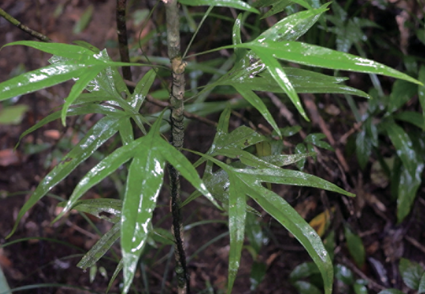
Leptochilus ornithopus T. Fujiw. & B.H. Quang (Polypodiaceae, Polypodiales) is described as a new species, based on integrated evidence from phylogenetic and morphological examinations. The new species is most similar to L. digitatus and L. longipes but distinguished from both by its having ovate rhizome scales, narrowly cuneate and gradually reduced lamina base, narrowly lanceolate lateral lobes of lamina which are widest at proximal 1/3 or base, and the sori at an angle of 31–38(–40) degree with the midrib.
References
Baker, J.G. (1890) Tonquin ferns. Journal of Botany, British and Foreign 28: 262–268.
Baker, J.G. (1895) CCCCXLVII.—Decades Kewenses. Bulletin of Miscellaneous Information Kew 1895: 53–56. https://doi.org/10.2307/4118477
Baker, J.G. (1898) DCXXIII.—Decades Kewenses. Bulletin of Miscellaneous Information Kew 1898: 224–234. https://doi.org/10.2307/4119473
Blume, C. (1828) Enumeratio plantarum, fasc. 2. J.W. van Leeuwen, Leiden.
Chen, C.-C., Hyvönen, J. & Schneider, H. (2022) Re-terrestrialization in the phylogeny of epiphytic plant lineages: Microsoroid ferns as a case study. Journal of Systematics and Evolution. https://doi.org/10.1111/jse.12899
Ching, R.-C. (1933) Studies of Chinese ferns—X. Bulletin of the Fan Memorial Institute of Biology 4: 293–362.
Christ, H. (1905) Les collections de fougères de la Chine au Muséum d’histoire naturelle de Paris. Bulletin de la Société Botanique de France 52 (Suppl. 1): 1–69. https://doi.org/10.1080/00378941.1905.10829209
Copeland, E.B. (1929) The oriental genera of Polypodiaceae, 16. University of California Publications in Botany, pp. 45–128.
Copeland, E.B. (1947) Genera Filicum. Chronica Botanica Co., Waltham.
Darriba, D., Taboada, G.L., Doallo, R. & Posada, D. (2012) jModelTest 2: more models, new heuristics and high-performance computing. Nature Methods 9: 772. https://doi.org/10.1038/nmeth.2109
Don, D., Hamilton, F. & Wallich, N. (1825) Prodromus florae Nepalensis, sive enumeration vegetabilium, quae in itinere per Nepaliam proprie dictam et regions conterminas, ann. 1802–1803. Wilks, London. https://doi.org/10.5962/bhl.title.86
Doyle, J.J. & Doyle, J.L. (1987) A rapid DNA isolation procedure for small quantities of fresh leaf tissue. Phytochemical Bulletin 19: 11–15.
Hara, H. (Ed.) (1966) Flora of Eastern Himalaya, 1st Report. The University of Tokyo Press, Tokyo.
IUCN (2021) IUCN Red List Categories and Criteria, version 2021-1. Available from: http://www.iucnredlist.org (accessed 30 September 2022)
Katoh, K. & Standley, D.M. (2013) MAFFT multiple sequence alignment software version 7: Improvements in performance and usability. Molecular Biology and Evolution 30: 772–780. https://doi.org/10.1093/molbev/mst010
Kaulfuss, G.F. (1824) Enumeratio filicum. C. Cnobloch, Leipzig.
Kress, W. (1989) The systematic distribution of vascular epiphytes. In: Lüttge, U. (Ed.) Vascular Plants as Epiphytes. Ecological Studies (Analysis and Synthesis), vol. 76. Springer, Berlin, pp. 234–261.
Labiak, P.H. (2017) Notes on the taxonomy and growth habits of three species of Campyloneurum (Polypodiaceae) from southeastern Brazil. American Fern Journal 107: 1–20. https://doi.org/10.1640/0002-8444-107.1.1
Lagomarsino, L.P., Grusz, A.L. & Moran, R.C. (2012) Primary hemiepiphytism and gametophyte morphology in Elaphoglossum amygdalifolium (Dryopteridaceae). Brittonia 64: 226–235. https://doi.org/10.1007/s12228-011-9216-y
Larsson, A. (2014) AliView: A fast and lightweight alignment viewer and editor for large datasets. Bioinformatics 30: 3276–3278. https://doi.org/10.1093/bioinformatics/btu531
Liang, Z.-L., Shui, Y.-M., Chen, W.-H., Yu, Z.-Y., Zhang, L. & Zhang, L.-B. (2020) Leptochilus gracilis (Polypodiaceae), a new fern species from southeastern Yunnan, China based on morphological and molecular evidence. Phytotaxa 468 (1): 112–120. https://doi.org/10.11646/phytotaxa.468.1.7
Middleton, D.J., Armstrong, K., Baba, Y., Balslev, H., Chayamarit, K., Chung, R.C.K., Conn, B.J., Fernando, E.S., Fujikawa, K., Kiew, R., Luu H.T., Aung M.M., Newman M.F., Tagane S., Tanaka N., Thomas D.C., Tran T.B., Utteridge, T.M.A., van Welzen P.C., Widyatmoko, D., Yahar, T. & Wong, K.M. (2019) Progress on Southeast Asia’s flora projects. Gardens’ Bulletin Singapore 71: 267–319. https://doi.org/ 10.26492/gbs71(2).2019-02
Nitta, J.H. & Epps, M.J. (2009) Hemi-epiphytism in Vandenboschia collariata (Hymenophyllaceae). Brittonia 61: 392–397. https://doi.org/10.1007/s12228-009-9097-5
Nguyen, L.T., Schmidt, H.A., Von Haeseler, A. & Minh, B.Q. (2015) IQ-TREE: A fast and effective stochastic algorithm for estimating maximum-likelihood phylogenies. Molecular Biology and Evolution 32: 268–274. https://doi.org/10.1093/molbev/msu300
Nooteboom, H.P. (1997) The microsoroid ferns (Polypodiaceae). Blumea 42: 261–395.
Presl, C.B. (1849 [1851]) Epimeliae botanicae: cum tabulis quindecim lithographicis. Abhandlungen der Königlichen Böhmischen Gesellschaft der Wissenschaften, ser. 6: 361–624. https://doi.org/10.5962/bhl.title.61845
Putz, F.E. & Holbrook, N.M. (1986) Notes on the natural history of hemiepiphytes. Selbyana 9: 61–69.
Rambaut, A. & Drummond, A.J. (2013) Tracer v1.6. Available from: http://beast.bio.ed.ac.uk/Tracer (accessed 4 May 2019)
Ronquist, F., Teslenko, M., van der Mark, P., Ayres, D.L., Darling, A., Höhna, S., Larget, B., Liu, L., Suchard, M.A. & Huelsenbeck, J.P. (2012) MrBayes 3.2: efficient Bayesian phylogenetic inference and model choice across a large model space. Systematic Biology 61: 539–542. https://doi.org/10.1093/sysbio/sys029
Testo, W. & Sundue, M. (2014) Primary hemiepiphytism in Colysis ampla (Polypodiaceae) provides new insight into the evolution of growth habit in ferns. International Journal of Plant Sciences 175: 526–536. https://doi.org/10.1086/675934
Vaidya, G., Lohman, D.J. & Meier, R. (2011) SequenceMatrix: concatenation software for the fast assembly of multi-gene datasets with character set and codon information. Cladistics 27: 171–180. https://doi.org/10.1111/j.1096-0031.2010.00329.x
Wang, L., Qi, X., Xiang, Q., Heinrichs, J., Schneider, H. & Zhang, X.-C. (2010) Phylogeny of the paleotropical fern genus Lepisorus (Polypodiaceae, Polypodiopsida) inferred from four chloroplast DNA regions. Molecular Phylogenetics and Evolution 54: 211–225. https://doi.org/10.1016/j.ympev.2009.08.032
Watkins Jr, J.E. & Moran, R.C. (2019) Gametophytes of the fern genera Dracoglossum and Lomariopsis (Lomariopsidaceae) and their phylogenetic significance. International Journal of Plant Sciences 180: 1004–1015. https://doi.org/10.1086/705587
Watts, J.L., Moran, R.C. & Watkins Jr, J.E. (2019) Hymenasplenium volubile: documentation of its gametophytes and the first record of a hemiepiphyte in the Aspleniaceae. Annals of Botany 124: 829–835. https://doi.org/10.1093/aob/mcz124
Wu, S., Phan, L. & Xiang, J. (2005). A new genus and two new species of ferns from Vietnam. Novon 15: 245–249.
Zhang, L., Lu, N.-T., Zhou, X.-M., Chen, D.-K., Knapp, R., Zhou, L., Guo, L., Luong, T.-T., Sun, H., Gao, X.-F. & Zhang, L.-B. (2019) A plastid phylogeny of the Old World fern genus Leptochilus (Polypodiaceae): Implications for cryptic speciation and progressive colonization from lower to higher latitudes. Molecular Phylogenetics and Evolution 134: 311–322. https://doi.org/10.1016/j.ympev.2019.01.013
Zhang, L. & Zhang, L.-B. (2018) Leptochilus sarawakensis nom. nov. (Polypodiaceae) from Malaysia. Phytotaxa 379 (3): 269–270. https://doi.org/10.11646/phytotaxa.379.3.6
Zhang, L., Guo, L. & Zhang, L.-B. (2018) New combinations in the fern genus Leptochilus (Polypodiaceae). Phytotaxa 374 (2): 172–176. https://doi.org/10.11646/phytotaxa.374.2.10
Zhang, L., Lu, N.-T. & Zhang, L.-B. (2015) Leptochilus oblongus (Polypodiaceae), a new fern species from northern Vietnam. Phytotaxa 234 (2): 195. https://doi.org/10.11646/phytotaxa.234.2.11
Zhang, X.-C. (2012) Lycophytes and ferns of China. Peking University Press, Beijing.
Zhang, X.-C. & Nooteboom, H.P. (2013) Leptochilus. In: Wu, Z.-Y., Raven, P.H. & Hong, D.-Y. (Eds.) Flora of China. Vols. 2–3: Lycopodiaceae through Polypodiaceae. Science Press & Missouri Botanical Garden Press, Beijing & St. Louis.
Zhao, M.-X., Xiang, J.-Y., Geekiyanage, N., Sun, H.-Y., Myo, K.-M., Dian, R.-N. & Tang, F.-L. (2017) Leptochilus mengsongensis (Polypodiaceae), a new species of fern from SW China. Phytotaxa 317 (2): 144–148. https://doi.org/10.11646/phytotaxa.317.2.7
Zotz, G. (2013) The systematic distribution of vascular epiphytes–a critical update. Botanical Journal of the Linnean Society 171: 453–481. https://doi.org/10.1111/boj.12010
Zotz, G., Almeda, F., Bautista-Bello, A.P., Eskov, A., Giraldo-Cañas, D., Hammel, B., Harrison, R., Köster, N., Krömer, T., Lowry II, P.P. & Moran, R.C. (2021) Hemiepiphytes revisited. Perspectives in Plant Ecology, Evolution and Systematics 51: 125620. https://doi.org/10.1016/j.ppees.2021.125620
Baker, J.G. (1895) CCCCXLVII.—Decades Kewenses. Bulletin of Miscellaneous Information Kew 1895: 53–56. https://doi.org/10.2307/4118477
Baker, J.G. (1898) DCXXIII.—Decades Kewenses. Bulletin of Miscellaneous Information Kew 1898: 224–234. https://doi.org/10.2307/4119473
Blume, C. (1828) Enumeratio plantarum, fasc. 2. J.W. van Leeuwen, Leiden.
Chen, C.-C., Hyvönen, J. & Schneider, H. (2022) Re-terrestrialization in the phylogeny of epiphytic plant lineages: Microsoroid ferns as a case study. Journal of Systematics and Evolution. https://doi.org/10.1111/jse.12899
Ching, R.-C. (1933) Studies of Chinese ferns—X. Bulletin of the Fan Memorial Institute of Biology 4: 293–362.
Christ, H. (1905) Les collections de fougères de la Chine au Muséum d’histoire naturelle de Paris. Bulletin de la Société Botanique de France 52 (Suppl. 1): 1–69. https://doi.org/10.1080/00378941.1905.10829209
Copeland, E.B. (1929) The oriental genera of Polypodiaceae, 16. University of California Publications in Botany, pp. 45–128.
Copeland, E.B. (1947) Genera Filicum. Chronica Botanica Co., Waltham.
Darriba, D., Taboada, G.L., Doallo, R. & Posada, D. (2012) jModelTest 2: more models, new heuristics and high-performance computing. Nature Methods 9: 772. https://doi.org/10.1038/nmeth.2109
Don, D., Hamilton, F. & Wallich, N. (1825) Prodromus florae Nepalensis, sive enumeration vegetabilium, quae in itinere per Nepaliam proprie dictam et regions conterminas, ann. 1802–1803. Wilks, London. https://doi.org/10.5962/bhl.title.86
Doyle, J.J. & Doyle, J.L. (1987) A rapid DNA isolation procedure for small quantities of fresh leaf tissue. Phytochemical Bulletin 19: 11–15.
Hara, H. (Ed.) (1966) Flora of Eastern Himalaya, 1st Report. The University of Tokyo Press, Tokyo.
IUCN (2021) IUCN Red List Categories and Criteria, version 2021-1. Available from: http://www.iucnredlist.org (accessed 30 September 2022)
Katoh, K. & Standley, D.M. (2013) MAFFT multiple sequence alignment software version 7: Improvements in performance and usability. Molecular Biology and Evolution 30: 772–780. https://doi.org/10.1093/molbev/mst010
Kaulfuss, G.F. (1824) Enumeratio filicum. C. Cnobloch, Leipzig.
Kress, W. (1989) The systematic distribution of vascular epiphytes. In: Lüttge, U. (Ed.) Vascular Plants as Epiphytes. Ecological Studies (Analysis and Synthesis), vol. 76. Springer, Berlin, pp. 234–261.
Labiak, P.H. (2017) Notes on the taxonomy and growth habits of three species of Campyloneurum (Polypodiaceae) from southeastern Brazil. American Fern Journal 107: 1–20. https://doi.org/10.1640/0002-8444-107.1.1
Lagomarsino, L.P., Grusz, A.L. & Moran, R.C. (2012) Primary hemiepiphytism and gametophyte morphology in Elaphoglossum amygdalifolium (Dryopteridaceae). Brittonia 64: 226–235. https://doi.org/10.1007/s12228-011-9216-y
Larsson, A. (2014) AliView: A fast and lightweight alignment viewer and editor for large datasets. Bioinformatics 30: 3276–3278. https://doi.org/10.1093/bioinformatics/btu531
Liang, Z.-L., Shui, Y.-M., Chen, W.-H., Yu, Z.-Y., Zhang, L. & Zhang, L.-B. (2020) Leptochilus gracilis (Polypodiaceae), a new fern species from southeastern Yunnan, China based on morphological and molecular evidence. Phytotaxa 468 (1): 112–120. https://doi.org/10.11646/phytotaxa.468.1.7
Middleton, D.J., Armstrong, K., Baba, Y., Balslev, H., Chayamarit, K., Chung, R.C.K., Conn, B.J., Fernando, E.S., Fujikawa, K., Kiew, R., Luu H.T., Aung M.M., Newman M.F., Tagane S., Tanaka N., Thomas D.C., Tran T.B., Utteridge, T.M.A., van Welzen P.C., Widyatmoko, D., Yahar, T. & Wong, K.M. (2019) Progress on Southeast Asia’s flora projects. Gardens’ Bulletin Singapore 71: 267–319. https://doi.org/ 10.26492/gbs71(2).2019-02
Nitta, J.H. & Epps, M.J. (2009) Hemi-epiphytism in Vandenboschia collariata (Hymenophyllaceae). Brittonia 61: 392–397. https://doi.org/10.1007/s12228-009-9097-5
Nguyen, L.T., Schmidt, H.A., Von Haeseler, A. & Minh, B.Q. (2015) IQ-TREE: A fast and effective stochastic algorithm for estimating maximum-likelihood phylogenies. Molecular Biology and Evolution 32: 268–274. https://doi.org/10.1093/molbev/msu300
Nooteboom, H.P. (1997) The microsoroid ferns (Polypodiaceae). Blumea 42: 261–395.
Presl, C.B. (1849 [1851]) Epimeliae botanicae: cum tabulis quindecim lithographicis. Abhandlungen der Königlichen Böhmischen Gesellschaft der Wissenschaften, ser. 6: 361–624. https://doi.org/10.5962/bhl.title.61845
Putz, F.E. & Holbrook, N.M. (1986) Notes on the natural history of hemiepiphytes. Selbyana 9: 61–69.
Rambaut, A. & Drummond, A.J. (2013) Tracer v1.6. Available from: http://beast.bio.ed.ac.uk/Tracer (accessed 4 May 2019)
Ronquist, F., Teslenko, M., van der Mark, P., Ayres, D.L., Darling, A., Höhna, S., Larget, B., Liu, L., Suchard, M.A. & Huelsenbeck, J.P. (2012) MrBayes 3.2: efficient Bayesian phylogenetic inference and model choice across a large model space. Systematic Biology 61: 539–542. https://doi.org/10.1093/sysbio/sys029
Testo, W. & Sundue, M. (2014) Primary hemiepiphytism in Colysis ampla (Polypodiaceae) provides new insight into the evolution of growth habit in ferns. International Journal of Plant Sciences 175: 526–536. https://doi.org/10.1086/675934
Vaidya, G., Lohman, D.J. & Meier, R. (2011) SequenceMatrix: concatenation software for the fast assembly of multi-gene datasets with character set and codon information. Cladistics 27: 171–180. https://doi.org/10.1111/j.1096-0031.2010.00329.x
Wang, L., Qi, X., Xiang, Q., Heinrichs, J., Schneider, H. & Zhang, X.-C. (2010) Phylogeny of the paleotropical fern genus Lepisorus (Polypodiaceae, Polypodiopsida) inferred from four chloroplast DNA regions. Molecular Phylogenetics and Evolution 54: 211–225. https://doi.org/10.1016/j.ympev.2009.08.032
Watkins Jr, J.E. & Moran, R.C. (2019) Gametophytes of the fern genera Dracoglossum and Lomariopsis (Lomariopsidaceae) and their phylogenetic significance. International Journal of Plant Sciences 180: 1004–1015. https://doi.org/10.1086/705587
Watts, J.L., Moran, R.C. & Watkins Jr, J.E. (2019) Hymenasplenium volubile: documentation of its gametophytes and the first record of a hemiepiphyte in the Aspleniaceae. Annals of Botany 124: 829–835. https://doi.org/10.1093/aob/mcz124
Wu, S., Phan, L. & Xiang, J. (2005). A new genus and two new species of ferns from Vietnam. Novon 15: 245–249.
Zhang, L., Lu, N.-T., Zhou, X.-M., Chen, D.-K., Knapp, R., Zhou, L., Guo, L., Luong, T.-T., Sun, H., Gao, X.-F. & Zhang, L.-B. (2019) A plastid phylogeny of the Old World fern genus Leptochilus (Polypodiaceae): Implications for cryptic speciation and progressive colonization from lower to higher latitudes. Molecular Phylogenetics and Evolution 134: 311–322. https://doi.org/10.1016/j.ympev.2019.01.013
Zhang, L. & Zhang, L.-B. (2018) Leptochilus sarawakensis nom. nov. (Polypodiaceae) from Malaysia. Phytotaxa 379 (3): 269–270. https://doi.org/10.11646/phytotaxa.379.3.6
Zhang, L., Guo, L. & Zhang, L.-B. (2018) New combinations in the fern genus Leptochilus (Polypodiaceae). Phytotaxa 374 (2): 172–176. https://doi.org/10.11646/phytotaxa.374.2.10
Zhang, L., Lu, N.-T. & Zhang, L.-B. (2015) Leptochilus oblongus (Polypodiaceae), a new fern species from northern Vietnam. Phytotaxa 234 (2): 195. https://doi.org/10.11646/phytotaxa.234.2.11
Zhang, X.-C. (2012) Lycophytes and ferns of China. Peking University Press, Beijing.
Zhang, X.-C. & Nooteboom, H.P. (2013) Leptochilus. In: Wu, Z.-Y., Raven, P.H. & Hong, D.-Y. (Eds.) Flora of China. Vols. 2–3: Lycopodiaceae through Polypodiaceae. Science Press & Missouri Botanical Garden Press, Beijing & St. Louis.
Zhao, M.-X., Xiang, J.-Y., Geekiyanage, N., Sun, H.-Y., Myo, K.-M., Dian, R.-N. & Tang, F.-L. (2017) Leptochilus mengsongensis (Polypodiaceae), a new species of fern from SW China. Phytotaxa 317 (2): 144–148. https://doi.org/10.11646/phytotaxa.317.2.7
Zotz, G. (2013) The systematic distribution of vascular epiphytes–a critical update. Botanical Journal of the Linnean Society 171: 453–481. https://doi.org/10.1111/boj.12010
Zotz, G., Almeda, F., Bautista-Bello, A.P., Eskov, A., Giraldo-Cañas, D., Hammel, B., Harrison, R., Köster, N., Krömer, T., Lowry II, P.P. & Moran, R.C. (2021) Hemiepiphytes revisited. Perspectives in Plant Ecology, Evolution and Systematics 51: 125620. https://doi.org/10.1016/j.ppees.2021.125620