

Abstract
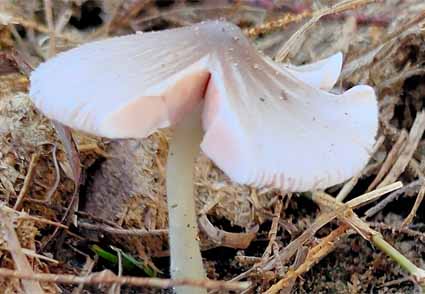
During surveys in the rainy season, a few collections of a novel Volvariella species were found on the decomposed matter, and sandy soil from the bed of the Indus River, Muzaffargarh, and Noorpur Thal, Khushab, Punjab, Pakistan. Phylogenetic analysis of the internal transcribed spacer (nrITS) has confirmed that this new species (namely Volvariella variicystidiosa) forms a separate clade from the previously known species of Volvariella. Volvariella variicystidiosa differs from a closely related species, V. taylorii, by its dull brown umbo and grayish brown striations on the pileus toward the margins, dull orange lamellae, and anatomically light yellow to gray pileipellis. Our new taxon is also different from existing species by having cheilocystidia and pleurocystidia with a broad variation of shapes and sizes. Abundant cheilocystidia are cymbiform to mucronate, narrowly to broadly moniliform with a broad base, and rarely broadly ellipsoid to ellipsoid with obtuse apex, triangular to conical; pleurocystidia are moderately ellipsoid, rarely flexuous and oblong. Our findings provide evidence that this fungus represents a new taxon and it is a great addition to our current knowledge of the vast diversity of Volvariella species.
References
<p align="justify"><span style="color: #000000;"><span style="font-family: Times New Roman, serif;"><span style="font-size: small;">Bruns, T.D. (1995) Thoughts on the processes that maintain local species diversity of ectomycorrhizal fungi. Plant Soil 170: 63–73. https://doi.org/10.1007/BF02183055</span></span></span>
<p align="justify"><span style="color: #000000;"><span style="font-family: Times New Roman, serif;"><span style="font-size: small;">Chattopadhyay, P., Talukdar, M., Beypih, J., Tayung, K. & Dutta, A.K. (2022) A new species of Volvariella (Agaricales, Basidiomycota) from West Bengal, India. Phytotaxa 567 (1): 36–48. https://doi.org/10.11646/phytotaxa.567.1.3</span></span></span>
<p align="justify"><span style="color: #000000;"><span style="font-family: Times New Roman, serif;"><span style="font-size: small;">Gardes, M. & Bruns, T.D. (1993) ITS primers with enhanced specificity for Basidiomycetes-Application to the identification of mycorrhizae and rusts. Molecular Ecology 2: 113–118. https://doi.org/10.1111/j.1365-294X.1993.tb00005.x</span></span></span>
<p align="justify"><span style="color: #000000;"><span style="font-family: Times New Roman, serif;"><span style="font-size: small;">Hall, T.A. (1999) BioEdit: a user-friendly biological sequence alignment editor and analysis program for Windows 95/98/NT. Nucleic Acids Symposium Series 41: 95–98.</span></span></span>
<p align="justify"><span style="color: #000000;"><span style="font-family: Times New Roman, serif;"><span style="font-size: small;">He, M.Q., Zhao, R.L., Hyde, K.D., Begerow, D., Kemler, M., Yurkov, A., McKenzie, E.H.C., Raspé, O., Kakishima, M., Sánchez-Ramírez, S., Vellinga, E.C., Halling, R., Papp, V., Zmitrovich, I.V., Buyck, B., Ertz, D., Wijayawardene, N.N., Cui, B.K., Schoutteten, N., Liu, X.Z., Li, T.H., Yao, Y.J., Zhu, X.Y., Liu, A.Q., Li, G.J., Zhang, M.Z., Ling, Z.L., Cao, B., Antonín, V., Boekhout, T., Da Silva, B.D.B., De Crop, E., Decock, C., Dima, B., Dutta, A.K., Fell, J.W., Geml, J., Ghobad-Nejhad, M., Giachini, A.J., Gibertoni, T.B., Gorjón, S.P., Haelewaters, D., He, S.H., Hodkinson, B.P., Horak, E., Hoshino, T., Justo, A., Lim, Y.W., Menolli Jr, N., Meši?, A., Moncalvo, J.M., Mueller, G.M., Nagy, L.G., Nilsson, R.H., Noordeloos, M., Nuytinck, J., Orihara, T., Ratchadawan, C., Rajchenberg, M., SilvaFilho, A.G.S., Sulzbacher, M.A., Tkal?ec, Z., Valenzuela, R., Verbeken, A., Vizzini, A., Wartchow, F., Wei, T.Z., Weiß, M., Zhao, C.L. & Kirk, P.M. (2019) Notes, outline and divergence times of Basidiomycota. Fungal Diversity 99: 105–367. https://doi.org/10.1007/s13225-019-00435-4</span></span></span>
<p align="justify"><span style="color: #000000;"><span style="font-family: Times New Roman, serif;"><span style="font-size: small;">Ijaz, M., Ahmad, H.R., Bibi, S., Ayub, M.A. & Khalid, S. (2020) Soil salinity detection and monitoring using Landsat data: a case study from Kot Addu, Pakistan. Arabian Journal of Geosciences 13 (13): 1?9. https://doi.org/10.1007/s12517-020-05572-8</span></span></span>
<p align="justify"><span style="color: #000000;"><span style="font-family: Times New Roman, serif;"><span style="font-size: small;">Justo, A., Minnis, A.M., Ghignone, S., Menolli, N.Jr., Capelari, M., Rodríguez, O., Malysheva, E., Contu, M. & Vizzini, A. (2011b) Species recognition in Pluteus and Volvopluteus (Pluteaceae, Agaricales): morphology, geography, and phylogeny. Mycological Progress 10 (4): 453–479. https://doi.org/10.1007/s11557-010-0716-z</span></span></span>
<p align="justify"><span style="color: #000000;"><span style="font-family: Times New Roman, serif;"><span style="font-size: small;">Justo, A., Vizzini, A., Minnis, A.M., Menolli, N.Jr., Capelari, M., Rodríguez, O., Malysheva, E., Contu, M., Chignone, S. & Hibbett, D.S. (2011a) Phylogeny of the Pluteaceae (Agaricales, Basidiomycota): taxonomy and character evolution. Fungal Biology 115 (1): 1–20. https://doi.org/10.1016/j.funbio.2010.09.012 </span></span></span>
<p align="justify"><span style="color: #000000;"><span style="font-family: Times New Roman, serif;"><span style="font-size: small;">Kaygusuz, O., Knudsen, H., Türkekul, Ý. & Çolak, Ö.F. (2020) Volvariella turcica, is a new species from Turkey, and multigene phylogeny of Volvariella. Mycologia 112 (3): 577–587. https://doi.org/10.1080/00275514.2020.1724048</span></span></span>
<p align="justify"><span style="color: #000000;"><span style="font-family: Times New Roman, serif;"><span style="font-size: small;">Khalid, A.N. (2022) A checklist of macrofungi of Pakistan published from 1998–2020. Pakistan Journal of Botany 54 (5): 1947–1962. https://doi.org/10.30848/PJB2022-5(23)</span></span></span>
<p align="justify"><span style="color: #000000;"><span style="font-family: Times New Roman, serif;"><span style="font-size: small;">Kumla, J., Suwannarach, N., Wannathes, N. & Lumyong, S. (2022) Survey of Volvariella (Agaricales, Basidiomycota) including two new species, V. neovolvacea, and V. thailandensis, from Northern Thailand. Diversity 14 (3): 161. https://doi.org/10.3390/d14030161</span></span></span>
<p align="justify"><span style="color: #000000;"><span style="font-family: Times New Roman, serif;"><span style="font-size: small;">Malysheva, E., Kapitonov, V. & Malysheva, V. (2022) A new species of Volvariella (Pluteaceae, Basidiomycota) from Western Siberia, Russia. Phytotaxa 538 (2): 141–148. https://doi.org/10.11646/phytotaxa.538.2.6</span></span></span>
<p align="justify"><span style="color: #000000;"><span style="font-family: Times New Roman, serif;"><span style="font-size: small;">Malysheva, E., Malysheca, V., Alexandrova, A. & Morozova, O. (2019) Observations on Pluteaceae in Vietnam. 1. New species and new records of Volvariella. Phytotaxa 408 (4): 233–254. https://doi.org/10.11646/phytotaxa.408.4.1</span></span></span>
<p align="justify"><span style="color: #000000;"><span style="font-family: Times New Roman, serif;"><span style="font-size: small;">Mehrotra, R.S. & Aneja, K.R. (1990) An Introduction to Mycology. New Age International, New Delhi, India.</span></span></span>
<p align="justify"><span style="color: #000000;"><span style="font-family: Times New Roman, serif;"><span style="font-size: small;">Miller, M.A., Pfeiffer, W. & Schwartz, T. (2010) Creating the CIPRES Science Gateway for inference of large phylogenetic trees, 2010 Gateway Computing Environments Workshop (GCE). New Orleans, LA, pp. 1–8. https://doi.org/10.1109/GCE.2010.5676129</span></span></span>
<p align="justify"><span style="color: #000000;"><span style="font-family: Times New Roman, serif;"><span style="font-size: small;">Moncalvo, J.M., Vilgalys, R., Redhead, S.A., Johnson, J.E., James, T.Y., Aime, M.C., Hofstetter, V., Verduin, S.J.W., Larsson, E., Baroni, T.J., Thorn, R.G., Jacobsson, S., Clémençon, H. & Miller, Jr. O.K. (2002) One hundred and seventeen clades of euagarics. Molecular Phylogenetics and Evolution 23: 357–400. https://doi.org/10.1016/S1055-7903(02)00027-1</span></span></span>
<p align="justify"><span style="color: #000000;"><span style="font-family: Times New Roman, serif;"><span style="font-size: small;">Munsell, A. (1994) Soil color charts. revised edition. Macbeth Division of Kollmorgen Instruments Corporation, New York.</span></span></span>
<p align="justify"><span style="color: #000000;"><span style="font-family: Times New Roman, serif;"><span style="font-size: small;">Niego, A.G.T., Sysouphanthong, P., Thongklang, N., Hyde, K.D., Phonemany, M., Phookamsak, R. & Raspe, O. (2021) A new species of Volvariella and the first record of Volvariella pulla (Agaricales: Incertae sedis) from Thailand. Phytotaxa 480 (3): 237–250. https://doi.org/10.11646/phytotaxa.480.3.3</span></span></span>
<p align="justify"><span style="color: #000000;"><span style="font-family: Times New Roman, serif;"><span style="font-size: small;">Priest, M. & Conde, B. (2006) The occurrence of Volvariella volvacea (Bull.: Fr.) Singer in the Northern Territory, Australia. Australasian Mycologist 25 (2): 65–67</span></span></span>
<p align="justify"><span style="color: #000000;"><span style="font-family: Times New Roman, serif;"><span style="font-size: small;">Rambaut, A. (2014) FigTree 1.4. 2 software. Institute of Evolutionary Biology, University of Edinburgh. Rambaut, A., Suchard, M.A. & Xie, D. Tracer v. 1.6. Available from: http://beast.bio.ed.ac.uk/Tracer (accessed 9 January 2018)</span></span></span>
<p align="justify"><span style="color: #000000;"><span style="font-family: Times New Roman, serif;"><span style="font-size: small;">Shaheen, H., Qureshi, R., Qaseem, M.F., Amjad, M.S. & Bruschi, P. (2017) The cultural importance of indices: A comparative analysis based on the useful wild plants of Noorpur Thal Punjab, Pakistan. European Journal of Integrative Medicine 12: 27–34. https://doi.org/10.1016/j.eujim.2017.04.003</span></span></span>
<p align="justify"><span style="color: #000000;"><span style="font-family: Times New Roman, serif;"><span style="font-size: small;">Singer, R. (1986) The Agaricales in modern taxonomy (4th edition). Koenigstein, Koeltz Scientific, pp. 455–457.</span></span></span>
<p align="justify"><span style="color: #000000;"><span style="font-family: Times New Roman, serif;"><span style="font-size: small;">Stewart, R.R. (1972) An annotated catalogue of the vascular plants of West Pakistan and Kashmir. In: Nasir, E. & Ali, S.I. (Eds.) Flora of Pakistan. Fakhri Printing Press, Karachi.</span></span></span>
<p align="justify"><span style="color: #000000;"><span style="font-family: Times New Roman, serif;"><span style="font-size: small;">Usman, M. & Khalid, A.N. (2020) Termitomyces acriumbonatus sp. nov. (Lyophyllaceae, Agaricales) from Pakistan. Phytotaxa 477: 217–228. https://doi.org/10.11646/phytotaxa.477.2.6</span></span></span>
<p align="justify"><span style="color: #000000;"><span style="font-family: Times New Roman, serif;"><span style="font-size: small;">Vellinga, E.C. (2001a) Studies in Lepiota III. Some species from California. Mycotaxon 80: 285–295. https://doi.org/10.3852/09-180</span></span></span>
<p align="justify"><span style="color: #000000;"><span style="font-family: Times New Roman, serif;"><span style="font-size: small;">White, T.J., Bruns, T., Lee, S. & Taylor, J. (1990) Amplification and direct sequencing of fungal ribosomal RNA genes for phylogenetics. In: PCR protocols: a guide to methods and applications. Academic Press, San Diego, 482 pp. https://doi.org/10.1016/B978-0-12-372180-8.50042-1</span></span></span>