

Abstract
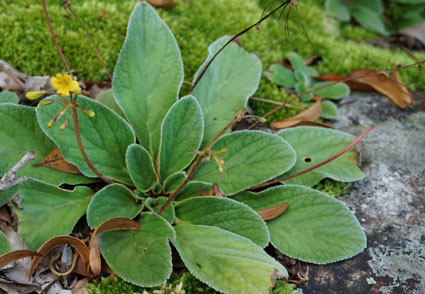
Oreocharis hainanensis, a new species of Gesneriaceae is described and illustrated from low-altitudual karst areas in Hainan Island, South China. The new species is easily distinguished from its closely-related O. jasminina by campanulate floral tube, zygomorphic corolla and exserted stamens. It also shows different habitats from the four currently-recognized Oreocharis taxa on the island. Molecular phylogeny analysis based on plastid trnL-trnF and nuclear ITS1/2 sequences supported the delimitation of the new species, which forms a monophyletic clade with all the other Oreocharis taxa from Hainan Island. The roles of habitat and floral isolation in the evolution of the new species and its affinities are discussed. The species was assessed as Vulnerable (VU C1 and D2) according to IUCN Red List Categories and Criteria.
References
Arnott, G.A.W. (1832) Botany. In: Napier, M. & Browne, J. (Eds.) Encyclopedia Britannica, ed. 7(5). Encyclopaedia Britannica Inc, Edinburgh, 121 pp.
Bentham, G. (1876) Gesneriaceae. In: Bentham, G. & Hooker, J.D. (Eds.) Genera Plantarum 2 (2). Lovell Reeve & Co., London, pp. 990–1025.
Blume, C.L. (1826) Bijdragen tot de flora van Nederlandsch Indie?. Ter Lands Drukkerij, Batavia, 766 pp.
Burtt, B.L. (1984) Studies in the Gesneriaceae of the Old World: XLVII. Revised generic concepts for Boea and its allies. Notes from the Royal Botanic Garden, Edinburgh 41: 401–452.
Chun, H.Y. (1946) Gesneriacearum Plantae Novae Sinicarum. Sunyatsenia 6: 299–300.
Chun, H.Y. (1974) Flora of Hainan 3. Science Press, Beijing. 588 pp.
Castellanos, M.C., Wilson, P. & Thomson, J.D. (2004) ‘Anti-bee’ and ‘pro-bird’ changes during the evolution of hummingbird pollination in Penstemon flowers. Journal of Evolutionary Biology 17: 876–885. https://doi.org/10.1111/j.1420-9101.2004.00729.x
Chen, W.H., Nguyen, Q.H., Chen, R.Z., Nguyen, S.K., Nguyen, V.T., Möller, M., Middleton, D.J. & Shui, Y.M. (2018) Two new species of Oreocharis (Gesneriaceae) from Fan Si Pan, the highest mountain in Vietnam. PhytoKeys 94: 95–106. https://doi.org/10.3897/phytokeys.94.21329
Chen, W.H., Zhang, Y.M., Guo, S.W., Zhang, Z.R., Chen, L. & Shui, Y.M. (2020) Reassessment of Bournea Oliver (Gesneriaceae) based on molecular and palynological evidence. PhytoKeys 157: 27–41. https://doi.org/10.3897/phytokeys.157.55254
Doyle, J.J. & Doyle, J.L. (1987) A rapid DNA isolation procedure for small quantities of fresh leaf tissue. Phytochemical Bulletin 19: 11–15.
https://doi.org/10.1016/0031-9422(80)85004-7
Forster, J.R. & Forster, G. (1776) Characteres Generum Plantarum. White, B., Cadell, T. & Elmsley, P., London, 150 pp.
Hall, T.A. (1999) BioEdit: A user-friendly biological sequence alignment editor and analysis program for Windows 95/98/NT. Nucleic Acids Symposium Series 41: 95–98. https://doi.org/10.14601/Phytopathol_Mediterr-14998u1.29
Hooker, J.D. (1893) Icones Plantarum, or figures, with brief descriptive characters and remarks, of new or rare plants, selected from the author’s herbarium. Vol. 23, ser. 4, 3. Longman, Reese, Orne, Brown, Green & Longman, Kew, Bentham-Moxon Trust, London, t. 2254.
Huelsenbeck, J.P. & Ronquist, F. (2001) MRBAYES: Bayesian inference of phylogenetic trees. Bioinformatics 17: 754–755. https://doi.org/10.1093/bioinformatics/17.8.754
IUCN Standards and Petitions Subcommittee (2019) Guidelines for using the IUCN Red List Categories and criteria, version 14. Standards and Petitions Committee, 113 pp.
Jack, W. (1823) On Cyrtandraceae, a new natural order of plants. Transactions of the Linnean Society of London 14: 23–44.
Jin, X., Ling, S.J., Wen, F. & Ren, M.X. (2021) Biogeographical pattern and floral evolution of Oreocharis (Gesneriaceae). Plant Science Journal 39: 379–388. https://doi.org/10.11913/PSJ.2095-0837.2021.40379
Kong, H.H., Condamine, F.L., Yang, L.H., Harris, A.J., Feng, C., Wen, F. & Kang, M. (2021) Phylogenomic and macroevolutionary evidence for an explosive radiation of a plant genus in the miocene. Systematic Biology syab068. https://doi.org/10.1093/sysbio/syab068
Kumar, S., Nei, M., Dudley, J. & Tamura, K. (2008) MEGA: a biologist-centric software for evolutionary analysis of DNA and protein sequences. Briefings in Bioinformatics 9: 299–306. https://doi.org/10.1093/bib/bbn017
Li, Z.Y. & Wang, Y.Z. (2005) Plants of Gesneriaceae in China. Henan Science & Technology Publishing House, Zhengzhou, 721 pp.
Ling, S.J., Meng, Q.W., Tang, L. & Ren, M.X. (2017) Pollination syndromes of Chinese Gesneriaceae: a comparative study between Hainan Island and neighboring regions. The Botanical Review 83: 59–73. https://doi.org/10.1007/s12229-017-9181-6
Ling, S.J., Qin, X.T., Song, X.Q., Zhang, L.N. & Ren, M.X. (2020a) Genetic delimitation of Oreocharis species from Hainan Island. PhytoKeys 157: 59–81. https://doi.org/10.3897/phytokeys.157.32427
Ling, S.J., Guan, S.P., Wen, F., Shui, Y.M. & Ren, M.X. (2020b) Oreocharis jasminina (Gesneriaceae), a new species from mountain tops of Hainan Island, South China. PhytoKeys 157: 121–135. https://doi.org/10.3897/phytokeys.157.50246
Lv, Z.Y., Yusupov, Z., Zhang, D.G., Zhang, Y.Z., Zhang, X.S., Lin, N., Tojibaev, K., Sun, H. & Deng, T. (in press) Oreocharis xieyongii, an unusual new species of Gesneriaceae from western Hunan, China. Plant Diversity. https://doi.org/10.1016/j.pld.2021.11.008
Martén-Rodríguez, S., Almarales-Castro, A. & Fenster, C.B. (2009) Evaluation of pollination syndromes in Antillean Gesneriaceae: evidence for bat, hummingbird and generalized flowers. Journal of Ecology 97: 348–359. https://doi.org/10.1111/j.1365-2745.2008.01465.x
Merrill, E.D. (1922) Diagnoses of Hainan plants. The Philippine Journal of Science 21: 337–355.
Muchhala, N. (2007) Adaptive trade-off in floral morphology mediates specialization for flowers pollinated by bats and hummingbirds. American Naturalist 169: 494–504. https://doi.org/10.1086/512047
Myers, N., Mittermeier, R.A., Mittermeier, C.G., da Fonseca, G.A. & Kent, J. (2000) Biodiversity hotspots for conservation priorities. Nature 403: 853–858. https://doi.org/10.1038/35002501
Möller, M., Middleton, D., Nishii, K., Wei, Y.G., Sontag, S. & Weber, A. (2011) A new delineation for Oreocharis incorporating an additional ten genera of Chinese Gesneriaceae. Phytotaxa 23: 1–36. https://doi.org/10.11646/phytotaxa.23.1.1
Nees von Essenbeck, C.G.D. (1825) Trichosporeae. Flora oder Botanische Zeitung 8: 143.
Nylander, J.A.A. (2004) MrModeltest v2. Program distributed by the author. Evolutionary Biology Centre, Uppsala University.
Pan, K.Y. (1987) Taxonomy of the genus Oreocharis (Gesneriaceae). Acta Phytotaxonomica Sinica 26: 450–457.
Swofford, D.L. (2003) PAUP*: Phylogenetic analysis using parsimony (* and other methods) Version 4.0b10. Sinauer Associates, Sunderland, Massachusetts, 142 pp.
Stevens, W.D. (2009) Apocynaceae. In: Davidse, G., Sousa, M. & Chater, A.O. (Eds.) Flora Mesoamericana. Missouri Botanical Garden Press, St. Louis, pp. 703–768.
Taberlet, P., Gielly, L., Pautou, G. & Bouvet, J. (1991) Universal primers for amplification of three non-coding regions of chloroplast DNA. Plant Molecular Biology 17: 1105–1109. https://doi.org/10.1007/BF00037152
Wei, Y.G. (2010) Gesneriaceae of South China. Guangxi Science and Technology Publishing House, Nanning, 777 pp.
Weber, A., Clark, J.L. & Möller, M. (2013) A new formal classification of Gesneriaceae. Selbyana 31: 68–94. [https://www.jstor.org/stable/24894283]
White, T.J., Bruns, T.D., Lee, S.B. & Taylor, J. (1990) Amplification and direct sequencing of fungal ribosomal RNA genes for phylogenetics. PCR Protocols 1990: 315–322.
Xing, F.W. & Li, Z.X. (1993) A new species of Paraboea from Hainan Island. Acta Botanica Yunnanica 15: 1–3.