

Abstract
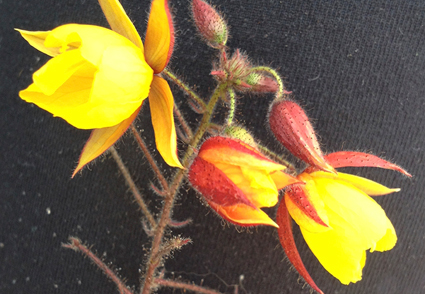
A new species of Chamaecrista was found in the Serra do Espinhaço region in the state of Minas Gerais, Brazil, during an expedition to study the taxonomy of this genus. Chamaecrista sempreviva Fort.-Perez & L.C. Zeferino sp. nov. is herein described, illustrated, and assigned to Chamaecrista sect. Absus. Comments about the ecology, distribution, preliminary conservation status as well as its morphological relationships and flowering and fruiting season of the new species, are provided. Additionally, a secretory structure survey of the leaflets of the new species and its related congeners is presented. All species studied share the presence of secretory and mucilaginous idioblasts in their leaflets, but the position of these cells types serves to differentiate them.
References
Bezerra, L.M.A.P., Vargas, W., Cândido, E.S., Monteiro, T.C., Vatanparast, M. & Fortuna-Perez, A.P. (2019) Rhynchosia mineira (Leguminosae: Papilionoideae), a new and critically endangered species from Minas Gerais, Brazil. Kew Bulletin 74: 62. https://doi.org/10.1007/S12225-019-9852-Z.
BFG—Brazil Flora Group. (2015) Growing knowledge: an overview of seed plant diversity in Brazil. Rodriguésia 66: 1085–1113. https://doi.org/10.1590/2175-7860201566411.
Conceição, A.S., Giulietti, A.M. & Queiroz, L.P. (2003) O gênero Chamaecrista Moench (Leguminosae-Caesalpinioideae) em Catolés, Abaíra, Chapada Diamantina, Bahia. Brasil. Sitientibus 3: 81–108.
Cota, M.M.T., Rando, J.G. & Mello-Silva, R. (2016) Chamaecrista petiolata (Leguminosae, Caesalpinioideae), new species from Diamantina Plateau, Minas Gerais, Brazil. Phytotaxa: 267: 70–76. https://doi.org/10.11646/phytotaxa.267.1.7
Coutinho, I.A.C., Francino, D.M.T., Azevedo, A.A. & Meira, R.M.S.A. (2012) Anatomy of the extrafloral nectaries in species of Chamaecrista section Absus subsection Baseophyllum (Leguminosae, Caesalpinioideae). Flora 207: 427–435. https://doi.org/10.1016/j.flora.2012.03.007.
Coutinho, I.A.C., Francino, D.M.T. & Meira, R.M.S.A. (2013) Leaf anatomical studies of Chamaecrista subsect. Baseophyllum (Leguminosae, Caesalpinioideae): new evidence for the up-ranking of the varieties to the species level. Plant Systematics and Evolution 299: 1709–1720. https://doi.org/10.1007/s00606-013-0827-5
Dantas, M.M. & Silva, M.J. (2013) O gênero Chamaecrista (Leguminosae, Caesalpinioideae, Cassieae) no Parque Estadual da Serra Dourada, Goiaìs, Brasil. Rodrigueìsia 64: 581–595. https://doi.org/10.1590/S2175-78602013000300010
De Candolle, A.P. (1816) Cassia sect. Absus DC.. Histoire Naturelle et Médicale des Casses 116.
ESRI. (2016) ArcGIS. Environmental Systems Resource Institute, Redlands, California.
Fortuna-Perez, A.P., Vatanparast, M., Cândido, E.S. & Vargas, W. (2016) Zornia melanocarpa (Leguminosae, Papilionoideae, Dalbergieae), a New Species from Serra do Espinhaço, Brazil, and its Phylogenetic Position in the Genus. Systematic Botany 41: 298–306. https://doi.org/10.1600/036364416X691867
Gerlach, G. (1969) Botanische Mikrotechnik, eine Einfuhrung. Gorg Thieme, Stuttgard.
Gerrits, P.O. (1991) The application of glycol methacrylate in histotechnology; some fundamental principles. Department of Anatomy and Embryology, State University Groningen, Netherlands.
Irwin, H.S. & Barneby, R.C. (1977) Cassia ser. Apoucouita H.S. Irwin & Barneby, Brittonia 29: 281.
Irwin, H.S. & Barneby, R.C. (1978) Monographic studies in Cassia (Leguminosae Caesalpinioideae) III. Sections Absus and Grimaldia. Memoirs of the New York Botanical Garden 30: 1–277.
Irwin, H.S. & Barneby, R.C. (1981) Cassieae. In: Polhill, R.M. & Raven, P.H. (Eds.) Advances in legume systematics, part I. Kew: Royal Botanic Gardens. pp. 97–106
Irwin, H.S. & Barneby, R.C. (1982) The American Cassiinae: a synoptical revision of Leguminosae tribe Cassieae subtribe Cassiinae in the New World. Memoirs of the New York Botanical Garden 35: 455–918.
IUCN Standards and Petitions Subcommittee. (2017) Guidelines for Using the IUCN Red List Categories and Criteria. Version 13. Prepared by the Standards and Petitions Subcommittee. [http://www.iucnredlist.org]
Johansen, D.A. (1940) Plant Microtechnique. McGraw-Hill, New York.
Lewis, G.P. (2005) Tribe Cassieae. In: Lewis, G.P., Schrire, B., Mackinder, B. & Lock, M. (Eds.) Legumes of the world. Kew: Royal Botanic Gardens. pp. 111–161.
Linnaeus, C. (1753) Species plantarum, exhibentes plantas ritecognitas, ad genera relatas cum differentiis specificis, nominibus trivialibus, synonymis selectis locis natalibus, secundum systema sexual digestas. v. I. Laurentii Salvii, Holmiæ, pp. 379–380.
LPWG—Legume Phylogeny Working Group. (2017) A new subfamily classification of the Leguminosae based on a taxonomically comprehensive phylogeny. Taxon 66: 44–77. https://doi.org/10.12705/661.3
Matos, R.G., Souza, A.O., Santos, I.S. & Silva, M.J. (2020) Leaf anatomy and macro-morphological data support a new species of the legume genus Chamaecrista (Fabaceae, Caesalpinioideae) from Goiás, Brazil. Phytotaxa 443: 167–178. https://doi.org/10.11646/phytotaxa.443.2.4
Metcalfe, C.R. & Chalk, L. (1950) Anatomy of the dicotyledons: Leaves, stem and wood in relation to taxonomy with notes on economic uses. Oxford: Clarendon Press.
Moench, C. (1794) A staminum situ describendi. Methodus Plantas Horti Botanic et Agri Marburgensis 1: 1–368.
Pougy, N., Verdi, M., Martins, E., Loyola, R. & Martinelli, G. (2015) Plano de Ação Nacional para a Conservação da Flora Ameaçada de Extinção da Serra do Espinhaço Meridional. CNCFlora, Jardim Botânico do Rio de Janeiro, Laboratório de Biogeografia da Conservação, Andrea Jakobsson Estúdio, Rio de Janeiro. 100 pp.
Rando, J.G., Hervencio, P., Souza, V.C., Giulietti, A.M. & Pirani, J.R. (2013) Flora da Serra do Cipó, Minas Gerais: Leguminosae- “Caesalpinioideae”. Boletim de Botânica da Universidade de São Paulo 13: 141–198.
Rando, J.G., Cota, M.M. & Melo-Silva, R. (2016) Chamaecrista petiolata (Leguminosae, Caesalpinioideae), new species from Diamantina Plateau, Minas Gerais, Brazil. Phytotaxa 267: 71. https://doi.org/10.11646/phytotaxa.267.1.7
Schrank, F.P. (1805) Grimaldia. Botanische Zeitung (Regensburg) 4: 184.
Silva, M.J., Souza, A.O. & Alonso, A.A. (2017) Chamaecrista belladonna (Fabaceae, Caesalpinioideae, Cassieae), a new threatened endemic species from Goiás, Brazil. Brittonia 69: 544–552. https://doi.org/10.1007/s12228-017-9489-x
Silva, M.J., Souza, A.O. & Alonso, A.A. (2019) A new species for the legume genus Chamaecrista (Fabaceae, Caesalpinioideae) supported by molecular, morphological, and anatomical data. Plant Systematics and Evolution 305: 325–340. https://doi.org/10.1007/s00606-019-01569-3
Smith, F.H. & Smith, E.C. (1942) Anatomy of the inferior ovary of Darbya. American Journal of Botany 29: 464–471. https://doi.org/10.2307/2437312
Solereder, H. (1908) Systematic anatomy of the dicotyledons. In: A handbook for laboratories of pure and applied Botany vol. 1. Oxford: Clarendon Press.
Souza, A.O. & Silva, M.J. (2015) Estudo taxonômico do gênero Chamaecrista Moench. (Caesalpinioideae, Leguminosae) na Floresta Nacional de Silvânia, Goiás, Brasil. Iheringia 70: 73–88.
Souza, A.O., Lewis, G.P. & Silva, M.J. (2021) A new infrageneric classification of the pantropical genus Chamaecrista (Fabaceae: Caesalpinioideae) based on a comprehensive molecular phylogenetic analysis and morphology. Botanical Journal of the Linnean Society 197: 350–395. https://doi.org/10.1093/botlinnean/boab029
Thiers, B. (2021 [continuously updated]) Index Herbariorum: A global directory of public herbaria and associated staff. New York Botanical Garden’s Virtual Herbarium. Available from: http://sweetgum.nybg.org/science/ih/ (accessed January 2021)
Zeferino, L.C., Queiroz, R.T., Rando, J.G., Cota, M.M.T., Fantini, I.F., Caetano, A.P.S. & Fortuna-Perez, A.P. (2019) O gênero Chamaecrista (Leguminosae: Caesalpinioideae) no Parque Estadual do Rio Preto, São Gonçalo do Rio Preto, Minas Gerais, Brasil. Rodriguésia 70: e02802017. https://doi.org/10.1590/2175-7860201970030