

Abstract
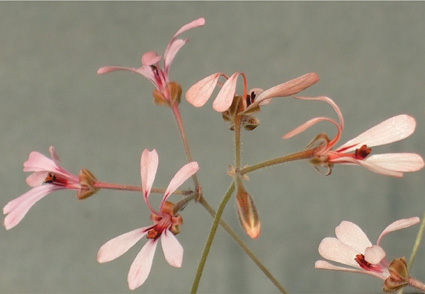
Pelargonium hammansbergense and P. roseopetalum are described as new species. Both are deciduous geophytes with turnip-shaped tubers belonging to P. section Hoarea. These two species share spathulate petals with narrow cuneate claws. However, they differ in leaf shape, flower colour and markings on the petals. Their flower structure corresponds to that of P. aridicola, P. hirtipetalum, P. pubipetalum, P. reflexipetalum and P. tripalmatum. The seven species are compared with regard to the flower and leaf morphology, palynology and chromosome numbers. They all occur in the winter rainfall region along the west coast of South Africa. The two new species described here are illustrated and a key for the identification of the seven species with a P. aridicola flower type is included.
References
Alarcón, M.L., Aldasoro, J.J., Aedo, C. & Navarro, C. (2003) A new species of Erodium L’Hér. (Geraniaceae) endemic to Australia. Botanical Journal of the Linnean Society 141 (2): 243–250. https://doi.org/10.1046/j.1095-8339.2003.00137.x
Bortenschlager, S. (1967) Vorläufige Mitteilungen zur Pollenmorphologie in der Familie der Geraniaceen und ihre systematische Bedeutung. Grana Palynologica 7: 400–468. https://doi.org/10.1080/00173136709430046
Brown, N.E. (1913) Pelargonium luteolum. Kew Bulletin 1913: 299. https://doi.org/10.2307/4118441
Compton, R.H. (1931) The Flora of the Whitehill District. Transactions of the Royal Society of South Africa 19: 269–326. https://doi.org/10.1080/00359193109518840
Candolle, A.P. de (1824) Geraniaceae. Prodromus systematis naturalis regni vegetabilis, Vol. 1. Treuttel & Wurts, Paris, pp. 673–682.
Gibby, M., Hinnah, S., Marais, E.M. & Albers, F. (1996) Cytological variation and evolution within Pelargonium section Hoarea (Geraniaceae). Plant Systematics and Evolution 203: 111–142. https://doi.org/10.1007/BF00985241
Gresse, P.G. (compiler) (1997) 3319 Worcester: 1:250 000 Geological Map Series, Council for Geoscience, South Africa.
Gresse, P.G. & Theron, J.N. (1992) The geology of the Worcester area. Government Printer, Pretoria.
Harvey, W.H. (1860) Geraniaceae. In: Harvey, W.H. & Sonder, O.W. (Eds.) Flora Capensis. Vol. 1. Hodges, Smith & Co, Dublin, pp. 259–308.
Jackson, S.P. (1961) Climatical atlas of Africa. CCTA/CSA, Lagos.
Jussieu, A.L. de (1789) Genera Plantarum secundum ordines naturales disposita. Viduam Herissant Typographum, Parisiis, 498 pp.
L’Héritier de Brutellle, C.-L. (1789) Geraniaceae. In: Aiton, W. (Ed.) Hortus Kewensis, vol. 2. George Nicol, London, 460 pp. https://doi.org/10.5962/bhl.title.4504
Le Roux, A. (2018) The vegetation ecology of the Witteberg and Dwyka Groups south of Worcester, Western Cape Province, South Africa. PhD Thesis, University of South Africa, Pretoria.
Leistner, O.A. & Morris, J.W. (1976) Southern African place names. Annals of the Cape Provincial Museums 12: 1–565.
Lessing, C.F. (1832) Genus Elytropappus. In: Synopsis generum compositarum earumque dispositionis novae tentamen, monographis multarum Capensium interjectis. Berolini, Berlin, pp. 344–345. https://doi.org/10.5962/bhl.title.51470
Marais, E.M. (1981) Die taksonomiese waarde van die blom van Pelargonium (Geraniaceae). Unpublished M.Sc. Thesis, University of Stellenbosch.
Marais, E.M. (1994) Taxonomic studies in Pelargonium, section Hoarea (Geraniaceae). Dissertation presented for the degree of Philosophy at the University of Stellenbosch, South Africa.
Marais, E.M. (1996) Pelargonium tripalmatum (Geraniaceae): a new species from the Richtersveld. South African Journal of Botany 62: 225–227. https://doi.org/10.1016/S0254-6299(15)30648-7
Marais, E.M. (1997a) Name changes in Pelargonium, section Hoarea (Geraniaceae). South African Journal of Botany 63: 68–73. https://doi.org/10.1016/S0254-6299(15)30705-5
Marais, E.M. (1997b) Three new species of Pelargonium (Geraniaceae) from Namaqualand. South African Journal of Botany 63: 82–89. https://doi.org/10.1016/S0254-6299(15)30707-9
Marais, E.M. (2000) Since the Ph.D thesis: Marais, E.M. (1994), Taxonomic studies in Pelargonium, section Hoarea (Geraniaceae). Ph. D. thesis, University of Stellenbosch, was reprinted and distributed by the Geraniaceae Group (England) in 2000, the name Pelargonium vinaceum E.M.Marais is considered effectively published from March 2000 (Article 29 of the International Code of Botanical Nomenclature, Greuter et al. 1994).
Persoon, C.H. (1806) Synopsis plantarum. Vol. 2. J.G. Cottam, Tübingen.
Plants of the World Online (2021) Geraniaceae Juss. Kew Science. Available from: http://powo.science.kew.org/taxon/urn:lsid:ipni.org:names:30001521-2 (accessed 26 May 2021)
Salisbury, R.A. (1806) Pelargonium nummulifolium. In: The paradisis londinensis, Vol. 1. W. Hooker, London.
Snijman, D. & Perry, P. (1987) A floristic analysis of the Nieuwoudtville Wild Flower Reserve, north-western Cape. South African Journal of Botany 53: 445–454. https://doi.org/10.1016/S0254-6299(16)31378-3
Thiers, B. (2021) Index Herbariorum: a global directory of public herbaria and associated staff. New York Botanical Garden’s Virtual Herbarium. [http://sweetgum.nybg.org/science/ih/]
Touloumenidou, T., Bakker, F.T., Marais, E.M. & Albers, F. (2004) Chromosomal evolution interpreted from the rDNA ITS phylogeny for Pelargonium sect. Hoarea (Geraniaceae). In: Thiede, J., Veste, M., Jürgens, N. & Metzing, D. (Eds.) Succulent Plant Research in Africa: Schumania 4. Biodiversity & Ecology 2: 93–106.
Wagensommer, R.P. & Venanzoni, R. (2021) Geranium lucarinii sp. nov. and re-evaluation of G. kikianum (Geraniaceae). Phytotaxa 489 (3): 252–262. https://doi.org/10.11646/phytotaxa.489.3.2