
Abstract
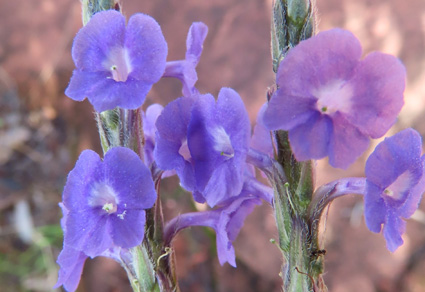
Stachytarpheta pradoi (Verbenaceae) is described as a new species based on fieldwork and examination of herbarium collections. Distributed in Bolivia and Brazil, it occurs in dry, open habitats, including sandy and rocky plains at elevations between 400 and 560 m. The main distinguishing features of the species include densely hirsute-villous branches; leaf blades with an attenuate base, decurrent into petiole; narrow-cylindrical inflorescences up to 1 m long; linear or narrowly lanceolate bracts, shorter than or equaling the calyx in length, with the abaxial surface glabrescent and the margins conspicuously ciliate, and lilac or blue corollas. To address the longstanding misidentification of Bolivian specimens of Stachytarpheta pradoi as Stachytarpheta canescens, a detailed discussion of the taxonomic identity and geographic distribution of both species is provided. A preliminary conservation status assessment suggests that Stachytarpheta pradoi can be treated as Endangered (EN).
References
- Antonelli, A. & Sanmartín, I. (2011) Why are there so many plant species in the Neotropics? Taxon 60: 403–414. https://doi.org/10.1002/tax.602010
- Antonelli, A. (2022) The rise and fall of Neotropical biodiversity. Botanical Journal of the Linnean Society 199: 8–24. https://doi.org/10.1093/botlinnean/boab061
- Antonelli, A., Fry, C., Smith, R.J., Eden, J., Kersey, P.J., Larridon, I., Paton, A.J., Simmonds, M.S.J., Ainsworth, A.M., Bachman, S.P., Cheek, M., Davis, C.C., Forest, F., Lennon, S., Little, D.P., Nesbitt, M., Nic Lughadha, E., Smith, S.A., Wilkinson, T., Williams, C., Abdul, S.D., Abdullahi, S., Abermann, J., Aceae, C.C., Aguero, B., Ahlstrand, N.I., Ajikah, L.B., Akanni, G.T., Akomaye, F.A., Alsos, I.G., Alveo, R., Amador, L.G., Ameka, G.K., Arno, J., Asase, A., Atkinson, W., Austin, M.W., Ávila, F.A., Ayodele, A.E., Babale, A., Baider, C., Baker, W.J., Bakhshi, M., Balick, M.J., Bamigboye, S.O., Baniaga, A.E., Bard, N.W., Barrett, R.D.H., Barrett, R.L., Bárrios, S., Basman, A., Bastianelli, D., Batke, S.P., Baumgartner, A., Bazan, S., Bazzicalupo, A., Becker, J., Begum, N., Bello, A., Beltrán-Rodríguez, L., Biersma, E.M., Biketova, A.Yu., Birchenko, I., Bjorkman, A.D., Blake, S.L.E., Blomberg, M., Bochorny, T., Bonnet, P., Bontrager, M., Boughalmi, K., Boyko, J.D., Bradshaw, A.J., Breman, E., Bu, W., Bugnaski, Z., Bytebier, B., Caballero-Rodriguez, D., Cahen, D., Callow, C., Cardinal-McTeague, W., Cardoso, D., Carranza, J., Carvajal, F., Carvey, N., Cavender-Bares, J., Chacón-Madrigal, E., Chandrasekaran, S., Chapman, T., Chen, F., Chen, S.-C., Chibwe, B., Childs, C., Chukwuma, D.M., Chukwuma, E.C., Clubbe, C., Cockel, C., Coimbra, C.E.A.Jr, Colli-Silva, M., Coomes, D.A., Couvreur, T.L.P., Culham, A., Cunha, S.P., da Silva Caminha, S.A.F., Dalcin, E., Dallimore, T., D’Apolito, C., Davies, N.M.J., Davies, T.J., Dayaram, A., Dayrell, R.L.C., de Alba, D., de Fátima Maciel-Silva, J., De Smedt, S., de Vere, N., Demissew, S., Dhanda, S., Dhanjal-Adams, K.L., Diaz-Jaramillo, A., Doubt, J., Druzhinina, I., Durgante, F.M., Eckert, I., Eckert, L., Ekeke, C., Fang, X., Fay, M.F., Feder, L., Filardi, F.R., Fischer, M.C., Fisher, D.O., Florens, F.B.V., Flores-Camargo, D.G., Folorunso, A.E., Fonseca-Kruel, V.S., Forzza, R.C., Francisco, M., Fu, Z., Gadar, K., Gårdman, V., Gargiulo, R., Gaya, E., Geeves, C., Gladitsch, H., Goëau, H., Golan, J., Gómez Barreiro, P., Goodman, L., Govaerts, R., Grace, O.M., Gray, A., Gremer, J.R., Groom, Q., Guerrero, P.C., Guggisberg, A., Guzicka, M., Guzmán, J.A., Harding, L., Hardwick, K.A., Harris, K., Hart, R., Hassel, K., Haston, E.M., Heberling, J.M., Hernández-Leal, M.S., Hert, Z.L., Hill, A.P., Hill, D.G., Hill, R., Hoban, S., Hodgson, E., Hoffman, B., Høye, T.T., Huang, C., Hudson, A.R., Hudson, M., Humphreys, A.M., Ibrahim, J.A., Iroka, C.F., Jackson, R., Jacobs, S.J., Jaramillo, C., Jernnäs, M., Johnson, R.F., Joly, A., Jones, L., Kallow, S., Karthik, V., Karthikeyan, A., Kaul, A.D., Kharouba, H.M., Khelidj, N.M., Klopper, R.R., Kothari, S., Kreuzer, C., Krieger, J., Kuhnhäuser, B.G., Kutza, A.D., Le, J., le Roux, M.M. & Lee, A.K. (2026) State of the World’s Plants and Fungi 2026. Royal Botanic Gardens, Kew. https://doi.org/10.34885/rdzs-ky83
- Atkins, S. (2005) The genus Stachytarpheta (Verbenaceae) in Brazil. Kew Bulletin 60: 161–272.
- Bachman, S., Moat, J., Hill, A.W., de la Torre, J. & Scott, B. (2011) Supporting Red List threat assessments with GeoCAT: geospatial conservation assessment tool. ZooKeys 150: 117–126. https://doi.org/10.3897/zookeys.150.2109
- Barbosa, V.A., Nabout, J.C. & Cunha, H.F. (2023) Spatial and temporal deforestation in the Brazilian Savanna: The discrepancy between observed and licensed deforestation in the state of Goiás. Land Use Policy 131: 106730. https://doi.org/10.1016/j.landusepol.2023.106730
- Barbosa Rodrigues, J. (1903) Myrtacées du Paraguay recueillies par Mr. le Dr. Emile Hassler et déterminées par J. Barbosa Rodrigues. J.Goffin & Fils, Bruxelles, 20 pp.
- Bebber, D.P., Carine, M.A., Wood, J.R., Wortley, A.H., Harris, D.J., Prance, G.T., Davidse, G., Paige, J., Pennington, T.D., Robson, N.K. & Scotland, R.W. (2010) Herbaria are a major frontier for species discovery. Proceedings of the National Academy of Sciences 107: 22169–22171. https://doi.org/10.1073/pnas.1011841108
- Beentje, H. (2010) The Kew Plant Glossary, an illustrated dictionary of plant terms. Kew Publishing, London, Royal Botanic Gardens, 160 pp.
- Besnard, G., Gaudeul, M., Lavergne, S., Muller, S., Rouhan, G., Sukhorukov, A.P., Vanderpoorten, A. & Jabbour, F. (2018) Herbarium-based science in the twenty-first century. Botany Letters 165: 323–327. https://doi.org/10.1080/23818107.2018.1482783
- Braz, A.M., Oliveira, I.J. & Cavalcanti, L.C.S. (2019) Mapeamento do uso e cobertura da terra no município de Mineiros (GO): uma representação a partir das fitofisionomias do Cerrado. Ambiência 15: 675–694. https://doi.org/10.5935/ambiencia.2019.03.12
- Cardoso, P.H., Menini Neto, L. & Salimena, F.R.G. (2019a) Novos sinônimos em Stachytarpheta (Verbenaceae) do Brasil. Hoehnea 46: e082019. https://doi.org/10.1590/2236-8906-08/2019
- Cardoso, P.H., Menini Neto, L., Bernacci, L.C. & Salimena, F.R.G. (2019b) Stachytarpheta kriegeriana (Verbenaceae), a new species from São Paulo state, Brazil. Phytotaxa 422: 248–254. https://doi.org/10.11646/phytotaxa.422.3.5
- Cardoso, P.H., Menini Neto, L., Salimena, F.R.G. & Trovó, M. (2020a) Novelties in Brazilian Stachytarpheta (Verbenaceae): a new species and taxonomic updates. Phytotaxa 475: 239–252. https://doi.org/10.11646/phytotaxa.475.4.2
- Cardoso, P.H., Menini Neto, L. & Salimena, F.R.G. (2020b) Taxonomic notes on Stachytarpheta (Verbenaceae) from Brazil. Kew Bulletin 75: 17. https://doi.org/10.1007/s12225-020-9875-5
- Cardoso, P.H., O’Leary, N., Olmstead, R.G., Moroni, P. & Thode, V. (2021a) An update of the Verbenaceae genera and species numbers. Plant Ecology and Evolution 154: 80–86. https://doi.org/10.5091/plecevo.2021.1821
- Cardoso, P.H., Menini Neto, L., Cabral, A. & Trovó, M. (2021b) Taxonomic updates in Brazilian Stachytarpheta (Verbenaceae) with atropurpureous to black corollas: two new species and a new synonym. Phytotaxa 523: 167–178. https://doi.org/10.11646/phytotaxa.523.2.4
- Cardoso, P.H., Menini Neto, L., Somavilla, N.S. & Trovó, M. (2022a) A morphometric approach and recircumscription of the Stachytarpheta longispicata complex (Verbenaceae). European Journal of Taxonomy 833: 12–45. https://doi.org/10.5852/ejt.2022.833.1881
- Cardoso, P.H., Moroni, P., Antar, G., Menini Neto, L. & Trovó, M. (2022b) Typifications and new synonyms in Stachytarpheta (Verbenaceae) from Brazil. Phytotaxa 558: 93–102. https://doi.org/10.11646/phytotaxa.558.1.6
- Cardoso, P.H., Menini Neto, L. & Trovó, M. (2023) Still on the Stachytarpheta longispicata complex (Verbenaceae): two new narrowly endemic species from the Cerrado domain of Central Brazil. Nordic Journal of Botany 2023: e03946. https://doi.org/10.1111/njb.03946
- Cardoso, P.H., Colli-Silva, M., Menini Neto, L. & Trovó, M. (2024a) Distribution and historical aspects of Brazilian Stachytarpheta (Verbenaceae): exploring a comprehensive dataset of taxonomically verified specimens. Flora 317: 152561. https://doi.org/10.1016/j.flora.2024.152561
- Cardoso, P.H., Salimena, F.R.G., Dittrich, V.A.O., Menini Neto, L. & Trovó, M. (2024b) Stachytarpheta liviae (Verbenaceae): a noteworthy new species from the Espinhaço Range, Brazil. Phytotaxa 633: 291–299. https://doi.org/10.11646/phytotaxa.633.3.9
- Cardoso, P.H., Salimena, F.R.G., Luizi-Ponzo, A.P., Somavilla, N., Patrício, P.T. & Trovó, M. (2025a) Stachytarpheta serrana, a new species of Verbenaceae endemic to the Diamantina Plateau in the Espinhaço Range (Minas Gerais, Brazil), with palynological and anatomical notes. Anais da Academia Brasileira de Ciências 97 (Suppl. 2): e20241271. https://doi.org/10.1590/0001-3765202520241271
- Cardoso, P.H., Renon, P., Costa, M.L. & Morais, I.L. (2025b) Verbenaceae in Emas National Park (Goiás state, Central Brazil), with a focus on chromatic variation in the corollas of Lippia filifolia. Webbia 80: 107–120. https://doi.org/10.36253/jopt-16698
- Cardoso, P.H. & Salimena, F.R.G. (2026) Stachytarpheta in Flora e Funga do Brasil. Jardim Botânico do Rio de Janeiro. Available from: [https://floradobrasil.jbrj.gov.br/FB15189] (accessed 19 May 2026)
- Davis, C.C. (2023) The herbarium of the future. Trends in Ecology & Evolution 38: 412–423. https://doi.org/10.1016/j.tree.2022.11.015
- de Queiroz, K. (2007) Species concepts and species delimitation. Systematic Biology 56: 879–886. https://doi.org/10.1080/10635150701701083
- Fontaine, B., Perrard, A. & Bouchet, P. (2012) 21 years of shelf life between discovery and description of new species. Current Biology 22: R943–R944. https://doi.org/10.1016/j.cub.2012.10.029
- Froelich, S., Gupta, M.P., Siems, K. & Jenett-Siems, K. (2008) Phenylethanoid glycosides from Stachytarpheta cayennensis (Rich.) Vahl (Verbenaceae), a traditional antimalarial medicinal plant. Revista Brasileira de Farmacognosia 18: 517–520. https://doi.org/10.1590/S0102-695X2008000400003
- GBIF (2026) GBIF—the Global Biodiversity Information Facility. Available from: https://www.gbif.org/ (accessed 31 May 2026) https://doi.org/10.7717/peerj.7387/supp-1
- Gonçalves, E.G. & Lorenzi, H. (2007) Morfologia vegetal: organografia e dicionário ilustrado de morfologia das plantas vasculares. Instituto Plantarum, Nova Odessa, 416 pp.
- Goodwin, Z.A., Harris, D.J., Filer, D., Wood, J.R. & Scotland, R.W. (2015) Widespread mistaken identity in tropical plant collections. Current Biology 25: R1066–R1067. https://doi.org/10.1016/j.cub.2015.10.002
- Guimarães, C.C., Sandy, C.M., Figueira, R., da Rocha Gonçalves, M., Crevelin, E.J., Cardoso, P.H., Fabro, A.T., Carmona, F., Borges, M.C. & Pereira, A.M.S. (2023) Anti-asthmatic activity of standardized hydro-ethanolic and aqueous extracts of Stachytarpheta cayennensis (Rich.) Vahl in a murine model. Journal of Ethnopharmacology 302: 115877. https://doi.org/10.1016/j.jep.2022.115877
- Harley, R.M. (2012) New species of Hyptis (Lamiaceae) from Bolivia. Kew Bulletin 67: 779–788. https://doi.org/10.1007/s12225-012-9407-z
- Harris, J.G. & Harris, M.W. (2001) Plant identification terminology: an illustrated glossary. 2ed. Spring Lake Publ., Spring Lake, 216 pp.
- Ibisch, P.L., Chive, J.C., Espinoza, S.D. & Araujo, N.V. (2005) Conservation status of biodiversity. In: Ibisch, P.L. & Mérida, G. (Eds.) Biodiversity: The richness of Bolivia. State of knowledge and conservation. Ministry of Sustainable Development. Editorial FAN, Santa Cruz de la Sierra, pp. 255–286.
- IUCN (2012) IUCN Red List Categories and Criteria: Version 3.1. Gland, Switzerland and Cambridge, UK, International Union for Conservation of Nature and Natural Resources (IUCN). Available from: http://www.iucnredlist.org/ (accessed 19 May 2026)
- IUCN Standards and Petitions Subcommittee (2024) Guidelines for Using the IUCN Red list Categories and Criteria. Version 15.1. Prepared by the Standards and Petitions Subcommittee. Available from: http://www.iucnredlist.org/documents/RedListGuidelines.pdf (accessed 19 May 2026)
- Jacquin, J.F. (1844) Eclogae Plantarum Rariorum 2. Strauss, Vienna, 68 plates.
- JSTOR (2026) Global Plants. ITHAKA. Available from: http://www.plants.jstor.org (accessed 31 May 2026)
- Kunth, C.S. (1818) Nova genera et species plantarum quas in peregrinatione ad plagam aequinoctialem orbis novi collegerunt, descripserunt, partim adumbraverunt Amat. Bonpland et Alex. de Humboldt. Vol. 4. Ed. folio. Paris: N. Maze.
- Link, J.H.F. (1821) Enumeratio Plantarum Horti Regii Berolinensis Altera. pt. 1. Paris, 458 pp. https://doi.org/10.5962/bhl.title.66
- Marx, H., O’Leary, N., Yuan, Y., Lu-Irving, P., Tank, D., Múlgura, M.E. & Olmstead, R. (2010) A molecular phylogeny and classification of Verbenaceae. American Journal of Botany 97: 1647–1663. https://doi.org/10.3732/ajb.1000144
- Moldenke, H.N. (1978) Notes on new or noteworthy plants CXIV. Phytologia 40: 220–225. https://doi.org/10.5962/bhl.part.28275
- Moldenke, H.N. (1979) Notes on new or noteworthy plants CXXI. Phytologia 41: 449–451. https://doi.org/10.5962/bhl.part.20793
- Moldenke, H.N. (1984) Notes on new or noteworthy plants CLXXIV. Phytologia 55: 232–234.
- O’Leary, N., Calviño, C.I., Martínez, S., Lu-Irving, P., Olmstead, R.G. & Múlgura, M.E. (2012) Evolution of morphological traits in Verbenaceae. American Journal of Botany 99: 1778–1792. https://doi.org/10.3732/ajb.1200123
- Pacheco, P. & Mertens, B. (2004) Land use change and agriculture development in Santa Cruz, Bolivia. Bois et Forets des Tropiques 280: 29–40. https://doi.org/10.19182/bft2004.280.a20237
- Patrício, P.T., Cardoso, P.H. & Luizi-Ponzo, A.P. (2024) Pollen morphology and its taxonomic potential in Stachytarpheta sect. Stachytarpheta (Verbenaceae) occurring in Brazil. Palynology 48: 2284144. https://doi.org/10.1080/01916122.2023.2284144
- Pinheiro, F.D.C., Forzza, R.C., Leitman, P.M. & Prado, J. (2024) The REFLORA Program: implementation, repatriation, and creation of the REFLORA Virtual Herbarium as a tool for biodiversity studies. Biota Neotropica 24: e20241701. https://doi.org/10.1590/1676-0611-BN-2024-1701
- POWO. (2026) Plants of the World Online. Available from: https://powo.science.kew.org/taxon/urn:lsid:ipni.org:names:864706-1 (accessed 31 May 2026)
- REFLORA (2026) REFLORA—Plantas do Brasil: Resgate Histórico e Herbário Virtual para o Conhecimento e Conservação da Flora Brasileira. Available from: https://floradobrasil.jbrj.gov.br/reflora/PrincipalUC/PrincipalUC.do (accessed 31 May 2026)
- Salimena, F.R.G., Ferreira, S.C., Cardoso, P.H. & Valério, V.I.R. (2016) Verbenaceae. In: Rizzo, J.A. (Ed.) Flora dos Estados de Goiás e Tocantins. Coleção Rizzo, vol. 47. Editora da Universidade Federal de Goiás, Goiânia, pp. 1–157.
- Schapoval, E.E.S., de Vargas, M.R.W., Chaves, C.G., Bridi, R., Zuanazzi, J.A.S. & Henriques, A.T. (1998) Antiinflammatory and antinociceptive activities of extracts and isolated compounds from Stachytarpheta cayennensis. Journal of Ethnopharmacology 60: 53–59. https://doi.org/10.1016/S0378-8741(97)00136-0
- Schauer, J.C. (1847) Verbenaceae. In: de Candole, A.L.P.P. (Ed.) Prodromus Systematis Naturalis Regni Vegetabilis 11. Sumptibus Sociorum Treuttel et Würtz, Paris, pp. 522–700.
- Schauer, J.C. (1851) Verbenaceae. In: Martius, C.F.P. & Eichler, A.W. (Eds.) Flora brasiliensis. F. Fleischer, Leipzig, pp. 169–308.
- Silva, V.A.D., Cardoso, P.H. & Echternacht, L. (2023) Verbenaceae in Itacolomi State Park, Minas Gerais, Brazil: richness, geographical distribution, and a new synonym for Stachytarpheta commutata. Rodriguésia 74: e00642022. https://doi.org/10.1590/2175-7860202374024
- Soltis, P.S. (2017) Digitization of herbaria enables novel research. American Journal of Botany 104: 1281–1284. https://doi.org/10.3732/ajb.1700281
- speciesLink (2026) speciesLink network. Available from: [specieslink.net/search] (accessed 31 May 2026)
- Sweeney, P.W., Starly, B., Morris, P.J., Xu, Y., Jones, A., Radhakrishnan, S., Grassa, C.J. & Davis, C.C. (2018) Large-scale digitization of herbarium specimens: development and usage of an automated, high-throughput conveyor system. Taxon 67: 165–178. https://doi.org/10.12705/671.10
- Tejada, G., Dalla-Nora, E., Cordoba, D., Lafortezza, R., Ovando, A., Assis, T. & Aguiar, A.P. (2016) Deforestation scenarios for the Bolivian lowlands. Environmental research 144: 49–63. https://doi.org/10.1016/j.envres.2015.10.010
- Thiers, B. (2026 [continuously updated]) Index Herbariorum: A global directory of public herbaria and associated staff. New York Botanical Garden’s Virtual Herbarium. Available from: http://sweetgum.nybg.org/ih/ (accessed 30 May 2026)
- Trovó, M. & Cardoso, P.H. (2025) The legacy of Harold Norman Moldenke to the Eriocaulaceae and Verbenaceae, with special comments on type citations. Botany Letters 173: 3–10. https://doi.org/10.1080/23818107.2025.2571938
- Vahl, M.H. (1804) Enumeratio plantarum: vel ab aliis, vel ab ipso observatarum, cum earum differentiüs specificis, synonymis selectis et descriptionibus succinctis, vol. 1. N. Mölleri et Filii, Aulae Regiae et Universitatis Typographorum, Hauniae [Copenhagen], LX 381 pp. https://doi.org/10.5962/bhl.title.7564
- Villarroel, D., Faria, J.E.Q., Belmont, A.M., Gomes, S.M. & Proença, C.E.B. (2016) New botanical discoveries in Eugenia (Myrtaceae) from Bolivia and Brazil. Phytotaxa 253: 266–274. https://doi.org/10.11646/phytotaxa.253.4.2
- Walpers, W.G. (1845) Synopsis Verbenacearum, Myoporinearum, Selaginearum, Stilbinearum, Globulariearum et Plantaginearum. Repertorium Botanices Systematicae 4. Sumtibus Friderici Hofmeister, Leipzig, 134 pp.
- WFO (2026) World Flora Online. Available from: https://www.worldfloraonline.org/taxon/wfo-0000314807 (accessed 31 May 2026)