
Abstract
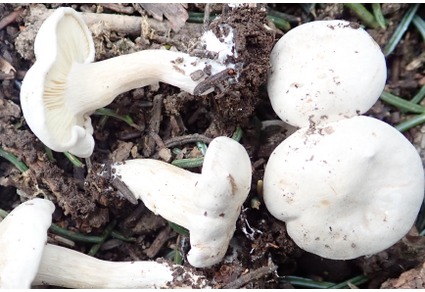
A new species, Ossicaulis, O. gansuensis, collected from the Qilian Mountains Natural Protection Station in Gansu Province, China, is described and illustrated. Its taxonomic position is established through morphological observations and phylogenetic analyses of multi-gene sequences (ITS+LSU+tef1-α+rpb2). Morphologically and ecologically, the new species is distinguished from other members of the genus by its white basidiomata, irregular pileus margins, larger basidia and basidiospores, and unique subcoprophilous and pine-cone-associated habitats. Molecular phylogenetic results show that O. gansuensis is nested within the monophyletic clade of Ossicaulis with high support (100/100/1), while also verifying the monophyly of related genera and the polyphyly of the traditional Lyophyllum sensu lato and Calocybe. In terms of evolutionary ecology, the shift from typical wood-decaying to pine-cone epiphytic and subcoprophilous habitats reflects an ecological niche compression and highly specialized survival strategy to avoid competition in the extreme cold and arid environment of the Qilian Mountains. This study not only fills the lineage and geographic distribution gaps in Ossicaulis in Asian cold-arid regions and Northwest China but also suggests that the Qilian Mountains and surrounding areas may serve as a significant center of fungal biodiversity.
References
- Bellanger, J.M., Moreau, P.A., Corriol, G., Bidaud, A., Chalange, R., Dudova, Z. & Richard, F. (2015) Plunging hands into the mushroom jar: a phylogenetic framework for Lyophyllaceae (Agaricales, Basidiomycota). Genetica 143: 169–194. https://doi.org/10.1007/s10709-015-9823-8
- Bon, M. (1994) Deux Lyophylloideae intéressantes et le genre Gerhardtia st. et nom. nov. Documents Mycologiques 24 (93): 65–68.
- Borovička, J., Noordeloos, M.E., Gryndler, M. & Oborník, M. (2011) Molecular phylogeny of Psilocybe cyanescens complex in Europe, with reference to the position of the secotioid Weraroa novae-zelandiae. Mycological Progress 10 (2): 149–155. https://doi.org/10.1007/s11557-010-0684-3
- Cleland, J.B. (1934) Toadstools and mushrooms and other larger fungi of South Australia (Part I). Adelaide, pp. 1–178. https://doi.org/10.5962/bhl.title.112109
- Contu, M. (2007) Funghi della Sardegna: note e descrizioni—VII. Micol. Veget. Medit. 22 (1): 29–40.
- Crous, P.W., Carnegie, A.J., Wingfield, M.J., Sharma, R., Mughini, G., Noordeloos, M.E., Santini, A., Shouche, Y.S., Bezerra, J.D.P., Dima, B., Guarnaccia, V., Imrefi, I., Jurjević, Ž., Knapp, D.G., Kovács, G.M., Magistà, D., Perrone, G., Rämä, T., Rebriev, Y.A., Shivas, R.G., Singh, S.M., Souza-Motta, C.M., Thangavel, R., Adhapure, N.N., Alexandrova, A.V., Alfenas, A.C., Alfenas, R.F., Alvarado, P., Alves, A.L., Andrade, D.A., Andrade, J.P., Barbosa, R.N., Barili, A., Barnes, C.W., Baseia, I.G., Bellanger, J.-M., Berlanas, C., Bessette, A.E., Bessette, A.R., Biketova, A.Yu., Bomfim, F.S., Brandrud, T.E., Bransgrove, K., Brito, A.C.Q., Cano-Lira, J.F., Cantillo, T., Cavalcanti, A.D., Cheewangkoon, R., Chikowski, R.S., Conforto, C., Cordeiro, T.R.L., Craine, J.D., Cruz, R., Damm, U., de Oliveira, R.J.V., de Souza, J.T., de Souza, H.G., Dearnaley, J.D.W., Dimitrov, R.A., Dovana, F., Erhard, A., Esteve-Raventós, F., Félix, C.R., Ferisin, G., Fernandes, R.A., Ferreira, R.J., Ferro, L.O., Figueiredo, C.N., Frank, J.L., Freire, K.T.L.S., García, D., Gené, J., Gęsiorska, A., Gibertoni, T.B., Gondra, R.A.G., Gouliamova, D.E., Gramaje, D., Guard, F., Gusmão, L.F.P., Haitook, S., Hirooka, Y., Houbraken, J., Hubka, V., Inamdar, A., Iturriaga, T., Iturrieta-González, I., Jadan, M., Jiang, N., Justo, A., Kachalkin, A.V., Kapitonov, V.I., Karadelev, M., Karakehian, J., Kasuya, T., Kautmanová, I., Kruse, J., Kušan, I., Kuznetsova, T.A., Landell, M.F., Larsson, K.-H., Lee, H.B., Lima, D.X., Lira, C.R.S., Machado, A.R., Madrid, H., Magalhães, O.M.C., Majerova, H., Malysheva, E.F., Mapperson, R.R., Marbach, P.A.S., Martín, M.P., Martín-Sanz, A., Matočec, N., McTaggart, A.R., Mello, J.F., Melo, R.F.R., Mešič, A., Michereff, S.J., Miller, A.N., Minoshima, A., Molinero-Ruiz, L., Morozova, O.V., Mosoh, D., Nabe, M., Naik, R., Nara, K., Nascimento, S.S., Neves, R.P., Olariaga, I., Oliveira, R.L., Oliveira, T.G.L., Ono, T., Ordoñez, M.E., de M. Ottoni, A., Paiva, L.M., Pancorbo, F., Pant, B., Pawłowska, J., Peterson, S.W., Raudabaugh, D.B., Rodríguez-Andrade, E., Rubio, E., Rusevska, K., Santiago, A.L.C.M.A., Santos, A.C.S., Santos, C., Sazanova, N.A., Shah, S., Sharma, J., Silva, B.D.B., Siquier, J.L., Sonawane, M.S., Stchigel, A.M., Svetasheva, T., Tamakeaw, N., Telleria, M.T., Tiago, P.V., Tian, C.M., Tkalčec, Z., Tomashevskaya, M.A., Truong, H.H., Vecherskii, M.V., Visagie, C.M., Vizzini, A., Yilmaz, N., Zmitrovich, I.V., Zvyagina, E.A., Boekhout, T., Kehlet, T., Læssøe, T. & Groenewald, J.Z. (2019) Fungal Planet description sheets: 868–950. Persoonia 42 (1): 291–473. https://doi.org/10.3767/persoonia.2019.42.11
- Deng, Y.L., Chen, M., Wang, K.S., Liu, W.T., Chen, D.X., Yang, S.Q., Li, W.L., Zhou, H.M. & Zhao, C.L. (2025) Morphological and phylogenetic analyses reveal one new genus and six new species in Irpicaceae and Steccherinaceae (Polyporales, Basidiomycota) from the Yunnan–Guizhou Plateau, Asia. IMA Fungus 16: e172367. https://doi.org/10.3897/imafungus.16.172367
- Ditmar, L.P.F. (1809) Duo genera fungorum. Neues Journal für die Botanik 3 (3–4): 55–57.
- Dong, J.H., Li, Q., Yuan, Q., Luo, Y.X., Zhang, X.C., Dai, Y.F., Zhou, Q., Liu, X.F., Deng, Y.L., Zhou, H.M., Muhammad, A. & Zhao, C.L. (2024) Species diversity, taxonomy, molecular systematics and divergence time of wood-inhabiting fungi in Yunnan-Guizhou Plateau, Asia. Mycosphere 15: 1110–1293. https://doi.org/10.5943/mycosphere/15/1/10
- Felsenstein, J. (1985) Confidence intervals on phylogenetics: an approach using bootstrap. Evolution 39 (4): 783–791. https://doi.org/10.1111/j.1558-5646.1985.tb00420.x
- Heim, R. (1942) Nouvelles études descriptives sur les agarics termitophiles d'Afrique tropicale. Archives du Muséum National d'Histoire Naturelle, 6ème série 18 (1): 107–16. [https://sciencepress.mnhn.fr/en/periodiques/archives-serie6/18/1/2]
- Hofstetter, V., Redhead, S.A., Kauff, F., Moncalvo, J.M., Matheny, P.B. & Vilgalys, R. (2014) Taxonomic Revision and Examination of Ecological Transitions of the Lyophyllaceae (Basidiomycota, Agaricales) Based on a Multigene Phylogeny. Cryptogamie, Mycologie 35 (4): 399–425. https://doi.org/10.7872/crym.v35.iss4.2014.399
- Holec, J. & Kolařík, M. (2013) Ossicaulis lachnopus (Agaricales, Lyophyllaceae), a species similar to O. lignatilis, is verified by morphological and molecular methods. Mycological Progress 12 (3): 589–597. https://doi.org/10.1007/s11557-012-0866-2
- Hu, Y., Karunarathna, S.C., Li, H., Galappaththi, M.C., Zhao, C.L., Kakumyan, P. & Mortimer, P.E. (2022) The impact of drying temperature on basidiospore size. Diversity 14 (4): 239. https://doi.org/10.3390/d14040239
- Kalamees, K. (1992) Tricholomella, a new genus, with the distribution data of Tricholomella constrictum, comb. nov. in east Europe and Asia. Persoonia 14 (4): 445–447. [https://scispace.com/pdf/tricholomella-a-new-genus-with-the-distribution-data-of-4a0wx82zha.pdf]
- Karsten, P.A. (1881) Hymenomycetes Fennici enumerati. Acta Societatis pro Fauna et Flora Fennica 2 (1): 1–40. [https://www.biodiversitylibrary.org/bibliography/13345]
- Kornerup, A. & Wanscher, J.H. (1978) Methuen handbook of colour. Eyre Methuen. London, UK, 252 pp.
- Luo, K.Y., Chen, Z.Y. & Zhao, C.L. (2022) Phylogenetic and taxonomic analyses of three new wood—inhabiting fungi of Xylodon (Basidiomycota) in a forest ecological system. Journal of Fungi 8 (4): 405. https://doi.org/10.3390/jof8040405
- Matheny, P.B. (2005) Improving phylogenetic inference of mushrooms with RPB1 and RPB2 nucleotide sequences (Inocybe; Agaricales). Molecular Phylogenetics and Evolution 35 (1): 1–20. https://doi.org/10.1016/j.ympev.2004.11.014
- Matheny, P.B., Curtis, J.M., Hofstetter, V., Aime, M.C., Moncalvo, J.M., Ge, Z.W., Slot, J.C., Ammirati, J.F., Baroni, T.J., Bougher, N.L., Hughes, K.W., Lodge, D.J., Kerrigan, R.W., Seidl, M.T., Aanen, D.K., DeNitis, M., Daniele, G.M., Desjardin, D.E., Kropp, B.R., Norvell, L.L., Parker, A., Vellinga, E.C., Vilgalys, R. & Hibbett, D.S. (2006) Major clades of Agaricales: a multilocus phylogenetic overview. Mycologia 98 (6): 982–995. https://doi.org/10.3852/mycologia.98.6.982
- Minh, B.Q., Schmidt, H.A., Chernomor, O., Schrempf, D., Woodhams, M.D., Haeseler, A. & Lanfear, R. (2020) IQ-TREE 2: New models and efficient methods for phylogenetic inference in the genomic era. Molecular Biology and Evolution 37 (5): 1530–1534. https://doi.org/10.1093/molbev/msaa015
- Moncalvo, J.M., Vilgalys, R., Redhead, S.A., Johnson, J.E., James, T.Y., Aime, M.C., Hofstetter, V., Verduin, S.J.W., Larsson, E., Baroni, T.J., Thorn, R.G., Jacobsson, S., Clémençon, H. & Miller, O.K. (2002) One hundred and seventeen clades of euagarics. Molecular Phylogenetics and Evolution 23 (3): 357–400. https://doi.org/10.1016/S1055-7903(02)00027-1
- Qi, Y., Xu, F., Yang, Z.Q., Hou, J.X., Xu, A.G., Guo, H.B., Yu, X.D. & Yang, R.H. (2023) Gerhardtia tomentosa and Ossicaulis borealis (Agaricales, Lyophyllaceae)—Two new species from northeast China. Frontiers in Microbiology 14: 1118853. https://doi.org/10.3389/fmicb.2023.1118853
- Rathnayaka, A.R., Tennakoon, D.S., Jones, G.E., Wanasinghe, D.N., Bhat, D.J., Priyashantha, A.H., Stephenson, S.L., Tibpromma, S. & Karunarathna, S.C. (2025) Significance of precise documentation of hosts and geospatial data of fungal collections, with an emphasis on plant-associated fungi. New Zealand Journal of Botany 63 (2–3): 462–489. https://doi.org/10.1080/0028825X.2024.2381734
- Redhead, S.A. & Ginns, J.H. (1985) A reappraisal of agaric genera associated with brown rots of wood. Transactions of the Mycological Society of Japan 26 (3): 349–381. [https://eurekamag.com/research/001/288/001288798.php?srsltid=AfmBOopJIw44InlktrGLCdpyhYBGMG1GW9bUkcwfwRbcdPw8-mwAJKZe]
- Ronquist, F., Teslenko, M., van der Mark, P., Ayres, D.L., Darling, A., Höhna, S., Larget, B., Liu, L., Suchard, M.A. & Huelsenbeck, J.P. (2012) MrBayes 3.2: efficient Bayesian phylogenetic inference and model choice across a large model space. Systematic Biology 61 (3): 539–542. https://doi.org/10.1093/sysbio/sys029
- Sánchez-García, M., Ryberg, M., Khan, F.K., Varga, T., Nagy, L.G. & Hibbett, D.S. (2020) Fruiting body form, not nutritional mode, is the major driver of diversification in mushroom forming fungi. Proceedings of the National Academy of Sciences USA 117 (51): 32528–32534. https://doi.org/10.1073/pnas.1922539117
- Sulaiman, S.Q., Al Anbagi, R.A., Alshuwaili, F.R. & Abdalrahman, S. (2024) New records of three Basidiomycetous species from Iraq using phenotypic and phylogenetic analyses. Plant Science Today 11: 4. https://doi.org/10.14719/pst.4416
- Swofford, D.L. (2002) PAUP*: phylogenetic analysis using parsimony (*and other methods). Version 4.0b10. Sinauer Associates: Massachusetts, MA, USA.
- Tang, S.M., Yu, F.M., Karunarathna, S.C., Luo, Z.L., Niu, K.Y., Li, R.Y., Li, L., Su, X.J. & Li, S.H. (2025) Morpho-phylogenetic analyses of two novel edible mushrooms from China and a mini review of Lyophyllum (Agaricales, Lyophyllaceae) cultivation and bioactivities. MycoKeys 112: 307–334. https://doi.org/10.3897/mycokeys.112.141615
- Vilgalys, R. & Hester, M. (1990) Rapid genetic identification and mapping of enzymatically amplified ribosomal DNA from several Cryptococcus species. Journal of Bacteriology 172 (8): 4238–4246. https://doi.org/10.1128/jb.172.8.4238-4246.1990
- Wei, S.W., Lu, B.Y., Wang, Y., Dou, W.J., Wang, Q. & Li, Y. (2023) Morphology and phylogeny of lyophylloid mushrooms in China with description of four new species. Journal of Fungi 9 (1): 77. https://doi.org/10.3390/jof9010077
- White, T.J., Bruns, T.D., Lee, S. & Taylor, J.W. (1990) Amplification and direct sequencing of fungal ribosomal RNA genes for phylogenetics science direct. In: PCR Protocol. Academic Press, pp. 315–322. [https://www.academia.edu/83456181/Amplification_and_Direct_Sequencing_of_Fungal_Ribosomal_Rna_Genes_for_Phylogenetics] https://doi.org/10.1016/b978-0-12-372180-8.50042-1
- Yang, S.D., Huang, H.Y., Zhao, J., Zeng, N.K. & Tang, L.P. (2018) Ossicaulis yunnanensis sp. nov. (Lyophyllaceae, Agaricales) from southwestern China. Mycoscience 59 (1): 33–37. https://doi.org/10.1016/j.myc.2017.07.008
- Yang, Y., Li, R., Jiang, Q.Q., Zhou, H.M., Muhammad, A., Wang, H.J. & Zhao, C.L. (2024) Phylogenetic and taxonomic analyses reveal three new wood-inhabiting fungi (Polyporales, Basidiomycota) in China. Journal of Fungi 10 (1): 55. https://doi.org/10.3390/jof10010055
- Yang, Y., Li, R., Liu, C.M. & Zhao, C.L. (2023) Morphological and molecular identification for two new species of wood-inhabiting macrofungi (Basidiomycota) from Yunnan-Guizhou Plateau, China. Phytotaxa 591 (1): 1–18. https://doi.org/10.11646/phytotaxa.591.1.1
- Yuan, Q., Luo, K.Y., Zhang, Y. & Zhao, C.L. (2023) Morphological characteristics and phylogenetic analyses revealed three new wood-inhabiting fungi (Agaricomycetes, Basidiomycota) in Southern China. Phytotaxa 592 (3): 179–195. https://doi.org/10.11646/phytotaxa.592.3.1
- Zhang, X.C., Li, Y.C., Wang, Y.Y., Xu, Z., Zhao, C.L. & Zhou, H.M. (2024) Xylodon asiaticus (Hymenochaetales, Basidiomycota), a new species of corticioid fungus from southern China. Phytotaxa 634 (1): 1–15. https://doi.org/10.11646/phytotaxa.634.1.1
- Zhao, D., Ye, T., Gao, F., Jakovlić, I., La, Q., Tong, Y., Liu, X., Song, R., Liu, F., Lian, Z.M., Zou, H., Li, W.X., Wang, G.T., Zeng, B. & Zhang, D. (2025) PhyloSuite v2: The development of an all-in-one, efficient and visualization-oriented suite for molecular dating analysis and other advanced features. IMeta 4 (6): e70095. https://doi.org/10.1002/imt2.70095