

Abstract
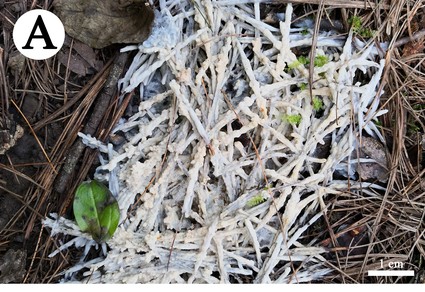
Helvellosebacina sclerotica sp. nov. was found in Yunnan Province, China, which is described here as a new species based on the morphological characteristics and molecular evidence. It is characterized by the resupinate basidiomata, smooth hymenial surface, a monomitic hyphal system with septate generative hyphae, and broadly ellipsoid to ellipsoid, smooth basidiospores (11–15 × 5.5–8.0 µm). Phylogenetic analyses of the combined internal transcribed spacer (ITS) and large subunit ribosomal RNA (nrLSU) sequence dataset confirmed that the new species belongs to Helvellosebacina. The phylogenetic tree inferred from ITS sequences showed that Helvellosebacina sclerotica was recovered as a sister group to H. granulate. Detailed descriptions, illustrations, and phylogenetic analyses of one new species are provided.
References
- Bruen, T.C., Philippe, H. & Bryant, D.A. (2006) A simple and robust statistical test for detecting the presence of recombination. Genetics 172 (4): 2665–2681. https://doi.org/10.1534/genetics.105.048975
- Chen, J.Z. & Zhao, C.L. (2020) Morphological and molecular identification of four new resupinate species of Lyomyces (Hymenochaetales) from southern China. MycoKeys 65: 101–118. https://doi.org/10.3897/mycokeys.65.48660
- Crous, P.W., Giraldo, A., Hawksworth, D.L., Robert, V., Kirk, P.M., Guarro, J., Robbertse, B., Schoch, C.L., Damm, U., Trakunyingcharoen, T. & Groenewald, J.Z. (2014) The genera of fungi: fixing the application of type species of generic names. IMA Fungus 5 (1): 141–160. https://doi.org/10.5598/imafungus.2014.05.01.14
- Crous, P.W., Wingfield, M.J., Jurjević, Ž., Balashov, S., Osieck, E.R., Marin-Felix, V., Luangsa-ard, J.J., Mejia, L.C., Cappelli, A., Parra, L.A., Lucchini, G., Chen, J., Moreno, G., Faraoni, M., Zhao, R.L., Weholt, O., Borovička, J., Jansen, G.M., Shivas, R.G., Tan, Y.P., Akulov, A., Alfenas, A.C., Alfenas, R.F., Altés, A., Avchar, R., Barreto, R.W., Catcheside, D.E.A., Chi, T.Y., Esteve-Raventós, Hanh, L.T.M., Fryar, S.C., Larsbrink, J., Oberlies, N.H., Olsson, L., Pancorbo, F., Raja, H.A., Thanh, V.N., Thuy, N.T., Ajithkumar, K., Akram, W., Alvarado, P., Angeletti, B., Arumugam, E., Atashi Khalaji, A., Bandini, D., Banniza, S., Baral, H.O., Barreto, M.C., Bellanger, J.M., Bezerra, J.D.P., Bezerra, J.L., Bianchin, V., Bibi, S., Boonmee, S., Braun, U., Brien, C., Brodt, T., Cano-Lira, J.F., Carriconde, F., Cazabonne, J., Cheewangkoon, R., Chethana, K.W.T., Cline, E.T., Cruz, A.C.R., Czachura, P., De Souza, J.T., Denchev, C.M., Denchev, T.T., Duong, T.A., Eyssartier, G., Flakus, A., Fournier, J., Frisullo, S., García-Jiménez, J., Gardiennet, A., Gené, J., Gryta, H., Hernández-Restrepo, M., Hirooka, Y., Hospenthal, D.R., Hubka, V., Illescas, T., Kezo, K., Kumar, S., Larsson, E., Lebel, T., Lechat, C., Lombard, L., Maciá Vicente, J.G., Mahadevakumar, S., Mang, S.M., Marbach, P.A.S., Marincowitz, S., Mateos, A., Mehrabi Koushki, M., Miglio, B.V., Mombert, A., Montaño-Mata, N.J., Murugadoss, R., Noor, A., Obermayer, E., Oliveira, J.A., Pereira, O.L., Piątek, M., Pinto, A., Pugh, T.A.M., Ramírez, G.H., Raphael, B., Rawat, G., Renuka, M., Reschke, K., Riebesehl, J., Ruiz Mateo, A., Saar, I., Saba, M., Safi, A., Sánchez, R.M., Sandoval Denis, M., Savitha, A.S., Sharma, A., Shelke, D., Soliz Santander, F.F., Sonawane, H., Souza, M.G.A.P., Starink-Willemse, M., Stryjak-Bogacka, M., Thines, M., Torres García, D., Traba, J.M., Vauras, J., Vermaas, M., Villarreal, M., Vu, D., Whiteside, E.J., Zafari, D. & Groenewald, J.Z. (2024) Fungal Planet description sheets: 1697–1780. Fungal Systematics and Evolution 14: 325–577. https://doi.org/10.3114/fuse.2024.14.19
- Deng, Y.L., Chen, M., Wang, K.S., Liu, W.T., Chen, D.X., Yang, S.Q., Li, W.L., Zhou, H.M. & Zhao, C.L. (2025) Morphological and phylogenetic analyses reveal one new genus and six new species in Irpicaceae and Steccherinaceae (Polyporales, Basidiomycota) from the Yunnan–Guizhou Plateau, Asia. IMA Fungus 16: e172367. https://doi.org/10.3897/imafungus.16.172367
- Deshmukh, S., Hückelhoven, R., Schäfer, P., Imani, J., Sharma, M., Weiss, M., Waller, F. & Kogel, K.H. (2006) The root endophytic fungus Piriformospora indica requires host cell death for proliferation during mutualistic symbiosis with barley. Proceedings of the National Academy of Sciences of the United States of America 103 (49): 18450–18457. https://doi.org/10.1073/pnas.0605697103
- Dissanayake, A.J., Bhunjun, C.S., Maharachchikumbura, S.S. & Liu, J.K. (2020) Applied aspects of methods to infer phylogenetic relationships amongst fungi. Mycosphere 11: 2652–2676. https://doi.org/10.5943/mycosphere/11/1/-18
- Dong, J.H., Chen, M.L., Chen, M., Li, Q., Zhu, Y.J., Zhang, X.C., Zhou, C.Q., Li, W., Muhammad, A., Zhou, H.M., Jabeen, S. & Zhao, C.L. (2025a) Notes, outline, taxonomy and phylogeny of wood-inhabiting Agaricales. Mycosphere 16 (1): 2599–2711. https://doi.org/10.5943/mycosphere/16/1/16
- Dong, J.H., Li, Q., Yuan, Q., Luo, Y.X., Zhang, X.C., Dai, Y.F., Zhou, Q., Liu, X.F., Deng, Y.L., Zhou, H.M., Muhammad, A. & Zhao, C.L. (2024) Species diversity, taxonomy, molecular systematics and divergence time of wood-inhabiting fungi in Yunnan-Guizhou Plateau, Asia. Mycosphere 15: 1110–1293. https://doi.org/10.5943/mycosphere/15/1/10
- Dong, J.H., Zhang, X., Guan, Q.X. & Wu, F. (2025b) Morphological characteristics and phylogenetic analysis reveal Helvellosebacina filicata sp. nov. and Sebacina aciculicola sp. nov. in Sebacinales from southwest China. MycoKeys 118: 105–118. https://doi.org/10.3897/mycokeys.118.152160
- Floudas, D. & Hibbett, D.S. (2015) Revisiting the taxonomy of Phanerochaete (Polyporales, Basidiomycota) using a four gene dataset and extensive ITS sampling. Fungal Biology 119: 679–719. https://doi.org/10.1016/j.funbio.2015.04.003
- Glez-Peña, D., Gómez-Blanco, D., Reboiro-Jato, M., Fdez-Riverola, F. & Posada, D. (2010) ALTER: program oriented conversion of DNA and protein alignments. Nucleic Acids Research 38: 14–18. https://doi.org/10.1093/nar/gkq321
- Guan, Q.X. & Zhao, C.L. (2023) Five new species of Schizoporaceae (Basidiomycota, Hymenochaetales) from East Asia. MycoKeys 96: 25–56. https://doi.org/10.3897/mycokeys.96.99327
- Hibbett, D., Nagy, L. & Nilsson, R. (2025) Fungal diversity, evolution, and classification. Current Biology 35: 463–469. https://doi.org/10.1016/j.cub.2025.01.053
- Kalyaanamoorthy, S., Minh, B.Q., Wong, T.K.F., von Haeseler, A. & Jermiin, L.S. (2017) ModelFinder: Fast model selection for accurate phylogenetic estimates. Nature Methods 14 (6): 587–589. https://doi.org/10.1038/nmeth.4285
- Katoh, K., Rozewicki, J. & Yamada, K.D. (2019) MAFFT online service: Multiple sequence alignment, interactive sequence choice and visualization. Briefings in Bioinformatics 20 (4): 1160–1166. https://doi.org/10.1093/bib/bbx108
- Larsson, A. (2014) AliView: A fast and lightweight alignment viewer and editor for large data sets. Bioinformatics 30 (22): 3276–3278. https://doi.org/10.1093/bioinformatics/btu531
- Larsson, K.H., Viner, Ilya V.S. & Spirin, V. (2025) Additions to the taxonomy of Phanerochaete sensu lato (Polyporales, Basidiomycota); one new genus, two new species and twelve new combinations. Mycological Progress 24: 74. https://doi.org/10.1007/s11557-025-02094-z
- Luo, K.Y., Chen, Z.Y. & Zhao, C.L. (2022) Phylogenetic and taxonomic analyses of three new wood–inhabiting fungi of Xylodon (Basidiomycota) in a forest ecological system. Journal of Fungi 8: 405. https://doi.org/10.3390/jof8040405
- Malysheva, V., Spirin, V.A., Miettinen, O., Kout, J., Savchenko, A. & Larsson, K. (2019) On Craterocolla and Ditangium (Sebacinales, Basidiomycota). Mycological Progress 18: 753–762. https://doi.org/10.1007/s11557-019-01485-3
- Martin, F. & Tan, H. (2025) Saprotrophy-to-symbiosis continuum in fungi. Current Biology 35 (11): 469–475. https://doi.org/10.1016/j.cub.2025.01.032
- Miettinen, O., Spirin, V., Vlasak, J., Rivoire, B., Stenroos, S. & Hibbett, D. (2016) Polypores and genus concepts in Phanerochaetaceae (Polyporales, Basidiomycota). MycoKeys 17: 1–46. https://doi.org/10.3897/mycokeys.17.10153
- Miller, M.A., Pfeiffer, W. & Schwartz, T. (2012) The CIPRES science gateway. [In Proceedings of the 1st Conference of the Extreme Science and Engineering Discovery Environment: Bridging from the Extreme to the Campus and Beyond, Chicago, IL, 1–39.] https://doi.org/10.1145/2335755.2335836
- Moyersoen, B. & Weiß, M. (2014) New neotropical Sebacinales species from a Pakaraimaea dipterocarpacea forest in the Guayana region, Southern Venezuela: structural diversity and phylogeography. PLoS One 9 (7): 1–17. https://doi.org/10.1371/journal.pone.0103076
- Oberwinkler, F., Riess, K., Bauer, R. & Garnica, S. (2014) Morphology and molecules: the Sebacinales, a case study. Mycological Progress 13 (3): 445–470. https://doi.org/10.1007/s11557-014-0983-1
- Petersen, J.H. (1996) Farvekort. The Danish Mycological Society’s Colour-Chart. Foreningen til Svampekundskabens Fremme, Greve, pp. 1–6.
- Quaedvlieg, W., Binder, M., Groenewald, J.Z., Summerell, B.A., Carnegie, A.J., Burgess, T.I. & Crous, P.W. (2014) Introducing the consolidated species concept to resolve species in the Teratosphaeriaceae. Persoonia 33 (1): 1–40. https://doi.org/10.3767/003158514X681981
- Qu, M.H., Wang, D.Q. & Zhao, C.L. (2022) A Phylogenetic and taxonomic study on Xylodon (Hymenochaetales): focusing on three new Xylodon species from southern China. Journal of Fungi 8: 35. https://doi.org/10.3390/jof8010035
- Rathnayaka, A.R., Tennakoon, D.S., Jones, G.E., Wanasinghe, D.N., Bhat, D.J., Priyashantha, A.H., Stephenson, S.L., Tibpromma, S. & Karunarathna, S.C. (2025) Significance of precise documentation of hosts and geospatial data of fungal collections, with an emphasis on plant‐associated fungi. New Zealand Journal of Botany 63 (2-3): 462–489. https://doi.org/10.1080/0028825X.2024.2381734
- Rehner, S.A. & Samuels, G.J. (1994) Taxonomy and phylogeny of Gliocladium analysed from nuclear large subunit ribosomal DNA sequences. Mycological Research 98 (6): 625–634. https://doi.org/10.1016/S0953-7562(09)80409-7
- Riess, K., Oberwinkler, F., Bauer, R. & Garnica, S. (2013) High genetic diversity at the regional scale and possible speciation in Sebacina epigaea and S. incrustans. BMC Evolutionary Biology 13: 102. https://doi.org/10.1186/1471-2148-13-102
- Ronquist, F., Teslenko, M., van der Mark, P., Ayres, D.L., Darling, A., Hohna, S., Larget, B., Liu, L., Suchard, M.A. & Huelsenbeck, J.P. (2012) Mrbayes 3.2: Efficient bayesian phylogenetic inference and model choice across a large model space. Systematic Biology 61 (3): 539–542. https://doi.org/10.1093/sysbio/sys029
- Sesli, E. (2021) Helvellosebacina granulata sp. nov. (Basidiomycota: Sebacinaceae) from the East Black Sea Region of Turkey. Nordic Journal of Botany 39 (6): e03189. https://doi.org/10.1111/njb.03189
- Spirin, V., Volobuev, S., Okun, M., Miettinen, O. & Larsson, K.H. (2017) What is the type species of Phanerochaete (Polyporales, Basidiomycota). Mycological Progress 16: 171–183. https://doi.org/10.1007/s11557-016-1267-8
- Suh, H., Seo, C.W., Park, K.H., Yoo, S., Kim, D., Cho, Y. & Lim, Y.W. (2026) Hidden diversity of crust-like Sebacinaceae (Sebacinales, Agaricomycetes) in Asia. IMA Fungus 17: e168486. https://doi.org/10.3897/imafungus.17.168486
- Tangthirasunun, N., Silar, P., Bhat, D.J., Chukeatirote, E., Wikee, S., Maharachchikumbura, S., Hyde, K. & Wang, Y. (2014) Morphology and phylogeny of Chaetospermum (asexual coelomycetous Basidiomycota). Phytotaxa 175: 61–72. https://doi.org/10.11646/phytotaxa.175.2.1
- Vilgalys, R. & Hester, M. (1990) Rapid genetic identification and mapping of enzymatically amplified ribosomal DNA from several Cryptococcus species. Journal of Bacteriology 172 (8): 4238–4246. https://doi.org/10.1128/jb.172.8.4238-4246.1990
- Wang, L., He, S.Y., Lambert, C., Zhu, Y.G., Zhang, J.L., Yang, Y., Li, W.L., Zhou, H.M. & Zhao, C.L. (2026) Comprehensive morphological and phylogenetic analyses of Hymenochaetales (Basidiomycota) unveil one new genus and twenty-six novel wood-inhabiting species from southwestern China. Persoonia 56: 328–380. https://doi.org/10.3114/persoonia.2026.56.05
- Wells, K., Bandoni, R.J., Lim, S.H. & Berbee, M.L. (2004) Observations on some species of Myxarium and reconsideration of the Auriculariaceae and Hyaloriaceae Auriculariales. 237.
- White, T.J., Bruns, T., Lee, S. & Taylor, J. (1990) Amplification and direct sequencing of fungal ribosomal RNA genes for phylogenetics. In: Innis, M.A., Gelfand, D.H., Sninsky, J.J. & White, T.J. (Eds.) PCR protocols: A guide to methods and applications. Academic Press, San Diego, pp. 315–322. https://doi.org/10.1016/B978-0-12-372180-8.50042-1
- Wu, F., Zhou, L.W., Vlasák, J. & Dai, Y.C. (2022) Global diversity and systematics of Hymenochaetaceae with poroid hymenophore. Fungal Diversity 113: 1–192. https://doi.org/10.1007/s13225-021-00496-4
- Yang, Y., Li, R., Jiang, Q.Q., Zhou, H.M., Muhammad, A., Wang, H.J. & Zhao, C.L. (2024) Phylogenetic and taxonomic analyses reveal three new wood-inhabiting fungi (Polyporales, Basidiomycota) in China. Journal of Fungi 10: 55. https://doi.org/10.3390/jof10010055
- Yang, Y., Li, R., Liu, C.M. & Zhao, C.L. (2023) Morphological and molecular identification for two new species of wood-inhabiting macrofungi (Basidiomycota) from Yunnan-Guizhou Plateau, China. Phytotaxa 591 (1): 1–18. https://doi.org/10.11646/phytotaxa.591.1.1
- Yuan, Q., Luo, K.Y., Zhang, Y. & Zhao, C.L. (2023) Morphological characteristics and phylogenetic analyses revealed three new wood-inhabiting fungi (Agaricomycetes, Basidiomycota) in Southern China. Phytotaxa 592 (3): 179–195. https://doi.org/10.11646/phytotaxa.592.3.1
- Yuan, Y., Chen, J.J., Korhonen, K., Martin, F. & Dai, Y.C. (2021) An updated global species diversity and phylogeny in the forest pathogenic genus Heterobasidion (Basidiomycota, Russulales). Frontiers in Microbiology 11: 596393. https://doi.org/10.3389/fmicb.2020.596393
- Zhang, Q.Y., Liu, H.G., Papp, V., Zhou, M., Dai, Y.C. & Yuan, Y. (2023) New insights into the classification and evolution of Favolaschia (Agaricales, Basidiomycota) and its potential distribution, with descriptions of eight new species. Mycosphere 14: 777–814. https://doi.org/10.5943/mycosphere/14/1/10
- Zhang, X.C., Li, Y.C., Wang, Y.Y., Xu, Z., Zhao, C.L. & Zhou, H.M. (2024) Xylodon asiaticus (Hymenochaetales, Basidiomycota), a new species of corticioid fungus from southern China. Phytotaxa 634 (1): 1–15. https://doi.org/10.11646/phytotaxa.634.1.1
- Zhao, H., Cui, Y.J., Guan, Q.X., Wang, K., Zhuang, L., Zeng, G.Y., Wei, Y.L., Wu, F. & Yuan, H.S. (2025) Global species diversity and distribution patterns within the order Hymenochaetales (Agaricomycetes, Basidiomycota). Mycosphere 16 (1): 3257–3280. https://doi.org/10.5943/mycosphere/16/1/24
- Zhou, H.M., Gu, Z.R. & Zhao, C.L. (2024) Molecular phylogeny and morphology reveal a new species of Asterostroma from Guizhou Province, China. Phytotaxa 635 (2): 173–181. https://doi.org/10.11646/phytotaxa.635.2.7
- Zhou, M., Dai, Y.C., Vlasák, J., Liu, H.G. & Yuan, Y. (2023) Updated systematics of Trichaptum s.l. (Hymenochaetales, Basidiomycota). Mycosphere 14: 815–917. https://doi.org/10.5943/mycosphere/14/1/11