
Abstract
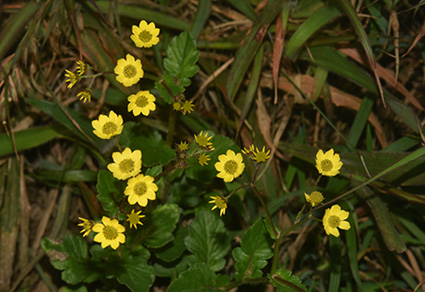
A new species of Senecio, S. indoludens, is described based on specimens from the montane habitats of the Baba budangiri-Mullayanagiri ranges in Karnataka, India. For a long time, this taxon has been misidentified as S. ludens, and the present paper also resolves the identity crisis of S. ludens in India. In addition, this study reports the confirmed record of S. ludens from Agasthyamala Biosphere Reserve of the southern Western Ghats. A critical evaluation of the distribution and ecology of both taxa, along with an illustration of the new species, is provided.
References
- Arnott, W. (1836) Pugillus plantarum Indiae orientalis. Nova Acta Physico-Medica Academiae Caesareae Leopoldino-Carolinae Naturae Curiosorum Exhibentia Ephemerides sive Obserationes Historias et Experimenta 18: 319–356.
- Cassini, A.H.G. de (1819) Suite du sixième mémoire sur la famille de Synanthérées, contenant les caractères des tribus. Journal de Physique, de Chimie, d’Histoire Naturelle et des Arts 88: 189–204.
- Clarke, C.B. (1876) Compositae Indicae: Descriptae et Secus Genera Benthamii Ordinatae. Thacker & Co., London, 347 pp. https://doi.org/10.5962/bhl.title.49202
- Dumortier, B.C.J. (1827) Florula Belgica, opera majoris prodromus. J.Casterman, Tournai, 172 pp.
- Dana, E.D., Verloove, F., Alves, P. & Heiden, G. (2021) Senecio brasilensis (Sperg.) Less. (Asteraceae), another potentially invasive alien species in Europe. BioInvasions Records 10 (3): 521–536. https://doi.org/10.3391/bir.2021.10.3.02
- Gamble, J.S. (1921) Compositae. In: Gamble, J.S. The Flora of the Presidency of Madras, vol. 2 (4). Adlard & Son Ltd., London, pp. 658–733.
- Grierson, A.J.C. (1980) Compositae. In: Dassanayake, M.D. & Fosberg, F.R. (Eds.) A revised handbook to the flora of Ceylon, vol. 1. Amernd Publishing, New Delhi, pp. 111–278.
- Hooker, J.D. (1881) Compositae. In: Hooker, J.D. The Flora of British India, vol. 3. Lovell Reeve and Co., London, pp. 219–419.
- Jeswani, A.S., Yadav, S.R. & Lekhak, M.M. (2024) A new Senecio (Asteraceae) from the Anjaneri Hills of Nashik, India. Nordic Journal of Botany 2024 (8): e04366. https://doi.org/10.1111/njb.04366
- Karthikeyan, S., Sanjappa, M., Moorthy, S., Bhattacharjee, B., Dash, S.S., Meena, S.L. & Mastakar, V.K. (2020) Senecio. In: Mao, A.A. & Dash, S.S. (Eds.) Flowering Plants of India, An Annotated Checklist (Dicotyledons), vol. 1. Botanical Survey of India, Kolkata, pp. 786–790.
- Linnaeus, C. (1753) Species plantarum. L. Salvius, Stockholm, 1200 pp.
- Murugan, P., Karthik, B., Murugesan, M. & Murugan, C. (2024) Senecio sisparensis (Asteraceae), a new species from southern Western Ghats, India. Phytotaxa 637 (2): 206–210. https://doi.org/10.11646/phytotaxa.637.2.8
- Pelser, P.B., Nordenstam, B., Kadereit, J.W. & Watson, L.E. (2007) An ITS phylogeny of tribe Senecioneae (Asteraceae) and a new delimitation of Senecio L. Taxon 56 (4): 1077–1104. https://doi.org/10.2307/25065905
- POWO (2026) Plants of the World Online. Facilitated by the Royal Botanic Gardens, Kew. Published on the Internet. Available from: https://powo.science.kew.org/ (accessed 7 May 2026)
- Ravikumar, K., Tangavelou, A.C. & Page, N. (2021) Seed plants of Karnataka, India: a concise dictionary. Foundation for Revitalisation of Local Health Traditions-TransDisciplinary University (FRLHT-TDU), Bengaluru and National Biodiversity Authority (NBA), Chennai, 836 pp.
- Sanjappa, M. & Sringeshwara, A.N. (2019) Flora of Karnataka, A Checklist, vol. 2. Karnataka Biodiversity Board, 1002 pp.
- Sharma, B.D., Singh, N.P., Raghavan, R.S. & Deshpande, U.R. (1984) Flora of Karnataka: Analysis. Botanical Survey of India, Kolkata, 394 pp.
- Singh, P., Karthigeyan, K., Lakshminarasimhan, P. & Dash, S.S. (2015) Endemic vascular plants of India. Botanical Survey of India, Kolkata, 339 pp.
- Thiers, B.M. (2024 [continuously updated]) Index Herbariorum. Available from: https://sweetgum.nybg.org/science/ih/ (accessed 10 October 2025)