
Abstract
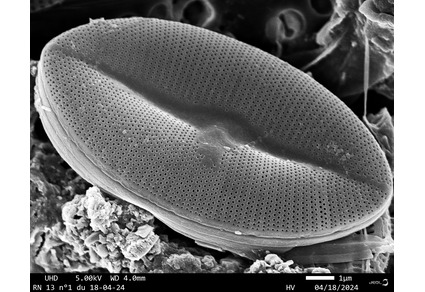
A new marine benthic diatom belonging to the genus Xenobennettella Witkowski & Riaux-Gobin is described from the coastal waters of Easter Island, Rapa Nui, Polynesia, South Pacific. The newly proposed species, Xenobennettella moai sp. nov. exhibits a cavum on the sternum valve (SV), a morphological feature also observed in X. coralliensis, recently described from the Indian Ocean. Ultrastructural features observed in the scanning electron microscope clearly delineate both taxa, including differences in sternum valve (SV) stria patterns and the structure of the asymmetric SV fascia. A third taxon, Xenobennettella sp., recorded from Polynesia, but not fully characterized, also differs from the other two taxa. The alveolate (i.e., bilayered) status of the SV in X. moai sp. nov. is also considered a key feature, as well as the curvature and general design of the external raphe endings. In order to compare the morphological traits of ‘cavum-bearing’ Achnanthales, or any other distinctive asymmetric area devoid of areolae, we conducted a cladistic analysis based on ultrastructure elements. The reconstruction results, based on 21 morphological characters and 10 Achnanthales genera, often showing asymmetric areas, places Xenobennettella within these genera and delineate independent clades. Our results indicate that the cavum is a polyphyletic structure, likely non-homologous among the different concerned genera.
References
- Backman, A.L. & Cleve-Euler, A. (1922) Die fossile Diatomaceenflora in Österbotten. Acta Forestalia Fennica 22 (4): 1–73. https://doi.org/10.14214/aff.7073
- Bąk, M. & Lange-Bertalot, H. (2014) Four small-celled Planothidium species from Central Europe proposed as new to science. Oceanological and Hydrobiological Studies 43 (4): 346–359. https://doi.org/10.2478/s13545-014-0152-9
- Bennett, A.G. (1920) On the occurrence of diatoms on the skin of whales. Proceedings of the Royal Society of London. Series B, Containing Papers of a Biological Character 91 (641): 352–357. https://doi.org/10.1098/rspb.1920.0021
- Bory de Saint-Vincent, J.B.G.M. (1822) Achnanthe. Achnanthes. In: Audouin, I. et al. (Eds.) Dictionnaire Classique d’Histoire Naturelle. Vol. 1. Rey & Gravier, Paris, pp. 79–80.
- Brun, J. & Tempère, J. (1889) Diatomées fossiles du Japon. Espèces marines et nouvelles des calcaires argileux de Sendaï et de Yedo. Mémoires de la Société de Physique et d’Histoire Naturelle de Genève 30 (9): 1–75. https://doi.org/10.5962/bhl.title.64354
- Bukhtiyarova, L.M. & Lyakh, A.M. (2014) Functional morphology of the horseshoe spot in the frustule of Planothidium species (Bacillariophyta). Ukrainian Botanical Journal 71: 223–227. https://doi.org/10.15407/ukrbotj71.02.223
- Cleve, P.T. (1891) The Diatoms of Finland. Acta Societatis pro Fauna et Flora Fennica 8 (2): 1–68. https://doi.org/10.5962/bhl.title.64355
- Cleve, P.T. (1894) Synopsis of the naviculoid diatoms. Part I. Kongliga Svenska Vetenskapsakademiens Handlingar Series 4 26 (2): 1–194.
- Cleve-Euler, A. (1953) Die Diatomeen von Schweden und Finnland. Part III. Monoraphideae, Biraphideae 1. Kongliga Svenska Vetenskaps-Akademiens Handlingar Series 4 (5): 1–255.
- Coste, M., Boutry, S., Tison-Rosebery, J. & Delmas, F. (2009) Improvements of the Biological Diatom Index (BDI): Description and efficiency of the new version (BDI-2006). Ecological Indicators 9: 621–650. [https://www.sciencedirect.com] https://doi.org/
- Denys, L. & De Smet, W.H. (2010) Epipellis oiketis (Bacillariophyta) on harbor porpoises from the North Sea Channel (Belgium). Polish Botanical Journal 55: 175–182. [http://maxbot.botany.pl/cgi-bin/pubs/data/article_pdf?id=2173]
- De Stefano, M. & Marino, D. (2001) Comparison of Cocconeis pseudonotata sp. nov. with two closely related species, C. notata and C. diruptoides, from Posidonia oceanica leaves. European Journal of Phycology 36: 295–306. https://doi.org/10.1080/09670260110001735458
- De Stefano, M. & Marino, D. (2003) Morphology and taxonomy of Amphicocconeis gen. nov. (Achnanthales, Bacillariophyceae, Bacillariophyta) with considerations on its relationship to other monoraphid diatom genera. European Journal of Phycology 38: 361–370. https://doi.org/10.1080/09670260310001612646
- De Stefano, M. & Romero, O. (2005) A survey of alveolate species of the diatom genus Cocconeis (Ehr.) with remarks on the new section Alveolatae. Bibliotheca Diatomologica 52: 1–133.
- Du, F., Li, Y. & Xu, K. (2024) Phylogeny and evolution of Cocconeiopsis (Cocconeidaceae) as revealed by complete chloroplast and mitochondrial genomes. International Journal of Molecular Sciences 25: 266. https://doi.org/10.3390/ijms25010266
- Edlund, M.B., Soninkhishig, N., Williams, R.M. & Stoermer, E.F. (2001) Biodiversity of Mongolia: checklist of diatoms, including new distributional reports of 31 taxa. Nova Hedwigia Beih 72 (1–2): 59–90. https://doi.org/10.1127/nova.hedwigia/72/2001/59
- Ehrenberg, C.G. (1837) Zusätze zur Erkenntniss grosser organischer Ausbildung in den kleinsten thierischen Organismen. Abhandlungen der Königlichen Akademie der Wissenschaften zu Berlin 1835: 150–181.
- Ehrenberg, C.G. (1843) Mittheilungen über 2 neue asiatische Lager fossiler Infusorien-Erden aus dem russischen Trans-Kaukasien (Grusien) und Sibirien. Bericht über die zur Bekanntmachung geeigneten Verhandlungen der Königlich-Preussischen Akademie der Wissenschaften zu Berlin 1843: 43–49. https://doi.org/10.1515/9783112391648-011
- Ellegaard, M., Lenau, T.A., Lundholm, N., Maibohm, C., Friis, S.M.M., Rottwitt, K. & Su, Y. (2016) The fascinating diatom frustule–can it play a role for attenuation of UV radiation? Journal of Applied Phycology 28 (6): 3295–3306. https://doi.org/10.1007/s10811-016-0893-5
- Farris, J.S. (1970) Methods for computing Wagner trees. Systematic Zoology 19: 83–92. [https://www.jstor.org/stable/2412028]
- Ferrario, M.E., Cefarelli, A.O., Fazio, A., Bordino, P. & Romero, O.E. (2019) Bennettella ceticola (Nelson ex Bennett) Holmes on the skin of Franciscana dolphin (Pontoporia blainvillei) of the Argentinean Sea: an emendation of the generic description. Diatom Research 33: 485–497. https://doi.org/10.1080/0269249X.2019.1572651
- Goessling, J.W., Ashworth, M.P., Ellegaard, M., Serôdio, J. & Lopez Garcia, M. (2024) Hypotheses on frustule functionalities: From single species analysis to systematic approaches. In: Goessling, J.W., Serôdio, J. & Lavaud, J. (Eds.) Diatom Photosynthesis: From Primary Production to High Value Molecules. Wiley Scrivener, Beverly, Mass., pp. 267–300. https://doi.org/10.1002/9781119842156.ch9
- Grunow, A. (1862) Die österreichischen Diatomaceen nebst Anschluss einiger neuen Arten von andern Lokalitäten und einer kritischen Uebersicht der bisher bekannten Gattungen und Arten. Erste Folge. Epithemieae, Meridioneae, Diatomeae, Entopyleae, Surirelleae, Amphipleureae. Zweite Folge. Familie Nitschiaea. Verhandlungen der kaiserlich-königlichen zoologisch-botanischen Gesellschaft in Wien 12: 315–472 [Abt. 1], 545–588 [Abt. 2]. https://doi.org/10.5962/bhl.title.64361
- Grunow, A. (1867 ‘1868’) Algae. In: Fenzl, E. et al. (Eds.) Reise der österreichischen Fregatte Novara um die Erde in den Jahren 1857, 1858, 1859 unter den Befehlen des Commodore B. von Wüllerstorf-Urbair. Botanischer Theil. Erster Band. Sporenpflanzen. Vol. 1. Aus der Kaiserlich Königlichen Hof- und Staatsdruckeri, Wien [Vienna], pp. 1–104.
- Hein, M.K. (1991) Anorthoneis dulcis sp. nov., a new freshwater diatom from Northern Florida, U.S.A. Diatom Research 6: 267–280. https://doi.org/10.1080/0269249X.1991.9705172
- Héribaud, J.-B. (1893) Les Diatomées d’Auvergne. Pensionnat des Frères des Écoles Chrétiennes & Librairie des Sciences Naturelles, Clermont-Ferrand & Paris, 255 pp.
- Héribaud, J.-B. (1903) Les Diatomées Fossiles d’Auvergne (second Mémoire). Librairie des Sciences Naturelles, Paris, 166 pp.
- Holmes, R.W. (1985) The morphology of diatoms epizoic on cetaceans and their transfer from Cocconeis to two new genera, Bennettella and Epipellis. British Phycological Journal 20 (1): 43–57. https://doi.org/10.1080/00071618500650061
- Jahn, R., Abarca, N., Gemeinholzer, B., Mora, D., Skibbe, O., Kulikovskiy, M., Gusev, E., Kusber, W.-H. & Zimmermann, J. (2017) Planothidium lanceolatum and Planothidium frequentissimum reinvestigated with molecular methods and morphology: four new species and the taxonomic importance of the sinus and cavum. Diatom Research 32 (1): 75–107. https://doi.org/10.1080/0269249X.2017.1312548
- Joh, G. (2021) Distribution of the genus Cocconeis (Bacillariophyceae) along the Seogwipo coast of Jeju Island, South Korea. Phytotaxa 528 (3): 149–179. https://doi.org/10.11646/phytotaxa.528.3.1
- Kulikovskiy, M., Lange-Bertalot, H. & Witkowski, A. (2013) Gliwiczia gen. nov. a new monoraphid diatom genus from Lake Baikal with a description of four species new for science. Phytotaxa 109 (1): 1–16. https://doi.org/10.11646/phytotaxa.109.1.1
- Kulikovskiy, M.S., Lange-Bertalot, H. & Kuznetsova, I.V. (2015) Lake Baikal: hotspot of endemic diatoms II. Iconographia Diatomologica 26: [1]–656.
- Kulikovskiy, M.S., Glushchenko, A.M., Kuznetsova, I.V. & Kociolek, J.P. (2022) Planoplatessa gen. nov. A new, neglected monoraphid diatom genus with a cavum. Plants [MDPI] 11 (2314): 1–9. https://doi.org/10.3390/plants11172314
- Kützing, F.T. (1846) Kurze Mittheilung über einige kieselschalige Diatomeen. Botanische Zeitung (Berlin) 4 (14): 247–249.
- Lange-Bertalot, H. (1999) Neue Kombinationen von Taxa aus Achnanthes Bory (sensu lato). Iconographia Diatomologica 6: 270–283.
- Li, L., Huang, Y.-Y., Nong, Q.-Z., Lai, J.-X. & Li, Y.-H. (2024) Planothidium pseudolinkei sp. nov. (Bacillariophyta), a new marine monoraphid diatom species from the coast of Guangxi, China. PhytoKeys 246: 237–249. https://doi.org/10.3897/phytokeys.246.128068
- Montgomery, R.T. (1978) Environmental and ecological studies of the diatom communities associated with the coral reefs of the Florida Keys. Ph.D. Thesis, Florida State University.
- Morales, E.A. (2006) Small Planothidium Round et Bukhtiyarova (Bacillariophyceae) taxa related to P. daui (Foged) Lange-Bertalot from the United States. Diatom Research 21 (2): 325–342. https://doi.org/10.1080/0269249X.2006.9705673
- Moss, M.O. & Carter, J.R. (1982) The resurrection of Achnanthes rostrata Østrup. Bacillaria 5: 157–164.
- Nelson, E.W. (1920) On the occurrence of Diatoms on the skin of Whales by A.G. Bennett. Appendix by E.W. Nelson. (Cocconeis ceticola). Proceedings of the Royal Society of London, series B. 91 (B 641): 352–357. https://doi.org/10.1098/rspb.1920.0021
- N’Guessan, K.R., Wetzel, C.E., Ector, L., Coste, M., Cocquyt, C., Van de Vijver, B., Yao, S.S., Ouattara, A., Kouamelan, E.P. & Tison-Rosebery, J. (2014) Planothidium comperei sp. nov. (Bacillariophyta), a new diatom species from Ivory Coast. Plant Ecology and Evolution 147 (3): 455–462. https://doi.org/10.5091/plecevo.2014.981
- Nixon, K. (1999) The parsimony ratchet, a new method for rapid parsimony analysis. Cladistics 15: 407–14. https://doi.org/10.1006/clad.1999.0121
- Paradis, E. & Schliep, K. (2019) ape 5.0: an environment for modern phylogenetics and evolutionary analyses in R. Bioinformatics 35: 526–528. https://doi.org/10.1093/bioinformatics/bty633
- Pennesi, C., Majewska, R., Sterrenburg, F.A.S., Totti, C. & De Stefano, M. (2018) Taxonomic revision and morphological cladistics analysis of the diatom genus Anorthoneis (Cocconeidaceae), with description of Anorthoneis arthus-bertrandii sp. nov. Phytotaxa 336 (3): 201–238. https://doi.org/10.11646/phytotaxa.336.3.1
- Petit, P. (1877) Catalogue des Diatomées. In: Folin, L. de & Périer, L. (Eds.) Les fonds de la mer. Étude sur les particularités nouvelles des régions sous-marines. Vol. 3. Savy, Paris, pp. 168–198.
- Potapova, M.G. (2012) New species and combinations in monoraphid diatoms (family Achnanthidiaceae) from North America. Diatom Research 27 (1): 29–42. https://doi.org/10.1080/0269249x.2011.644636
- R Core Team (2022) R: A language and environment for statistical computing. R Foundation for Statistical Computing, Vienna, Austria. [https://www.R-project.org/]
- Riaux-Gobin, C. & Compère, P. (2009) Olifantiella mascarenica gen. & sp. nov., a new genus of pennate diatom from Réunion Island, exhibiting a remarkable internal process. Phycological Research 57: 178–185. https://doi.org/10.1111/j.1440-1835.2009.00537.x
- Riaux-Gobin, C. & Al-Handal, A.Y. (2012) New species in the marine diatom genus Olifantiella (Bacillariophyta, Biraphidineae) from Rodrigues Island (Western Indian Ocean). Fottea 12 (2): 199–217. https://doi.org/10.5507/fot.2012.015
- Riaux-Gobin, C., Compère, P., Alhandal, Y.A.-H. & Straub, F. (2012) SEM survey of some small-sized Planothidium (Bacillariophyta) from coral sands off Mascarenes (Western Indian Ocean). Nova Hedwigia 141: 295–314.
- Riaux-Gobin, C., Romero, O.E. & Al-Handal, A.Y. (2009) Cocconeis costata var. subantarctica var. nov., a new marine diatom off Kerguelen Archipelago (Southern Ocean, Indian Sector). Diatom Research 24 (2): 393–404. https://doi.org/10.1080/0269249X.2009.9705809
- Riaux-Gobin, C., Romero, O.E., Compère, P. & Al-Handal, A.Y. (2011) Small-sized Achnanthales (Bacillariophyta) from coral sands off Mascarenes (Western Indian Ocean). Bibliotheca Diatomologica 57: 1–234. https://doi.org/10.1080/0269249X.2012.690209
- Riaux-Gobin, C., Coste, M., Jordan, R.W., Romero, O.E. & Le Cohu, R. (2014) Xenococconeis opunohusiensis gen. et sp. nov. and Xenococconeis neocaledonica comb. nov. (Bacillariophyta) from the tropical South Pacific. Phycological Research 62 (3): 153–169. https://doi.org/10.1111/pre.12046
- Riaux-Gobin, C., Compère, P., Straub, F., Ector, L. & Taxböck, L. (2017) Cocconeis voigtii F. Meister (Bacillariophyta) and other species from Meister’s and Voigt’s Nagasaki (Japan) material. Nova Hedwigia, Beihefte 146: 43–62. https://doi.org/10.1127/1438-9134/2017/043
- Riaux-Gobin, C., Garcia, M., Witkowski, A., Saenz-Agudelo, P., Coste, M. & Daniszewska-Kowalczyk, G. (2021) New Amphicocconeis (Bacillariophyta) from Raivavae and Tahiti Islands (South Pacific) and Porto Belo (Brazil), with re-examination of Psammococconeis. Phytotaxa 513 (1): 30–54. https://doi.org/10.11646/phytotaxa.513.1.2
- Riaux-Gobin, C., Jordan, R.W., Coste, M., Gorand, Y., Burns, L., Standen Valenzuela, T. & Galzin, R. (In Press) Two new Cocconeis epiphytes, among marine Achnanthales from Easter Island (Polynesia, South Pacific): Description and environmental conditions. In: Diatoms Book Series, Janice L. Pappas (Ed.) the University of Michigan.
- Risjani, Y., Witkowski, A., Kryk, A., Yunianta, Górecka, E., Krzywda, M., Safitri, I., Sapar, A., Dąbek, P., Arsad, S., Gusev, E., Rudiyansyah, Peszek, Ł. & Wróbel, R.J. (2021) Indonesian coral reef habitats reveal exceptionally high species richness and biodiversity of diatom assemblages. Estuarine, Coastal and Shelf Science 2021. https://doi.org/10.1016/j.ecss.2021.107551
- Round, F.E., Crawford, R.M. & Mann, D.G. (1990) The Diatoms: Biology and Morphology of the Genera. Cambridge University Press, Cambridge, 747 pp.
- Round, F.E. & Bukhtiyarova, L. (1996) Four new genera based on Achnanthes (Achnanthidium) together with a re-definition of Achnanthidium. Diatom Research 11 (2): 345–361. https://doi.org/10.1080/0269249X.1996.9705389
- Schliep, K.P. (2011) phangorn: phylogenetic analysis in R. Bioinformatics 27 (4): 592–593. [https://cran.r-project.org/web/packages/phangorn/vignettes/Trees.html] https://doi.org/10.1093/bioinformatics/btq706
- Schmidt, A. (1895) Atlas der Diatomaceenkunde. Ser. 5, Heft 49–60. O.R. Reisland Ascherleben, Leipzig.
- Smith, W. (1853) A synopsis of the British Diatomaceae with remarks on their structure, function and distribution and instructions for collecting and preserving specimens. The plates by Tuffen West. In two volumes. Vol. I. John van Voorst, Paternoster Row, London, pp. [i]–xxxiii, 1–89. https://doi.org/10.5962/bhl.title.10706
- Spaulding, S.A., Edlund, M.B. & Metzeltin, D. (2008) Planothidium. Available from: https://diatoms.org/genera/planothidium (accessed 27 July 2026)
- Kristan, N.V., Kristan, W.B. & Sheath, R.G. (2020) Diatom genus Planothidium (Bacillariophyta) from streams and rivers in California, USA: diversity, distribution and autecology. Phytotaxa 470: 1–30. https://doi.org/10.11646/phytotaxa.470.1.1
- Swofford, D.L. & Maddison, W.P. (1987) Reconstructing ancestral character states under Wagner parsimony. Mathematical Biosciences 87: 199–229. https://doi.org/10.1016/0025-5564(87)90074-5
- Tan, X., Liu, Y., Burford, M.A. & Zhang, Q. (2020) The performance of diatom indices in assessing temporal changes in water quality in a large lowland river ecosystem. River Research and Applications 37: 423–432. https://doi.org/10.1002/rra.3754
- Tseplik, N., Maltsev, Y., Glushchenko, A., Genkal, S. & Kulikovskiy, M. (2025) Molecular phylogeny of the diatom genus Planothidium with the description of Paraplanothidium gen. nov. and Pseudoplanothidium gen. nov. PLoS One 20 (11): e0333782. https://doi.org/10.1371/journal.pone.0333782
- Van de Vijver, B., Wetzel, C., Kopalova, K., Zidarova, R. & Ector, L. (2013) Analysis of the type material of Achnanthidium lanceolatum Brébisson ex Kützing (Bacillariophyta) with the description of two new Planothidium species from the Antarctic Region. Fottea, Olomouc 13 (2): 105–117. https://doi.org/10.5507/fot.2013.010
- Wetzel, C.E., Van de Vijver, B., Kopalová, K., Hoffmann, L., Pfister, L. & Ector, L. (2014) Type analysis of the South American diatom Achnanthes haynaldii (Bacillariophyta) and description of Planothidium amphibium sp. nov., from aerial and aquatic environments in Oregon (USA). Plant Ecology and Evolution 147 (3): 439–454. https://doi.org/10.5091/plecevo.2014.1058
- Wetzel, C.E., Van de Vijver, B., Blanco, S. & Ector, L. (2019) On some common and new cavum-bearing Planothidium (Bacillariophyta) species from freshwater. Fottea 19: 50–89. https://doi.org/10.5507/fot.2018.016
- Witkowski, A., Riaux-Gobin, C., Kryk, A., Plocinski, T., Zglobicka, I. & Kurzydlowski, K. (2022) Xenobennettella coralliensis a new monoraphid diatom genus characterized by the alveolate sternum valve with cavum, observed from coral reef habitats. PeerJ 10 (e13977): 1–21. https://doi.org/10.7717/peerj.13977