
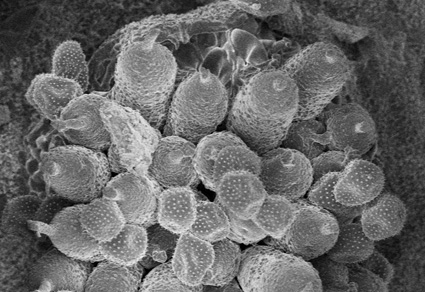

Abstract
This study reports Phragmidium gansuensis, a novel rust fungus species collected in Gansu Province, China, based on micromorphological characteristics and molecular data. This species is distinguished from morphologically similar taxa occurring on Rosa by its shorter teliospores with a length of 72–95 μm, longer pedicels, and an apical papilla. Phylogenetic analyses using combined ITS and LSU sequence data further supported the morphological identification.
References
- Aime, M.C. (2006) Toward resolving family-level relationships in rust fungi (Uredinales). Mycoscience 47: 112–122. https://doi.org/10.1007/S10267-006-0281-0
- Ali, B., Sohail, Y., Mumtaz, A.S. & Berndt, R. (2017) Phragmidium punjabense, a new species of rust fungus on Rosa brunonii in the outer Himalayan ranges of Murree, Pakistan. Nova Hedwigia 105 (3–4): 385–396. https://doi.org/10.1127/nova_hedwigia/2017/0418
- Arthur, J.C. (1906) Eine auf die Struktur und Entwicklungs-geschichte begründete Klassifikation der Uredineen. In: Wettstein, R.V., Wiesner, J. & Zahlbruckner, A. (Eds.) Verhandlungen des internationalen Botanischen Kon-gresses in Wien 1905. Gustav Fischer, Jena, pp. 331–348.
- Beenken, L., Zoller, S. & Berndt, R. (2012) Rust fungi on Annonaceae II: the genus Dasyspora Berk. & M.A. Curtis. Mycologia 104: 659–681. https://doi.org/10.3852/11-068
- Cummins, G.B. (1931) Phragmidium species of North America: differential teliospore and aecial characters. Mycologia 23 (6): 433–445. https://doi.org/10.1080/00275514.1931.12017054
- Dietel, P. (1905) Uber die arten der Gattung Phragmidium. Hedwigia 44: 112–132.
- Hiratsuka, N. (1935) Phragmidium of Japan. The Journal of Japanese Botany 7: 227–299.
- Kasai, M. (1910) On the Japanese species of Phragmidium. Transactions of the Sapporo Natural History Society 3: 25–51.
- Katoh, K. & Toh, H. (2010) Parallelization of the MAFFT multiple sequence alignment program. Bioinformatics 26: 1899–1900. https://doi.org/10.1093/bioinformatics/btq224
- Link, F. (1816 [1815]) Observationes I Ordines Plantarum naturales etc. III. Der Gesellschaft Naturforschender Freunde zu Berlin Magazin für die neuesten. Entdeckungen in der gesammten Naturkunde 7: 25–45.
- Liu, Y., Cao, B., Tao, S.Q., Tian, C.M. & Liang, Y.M. (2018) Phragmidium species parasitizing species of Rosaceae in Tibet, China, with descriptions of three new species. Mycological Progress 17 (8): 967–988. https://doi.org/10.1007/s11557-018-1406-5
- Liu, Y., Ono, Y., Kakishima, M., Gafforov, Y. & Liang, Y.M. (2019) Taxonomy and phylogenetic position of Phragmidium altaicum, a newly described rust fungus on Rosa, based on molecular and morphological data. Phytotaxa 423 (3): 187–194. https://doi.org/10.11646/phytotaxa.423.3.7
- Liu, Y., Liang, Y.M. & Ono, Y. (2020) Taxonomic revision of species of Kuehneola and Phragmidium on Rosa, including two new species from China. Mycologia 112 (4): 742–752. https://doi.org/10.1080/00275514.2020.1753426
- O’Donnell, K. (1993) Fusarium and its near relatives. In: Reynolds, D.R. & Taylor, J.W. (Eds.) The fungal holomorph: mitotic, meiotic and pleomorphic speciation in fungal systematics. CAB International, Wallingford, pp. 225–233.
- Ono, Y. & Wahyuno, D. (2019) Phragmidium satoanum, a new rust pathogen of Rosa hirtula in Japan. Mycoscience 60 (4): 237–245. https://doi.org/10.1016/j.myc.2019.05.001
- Ronquist, F. & Huelsenbeck, J.P. (2003) MrBayes 3: Bayesian phylogenetic inference under mixed models. Bioinformatics 19: 1572–1574. https://doi.org/10.1093/bioinformatics/btg180
- Stamatakis, A. (2014) RAxML version 8: A tool for phylogenetic analysis and post-analysis of large phylogenies. Bioinformatics 30: 312–1313. https://doi.org/10.1093/bioinformatics/btu033
- Sun, J.E., Zhang, Q., Luo, W.M., Yang, Y.Q., An, H.M. & Wang, Y. (2022) Four new Phragmidium (Phragmidiaceae, Pucciniomycetes) species from Rosaceae plants in Guizhou Province of China. MycoKeys 93: 193–213. https://doi.org/10.3897/mycokeys.93.90861
- Sydow, H. (1921) Verwandtschaftsverhältnisse und des gegenwärtigen Entwicklungs- anges zur Umgrenzung der Gattungen bei den Uredineen. Mycology 19: 161–175.
- Tamura, K., Stecher, G., Peterson, D., Filipski, A. & Kumar, S. (2013) MEGA6: molecular evolutionary genetics analysis version 6.0. Molecular Biology and Evolution 30: 2725–2729. https://doi.org/10.1093/molbev/mst197
- Tian, C.M., Shang, Y.Z., Zhuang, J.Y., Wang, Q. & Kakishima, M. (2004) Morphological and molecular phylogenetic analysis of Melampsora species on Poplars in China. Mycoscience 45: 56–66. https://doi.org/10.1007/S10267-003-0150-Z
- Wahyuno, D. (2002) A taxonomic study on Phragmidium species (Uredinales) parasitic on the genus Rosa. Doctoral dissertation of University of Tsukuba.
- Wahyuno, D., Kakishima, M. & Ono, Y. (2002) Aeciospore-surface structures of Phragmidium species parasitic on roses. Mycoscience 43 (2): 159–167. https://doi.org/10.1007/S102670200023
- Wahyuno, D., Kakishima, M. & Ono, Y. (2001) Morphological analyses of urediniospores and teliospores in seven Phragmidium species parasitic on ornamental roses. Mycoscience 42: 519–533. https://doi.org/10.1007/BF02460950
- Wei, S.X. (1988) A taxonomic study of the genus Phragmidium of China. Mycosystema 1: 179–210.
- Winter, G. (1884) Die Pilze Deutschlands, Oesterreichs, und der Schweiz: Schizomyceten, Saccharomyceten und Basidiomyceten. Verlag von Eduard Kummer.
- Wu, Q.Z., He, M.H., Liu, T.Z., Hu, H.M., Liu, L.L., Zhao, P. & Li, Q.R. (2023) Rust fungi on medicinal plants in Guizhou Province with descriptions of three new species. Journal of Fungi 9 (9): 953. https://doi.org/10.3390/jof9090953
- Yang, T., Chang, W., Cao, B., Tian, C.M., Zhao, L. & Liang, Y.M. (2015) Two new Phragmidium species identified on Rosa plants native to China. Phytotaxa 217 (2): 182–190. https://doi.org/10.11646/phytotaxa.217.2.8
- Zhang, Q., Wu, Q., Zhao, P., Habib, K., Wang, Y., Tang, D., Ahmad, M.A., Ren, R.L., Shen, X.C., Long, Q.D. & Li, Q. (2025) Unveiling new species of Phragmidiaceae (Basidiomycota, Pucciniales) on rosaceous plants from Guizhou, China. MycoKeys 115: 309–326. https://doi.org/10.3897/mycokeys.115.146604
- Zhao, P., Zhang, Z.F., Hu, D.M., Tsui, K.M., Qi, X.H., Phurbu, D., Gafforov, Y. & Cai, L. (2021) Contribution to rust flora in China I, tremendous diversity from natural reserves and parks. Fungal Diversity 5 (1): 1–58. https://doi.org/10.1007/s13225-021-00482-w
- Zhuang, J.Y., Wei, S.X. & Wang, Y.C. (2012) Flora Fungorum Sinicorum. Vol. 41. Uredinales IV. Science Press, Beijing.