
Abstract
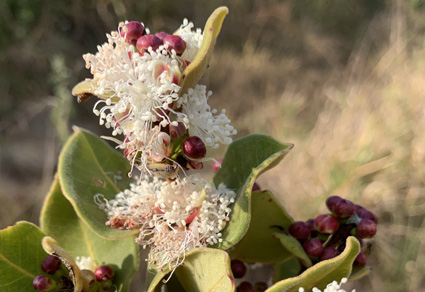
Eugenia velutifolia Mazine & Sobral was described in 2019, based on specimens collected in Cerrado of São Paulo state. The species was evaluated as Critically Endangered (CR), occupying an Extent of Occurrence of 18,575 km². At the time of its description, its fruit and seed were unknown. This study aimed to expand the species' morphological record and reevaluate its conservation status. Therefore, field expeditions were carried out to the species' occurrence area to collect botanical material, and specimens already deposited in physical and digital herbaria were analyzed. Based on the collected data, the morphological description of the species was expanded to include characters of fruits, seeds, bracts, and bracteoles. Additionally, data regarding its ecology and interaction with local biodiversity were added, along with a reevaluation of the extinction risk of Eugenia velutifolia following IUCN criteria. Field efforts demonstrated that population located within Itu municipality has been suppressed; thus, E. velutifolia currently occurs only in the municipality of Salto de Pirapora, with a decrease in EOO to 0.027 km² and for AOO to 4 km², maintaining the CR status. The species' endemism, anthropic pressure, and low abundance of individuals highlight the need for conservation efforts.
References
- Arantes, A.A. & Monteiro, R. (2002) A família Myrtaceae na Estação Ecológica do Panga, Uberlândia, Minas Gerais, Brasil. Lundiana 3: 111–127. https://doi.org/10.35699/2675-5327.2002.21804
- Bachman, S., Moat, J., Hill, A.W., de la Torre, J. & Scott, B. (2011) Supporting Red List threat assessments with GeoCAT: geospatial conservation assessment tool. ZooKeys 150: 117–126. https://doi.org/10.3897/zookeys.150.2109
- Baitello, J., Pastore, J., Aguiar, O. & Arzolla, F. (2013) Parque Estadual do Juquery: Refúgio de Cerrado no Domínio Atlântico. IF Série Registro 50: 1–46.
- Berg, O. (1855–1856) Revisio Myrtacearum Americae. Linnaea 27: 1–472.
- Berg, O.C. (1857–1859) Myrtaceae. In: von Martius, C.F.P. (Ed.) Flora Brasiliensis 14, pp. 1–655.
- BFG – The Brazilian Flora Group (2022) Brazilian Flora 2020: Leveraging the power of the collaborative scientific network. Taxon 71: 178–198. https://doi.org/10.1002/tax.12640
- Bünger, M.D.O., Mazine, F.F. & Stehmann, J.R. (2020) Revision of Eugenia section Phyllocalyx (Myrtaceae). Phytotaxa 474 (2): 99–118. https://doi.org/10.11646/phytotaxa.474.2.1
- Cambessèdes, J. (1832–1833) Myrtaceae. In: Saint-Hilaire, A. (org.) Flora Brasiliae Meridionalis 2: 277–384.
- Chamisso, L.K.A. (1832) Verbenaceae. Linnaea 7: 105–723.
- Cochrane, J.A., Crawford, A.D. & Monks, L.T. (2007) The significance of ex situ conservation to reintroduction of threatened plants. Australian Journal of Botany 55: 356–366. https://doi.org/10.1071/BT06173
- Coneglian, I.R.M. (2011) Morfoanatomia de ovário, pericarpo e semente de sete espécies de Myrteae DC. (Myrtaceae). Tese (Doutorado) – Universidade Estadual Paulista, Instituto de Biociências de Botucatu, 107 pp.
- Danner, M.A., Citadin, I., Sasso, S.A.Z., Sachet, M.R. & Ambrósio, R. (2010) Fenologia da floração e frutificação de mirtáceas nativas da floresta com araucária. Revista Brasileira de Fruticultura 32: 291–295. https://doi.org/10.1590/S0100-29452010005000008
- DATAGEO – Sistema Ambiental Paulista (2025) Cadastro Ambiental Rural. Available from: https://datageo.ambiente.sp.gov.br/app/?ctx=CAR (accessed 21 July 2025)
- De Candolle, A.P. (1828) Myrtaceae. Prodromus Systematis Universalis Regni Vegetabilis 3: 207–296.
- Durigan, G., Pilon, A.L.N., Assis, B.G., Souza, M.F., Baitello, B.J. (2018) Pequenas Plantas do Cerrado: Biodiversidade Negligenciada. SMA, São Paulo, 720 pp.
- Engler, A. (1876) Ochnaceae. In: von Martius, C.F.P. (Ed.) Flora Brasiliensis 12 (2), pp. 330.
- Flora e Funga do Brasil (2026) Jardim Botânico do Rio de Janeiro. Available from: http://floradobrasil.jbrj.gov.br/.
- Gonçalves, E.G. & Lorenzi, H. (2025) Morfologia vegetal: organografia e dicionário ilustrado de morfologia das plantas vasculares. Plantarum Institute of Flora Studies, São Paulo, 544 pp.
- Gressler, E., Pizo, M.A. & Morellato, L.P.C. (2006) Polinização e dispersão de sementes em Myrtaceae do Brasil. Brazilian Journal of Botany 29: 509–530. https://doi.org/10.1590/S0100-84042006000400002
- IUCN (Comitê de Padrões e Petições da UICN) (2024) Diretrizes para o uso das categorias e critérios da Lista Vermelha da IUCN. Versão 16. Available from: https://www.iucnredlist.org/resources/redlistguidelines (accessed 22 July 2025)
- Kunth, C.S. (1823) Nova Genera et Species Plantarum 6: 108–149.
- Kuhlmann, M. & Darosci, A. (2018) Frutos e sementes do Cerrado: espécies atrativas para a fauna. Vol. 2. M. K. Peres, Brasília, 464 pp.
- Lamberti, N.F., Miura, R.Y.H. & Silva, B.G.da. (2012) Frugivoria por aves em Eugenia uniflora L. (Myrtaceae) em ambientes antropizados na região de Sorocaba-SP. Revista do Instituto Florestal 24 (2): 225–241. https://doi.org/10.24278/2178-5031.2012242392
- Legrand, C.D. (1936) Las myrtaceas del Uruguay. Anales del Museo de Historia Natural de Montevideo II 4 (11): 1–71.
- Legrand, C.D. (1961) Mirtaceas del Estado de Santa Catarina (Brasil). Sellowia 13: 265–363.
- Linnaeus, C. (1753) Species Plantarum. Impensis Laurentii Salvii, Stockholm, 471 pp.
- Linnaeus, C. (1762–1763) Species Plantarum. Impensis Laurentii Salvii, Stockholm, 1684 pp.
- Lorenzi, H. (2025) Árvores brasileiras: manual de identificação e cultivo de plantas arbóreas nativas do Brasil. Vol. 1. Instituto Plantarum, Nova Odessa, 365 pp.
- Lorenzi, H. (2022) Árvores brasileiras: manual de identificação e cultivo de plantas arbóreas nativas do Brasil. Vol. 2. Instituto Plantarum, Nova Odessa, 384 pp.
- Lucresia, L., Stadnik, A.M.d., Staggemeier, V., Melo, J.O. & Sano, P.T. (2026) Myrtaceae in the Espinhaço Range: Distribution, Similarity Patterns and Geoclimatic Drivers of Species Turnover Across Different Geomorphological Structures and Vegetation Classes. The Botanical Review. https://doi.org/10.1007/s12229-026-09330-5
- Mattos, J.R. (1970) Novidades taxonômicas em Myrtaceae. Loefgrenia 42: 2.
- McVaugh, R. (1969) Myrtaceae. In: Flora of the Guayana Highland—part VIII. Memoirs of the New York Botanical Garden 19: 191.
- Mazine, F.F., Sant'ana, G.Z., Sobral, M. & Valdemarin, K.S. (2019) Eugenia velutifolia (Myrteae, Myrtaceae), a new species from the Cerrado of São Paulo, Brazil. Phytotaxa 392: 232–238. https://doi.org/10.11646/phytotaxa.392.3.6
- Mazine, F.F., Faria, J.E.Q., Giaretta, A., Vasconcelos, T., Félix, F. & Lucas, E. (2018) Phylogeny and biogeography of the hyper-diverse genus Eugenia (Myrtaceae: Myrteae), with emphasis on E. sect. Umbellatae, the most unmanageable clade. Taxon 67: 752–769. https://doi.org/10.12705/674.5
- Mazine, F.F., Bünger, M.O., Faria, J.E.Q., Lucas, E. & Souza, V.C. (2016) Sections in Eugenia (Myrteae, Myrtaceae): nomenclatural notes and a key. Phytotaxa 289: 225–236. https://doi.org/10.11646/phytotaxa.289.3.2
- Pausas, J.G., Lamont, B.B., Paula, S., Appezzato, G.B. & Fidelis, A. (2018) Unearthing belowground bud banks in fire‐prone ecosystems. New Phytologist 217: 1435–1448. https://doi.org/10.1111/nph.14982
- Pinheiro, E.da.S. & Durigan, G. (2012) Diferenças florísticas e estruturais entre fitofisionomias do cerrado em Assis, SP, Brasil. Revista Árvore 36: 181–193. https://doi.org/10.1590/S0100-67622012000100019
- Ribeiro, J.F., Kuhlmann, M., Ogata, R.S., Oliveira, M.C.de, Vieira, D.L.M. & Sampaio, A.B. (org.) (2022) Guia de plantas do cerrado para recomposição da vegetação nativa. Embrapa, Brasília, DF, 832 pp.
- Rozane, D., Machado, J., Biavati, A. & Soares, S.M. (2002) Por que Theognis sp. (Hemiptera: Coreidae) suga preferencialmente a parte inferior do botão floral de Psidium guajava (Goiaba)? Academia Insecta 2: 5–8.
- Santos, M.F. & Sano, P.T. (2012) Flora fanerogâmica da Serra do Ouro Branco, Minas Gerais: Myrtaceae. Rodriguésia 63: 1065–1083. https://doi.org/10.1590/S2175-78602012000400019
- Scinocca, M. (2025) Prima da pitanga, mas pouco saborosa: conheça a planta descoberta em Salto de Pirapora e que vai 'morar' no Jardim Botânico de Sorocaba. G1, Sorocaba. Available from: https://g1.globo.com/sp/sorocaba-jundiai/noticia/2025/03/13/prima-da-pitanga-mas-pouco-saborosa-conheca-a-planta-descoberta-em-salto-de-pirapora-e-que-vai-morar-no-jardim-botanico-de-sorocaba.ghtml (accessed 22 January 2026)
- Silva, G.B.M.da. & Pedroni, F. (2014) Frugivoria por aves em área de cerrado no município de Uberlândia, Minas Gerais. Revista Árvore 38: 433–442. https://doi.org/10.1590/S0100-67622014000300005
- Silva, A.T.D. & Mazine, F.F. (2016) A família Myrtaceae na Floresta Nacional de Ipanema, Iperó, São Paulo, Brasil. Rodriguésia 67: 203–224. https://doi.org/10.1590/2175-7860201667110
- Silva, G.S. (2022) Rebrota de espécies nativas do Cerrado: uma perspectiva estrutural. Tese de Doutorado, Escola Superior de Agricultura Luiz de Queiroz, Universidade de São Paulo, Piracicaba. https://doi.org/10.11606/T.11.2022.tde-03052023-144437
- Souza, V.C., Flores, T.B. & Lorenzi, H. (2013) Introdução à Botânica: morfologia. Instituto Plantarum, Nova Odessa, 300 pp.
- Specieslink (2026) SpeciesLink network. Available from: https://specieslink.net/search/ (accessed 25 August 2025)
- Thiers, B. (2025) Index Herbariorum: A global directory of public herbaria and associated staff. New York Botanical Garden's Virtual Herbarium. Available from: http://sweetgum.nybg.org/ih (accessed 1 September 2025)
- Valdemarin, K.S., Mazine, F.F. & Souza, V.C. (2024) Eugenia (Myrtaceae) from Reserva Natural do Vale, Espírito Santo, a center of plant endemism in the Brazilian Atlantic Rainforest. Phytotaxa 652 (1): 1–79. https://doi.org/10.11646/phytotaxa.651.1.1
- Valdemarin, K.S., Melo, J.D.O., Maruyama, A.S.C., Lucas, E., Souza, V.C. & Mazine, F.F. (2026) Eugenia magnicarpa, a new species with one of the largest fruits of Eugenia, from the Brazilian Atlantic Forest. Kew bulletin. https://doi.org/10.1007/s12225-025-10343-3
- Villarroel, D., Gomes–Bezarra, K.M. & Gomes, Y.C.E.B. (2014) Una nueva especie de Eugenia (Myrtaceae) del Cerrado boliviano. Brittonia 66: 316–320. https://doi.org/10.1007/s12228-014-9336-2
- Villarroel, D., Faria, J.E.Q., Belmont, A.M., Gomes, S.M. & Proença, C.E.B. (2016) New botanical discoveries in Eugenia (Myrtaceae) from Bolivia and Brazil. Phytotaxa 253 (4): 266–274. https://doi.org/10.11646/phytotaxa.253.4.2
- Villarroel, D., Faria, J.E.Q., Quevedo, A.W., Lopez, M., Miranda, V., Klitgaard, B.B. & Proença, C.E.B. (2018) Eugenia veadeirensis, a new species of Myrtaceae from the highlands of Goiás (Central Brazil) and new miscellaneous records for the Brazilian flora. Phytotaxa 373 (4): 283–290. https://doi.org/10.11646/phytotaxa.373.4.3
- Willdenow, C.L. (1799) Species Plantarum. Imprensis C.G. Nauk, Berolini, Berlin 2: 825–1340.